


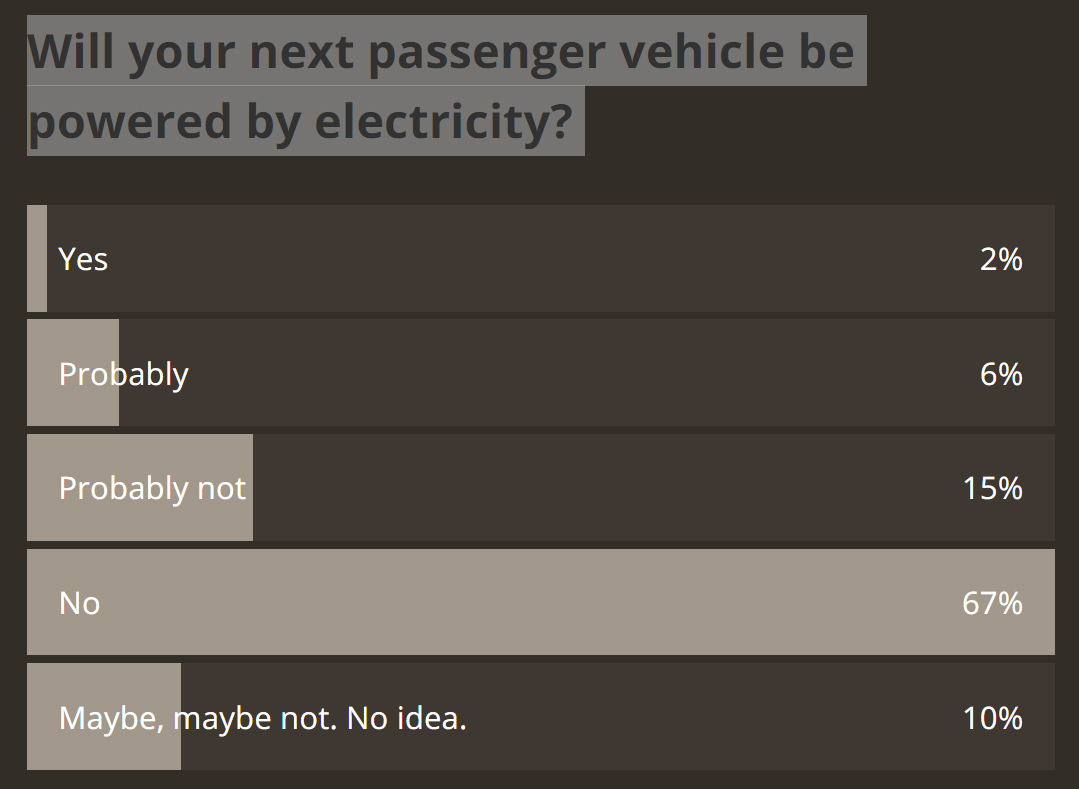
Last fall we polled rvtravel.com readers with this question: “Will your next passenger vehicle be powered by electricity?” Nearly 2,000 readers responded, with a resounding 67% saying “NO.” Tons of written responses were submitted. They ran the gamut from this simple answer, “Me getting an EV? The short answer no, long answer is hell no!!” to others that were more reasoned out. Perhaps we should have asked, “Will your next car be hybrid, electric, or gas?” A new report gives some surprising financial findings that could change your mind.
1.3 million hybrid, electric, and gas vehicles researched
iSeeCars, a research company that “helps shoppers find the best car deals by providing key insights and valuable resources,” crunched numbers on 1.3 million 3-year-old used cars. They compared odometer readings model-by-model to the list prices of the same models when sold new. They then ranked models in terms of least expense to most expensive, accounting for driving patterns.
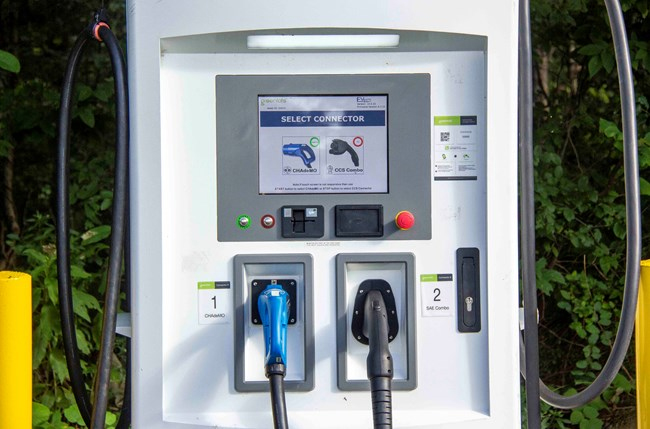
Turning back to our poll responses, many electric vehicle nay-sayers were concerned about the lack of charging infrastructure. “Range anxiety” is understandable, and Tesla’s decision to step back from supporting many charging stations hasn’t helped. One reader put it this way, “The infrastructure in the bulk of America cannot support this pie-in-the-sky dream.” That may explain this finding: Electric cars are driven 20 percent less than gasoline cars.
Electrics don’t get driven too far, and there’s a reason
It’s simple arithmetic. The less a car is driven, the more it costs per mile. So here’s a breakout of the study’s highlights.
- Electric cars are driven 20 percent less than gasoline cars; combined with their higher prices they cost 63.6 percent more for every 1,000 miles driven per year.
- Hybrids and plug-in hybrids are also driven less than gasoline models, but only by 2.7 and 4.8 percent, respectively, making their cost-per-1,000-miles per year much closer.
- The average electric car costs $5,108 for every 1,000 miles per year it’s driven compared to $3,056 for a hybrid car, $3,123 for a gasoline car, and $4,351 for a plug-in hybrid.
Did you catch that last point? Let’s break it down another way. The cost-per-mile for hybrid, electric, and gas vehicles works out this way:
- Electric: $5.11
- Hybrid: $3.06
- Gas: $3.12
- Plug-in hybrid: $4.35
No, you don’t pay $3.12 a mile for your “gasser” at the fuel pump. These figures all take into consideration the original purchase price of the car, and its operating costs, over three years. So, if economics are a driver in your vehicle purchase plans, the least expensive vehicle for you is a hybrid gas/electric car. Interestingly, with either the gasoline or hybrid gas/electric, issues of range anxiety are moot. You don’t need to look for a place to plug in.
Least-expensive to drive alternative vehicles

And one final highlight from the report. The Honda Insight Hybrid is the least expensive alternative fuel car to drive, costing $1,463 per 1,000 miles per year ($1.47 per mile). The Insight is followed by the Hyundai IONIQ Hybrid at $1,813 ($1.81 per mile). And finally, the third least expensive non-gasser car to drive is the Toyota Corolla Hybrid at $1,857 ($1.86 per mile). For car market followers, iSeeCars notes, “Unfortunately, the Insight Hybrid and IONIQ Hybrid were canceled after the 2022 model year, but they remain available on the used car market.”
But RVers have more to consider

For RVers, of course, the hybrid, electric, or gas decision comes along with factors that non-RVers don’t worry about. If your RV is a motorhome, the big question is, “Can I tow it?” The easy answer is, sure—you’ll just need to use a flat trailer behind your motorhome. Any vehicle can be driven up and towed this way. That’s inconvenient for many.
Tow dollies are a possibility, and flat towing would be great. One car manufacturer, speaking broadly of all brands: “A hybrid vehicle cannot be towed behind a motor home, as it will cause the battery to overcharge causing damage to the hybrid battery. This includes dingy towing as well as towing with two wheels off the ground.” The response here is, “Perfectly wrong!”
Close friends of our family regularly towed their Chevrolet Bolt on a dolly behind their Class A. It took a couple of adjustments to make it work. They learned the hard way on their first trip out, having to replace the two tires in road-contact, that there was something about automatic braking that had to be worked around.
Company claims to have an answer to towing dilemma
As to other all-electric and hybrid vehicles, here’s what rvibrake.com published: “ARE HYBRID & ELECTRIC VEHICLES TOWABLE? The short answer? Yes. However, it is a bit more complicated than that. For starters, just like gas-powered cars, only certain makes and models are capable of being towed with four wheels down.” This outfit produces what’s needed to set up electrics and hybrids to either flat tow or dolly tow. You can click here to see the list of what 2023-2024 vehicles can be flat towed.
The other big question for RVers who aren’t motorhome fans is this one: Can I tow my trailer with something other than a gasser? That’s another question, and suitable for further exploration. We’ll revisit this one in a future article.
Dig deeper
And for those who’d like to dig deeper into the iSeeCars report, there’s more to be learned. The report goes into great detail on what are the “most driven” EVs, hybrids, and plug-in hybrid vehicles. It goes on to show why EVs are the most expensive cars to drive, and why hybrids are the least expensive—even cheaper than gassers. And it explores what you can expect the cost-per-thousand miles driven of many alternative fuel vehicles. You can see the report here.
Meanwhile, the question remains. Will this new information change your mind about having a hybrid, electric, or gas vehicle in your future? We’d love to hear your comments.
##RVT1156b

No one talks about the desicration of the earth in mining the materials for the batteries. Oh and what about the slave (much child) labor that work mines also. Years ago we had blood diamonds and that outrageous everyone. This is the same thing and nobody gives a crap.
Some say there are not enough material to make the amount of batteries need to make everyone an EV. Again no one cares.
What kind of battery in your RV?
Not lithium because you don’t boondock- just plug in? Who cares about their disposal, who cares about your power generation pollution?
Can you provide some creditable sources to support your questionable assertions? Are you equally against the use of lithium batteries in other applications, like RV batteries, laptops, tablets, and cell phones?
It interesting when they quote costs per mile for an electric, they usually base this on chargers you pay for versus charging at home. If an electric is charged at home, it’s so much cheaper. Electrics can be good for around town type driving.
We have a 2017 Chev Volt, a hybrid. We could not be happier. We would consider another hybrid or full electric. Hands down! I am considering an electric truck.
We have a fifth wheel and do not tow a vehicle.
I’ve had good luck with milage on hybrid vehicles. If only Ford could improve the quality of the F150 hybrid. Wish GM would make hybrid vehicles. Plug in hybrids are a joke.
My state, Mississippi, started charging each electric and hybrid $75 each year to make up the road tax we are not paying at the pump. Thats the equivalent in taxes of buying 500 extra gallons of gas a year. Sorry folks, my hybrid does not save me 500 gallons a year vs a gas car. I get 48 MPG. Many similar gas cars are getting 35-40 MPG.
We have towed a 2022 Jeep Wrangler 4xe hybrid 11,000 miles. No problems.
The key to your conclusions is framed by this statement: “It’s simple arithmetic. The less a car is driven, the more it costs per mile.” But the unexpressed variable in that equation is time: driven less over what period? If it’s a year (as you go on to incorporate) you get one set of answers; but if it’s the lifetime of possession, you almost certainly will get a different result, especially as EV battery prices continue to come down and gas prices rise.
Actually, now that I’ve looked at the iSeeCars report itself, it seems to me it’s even more two-dimensional than I thought when reading your article. It appears that the cost comparison is based solely on purchase price and miles driven per year, with absolutely no inclusion of either gas prices or cost of electricity factored in—never mind annual or lifetime maintenance costs. Talk about loading the dice! As “studies” go, this one’s pretty useless. In my opinion, of course.
People should have the choice to drive what ever they want, and not force it on us.
I test drove a tesla for fun. Was shocked how much better the driving experience was and bought one. It is the best car I’ve owned by far purely on the driving experience. Electric “engines” are the future but there’s a long way to go to improve battery charging & infrastructure.
100 years from now we’ll be complaining about how great EV infrastructure is when some fusion company comes out and says they want to put tiny fusion reactors into every car/RV. The owners of the infrastructure will launch campaigns to tell people how to think negatively about this.
Did the exact same thing, drove a Tesla model X and was totally sold. Quick, quiet, safe and comfortable, and very cheap to charge and drive. Best car out of all I’ve owned over the years.
We did a demo drive in a Model 3. One week later we owned a Model 3 Long Range. A month earlier we were in the “never own an EV” camp. We put 12,000 miles on it in 10 months. We’ve had it for 17 months and love it. I do ALL the maintenance (OK, I rotate the tires). Tesla’s charging infrastructure is the best. It’s not for everyone, but we thoroughly enjoy it!
Stay safe & FREE, Joe
I want my hybrid diesel-electric truck. The way I drive I get the same fuel mileage in rolling hills(GA) as on flat land(FL) driving – 11.4 mpg towing a 7 ton 5th wheel with a HD diesel. A hybrid diesel-electric is expect to boost fuel efficiency by 20-35%. So conservatively at 25% better fuel mileage I would save roughly $900 every 10000 miles. If it costs $9000 more for a hybrid it would take 10 years to recover the cost. There is an added bonus. The 25% added range: 425 miles instead of 330 miles per fill up. I could skip the states (like PA) with higher fuel taxes and save further. With my auxiliary fuel tank I could make it 1/3 of the way across the US without filling up again and pick.
It seems to me, the near term solution should by hybrid. Improved power and mileage and the same infrastructure for fuel. Plenty of choices for cars, but not for trucks. Zero for HDs and they could use this tech the most.
I loved my electric car! I purchased it thinking I would be working 7 more years before retirement. Whoops.
The short story: I ended up retiring 5.5 years early we sold everything (including my beloved car) after buying our 5th wheel. Then, we hit the road full time.
After reading this article, I would now consider a hybrid.
And yes, lithium mining is not at all environmentally friendly (or geopolitically for that matter) but I would not trade my lithium battery in my 5’er for anything.
The Ford Maverick Hybrid pickup is also 4-wheel down flat towable. They are difficult to find though.
As is the Ford Escape hybrid, which is the same basic platform. But the SUV is much easier to find at a reasonable price than the pickup.
Today, I hire somebody to move our seasonal-use larger TT. It is our winter 2nd home. For as often as it moves, I see no reason to own a tow vehicle that big.
We have a 21′ TT that can be towed by a Subaru Ascent SUV. I think electric motors in hybrids have turned the corner to handle this kind of towing. And I suspect a hybrid might be in our future. Battery technology continues to evolve. There is a shift from lithium to sodium technology that could further drop the price of hybrid vehicles. And who knows? Will we run those internal combustion engines on hybrids from propane or better, hydrogen? That technology is looking better day by day.
No hydrogen drive as yet, but great for supplying the power for electric drive ..
Thank you, Russ and Tina! 🙂 Extremely interesting story and report. 🤔 No, it won’t change my mind, but I never considered towing an electric vehicle (EV). For an EV to make sense for us it would be our second car, the one that stays home when we travel in the RV. Currently that is DW’s car and she is NOT parting with her Mustang GT convertible until it falls apart (not likely). The towed vehicle is and will be powered by gasoline or diesel fuel. Thanks again and safe travels! 🙂
It’s hard to believe all of the findings. Who paid iSeeCars to conduct this study? If it was industry or Government often times the findings can be biased in favor of the financers desired outcome. Draft reports are often reviewed and suggestions made by the financers before publication. Take the inflation rate for example. Don’t get me wrong. I’m not anti-EV. We’re in the early stages and I hope the technology can morph into a more practical less- flammable mode of transportation.
Agree – this is a pretty questionable report. One assertion “The average electric car costs $5,108 for every 1,000 miles per year”? We have a Nissan Leaf as one car in addition to a truck used to pull our TT. We’ve driven it 20,000 miles in 3 years, so using this math it would cost us around $35,000 per year, or $105,000 over the 3 years. Our electric costs run $.03/ mile if we don’t factor in our home solar ($.01/mile if we do). Our only maintenance costs have been tire rotations. Consumer Reports published a report that showed in most cases EV’s paid off the higher initial costs in 2-3 years and were cheaper to own after that. That does vary by manufacturer and model.
Warren, I wouldn’t trust left-leaning Consumer Reports for the toothbrush I use daily. You can find as many “other” reports and articles, especially in The Wall Street Journal, debunking the “myth” we are being told about EVs.
I’m glad you are having such success with your Leaf, I have heard similar reports from Chevy Bolt owners as well. As I posted above, I wouldn’t mind a Bolt myself as a second vehicle, but my wife and I are closer to downsizing to one vehicle for our, house than going out and spending $30K on a new EV.
The interesting thing about hybrids, is that they make the most efficient use of gasoline by storing energy in the battery when cruising on a level road, and using the electric motor and gasoline motor together when more power is needed. It also allows a somewhat smaller gasoline engine to be used in the car than would otherwise be needed. This is the reason for their reduced cost even after taking the extra battery and motor into account.
If the concern is reducing climate change from burning fossil fuels, the source of recharging electricity has to be considered. In regions where burning coal is the main process to generate the electricity for charging vehicles, it’s false progress.
Times are changing .. fast.
I have a 2024 Ford Escape Hybrid SUV. It can be towed 4 down. Instructions are clear in the manual. I open the manual on the screen when setting up to tow. Has the latest safety and convenience assists. Get 36 mpg around town. Blue Ox makes a base plate. Easy to tow. Available with 4WD. Good car so far.
Just another article pointing out the shortfall of EVs, although the Fed’s are still trying to shove them down our throats.
IMHO most folks wouldn’t mind an EV as a second vehicle for around-town transportation, but to have a mileage-limiting vehicle parked in the garage, plugged in, and drawing expensive electricity sitting there, nope.
It’s because of the initial price of a new EV. EV prices are in free fall at the moment, as the public has recognized the value of the hybrid. You can get a Tesla Model 3 for $38K right now. Also, most EV drivers, as you suggest, do have a gas vehicle as their primary. It’s still an “elite” vehicle for most. But with slightly used EVs in the 25K range, my bet is the EV math comes out on top right now (I currently drive an F350 at 10 MPG).
At this time I think I’m going to see what shakes out. But will not even think EV.
We were Prius owners for 19 years. A 2004 and a 2012 C model. Awesome cars, super reliable. Did all my own maintenance, I am kind of a geek in that respect. My commute was 42 miles round trip, semi-rural. Could get to work and home on a gallon of gas. I put 220,000 miles on the ‘04. Never had to replace the hybrid battery on either one. I think hybrids are the best “compromise” if you want to call it that. Sold the ‘04 when we both retired because we didn’t need 2 commuter cars any more. Got good money for it. No EV in our future.
Our vehicles are not only for in-town use, but also towing our TT and getting to interesting places. We live in the wide-open spaces of the SW US, it’s going to be a long time, if ever, before there is enough infrastructure for charging EVs close enough to each other in remote places to be useful. We’ll stick with gas vehicles, we currently have a truck and 4Runner, no plans to change any time soon,
Great comments from everyone on this article.
Agreed !
That is a very shallow “study”. Dividing purchase price by miles driven would make the least expensive option a class 8 truck! They cost more but are driven much further. The study you need to look for is one that looks at TCO or Total Cost of Ownership. Based on that, I just purchased a used full electric Kia. And yes, I can tow it with a dolly.
I wonder that if the results of the study were broken out regionally we would see much different figures. Here in the Western US charging stations are abundant. People who own or consider full electric vehicles understand that very few trips require the full possible range of any vehicle, so range anxiety is almost non-existent. The two most widely sold, (by a huge margin), models of vehicles in California last year were both full electric. High fuel prices in the West also aren’t considered in this flawed study.
Time will tell…
Frustrated by the REALITY of the EV BOONDOGGLE, the next act by the Biden regime will be to tax gasoline and diesel so high that it makes it economically unfeasible to NOT drive an electric car. They will FORCE it to happen …all in the name of some “green” BS.
After a little contemplation it seems the $100k/EV that FORD is currently losing on each and every EV they sell is not factored in to the study. Maybe it’s even worse than this study shows?
It’s already happening. In CA and AZ, BEV and PHEV registration renewals are 1.5 – 2x higher than ICE. Their reasoning is that these vehicles don’t pay the gas tax that is used to repair the roads, so they will be charged yearly for this tax when the tags are renewed. So EV’s aren’t cheaper than ICE and ICE cars will be made unattractive by getting even more tax at the pump… The cost of pumping oil out of the ground and refining and transportation will pretty much stay the same. It’s the tax that will make gas unaffordable… So the government will force us into submission through taxes. Boston tea party anyone???
All indisputable truths, and YES!
In my opinion (CA,NV) EVs, particularly Teslas, are mainly status symbols/virtue signals
California surveyed shows 60% (6 out of 10) car chargers did not work, from failed systems to vandalism with long lines waiting to charge at the remaining chargers. Yeah, gas stations nationwide from Nebraska to Alaska can be relied on, VS hit and miss remote electric charging stations. It is fine if you want one, don’t force the rest of us. Those who did not live and have to breathe the Smog filled air in the 1960’s don’t realize how clean the air today actually is.
Brian, you hit the proverbial nail on the head! About the air back in the 60’s. I see the “thumbs down” people are out in force today. No one cares! Some people will always believe that their view is the only view! The problem is, even though they do not agree with our assessment of EV’s, they should respect our right to give our opinions. But shallow individuals will always not respond to your Opinion, they will instead, just give you an anonymous, Thumbs Down! SMH!
Somebody should tell Biden about the report.
one thing you neglected to mention is the cost for Repairs of major parts on an EV! The Battery alone is astronomical, compared to a Gas Powered Vehicle. Why don’t you research that?
Well, I paid sixteen grand for my used plug-in hybrid, and have driven six thousand miles, so by your reckoning the principle is paid off. In EV mode fuel costs about four cents a mile, and in hybrid it soars to six. How can I ever afford that?
My insurance was unchanged.
The outlet in my garage was “pre-installed.”
I gotta think there is something wrong with your figuring, and I think I know. Since EV drivers tend to drive less, the numbers go up in your figuring.
You have calculated costs on the number of miles each is driven, which is meaningless for anyone buying a car; they will want to know the cost for THEM.
By this reasoning what is the cost per mile of an RV?
This is a ridiculous article. You guys are better than this.
When does the truth become ridiculous – when it doesn’t fit your belief regime?
The ICE is gonna’ be hard to replace.
In many cases, those with the EV’s live in urban areas. They would be better suited with more frequent and reliable mass transportation. Out in the boonies where I live, there are not so many EVs. I haven’t seen a charging station anywhere we shop when in town. I work at a power plant. We don’t have any there either – even though there are usually four or five Tesla EVs in the lot.
ICEs will be around for a long, long time. If that’s what you want, you can have it. There’s much misinformation & disinformation here and in the comments. EVs are wonderful for some but not for others. Buy whatever works best for you but do your own honest research to find out and, most of all, don’t let politics get in the way.
Yes, after reading this article I want a Hybrid now! Thanks so much for your breakdown of costs!
You don’t consider the fact that there are cheap gas cars, and most EVs and PHEVs are expensive. Lower cost gas card tend to have good fuel economy. Tesla is far and away the EV sales leader, and those aren’t cheap. All of this skews this type of cost analysis.
Plus, using FORD as an example, the cost to produce an EV is $135,000.00. The price of that vehicle is $35,000.00. Good thing the ICE vehicles are keeping FORD afloat. Maybe the price of the ICE vehicles would come down further if it’s price wasn’t subsidizing the EVs they produce?
$6K to $15K every 8 to 10 years for new batteries.
That alone, no thank you. EVs are not the answer. Diesel/Electric (think freight trains) is a more viable solution. A small Diesel engine running a generator would be super efficient
This sure got the Keyboard Warriors fired up.
All of whom commented on the article…. until you, whom chose to comment on the commentors, not the content of the article. Interesting. Triggered?
I think CP wants to psychoanalyze us! What an honor! He must have gotten tired of hardly ever RVing.
Dang it, you got me Bill.
My last trip where I flew to my large city destination, Hertz put me in a Tesla for the “manager’s special.” It was 60% charged as they don’t have a charger at that LE. Drove to my destination, 30 miles, and was at 11% battery. I drove to a charging station, a grocery store, charged fully and drove to next destination, 40 miles. At 60%, I thought I was good. The next morning I was below 50%, went to my close destination, and 2 Hours later headed out to the next destination 30 miles away, the battery was at 40%. I found a charging station, sat for the 15 minutes and then headed on. I again was near 10% when I got there, so off to another charging station. Lots of time wasted. Not my game.
I can not understand why someone on here gave you a “thumbs down”, just because you listed your own personal experience with an EV. You know that person is driving around in an EV. I have news for that person, just wait until something breaks on it and that person finds out what it costs to repair them. I will NEVER own an EV! Period! Thanks for the feedback of your experience. It just reinforces my already low opinion of the EV Market and its shortcomings! I” wait for my “thumbs down” from “that person”!
You do realize they could have been thumbing down Skibloom’s experience? But it shows when you say you “will NEVER own an EV!” why you jumped to a different conclusion.
No, if that were the case, they would have also commented on it. You are “grasping at straws” with that definition. And no matter what MY conclusion was, I still did not “thumbs down” anyone’s comment that disagreed with me. I respect everyone’s comments and their “Right” to believe as they do.
That’s what you would do. I tend not to comment and would actually thumbs down to comment on their experience. We all experience, interpret, and take action in different ways.
That’s what YOU would do. Thumbs down without a reason. Strictly the cowards approach to discourse.
Wow. What great discourse. It’s not thumbing down without a reason. It may be because someone thinks the experience listed is bad or it could be because they don’t agree with the sentiment shared. That doesn’t make it without a reason.
There’s a reason I usually avoid comments section and trying to engage in them. It’s because they are often toxic and are not true discussions. This conversation has not changed my mind. I’m out. Call me a coward or whatever you like, but this isn’t healthy for anyone.
You have not taken in the cost of battery replacement for EV and Hybrid cars incorrectly charged.
We drive an suv Escalade —Gasoline— and at the present time, have Zero desire for any alternative!!
I drive (and flat tow behind my motorhome) a 2022 Ford Escape plug-in hybrid. I drive this as much as any gas vehicle I’ve owned, and since my first 50 miles each day is pure electric, in just over 2 years I’ve averaged 235 miles-per-gallon, having driven 19,000+ miles in that time period. As for purchase price, my PHEV was $42,000 in 2022, and today the average price for any new car is $47,338. My PHEV is the perfect solution as far as I’m concerned.
Really poor article and the comments go right along with it. If you don’t want an EV, don’t buy it. No, they aren’t forcing you to buy them. We drive everything from a Tesla to a 1 ton diesel pickup. Our first choice is the EV that we have had for 8 years and 92K. We had had two window motors and two door handles replaced at our house. We probably wouldn’t rent an EV unless we knew where we were going and the charging situation. But we have traveled over 700 miles a day in our EV. It’s easy, but you do need to do some planning. The cost analysis is ridiculous. We like our truck and EV, but the truth is our 2.5 year old truck has had more recalls and maintenance than our 8 year old EV.
What a contorted way to compare costs of EV vs gas cars! The bias here is quite clear. For a more balanced view Edmunds has written a series of well researched articles about EVs and comparisons with gas vehicles.
https://www.edmunds.com/car-buying/electric-cars-vs-gas-cars.html?utm_source=marketo&utm_medium=email&utm_account=edmunds_insider&utm_targetid=622305c7-808f-4a48-a0af-8aa0ca1ca8ab&utm_campaign=newsletter&utm_term=2024_05_v3_newsletter&utm_adgroup=12429&utm_content=module_3
I bought a 2018 Hyundai Ioniq Hybrid new. I don’t drive a lot, being retired, about 6000 miles/year. I’ve had zero problems, get an average of 60 mpg fuel consumption, and enjoy driving this car. For about $26,000, I got the car and a 10-year/120k extended warranty from Hyundai, including tax and registration fees. It’s a no-worries car for me. When it’s worn out and not repairable, I’d buy another like it, but unfortunately, it seems that nothing like it will be available at that time in the future, so I take extra good care of it.