

By Cheri Sicard
RV owners are seeing more clear or milky flexible plumbing lines in modern rigs, and many are also seeing leaks and loose fittings. The problem is not the idea of the flexible hose; it is the way it is connected.
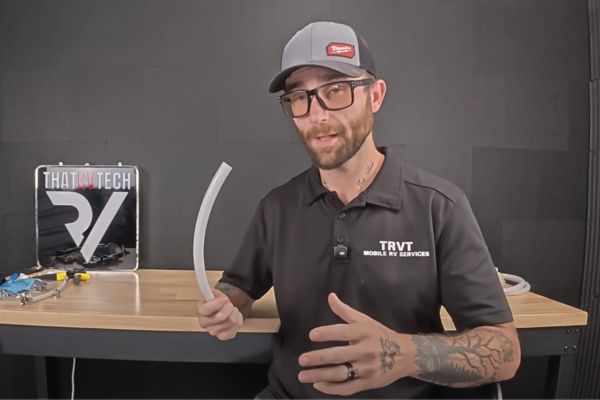
In the video at the end of this post, That RV Tech shows the right fittings, the right clamps, and the simple steps that stop the drips for good.
Many manufacturers use flexible polyvinyl tubing alongside rigid PEX-B. During COVID, supply issues led to some poor substitutes, and leaks spiked. Today’s tubing is better, but it still fails when paired with the wrong fittings.
Where flexible hose makes sense:
- Slide rooms with sinks or toilets that need movement without stressing joints.
- Near water pumps, as flexible lines cut vibration and noise.
The real reason it leaks
That flexible hose is not sized for standard PEX fittings. Push a PEX-B fitting into PEX, and it feels snug. Push the same fitting into the flexible hose, and it is loose. When clamped, it bunches like pants five sizes too big. Leaks start at those gaps.
Common causes:
- Mismatch in inner diameter between the flex line and PEX fittings.
- Over-crimping to close the gap, which distorts the hose and fails later.
Hose clamps chew into the tubing and do not apply even force. Standard PEX cinch clamps often do not fit over stretched flex line. Wrapping fittings with Teflon tape to bulk them up can work for a while, but then they leak again. These are band-aids, not solutions.
The correct fittings
The right part is a true 1/2-inch barb fitting matched to flexible polyvinyl, not a PEX insert. One end is a 1/2-inch barb for the flex line, the other end can be 1/2-inch PEX or threads for fixtures. The barb side fits tight in the hose, which creates a solid base for a proper crimp.
Most fixture ports in RVs use 1/2-inch FIP (Female Iron Pipe—female threads on the inside) or MIP (Male Iron Pipe—male threads on the outside) threads, like water heaters, faucets, and toilets. Barb-to-FIP or barb-to-MIP fittings exist and have for years. They press into the flex hose firmly and thread onto the fixture securely.
The right clamp
Use an Oetiker 18.5 mm ear clamp on the barb and flex connection. Standard PEX clamps usually do not fit this hose. The 18.5 mm ear clamp slides on easily, then crimps evenly around the barb.
Quick technique:
- Position the clamp about 1/8 inch from the end of the hose over the barb.
- Crimp fully using ear-clamp pliers and verify the ear is fully compressed.
Leak-free repair step-by-step
Cut the flexible hose square and clean.
- Slide an Oetiker 18.5 mm ear clamp onto the hose.
- Press the 1/2-inch barb fully into the hose. A snug fit is normal.
- Position the clamp 1/8 inch from the hose end, over the barb.
- Crimp the ear until fully compressed.
- Optional on long barbs, add a second clamp for extra security.
- Transition to PEX or to FIP/MIP as needed.
Flare-style compression fittings, including Flare-It, can work on this hose. They are common in RVs but can be finicky to tighten and retighten. They are an option, just not the simplest route compared to barb plus ear clamp.
Premade flexible lines are even better!
Hydraulic-crimped supply lines, like toilet supply hoses from the hardware store, are a smart upgrade near pumps or in service bays. They thread onto MIP ports, replace in minutes, and reduce leak points. Add a PEX-to-MIP adapter and use premade lines where flexibility is required.
Conclusion
Flexible hose has its place, but only with the right parts. Pair 1/2-inch barb fittings with Oetiker 18.5 mm ear clamps and match threads to FIP or MIP at fixtures. This removes the gap that causes leaks and outperforms the factory approach.
RELATED
- RV repair tech reveals the truth about RV plumbing codes
- Is there a recommended emergency plumbing kit for an RV?
- Where can I get wiring and plumbing diagrams for my older RV?
- The RV cheater vent is a simple fix for plumbing issues
RVDT2754
He is 100% spot on. Pushing hose that needs a barbed fitting end onto a Pex end is a recipe for disaster. Worse if done on plastic fittings.
In a pinch, wrapping the fitting with electrical tape will increase the fitting diameter so that a hose clamp can tension the flex tube enough to seal for an potentially permanent fit but I recommend replacing the fitting as soon as you can.