


By Russ and Tiña De Maris
Keeping the rubber on the road can be tiresome, particularly for RVers. For example, our tow unit is a 1-ton “dually,” that requires six tires on the pavement, then add the four tires on the trailer we pull (not to mention the spares) and there’s ten tires to be looked after. When it comes time to replace a tire, money talks.
How about you? Is it safe to buy and run used tires?
The folks at Consumer Reports recommend you steer completely away from used tires. Their reasoning is simple: You don’t know a thing about the background of the tire, who owned it, nor how they treated it. Since you can’t tell everything you need to know about a tire from a cursory inspection, the group best known for testing consumer products says, “The tire could have been driven overloaded, underinflated, or to excessively high speed. Any one or a combination of these factors could lead to internal damage not visible from the outside. In short, the used tire could be unsafe.”
But again, money talks. What if you do decide you really do need to buy a used tire or two (or ten)? Here are some things to look for as you carefully examine a potential purchase.
How deep is your tread: If you don’t have a tread depth gauge (and you really SHOULD have one), then the old standard of sticking a penny, head down in the tread, tells the tale. Mr. Lincoln’s head should be at least partially covered. If you can see all of the penny’s head, the tread is worn out.
 Don’t sing on the wrong cord: Roll the tire around and examine the entire length of tread. You shouldn’t see any cord, nor any trace of wire coming through.
Separate yourself from a separation: Check out the sidewall and the tread area. Beware of any bumps, irregularities, or wavy-looking areas. They could mean the tire’s been damaged and can be “separating,” or delaminating. Take it from our personal experience – a tire separation led to some serious damage on a Utah highway that spelled a total loss on one of our tow vehicles. Don’t just look – carefully run your hand along the sidewall and tread surface areas and feel for anything unusual.
Beat up beads: A tire’s bead area is where the tire meets the metal rim of the wheel. That bead needs to be solid, not chunked or damaged, to ensure a complete and safe seal. While you’re looking, check the sidewalls of the tire for small cracks indicating the potential of dry rot. They may appear, too, between the blocks of tread. Dry rot is a sure sign of problems.
Peek inside: The inside of lining of the tire should be carefully looked at. If a tire has been run overloaded or low on air, the sidewall begins to collapse. If that happens, they can fold over and contact themselves, rubbing, scrubbing and damaging the interior of the sidewall. If you see a wear stripe around the inside of the sidewall, or spot any tiny particles of rubber in the tire, or if you see the inner surface of the tire sidewall, reject the tire.
Rejectable repairs: Not all tire damage is bad. A puncture, properly repaired, can be OK. But a safe repair is a patch on the inside of the tire, not a “plug” of rubber pushed through the puncture. If a puncture is larger than ¼ inch, or is within an inch of a sidewall, don’t buy the tire.
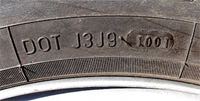 Hot dates: A tire may be undamaged and have loads of tread left on it, but if it’s aged, it’s not a safe tire. When we say “aged,” it’s recommended you never buy a used tire that’s any older than five or six years. A tire that’s seven years or older really needs to be replaced. How do you know how old the tire is? Look on the sidewall for the DOT code: the letters DOT, followed by several numbers are the code. The numbers are the key: The first two are the identification code of the tire plant where the tire was made. The next four numbers are the date of manufacture – the first two of those are the week, the next two are the year. So the four digits “1001” tell you the tire was made in the 10th week of 2001.
##FT1-18 ##RVDT1287

Sometimes you run into a deal. A few years ago my dad got some takeoffs from a new truck that had less than 2000 miles as the new owner wanted whitewall tires.
What was the original application for the “Used” tires? Data suggests that over half of all RV are operating their tires in overload or under-inflation, so IMO that would make them suspect. Why did the tires get removed in the first place? People seldom take tires off if they are happy with them. Can you get a warranty with the purchase? If not, Why not?