


Dear Dave,
While towing, it doesn’t seem that the truck power is charging the RV batteries. After driving for hours, there frequently isn’t enough juice to drop my front jacks. One battery came with the RV, the other was added last year. Thanks. —Jim, 2021 Keystone Montana 3761FL
Dear Jim,
The first thing I would check is the power coming from the alternator of your truck to the 7-pin connection. Mine is on the back bumper. Since you have a 5th wheel, it is most likely in the bed box on the side. You can use a multimeter, or CURT has a tester that makes it simple. You can get one on Amazon here.
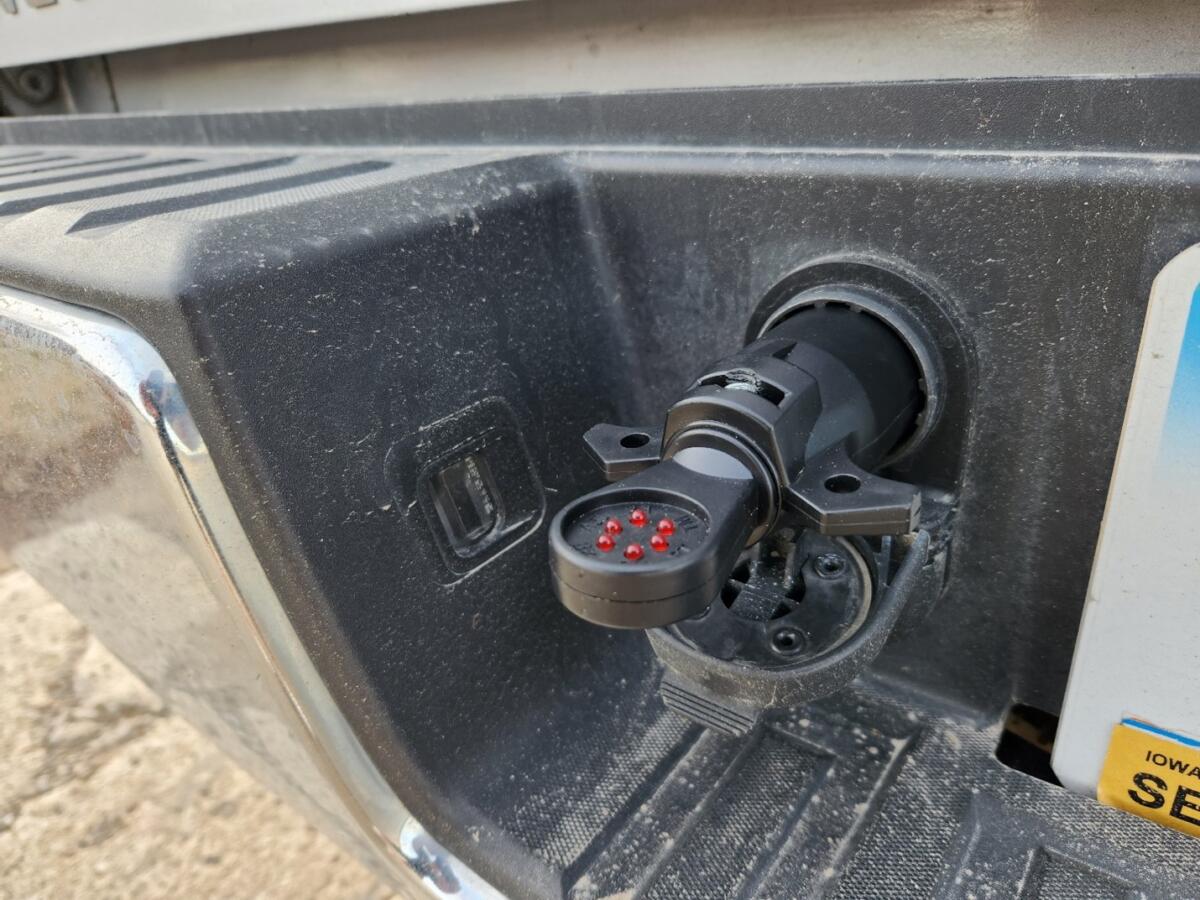
Each of the lights verify power for turn signals, brake lights, marker lights, and 12-volt power to the battery. The outlet has a groove or slot, so it can only be inserted in one direction. The outlet on my truck was positioned so the tester lights faced down and were almost impossible to read. I found there is a small set screw, which you can see in this photo, that can be loosened and gently turn the rounded light portion for better visibility. If you are using a multimeter, typically pin 4 is the 12-volt auxiliary power, and pin 1 is ground.
Might be a blown fuse on the truck
If you do not have power going to this outlet, most likely you have a fuse blown on the truck. Mine was located in the engine compartment in a weatherproof box. I have also read that many trucks have a fuse and relay in the glove box that must be installed for the 4 pin to get power. Check your owner’s manual to see if that is the case with yours. I have also found several discussions that indicated some Ford models needed the brake to be energized for 3+ seconds for the truck to recognize the trailer. It would be a good idea to contact your local truck dealer to see how yours is wired.
If you do have power, then you need to trace the pigtail back to the junction box on your RV. Start with verifying the pin on your pigtail is clean and is making good contact with the truck outlet. You may need to clean it with an emery cloth and electrical spray.
With the RV unplugged, use a multimeter to test the voltage at your battery. A fully charged battery should have 12.6 volts for flooded lead acid. Now plug in the 7-pin connector and start the truck. You should see the voltage go up to somewhere around 13 or more volts. This will indicate your truck is providing a charge while driving.
One other item to check is the battery disconnect switch. If it is engaged, most RVs will not receive a charge from the tow vehicle.
Could be bad batteries or using too much power
Keep in mind that the charge coming from your truck typically is a trickle charge and will not be able to keep up if you have bad batteries or are using a residential refrigerator. If your batteries are sulfated, they will show an initial surface charge but drop like a rock when a load is applied—like the leveling jacks or slide motor. When you plug the shoreline cord into the campground pedestal, the converter kicks in and provides 13.6 volts initially until the RV battery gets to 12.6 volts. It then tapers down to 13.2 volts for maintenance. Even though your rig is a 2021, it came with one battery that could be sulfated by now and adding a second one just allows the bad battery to drain it.
If you are running a residential refrigerator and other items through an inverter, it may be too much of a power drain for your truck charging system to keep up. Check the output of your truck’s alternator and you should be able to determine if this is the issue.
You might also enjoy this from Dave
Why doesn’t the tow vehicle charge RV’s batteries?
Dear Dave,
The car does not charge the battery to the RV when traveling, but the battery charges when hooked up to shore power. I’m wondering what could be the problem? All the fuses and the 7-point plug on the vehicle are good. —Matt, 2019 Forest River R-Pod 191
Dave Solberg is a leading expert in the RV industry and the author of the “RV Handbook.”
Read more from Dave here.
HAVE A QUESTION FOR DAVE?
Send your inquiries to him using the form below.
##RVDT2287

The trickle charge to our 5th wheel was not only annoying, but not enough to charge the batteries as we drove across the country to our Snowbird destination. As we would boondock at night, we used substantial battery power running the fridge, furnace and other items. My solution was to install a Redarc 50 amp DC/DC charger and have the batteries fully charged at every stop. If there is an extended dry camping stay, I run my truck for a couple hours and fully charge the battery bank. No need to carry around a big and heavy generator.
To gain the full 50-amp benefit, it would require a minimum of 8-gauge wire from the alternator to the DC-DC charger, although 6 gauge would be best. And certainly 6-gauge wire from the DC charger to the battery bank. A 7-pin trailer connection is not going to handle 50 amp current very long without burning up, so an auxiliary DC connector is also going to be required for the heavy gauge wiring between the tow vehicle and trailer for anyone considering a high current tow vehicle charging modification.
Thank you, Dave, for another lesson on the electrical connection between truck and towed RV! 🙂
Lenard’s comment is a good one. What I have done is feed an electrical cord from the front storage/battery area to the fifth wheel hitch. I have enough length there to drop down to a small generator and run it as we drive. I then have two options. I can either use a 20 Amp smart charger which the gen can run at an idle or I can plug in the whole trailer via a transfer switch and wiring to the front storage compartment.
Either way the gen runs on the eco setting and this is the only way to bring up the 4- 6 volt batteries as we travel.
The truck will never provide enough juice to do the job.
Now you can hook up a DC to DC Battery Charger for your truck that will use your alternator to charge the RV batteries while driving down the road.
I need the gen for boondocking anyhow so rather than double up on options…
we put those dollars toward fuel😊
Dave, I have a 2021 F350 and I tow RVs. I could never get any juice going to the RV battery. I tried testing the box and bumper plugs with a volt meter and a Curt Round Circuit Tester. Nothing. My Ford guy says there’s no current going to RV unless the truck senses the battery needs current. Gotta love technology. Well, most of the RVs I tow start with low batteries and after 100 miles they’re still low. Then my Ford guy says the truck (cont’d)…
has to be in Drive before current flow. Then my Ford guy tells me I need to drive at least 4 feet before current will flow. The only thing flowing here is what comes out of a male bovine. I got a Ford schematic and at the bumper & box plugs I cut the orange wire. I then ran a wire direct from my 40 amp outlet that’s under the hood, controlled (cont’d)
by an in-cab upfitter switch, and put in a 30 amp inline fuse direct to the orange wires at the bumper & box plugs. This has solved the problem and may help others with the same issue. Of note, is that from the factory the 40 amp outlets (there’s 2) are controlled by the ignition key. In the fuse box, for these outlets, you can change it so the 40 amp are hot all the time and controlled by the upfitter switches. Directions can be found on You Tube.