


Everyone: Here’s an article I wrote in 2017 about getting shocked from an RV that’s parked under high-voltage power lines. Yes, you can get shocked even when it’s in storage and not plugged in to shore power. Read on…
Dear Mike,
I’ve been reading about hot-skin voltages on your No-Shock-Zone site for a while and have  come up with a really strange one. We unplugged from a campground and drove several hundred miles before pulling into a storage facility. But when I got out and knelt on the wet ground to check my tire pressure and touched the trailer I got a pretty good shock, even though I’m not plugged into any power.
Is it possible there was something wrong with the power outlet back at the campground that charged up my RV? What could possibly be causing this? —Harold
Dear Harold,
 Taking a look at the picture of your storage facility gives me the answer to your conundrum. If you look overhead you’ll see a bunch of high-voltage power lines. They have upwards of 250,000 volts on them. And even though you’re not directly connected to them, the sheer size of your RV allows it to be magnetically coupled to the power lines, thereby creating up to a few thousand volts of charge to develop. But don’t worry. Unless you get really close to the power lines (several feet away or less) there will be such little current that there’s no danger of electrocution.
So the answer is that no, there’s nothing that could have happened back at the original campground that would charge up your RV. Unbeknownst to you, every time you drive under a high-voltage power line your RV is indeed charged up to several thousand volts, albeit with a very low current that you’ll only feel if you’re standing on the damp ground and touching your RV. And if your RV was plugged into a properly grounded power outlet, that would have drained away this harmless shock voltage.
A similar question:
Dear Mike,
We have recently purchased a new travel trailer, and I have noticed a small shock on different occasions while touching the frame. I understand the hot-skin condition and what causes it, but what is different in this case is the fact that the trailer is in storage when I’ve been shocked. No shore power, no generator, and even the battery has been disconnected (using the built-in disconnect switch).
My suspicion is that voltage is being induced by some overhead high-voltage power lines that are directly over the storage facility. On a humid day, you can “hear” the power lines “crackling.” I’ve searched around and haven’t found any similar situations described.
Have you ever heard of anything like this? I’m planning to attach a ground wire to a ground post and attach it to the frame while it’s parked to try and dissipate any voltage. Thanks in advance. —Dave
Dear Dave,
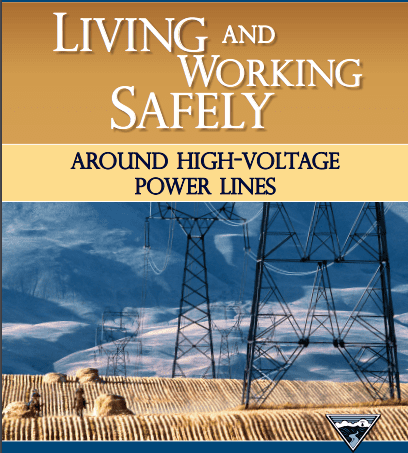 Anytime a large metallic object is underneath high-voltage power lines there’s a significant voltage induced on it which can range from a few hundred to several thousand volts. That’s due to magnetic coupling, and it’s a very well-defined problem out West where there’s a lot of 500,000- to 1,000,000-volt power lines running above roadways and parking lots. Now, there’s very little current available, perhaps 1mA, so it’s not dangerous at all. But this current is sufficient to startle you.
This is such a big issue on farms out West that the power company suggests you add a ground rod to metallic objects under power lines such as metal sheds, fences and irrigation pipes. So I think that adding a ground rod in your case is a good idea. Make sure there’s not underground wiring or pipes where you plan to drive a ground rod (call your local utility first), and use a standard 8-foot rod you can purchase from Lowe’s or Home Depot. Read an article about living safely around high-voltage power lines from the Bonneville Power Company HERE.
##RVT1081


I was under low hanging high tension wires on my dirt bike and felt the charge when I took my gloves off and touch the metal handle bars, I high tailed it out of there!