

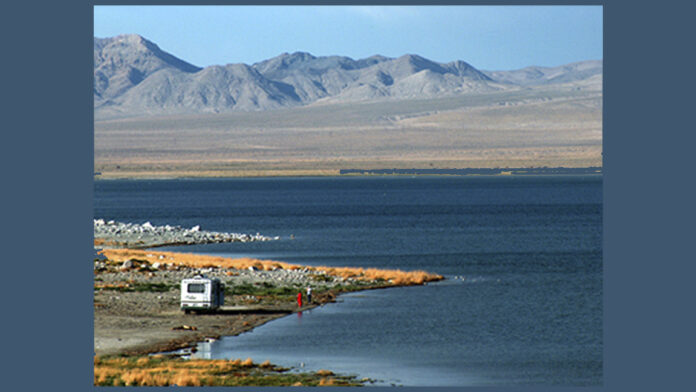
Talk to RVers who have spent years on the road and you’ll notice something: Many use free RV camping options instead of paying for every overnight stay.
That doesn’t mean they’re sneaking into campgrounds or ignoring the rules. Instead, they’re mixing paid campground nights with public-land camping, overnight travel stops and other legal, free options.
A recent camping survey suggests they’re far from alone. Nearly 60% of campers reported spending at least one night camping for free during the past year.
Free RV camping is only part of the picture
The survey, reported by Woodall’s Campground Magazine, found that 59.8% of campers used some form of free camping during the year.
Among those who did:
- 79.1% used dispersed camping areas.
- 63.7% used free established campgrounds.
- Many also reported staying on private property, their own land or other no-cost locations.
The numbers are interesting, but they probably won’t surprise many RVers.
Most RVers we know don’t see this as an either-or choice. They might spend several nights in a full-hookup campground, then spend a few nights boondocking on public land. They may use a campground near a national park, then stay free on a travel day while moving to the next destination.
In other words, free camping and paid camping often work together. For many travelers, free RV camping is simply another tool for managing travel costs and adding flexibility to a trip.
Most RVers don’t choose between free camping and paid camping. They use a mix of both.
Public lands remain one of the biggest opportunities
For RVers, much of the appeal comes from public lands.
Large areas managed by the Bureau of Land Management and the U.S. Forest Service allow dispersed camping in many locations.
That usually means no hookups, no laundry room and no swimming pool. It may also mean fewer neighbors, more open space and a campsite with a view that would be hard to find in a commercial park.
For RVers equipped with solar panels, generators or adequate battery capacity, boondocking can be a practical option for days or even weeks at a time.
Travel days are different
Many RVers also look at travel days differently than vacation days.
If you’re driving several hundred miles and plan to leave again the next morning, a full-service campground may not be necessary. Some RVers seek out legal overnight options while in transit, always checking local rules and obtaining permission where required.
The goal isn’t necessarily to avoid paying. It’s to pay when the amenities are worth it and save money when they aren’t needed.
Rising costs have changed the math
Campground rates have increased in many areas over the past several years, especially in popular destinations during peak seasons.
For RVers traveling for extended periods, even a handful of free nights each month can add up to meaningful savings over the course of a year.
That doesn’t mean campgrounds are becoming less important. Most RVers still appreciate hookups, dump stations, laundry facilities and the convenience that comes with them.
But many travelers have learned there’s no rule that says every night on the road has to come with a campsite fee.
That’s one of the advantages of RV travel. Depending on where you’re headed and what you need that night, you can choose the option that makes the most sense.
Sources
Woodall’s Campground Magazine
Outdoor Sportswire
RELATED
- Three free RV apps for easy navigation, big rigs, free camping, more
- Top 10 states for free camping and boondocking
- Forest Service plans to cancel free camping or raise rates at 33 Idaho campgrounds
- Moochdocking 101: How to score free camping and get invited back
- Best places for free camping in California
RVT1265
