


Dear Dave,
My sail switch recently went out and I had to have a repair tech come fix it. My furnace is located under my jackknife sofa in the front room area and it is a real pain. I had to remove the seat part before the tech got there to save me money. I got woke up 2 nights ago with a noise like the fan motor was hitting something, so today I decided to take the seat back out and try to find it.
The furnace is covered with a wood box with 2 pieces of metal screen for air flow, which I had to remove. I couldn’t take the furnace out but I tried vacuuming around it using my small leaf blower. I finally ended up unscrewing the furnace from the floor and lifting it just enough to get my hand in the duct. When I felt some of the aluminum tape hanging loose, I crumpled it a little while sticking it back. All said and done, I put everything back. However, my dilemma is that when I turned the furnace on before covering it back up with the box, I noticed that the furnace was hot to touch. Now I’m worried it could catch fire. Are they supposed to be hot to the touch? —Shirley

Dear Shirley,
Your furnace is a Dometic model DFM020121, 20,000 BTU and direct flow. That means it blows heat out of the front of the unit rather than through ductwork throughout the rig. The circles you see on the top and back are punch outs to add additional heating vents.
How the RV furnace works
I have a few concerns and questions, such as what diagnostic procedure was used by the tech to determine a new sail switch was needed in a 2021 furnace. When the thermostat calls for heat, it sends 12-volt power to the module board. That starts the motor and fan to purge the burner assembly and draw interior air into the chamber and out to the vents through the sail switch. If the airflow is not high enough, it will not raise the sail switch high enough to create an open circuit, which means no power to the module board and it will not start. I wonder why a new sail switch was needed in such a new unit?
Next, if a new sail switch was needed and installed, it would be in the curved cowling that surrounds the squirrel cage, like this photo.
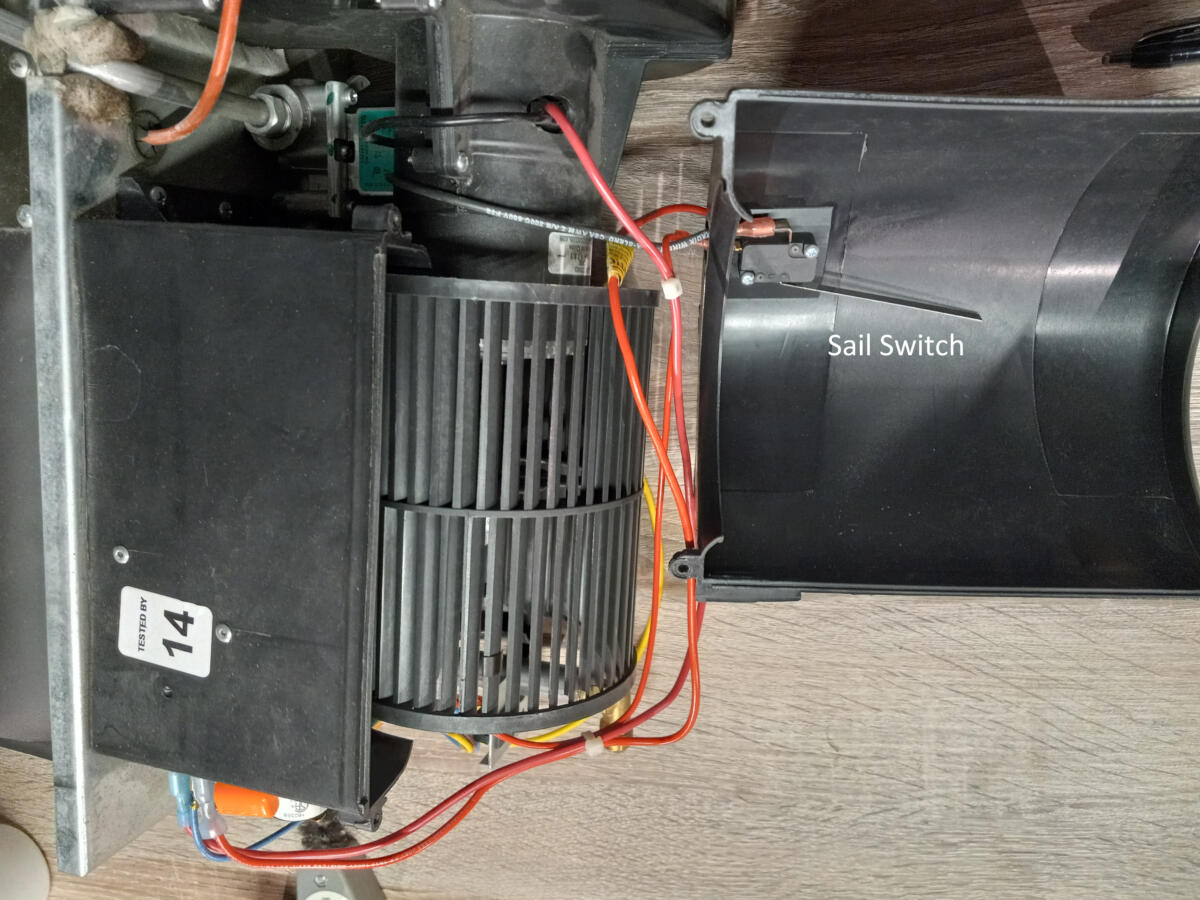
This cage is the only moving part, so if you are hearing sounds, it must be coming from this cage. Most likely, the cover could have been installed improperly or debris was left inside.
Another concern I have is that you needed to vacuum out debris from the area. Also that you found some of the duct tape hanging there. I have found furnaces that have had wood chips, insulation, and even wire nuts that have gotten sucked into the fan and create noise. However, it seems like you have silenced the noise but still have a heat issue.
What the limit switch does
The limit switch on the outgoing portion of the heat chamber is typically set to 160-170 degrees. If the temperature reaches that setting, it creates an open circuit and shuts the furnace down. So, I do not believe your furnace is getting hotter than that and would not start a fire. Keep in mind that if you place your hand on any metal object that is over 150 degrees, it will probably cause a blister so, yes, it does seem overly hot. You need to verify the temperature using an infrared thermometer to get the actual temperature.

You might also enjoy this from Dave
Why does my RV’s furnace only ignite when I lift the sail switch?
Dear Dave,
I have determined that my RV’s furnace blower airflow is not sufficient to activate the sail switch. The batteries are new and charged, but it will only ignite when the sail switch is depressed manually. There appears to be sufficient air blowing out of vents. I can’t see any blockages in lines or hoses, and there does not appear to be much dust on impeller blades. I am stuck and would appreciate any guidance. Thanks in advance. —Anthony, 2016 Bigfoot 25FB
Dave Solberg is a leading expert in the RV industry and the author of the “RV Handbook.”
Read more from Dave here.
HAVE A QUESTION FOR DAVE?
Send your inquiries to him using the form below.
##RVDT2304

We all know how well the RV heater case and combustion chamber are isolated from the surrounding materials that can come in contact with the heater. My concern is the first picture shows some of the couch material hanging down and may come in contact with the heater case or block any of the vent slots in the picture.
Shirley did say “The furnace is covered with a wood box with 2 pieces of metal screen for air flow, which I had to remove”. Hope this helps!
Snoopy
Thank you, Dave! 🙂
I’m being nitpicky Dave. I like your response except for questioning the sail switch replacement. A furnace sail switch issue is one of the easiest parts of an RV furnace to diagnose – be it a damaged sail (visual) or more likely, bad micro switch (using VOM’s continuity check). I have seen failed micro switches in any number of electric devices. Age is seemingly immaterial. Shirley didn’t offer any details of the tech’s diagnosis, so I have to assume replacing the switch fixed a non-heating furnace that briefly blew cool air then stopped running. While correct about the level of heat, I still don’t like the placement engineering. That much heat isn’t going to do any favors to the furniture.
My 2 cents worth.
My furnace was hot and manufacturer of the fiver only used 2 knock outs to supply heat to the coach. I added a heat to the bathroom and another to the living area. Reduced the temperature of heat coming out of hoses and made a more comfortable coach . I used insulated flexible ducting rather than just flexible duct. no sense trying to heat the underbelly (not basement). I guess the name of the game is “how cheaply can I make this?”