

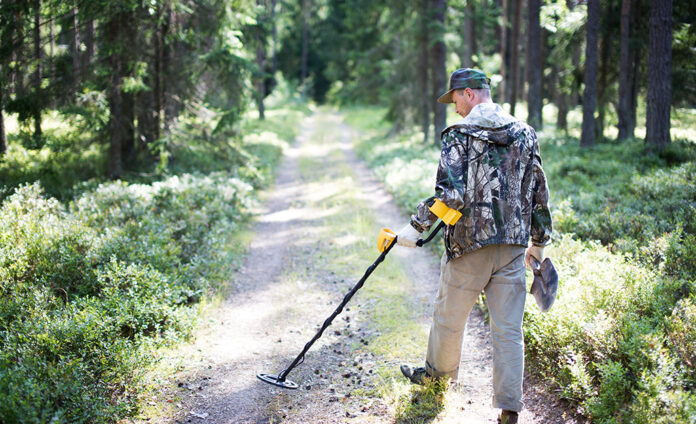
There’s something exciting and exhilarating about searching for treasure! If you feel that way, too, perhaps you’d enjoy the hobby of metal detecting.
It’s really no surprise that many RVers enjoy metal detecting. After all, RVing itself involves the search for adventure. The joy of discovering new places and things is baked into the DNA of most RVers. We love to spend time in the great outdoors, too! As it happens, all of these qualities perfectly fit with the hobby of metal detecting.
On a recent trip I met an RVer, Tim, who was a seasoned detectorist. His enthusiasm and knowledge, plus his detecting experiences, made for great conversations around our evening campfires.
Here’s a bit of what I learned from Tim. I hope the information will perhaps encourage you to think about making metal detecting a hobby for yourself!
Why RVers love detecting
There’s a lot to love about becoming a detectorist. Check this out:
• Outdoor exploration. Metal detecting gets you out of your RV recliner and into nature. No matter where you go, you could discover hidden gems while getting a bit of exercise, too.
• Thrill of the hunt. There’s a rush when your detector beeps—could it be a silver coin, a piece of jewelry, or a relic? That element of surprise keeps the hobby fresh for years.
• Historical connection. Every find tells a story about past inhabitants—coins from the 1800s, buttons from military uniforms, or old tools—all offer a hands-on link to local history.
• Social community. Detectorists often share tips, photos of finds, and trip reports online and at local clubs, making it easy to connect with fellow RVers who share your passion.
Tips for beginners
Not sure how to begin? Here are some tips:
• Choose the right detector. Look for entry-level models that balance ease of use with essential features. Popular picks include the Minelab Vanquish 340/540 and the Nokta Simplex. Both offer good depth and discrimination without breaking the budget. Consider weight and ergonomics before you purchase. Lighter machines reduce fatigue and allow you to hunt for longer periods of time.
• Learn discrimination and ground balance. Discrimination settings on your detector let you filter out unwanted metals like iron or aluminum foil, focusing on more valuable targets. Ground balancing reduces interference from mineralized soil, especially near rivers and beaches. Many modern detectors have automatic ground balance, but learning manual adjustment can improve your overall performance.
• Practice. Begin in your own backyard. It’s important to practice how to control your coil detector. (You may benefit from watching a video like this one.) You should sweep the coil slowly and close to the ground. Overlap each pass by about one-third of the coil’s width to ensure you cover the entire search area. Practice maintaining steady height and speed. Inconsistent motion can lead to missed targets or false signals.
Once you’ve practiced controlled sweeping, place a handful of coins and small metal objects buried at different depths in your yard. This helps you learn how targets sound at various depths and angles.
Understanding land ownership and permits
Before you head out to begin your metal detecting adventure, you must know and understand the rules:
• Private property: Always obtain written permission from landowners before detecting on private land.
• Public land: Laws vary by jurisdiction. Some state and national parks allow detecting only in designated areas or require permits; others ban it entirely.
• Archaeological protection: Federal sites and Indian lands fall under the Archaeological Resources Protection Act, which prohibits excavation without a permit.
How to check regulations
• Park websites: Most state parks publish rules online or provide maps of permitted zones.
• Park offices: Calling the park office or visitor center can clarify current restrictions and permit fees.
• Local metal detecting clubs: Club websites often compile state-by-state regulations and can advise on lesser-known sites.
• Federal resources: The Bureau of Land Management (BLM) and U.S. Forest Service websites list metal detecting policies for public lands. [Google “BLM metal detecting” or “U.S. Forest Service metal detecting” for info in pdf.]
Essential equipment
• Metal detector: Choose based on budget, terrain (all-terrain vs. beach-specific), and feature settings.
• Digging tools: A trowel or sand scoop plus a folding hand shovel help recover targets without damaging them. Tim (the RV detectorist I mentioned earlier) also recommends a pin pointer. Here are several to choose from depending on where you plan to search.
• Headphones: Waterproof models can be indispensable for water hunts and help you hear faint signals clearly.
• Finds pouch and trash bag: Separate target finds from debris to keep your site tidy and compliant with “leave no trace” principles. (Note: You can improvise and use your own bags, too.)
• GPS or smartphone app: Mark locations of high-yield spots to revisit later; apps like Avenza Maps or Gaia GPS work well offline.
• Protective gear: Gloves, knee pads, and sturdy shoes will keep you comfortable and safe on varied terrain.
You should try it!
Metal detecting is a mobile hobby that’s tailor-made for RV travel. It can enrich your journey with exciting discoveries and wonderful memories. Best of all, the necessary metal detecting tools are few, lightweight, and easily packable in all sizes of RVs. So, what are you waiting for?
Are you an RV detectorist as you travel? Tell us about it using the comments below.
YOU MIGHT ALSO ENJOY:
- A perfect creative hobby for the RVer: Rock painting
- How to be an RVer and still pursue your hobby
- Poll: Do you have a hobby?
RVT1206

Good article I would only add that metal detecting can be very frustrating like playing golf when you first start it does take practice and persistence. JMHO
I have always thought that would be a fun hobby to get into…just never took the plunge.
I have a entry level detector and it’s a piece of junk. I’d rather know one thats good.
I have a $600 Gold Bug II and all I’ve found with it is lead. As in bullets. And since I’ve move from the West, I never use it anymore. I need to change that.
Metal detecting is no longer worth it. My father-in-law has already covered every inch of ground that is available.
Thanks, KellyR! You just saved me a lot of money. 😉 Have a great week and safe travels!
Thank you for the information, Gail. I had no idea the detectors were so expensive!?! The price of new ones is quite a barrier to entry. Besides, KellyR’s father-in-law already found everything available. 😉 Have a great week and safe travels!
I’ve thought about it especially since we live at the beach it’s a gold jewelry gold mine!!! But we prefer rockhounding, much easier to find rocks even nice ones, they’re everywhere * !!!
So much fun to drive our small 25′ rig with several hundred pounds of rocks rolling around 😂. Surely you’ve seen Ricky and Lucy in “The Long, Long Trailer” !!!
*Florida may be the exception.