

Are high fuel prices a pain in your gas? RV manufacturer Thor says, “nah,” and they have the survey results to prove it. Trumpeting loudly, earlier this week Thor released its spin on a survey of 500 folks who have gone RVing in the last two years. We’ll look at the numbers, and will ask for your opinions, as it’s likely most of you never got the chance to tell Thor your own view.
Fuel price hikes encourage RV use?
Here’s the bold statement: “69% reported rising fuel costs have increased their likelihood to use an RV within the next year, or has no impact.” Really? Have rising fuel prices really encouraged you to use an RV in the next year? A closer look at the survey results reveal a bit of “sleight of hand” in the use of words.
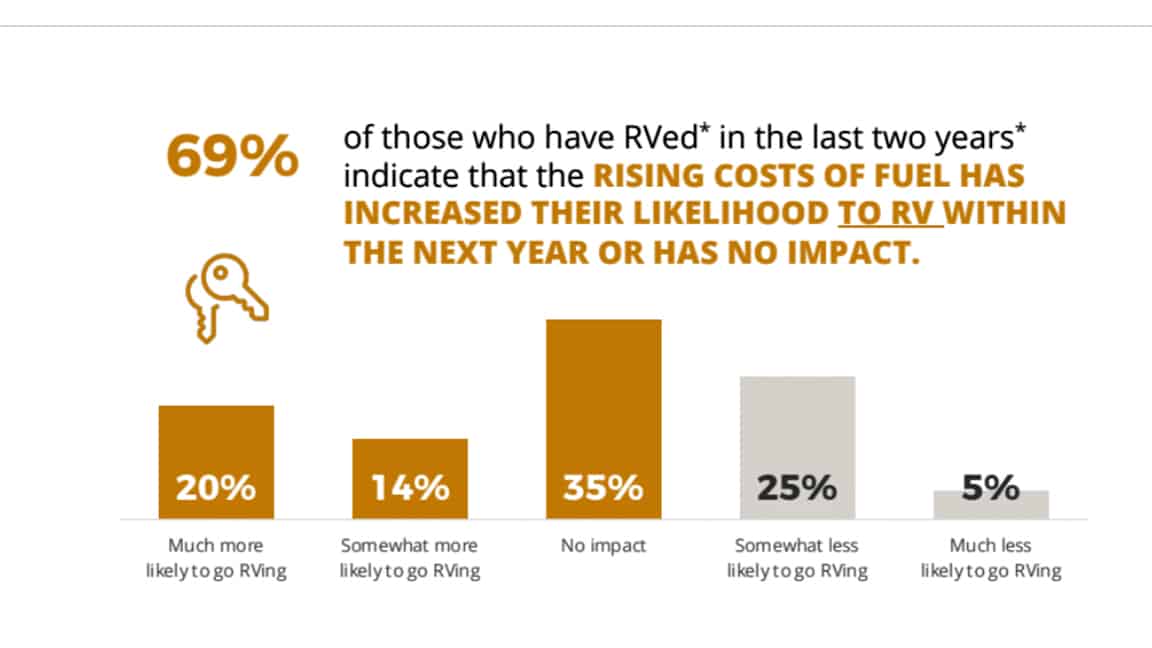
Yes, if you add up the totals of those who are “much more likely” to RV (20%), with those who are “somewhat more likely” to RV (14%), with those who say fuel prices have “no impact”, you’ll reach the taunted 69%. Of course, a big RV builder could hardly tell stockholders the other side of the story. If they did, it would read: “65% reported rising fuel costs have DECREASED their likelihood to use an RV within the next year, or has no impact.” Which statement sells better? They’re both true. But it gets better.
Buy a new rig?
The second major question in the survey tied to fuel prices could easily shake potential Thor investors. The company survey spin says this: “69% reported rising fuel costs have increased their likelihood to purchase an RV within the next five years, or has no impact.” Again, the graphic, and a little math, shows a clearer story.
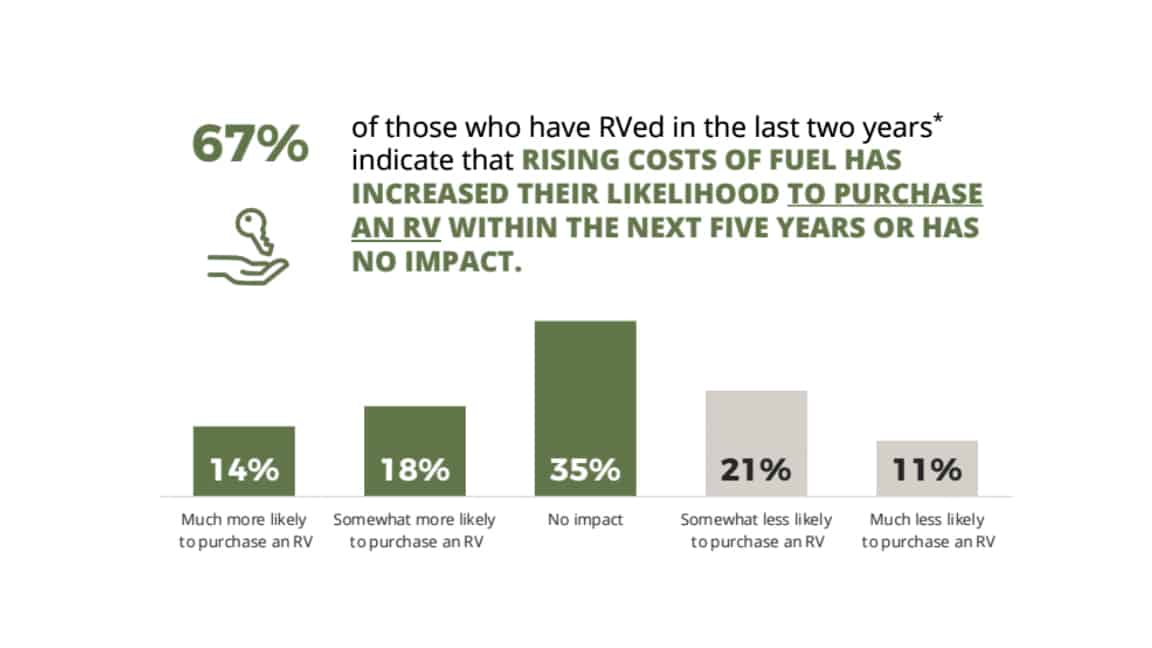
Evidently, fuel prices would spur 14% of survey responders to be “much more likely” to buy an RV. And 18% would be “somewhat more likely” to do the same. So, turning around the math, the survey could just as truthfully read: “69% reported rising fuel costs have decreased their likelihood to purchase an RV within the next five years, or has no impact.” Again, it’s all in the spin.
It’s interesting that Thor released this information on May 24. The survey itself was conducted in March. In mid-March, the average price of a gallon of gas in the U.S. stood at $4.32, according to the U.S. Energy Administration. As of Friday, gasoline averaged $4.60 a gallon, up six percent.
So we’ll throw the ball in your court. We’d like to ask you the same questions that Thor asked in its survey. We’ll report back next week on how things compare.
Your thinking, please…
Revision: Corrected erroneous data regarding fuel price hike. 5/29/22 9:32 a.m.
RELATED
- RV rental numbers still up despite fuel prices, thanks to “nearcations”
- Opinion: Just like campers, campgrounds are paying for fuel increases, too
##RVT1054b


The questions don’t ask “the rest of the story”. In addition, we should ask: Will you RV more, less or the same amount? Will you travel closer to home, further away, or about the same?
We really should ask questions about the impact of rising fuel costs on our activities and spending choices. For example, it might be helpful to understand what fuel price will cause us to stop or severely limit our RVing. Are seasonal or permanent sites in our futures?
Rising fuel costs will have a definite impact on the travel budget but we still plan to carry on with our retirement travel plans. the number of trips we take may be less but we still want to travel the country while still physically able to do so. No one knows what tomorrow will bring so if it is still within your means to do so I would say live your life to best of your ability.
Obviously there are people that will not be greatly affected by rising fuel & inflation costs, however the average working or fixed income RV owner will not have much of a choice but to limit their RV use or postpone an RV purchase. Now that interest rates are rising will also price out new purchases. I live in an RV park & several families are leaving their units home & flying to their destinations or staying much closer to home this Memorial Day weekend.
A 500 mile trip will cost you an extra $114. A full timer will need an extra 1-2k in their budget for fuel. Yes, it is impactful. A majority say no impact and the more/less basically cancel each other out from survey accuracy. Thor did a disservice to data interpretation here. Many people are affected and I hope solutions can be found to continue drilling longer term while investing in potential future clean ideas.
We are FT, no plans to change rv (class A), but gas prices could affect how far and wide we range on the road.
32% more likely to RV with higher gas prices. This doesn’t pass the smell test. I think 32% didn’t understand the question, or it was worded very poorly
It was worded that way to get the outcome they wanted, typical of todays manipulative times.
A good question to ask would be for those looking to buy a new RV, will you upsize or downsize
Because we are lucky to live within 40 minutes of our favorite Federal camp ground we are going fewer times but staying longer. The current Regimes attempt to cripple travel due to purposely creating an atmosphere to make gasoline unaffordable has failed.
Baloney……….
agreed
Member of the “flat earth society” too?
I’ll never own an electric vehicle ! More so because they are trying to force them on us !!
It’s still a choice my liberal friend. I suppose you think climate change is a farce as well. Using your logic, I would not wear seat belts, follow the speed limit or buy insurance all because these things are ‘forced upon us.’ Yet my health insurance premiums and taxes go up to pay for inevitable outcomes of folks that feel common sense is akin to ‘forcing’ something on us and who oppose it in the guise of ‘freedom.’
Agreed
Agree with you Dane. The other responders need to remove their heads
Those that don’t realize these price increases are intentional, just aren’t paying attention. LGB!
This is our second season having a seasonal site 250 miles from our home base. We’ve got the cost of fuel for our Super C up in April and back in October. Other than that expense it’s just fuel for our Honda Fit to get here every other week and it gets 40 mpg. Might be worth it to shell out the $300 they want to leave the camper on site during the winter the way things are going. We used to travel all over but 2019 was the last year for that. Polls can be bent anyway someone wants them to just by the wording so I don’t consider any to be reliable.
As they say, “statistics don’t lie, but liars use statistics”!!!
(FWIW, cliches often become cliches because they contain elements of truth.)
Of those likely to purchase an RV, are they planning to downsize to something more fuel efficient?
Of those planning to RV more, what are the dynamics? Are they RV”ing closer to home, staying in one location longer, or just anticipating less crowded conditions due to the higher fuel cost?
As my Statistics 101 professor pointed out long ago: when it’s his stats, he can tell whatever lie he wants; when it’s my stats I can do the same.
It will cost me over $3000 in diesel to go to Alaska and back later this year. I’ll bite the bullet and do it and hope for that other won’t.
Fuel is just another cost of “doing business” when we RV. First world problems here folks, let’s move on.
Not the case for everyone, only the entitled
We are staying at a resort for the summer, and glad we have our motorcycle along. It not really the high $$$$ that’s stopping us,it’s the principle behind it, they they want us to buy electric vehicles,not happening in this family ! As much as I hate driving our big ram dually,we need it to pull our toyhauler, hubby does all the driving and I only drive it to go food shopping or running small errands
And the cost is too high for some of us.
We live in Oregon and had made plans to go across the country, but due to gas prices put that trip on hold for awhile. Instead, We decided to take 3 trips. One to the coast, one to Reno, one to Montana, and staying longer in each place than we usually would.
When was this survey actually taken? The average price of a gallinules of gas in March of THIS YEAR was over $4 per gallon.
The $2.38 average was listed as the average for March 2020.
93% increase since March 2020 perhaps, but not in the last twice months.
I’m still not RVing, car camping in the Prius instead.
Me too. My RV has been idle this year. But I have already done two, multi-day trips sleeping in the Prius. Getting ready for a three week Prius trip. Less than $500 in gas for Prius. More than $2000 for gas if I took my fairly fuel efficient RV.
Sorry, David. It was a typo. It’s been corrected. Have a great day. 😀 –Diane
We have revised our summer travel plans. Our three month 10,000 mile trip that we planned is now a three week 800 mile one tank of fuel adventure. But so far we’re not having much luck finding any state or National Forest sites where we can reserve a site. So at this point this summers travel plans are looking very iffy!!!!
In RVers changing camping plans: Cites average gasoline price 3/9 was $4.25.
In Thor article, Energy Admin says average in Mid-March was $2.38.
What gives with these contradictory quotes?
i thought the same thing.I paid over $4.00 per gallon of regular gas where I live in central Florida in March and $4.29 in first of April.
The second poll (and Thor’s) should really be limited to those who had considered purchasing an RV, fuel prices have no impact on my intentions because I don’t intend to purchase an RV in the next 5 years.
An RV Manufacturer putting its spin on fuel prices is a non-story. From a sampling of 500 of more than likely Thor owners.
On top of fuel when adding in the high inflation and overall costs just to live it cuts into the majority of anyone to stay within a budget. I’ve been going less and closer to home, but trying to save some for longer trips this fall, unless gas gets even more ridiculous
Frankly, while exorbitant fuel cost is certainly big negative factor, the DOUBLING of RV prices over the last couple of years is the real 1000# gorilla in the room. “Greed is good, Greed is right”. “Maximize the shareholder’s value…and our management bonuses”
Says the man Gordon Geko!
$.50/mile to tow a modest camper is certainly motivation to consider what other alternatives are available
Much more interesting is the type of RV people would be buying, if rising fuel prices made it more likely that they would buy a new RV. I suspect that many people might buy another, smaller RV to get better fuel mileage.
We may travel less but not change the amount of nights being in our comfortable 5th wheel
Thor sells GAS GUZZLERS. Thor would always lie and say that.
Look, this whole thing is coming crashing down, so either short the market now, or get into cash.
As workampers specializing in regional, state and federal parks & their non-profit partners, we are provided a free site for 3-6 months at a time. This cuts WAY down on conventional RVing expenses. Plus, we occasionally take a position that provides a site AND pay a salary. We’ve been doing this for ten years f/t; our accommodation to higher diesel prices lately is to select our positions from within a smaller geographic area, reducing our fuel burn from one job to the next.
We just purchased a Country Coach, at our age, mid 70’s, we are not going to set around and wait for politicians to remove their head. We might not travel as far but we will travel.
My answer really falls into the category of no net impact. That’s only because we have ordered a new RV and no one seems to know when it will be available. In the meantime we are trying to sell our old RV. So we are not worried, yet, about fuel cost.
We live in our RV full time. We had/have major travel plans for this travel season. We left AZ in April and will return in late October. We have traveled from AZ to TN. We leave Tuesday for the next route, up and around Michigan, then cross country to WA and BC, down to OR, CA and then back to AZ. We have parked at our friends house here in TN for two 10 day sessions with a trip between to explore Mammoth Caves. Other than this stay we won’t be anywhere longer than 12 days and generally only 3-7. Lots of miles to cover, lots of sights to see. I didn’t change our plans with the increase in diesel costs. We have cut back on eating out and try not to wince too hard when fueling.
When I took my second retirement last summer, I did some travelling, but now that I’m back at work again I plan to stay close to home. Normally, I’d take three weeks in the spring and go to CA/NV/AZ for the spring races, but $5- gas really blows the budget. As for buying, we plan on getting a diesel pusher or Super C around 2035 or so, but until then our gasser Class A is fine. Buying something smaller, just for fuel efficiency, will not work for us. My wife brings a LOT of unnecessary stuff (and she feels the same way about my tools).
Gas is nearly twice as expensive, here in Canada, then it is in USA … food for thought for Americans who are thinking of travelling in Canada this summer … highest places are BC, Maritime provinces – Nova Scotia, PEI and Newfoundland … in Ontario it is about $8 US per gallon for gas and closer to $9 or $10 US per gallon for diesel … costs my husband approx $220 US to fill his F250 diesel …
While I plan on going camping where I have reservations at State Parks. If gas keeps going up, I might cancel reservations a distance from home and only camp where I have close reservations. With gas being high I will only reserve campsites next year less than 100 miles from home. I’m lucky I do own property with a campsite close to my home
We go to dog shows at a specific site without hook-ups. We upgraded to a DP in 2018 so we could go to shows further away- instead of 150 to 200 miles with the gasser to 350 t0 500 miles. This year we declined to go to 2 trials because of fuel costs. Diesel ranges from $6.29 to $6.59 in the metro Philadelphia, Pa. area.
I voted for “no impact” twice. Our RVing has fallen because we are awaiting the arrival of our new RV and do not wish to add miles to the one we are trading. It is not because of fuel prices. Similarly, we ordered a new RV in February because we want to downsize from 43 feet to 36 feet. We expect to take delivery of the new one and relinquish our current one in the next two weeks. So, we bought a new RV in order to downsize and thereby fit more campsites, not because of current or anticipated diesel prices.
The high cost of diesel will not affect my rv usage but instead I will be making shorter trips, had a 3 week trip planed but had to cancel it. While we could afford the extra cost we decided it was not worth it
Current trip is at 4500 miles. Have another 1500 miles to complete. Fuel prices are high but we are making memories. Love traveling in our RV!
Well said. We enjoy our travelling too. If it is still possible to make those memories happen then we plan to. Like they say, you can’t take it with you.
Living in montana next to three refinery’s the price is a rip-off to me! They raise the price up before it cost them more? Oil field’s are cap off here after they know how much they will give, to be used later!
Just remember in two years you all have the power to change what has happened . Clean the swamp to help restore AMERICA.
Yes it is way more expensive but you only live once. With our kids lacking conservative views, we look at it this way. We are spending our kids inheritance one gallon at a time.
With regard to the question of fuel prices affecting going RVing, I said much less likely only in that the TYPE of our RVing will change. We live in AZ and generally do cross country RVing (to the Outer Banks, FL, PA, MT, SD, etc). We live up in the White Mountains of AZ and will likely just be camping close to home until diesel fuel prices come down.
We have a big (for us) trip planned starting soon. It is a promised trip to take my sister to the Grand Canyon, like we did with my husband’s sister last year. We are looking at $2000-3000 in fuel alone for a 2 week trip. We pulled minute or is savings to cover trip costs. The rest of the year it will be short trips to a local USFS campground it state park, and we will dry camp at a few dog agility trials. At this point we make fault deciding to drive our Honda Fit (35-40 mog) for the economy it the Toyota 4Runner (20-23 mog) for the space or back road capability. We’re dressing the gas consumption in the RV – 7.5 mpg on a good day.
Fuel is up, but we will look to save other ways. We are still planning on several in-state trips with grands this summer and wintering in Tx. Plus, we will boondock more and look for lower priced CG’s. One less night in a $100 CG covers 200 miles of fuel. Maybe eating out one less time a week. It’s all relative!
My daily driver is a Lincoln Navigator that gets 13MPG. Our 2014 Anthem averages 10.3 MPG (no toad).
The only difference is the Lincoln uses gasoline and the Anthem uses diesel.
I didn’t answer the second question because I have no intention to buy another RV. I’m perfectly happy with the one I have.