


Tire sidewall bulges can be difficult to diagnose. Sometimes it is even possible to misinterpret a depression as a bulge. So let’s start off today’s lesson by clarifying the words.
According to Dictionary.com, “bulge” means a “rounded projection, bend, or protruding part; protuberance; hump.” I think we can all agree that this is a sidewall bulge.
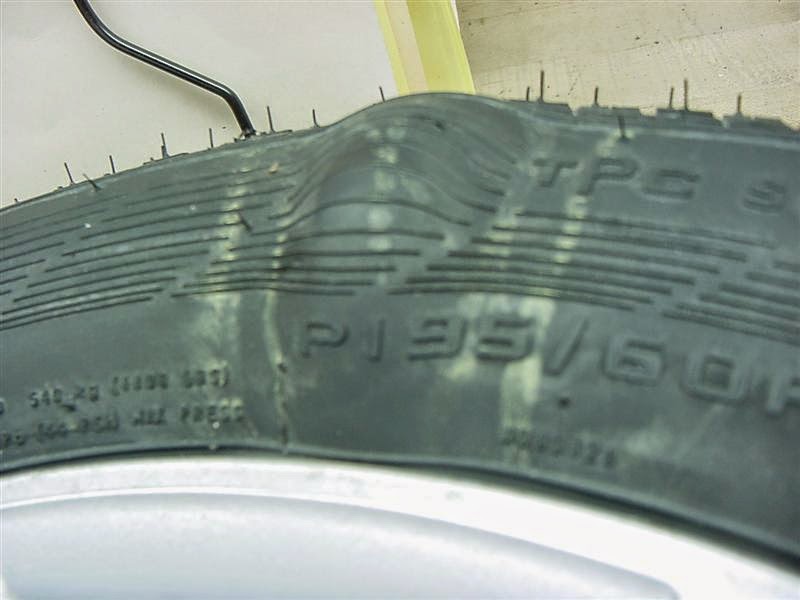
A depression would be the opposite, or “sunken place or part; an area lower than the surrounding surface.” Sometimes I may use the terms “bulge in” and “bulge out” just to be sure people have a clear understanding.
Samples of sidewall depression
Look closely at this shot and I think you can see that this is a depression in the sidewall.

Here are a couple of other shots showing a sidewall depression.


OK. So now you are probably asking why are these two conditions in tires and are they defects or what? Let’s step back for a moment and consider how tires are made.
The basics apply to all tires, be they small 10″ or 12″ as seen on micro cars, or 22.5″ tires as found on Class A RVs.
How a tire is built
In this post from my RVTireSafety.net blog, there are some links with videos showing the basic process of wrapping layers of fabric (or sometimes steel cord) that is in a sheet of rubber around a drum. The place where the builder starts and stops has a “splice”.
What causes a depression
The goal is to have a strong enough joint to keep the uncured rubber together until the tire is cured. In some constructions, this means a small overlap of one to maybe four cords. If the overlap is larger than desired, there is a doubling-up of the cord and this is what creates the depression.
I know this is counterintuitive, but you need to remember that when a tire is inflated the rubber stretches and the textile cords stretch a slight bit. However, if the splice is “heavy” or larger than desired, the forces from inflation are resisted by twice the normal amount of cord and rubber, so the stretch is less than in the rest of the tire. There is nothing wrong here other than a visual depression.
What causes a bulge when manufactured
A bulge is just the opposite. If the splice is “open” or there are cords missing, then that area will stretch out more. That is because there is only sidewall rubber resisting the air pressure, so the sidewall stretches out just like a balloon. A bulge from an open splice is noticeable as soon as the tire is inflated.
If you see this on a new tire, point it out to the tire dealer right away and confirm the bulge is below the level of concern for that make of tire. This will probably be less than 1/10″ above the surface of the rest of the tire and less than 1/2″ wide. If larger, I would request a different tire unless the dealer is willing to put in writing that the tire is safe. Get a nice close picture of the tire for your records and be sure the bulge does not get any larger.
More causes of a bulge on a tire
The other thing that can cause a bulge are a few broken body cords from some sort of impact such as a curb, pothole, or from hitting something on the road. Here is a shot of a 22.5 that suffered an impact.
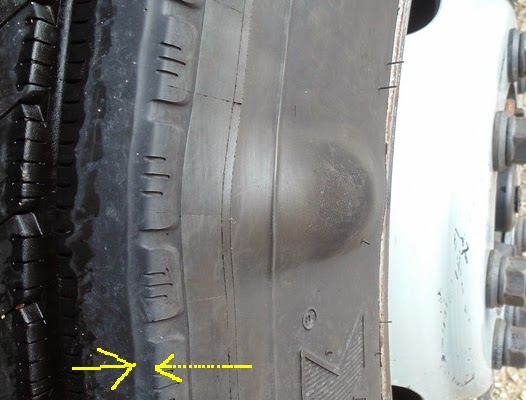
How I know this was not a factory defect
One thing to point out is how I know this was not a factory defect. I have yellow arrows pointing to the small amount of irregular tread wear. You will note that this level of wear is fairly uniform around the tire. If the defect had been in the tire from when new, I would expect the sidewall bulge to affect the tread wear. Since it didn’t, that indicates to me the break of the body cord is recent.
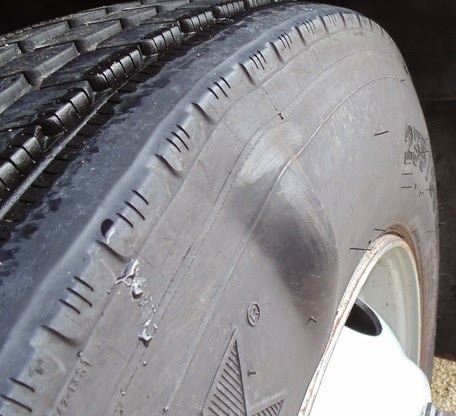
I hope everyone now understands the difference between a cosmetic depression and a bulge due to a tire impact. If you have a bulge that looks anything like the examples above, I would not drive on the tire. If we are talking about a high-pressure tire (75 psi or higher), I would not even stand near the tire while waiting for service. A tire explosion can be damaging or even injure people.
Roger Marble
Check out my Blog www.RVTireSafety.Net
Read more from Roger Marble on RVtravel.com.
##RVT1132

I had a faint sidewall depression just like these on a 5th wheel trailer tire and I thought it needed to be replaced. I looked hard at the other 3 tires and also found the same thing on all of them. I prepared to bite the bullet and replace them and was told by the tire store manager that they were a ‘factory mold mark’. Was I relieved! The mark went though the same letters on the sidewall of all 4 tires, which offered a clue that I did immediately recognize. I got a second opinion later and was told the same thing.
I drove for UPS for several years. As I was headed out of town one day my steering started acting all wonky vibrating and pulling back and forth. I stopped the vehicle and discovered a huge bulge on the inside edge of one of the front tires. I called the mechanic and he came out with another mounted tire. I helped him change it and load it into the truck he drove out.
When I got back to the building I heard that tire had blown up as it lay in the back of the truck. It had come completely off the floor, flipped over and almost tore a shelf off the wall of the package car.
When Roger says “A tire explosion can be damaging or even injure people.” you better believe him.
Maybe letting some of the air out might help?
I have found in the past, after I have take my tire in to a repair shop to be plugged and repaired, after having an object puncture my tire, is when I experience a bulge. I do not believe in having my tires repaired as a result.
Thank you for your continued effort to deepen my tire knowledge, Roger!
Eesh! If someone sells you a new tire and tells you that bulge is normal, you’re shopping in the tire store.
Thank you for demonstrating and explaining the differences between concave and convex tire bulges, Roger. Have a great day and safe travels!