By Greg Illes
 Not very many of us like the sound of a generator — it’s regarded by most as a necessary evil. In some areas, there are significant restrictions on generator-use times. Add to this the need to “warm up” a generator before you put a real load on it, and running a generator becomes even more annoying. But if you have to have 110 volts, what else can you do?
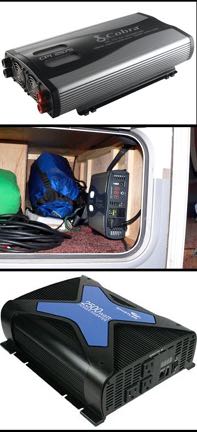
Fortunately, for those brief “I just need a little” times, there’s a relatively easy and affordable answer. Installing a 2000- to 3000-watt inverter will allow you to power anything up to a toaster, coffee maker, hair curler or even the microwave — in blissful silence. Yes, it draws a lot of current from your batteries, but for such a brief time it’s not a huge impact. For a typical two-battery coach-support system, toasting two slices of bread will use about 2 percent of your battery capacity. Running the coffee maker for five minutes will hit you for 3 to 4 percent. Clearly, you can’t be extravagant with high-power devices — but a few minutes a day will not break the bank.
Then there are those long-term needs for 110 volts, like charging a laptop or other device that doesn’t have a 12-volt plug-in charger. For these other low-power tasks, a typical inverter draws only about one-half amp of overhead — so you can run low-power devices that need 110 volts with very little penalty and no noise whatsoever.
Installation is straightforward, but you do need to be electrically handy; otherwise, have a pro do it. Note that this discussion is for a dedicated-outlet installation. An inverter can also be integrated into your overall 110-volt power system, but this is much more complicated (and expensive). With a dedicated outlet, you have to be able to plug your desired device into that outlet (which isn’t all that difficult in most cases).
I found a location near my batteries (short cable lengths), inside a cargo bay. I installed a remote-control panel ($19 extra) in a kitchen cabinet, and a dedicated extension outlet adjacent. I plugged a nightlight into one socket of the outlet, so when the inverter is on the outlet light goes on. All I have to do is plug in my toaster (or whatever) and I’m 110-volt-powered in five seconds. No noise, no warmup, no fuss. I also ran another extension outlet to near the rear bumper for outside power when I need it. My electric chain saw works wonderfully well to cut up firewood.
Modified sine wave inverters in this power class are pretty affordable — Amazon has some for under $100. If you want to run pure sine wave for sensitive electronics, you’ll be in the $200s or more. But the first time you run your microwave to warm up a snack during “quiet hours,” you’ll grin from ear to ear.
Greg Illes is a retired systems engineer who loves thinking up RV upgrades and modifications. When he’s not working on his motorhome, he’s traveling in it. You can follow his blog at www.divver-city.com/blog.
##RVT775