

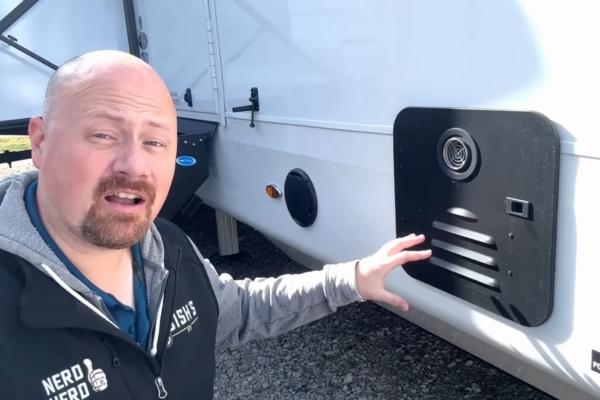
A lot of RV owners think their tankless on-demand water heater is broken, but most of the time, it isn’t. In the video at the end of this post, Josh the RV Nerd says the real problem is simple: Owners were never shown how these systems are meant to be used.
Bish’s RV, where Josh works, gets a steady stream of questions through its tech-help hotline, and the team tracks what people ask. That service, called Bish’s RV Fix Service, isn’t limited to people who bought from Bish’s. RV owners call from all over the country, with all kinds of rigs, and a clear pattern has popped up as more RV builders switch to tankless on-demand water heaters.
Josh points out that the data shows something surprising: In most cases, the heater is working exactly how it was designed. The issue is that many owners use it like a house shower, and that habit causes most of the “it’s not working” complaints.
Common complaints tend to sound like this:
- “It’s not getting hot enough.”
- “It takes too long to get hot.”
Josh’s point is that these are usually user-setup problems, not failed parts.
Busting the big misconception about propane use
Some owners assume a tankless unit sits there burning propane nonstop. That’s not how it works.
Most of the time, the unit is idle. A sensor watches for water flow. When someone turns on a shower or a faucet, and water starts moving through the heater, the burner kicks on and heats the water as it passes through. This is also why many RV tankless systems are propane-only: They need quick heat for a steady shower.
A simple rule helps:
- Do turn the system on and set a target temperature.
- Don’t treat it like a home setup where the faucet controls everything.
The home shower habit that causes cold water and frustration
The most common mistake happens right in the shower. At home, people turn on hot and cold, then tweak both until they find a comfortable temperature. With an RV tankless water heater, that “find the sweet spot” approach can confuse what the system is trying to do.
Josh’s advice is to stop using the shower knobs as the main temperature control. The water heater already has one.
Tankless water heaters respond to water flow. If the hot side is being choked down while cold water is added, the system can struggle to behave the way the owner expects. The goal is consistency: Let the heater deliver the temperature it was set to deliver.
The real key: Set the temperature at the control panel
Josh recommends using the water heater’s control panel as the main thermostat.
At the sink or shower, turn on the hot water knob only. After a moment, check the temperature. If it’s too hot, lower the setting at the control panel. If it’s too cool, raise it. After it’s dialed in, most people stop fiddling with the panel day to day.
If someone really wants a more “house-like” feel, Josh says they can set the heater hotter and add a small amount of cold at the faucet. Most won’t need to once it’s set right.
Quick step-by-step setup
- Turn the water heater on and choose a temperature at the control panel.
- At the fixture, use the hot knob only.
- Adjust the temperature at the control panel if needed.
Hot water delays come from distance, not a bad heater
Even when the heater is doing its job, hot water can feel slow at certain fixtures. The reason is that the plumbing runs inside the RV. If the heater is far from the shower, the line between them may be filled with cooled water. When the heater starts heating, that already-cold water still has to be pushed out before the hot water arrives.
Josh gave an example layout: A kitchen near the rear-mounted heater gets hot water faster, while a front shower takes longer.
Why boondockers may dislike tankless systems
That “push the cold water out” delay can waste water. For campers on full hookups, extra gray tank water is just another dump later. For boondockers, every gallon matters, so the wait can be annoying.
Josh also recommends a shopping tip for the next RV: Look for a layout that places the water heater as close as possible to the shower and sinks. That helps any water heater style.
RELATED
- How to troubleshoot your RV water heater
- RV Tools: Water heater flush wand
- Finding and identifying your RV’s water heater information
- How do I keep my RV’s on-demand water heater from freezing?
RVDT2834
Using only the hot water knob in the shower was a game changer, The down side is that I need to find a new exercise routine. I no longer do the cold water dance exercise trying to avoid those moments of ice water in the middle of a shampooing or rinsing off.
Our shower has a hand wand, so I turn it to the side when I am soaping up. That lets the cold water a few seconds to miss me. It takes some time to get used to it but love it now.
Very counter intuitive. And having to shop for a rig designed around the water heater-likewise. But now I might be able to help people on FB so thanks.
My RV has a Truma Aquago Plus On-Demand Hot Water Heater. The temperature of the hot water is set to 120 degrees F by the manufacturer and can’t be changed by the customer. Not all On-Demand Hot Water Heaters operate the way the article states. The article needs to reference the manufacturer of the hot water heater.
I have a Truma also and you are correct. But there is an Eco mode where it does not heat the water until there is a draw from a faucet OR the temperature gets below 42 degrees. Either way, you cannot control the actual temperature of the water if you want less than 120 degrees.