

By Cheri Sicard
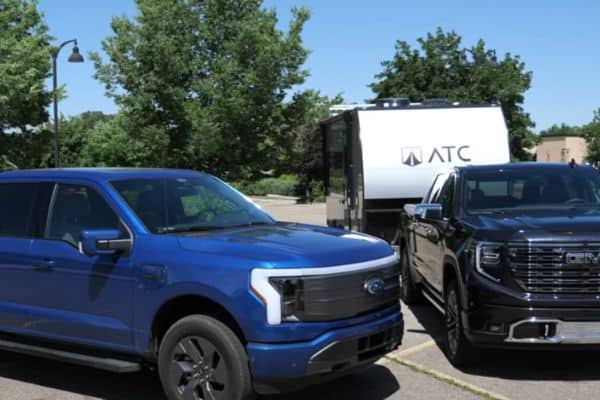
Welcome to the Epic RV Towing Showdown: GMC gas truck vs. electric Ford F-150!
- In one corner we have a gas-powered V-8 GMC Sierra.
- In the other corner is a fully electric F-150 Ford Lightning.
The challenge is to see which RV towing truck goes further on a single charge versus a single tank of gas when hauling identical travel trailers.
The GMC has a 24-gallon tank filled to capacity before starting. Onboard estimation said the truck would go about 264 miles on a tank of gas.
The Lightning started with a full 100% electric charge. Without the trailer, the onboard technology predicted 282 miles on the full charge, but when towing the trailer that estimate dropped down to 160 miles. (Spoiler alert, onboard estimates were off.)
The trailers in question each weighed about 6,000 lbs. The route they traveled was also identical.
The two drivers had cameras and radios in order to document the entire challenge and communicate and compare along the way. So more than just determining which truck will go further, you also get a review of both these popular vehicles, and the issues the drivers faced while completing the challenge.
Get the RV towing challenge results
So, how did these two trucks fare in this RV towing competition? What were the downsides or positives of each method? What kind of features do these trucks offer to make the job of RV towing more foolproof?
All of this along with the winner is revealed in the unique RV towing road trip challenge video below.
The video shows the full details of how this challenge was set up, the difficulties faced and how they were overcome, and which truck ultimately won the challenge.
Related:
High-end RV builder Bowlus takes a look at electric vehicle towing range debate

This proves that EVs are great commuter vehicles but not serious country traveling. The F150 and all the other EVs will work great as long as they’re in an urban area where they’re not asked to travel long distances or do any work. I can see the pickups being used in local businesses like plumbing, electrical, even carpentry. But they’re worthless for towing anything cross country. The F150 started out with the projected range of 300+ miles, after plugging in the trailer dimensions which only takes into account width, length, and weight not the height dropped range to 165. On the road overcoming wind resistance left it barely at 85 miles. This basically is the same as the way manufacturers rate their trucks for towing, loading a flatbed trailer with weight and no accounting for wind resistance. Overcoming wind resistance is much harder than overcoming weight. I can load a flatbed trailer with 5467 lbs of dead weight and get 15 mpg on my Nissan, TT it gets 9.3 mpg.
Practical EV long distance RV use is still 10 – 20 years away, if then. By that time, I’ll be dead or watching the marketing spin from a rest home.
I almost can’t wait to see how the 100% electric choirs are going to go electric with ATVs and Tanks! “Sorry, I can’t make it to the battle. I need to recharge up again,” Also, the federal government stepping in to build charge stations??? Anyone know if the federal government built gasoline and diesel stations? My bet is on NONE.
And who “Built” our roads? Anyone know if Shell or Mobil or any gas company built hundreds of miles of roads? My bet is none.
Roads are built with fuel taxes, something EVs don’t pay. Now some states are adding what you would pay in taxes to your annual license fee, which in some states is all ready high. I would rather pay fuel tax on what I drive instead of paying a tax on what a bureaucrat thinks I drive. I currently drive on average approximately 6700 miles a year in a 45 mpg hybrid, so my taxes are not that high. Here in TN I think the tax on an EV is between $200-$250, with the miles I drive I don’t pay near that much extra.
An Agenda Being Forced Upon Citizens By The WEF… History Has shown, This Will Become Another “Failed Agenda”….
Wasn’t that said to Henry Ford?
No, Roger..
Henry Ford wasn’t selling incapable vehicles. True there wasn’t many places to buy gas then, but you could stop at just about any general store or even a drug store and buy a gallon can of gasoline. Something you can’t do with an EV. These are great commuters, but the infrastructure is not there for long driving trips that don’t go through metropolitan areas. That is the major problem with EV’s, plus the time involved in recharging. With recharging time you could easily add 2-3 hours to a trip.
Haaaaaa.. Loved it. I have a 2016 Ford F250 crew cab 6.7 Diesel, and my trailer is a 2018, 38 foot Keystone Cougar 344 MKS. I average a bit over 1q2 MPG with that unit and have very little invested compared to the ew vehicles in this video. I firmly believe that EV will be the way of the future, but for the present meaning up til about 2050, it is not ready for human consumption, without a lot more research.
A fairer comparison would be a gas powered F150 versus the Lightening. The gas F150 has a 36 gal tank. Far more range than the GMC.
Why? What difference does it make? The end result is electric vehicles are terrible for doing anything but commuting. Apparently you didn’t watch the video as the ford did terrible and the gmc still had enough range left to turn around and return to base.
I see nothing about buying a vehicle that meets the intended use. What happens if you are given $5 and told to “fill it up” and see how far you can go. f350 vs VW Beetle? You can “stack the deck” to get the results you want.