

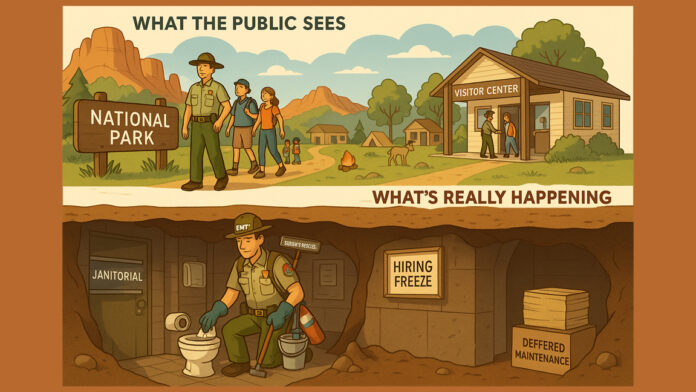
Staffing cuts at the National Park Service have sparked growing concern, but getting clear answers about the extent—and impact—of those cuts hasn’t been easy. This week, Deseret News, a Utah-based publication with a deep interest in national park issues, published a detailed investigation that sheds new light on what’s happening behind the scenes. From overworked rangers to unfilled seasonal positions, their reporting reveals how some of the country’s most treasured landscapes are being managed with fewer hands and stretched resources.
Below is a condensed summary of the Deseret News report. You can read Deseret’s story in full here
National Park Service staffing cuts: One staffer’s experience
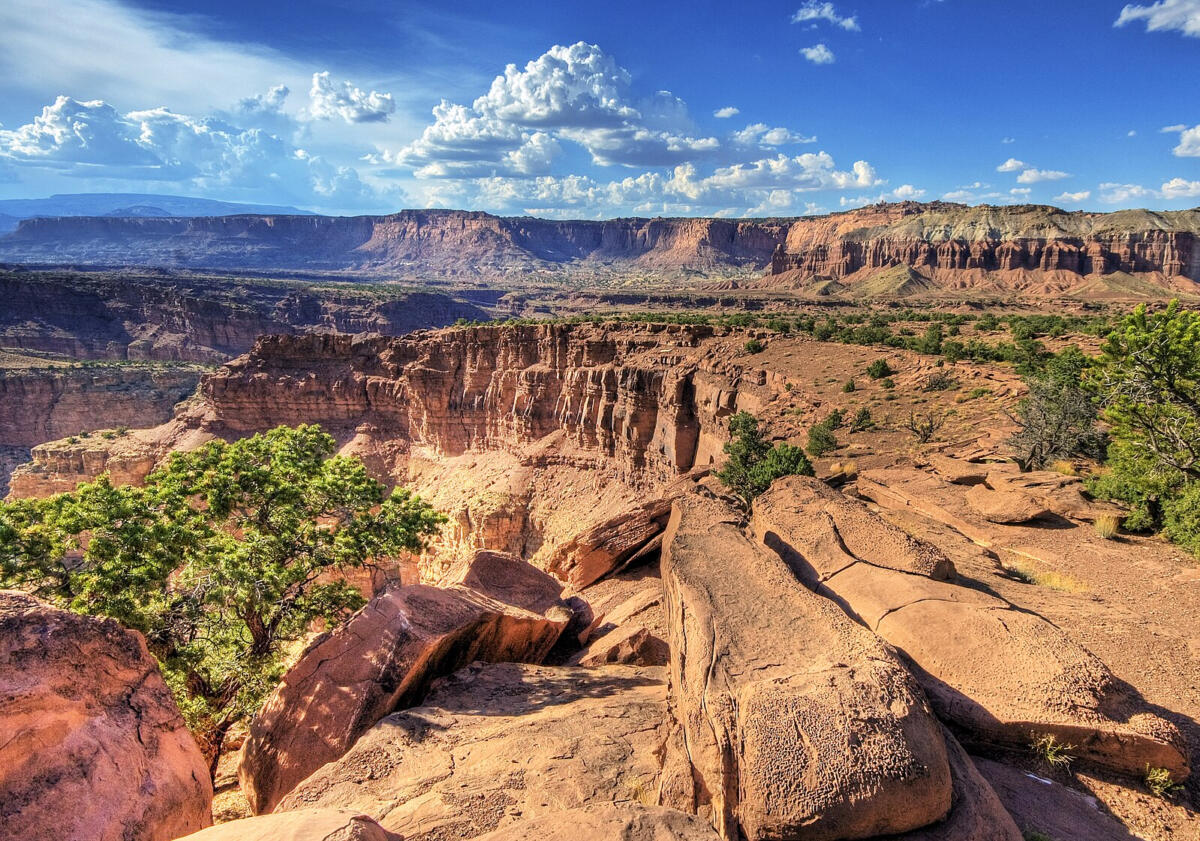
When Sue Fritzke led Capitol Reef National Park from 2018 to 2023, her staff often took on more than their regular duties. Workers were stretched thin, requiring cross-team support to handle a variety of tasks. This multitasking was known as “collateral duty,” Fritzke explained. “You had people that were a park ranger and ‘collateral duty EMT,’ ‘collateral duty firefighter,’ ‘collateral duty everything-else-that-you-could-possibly-think-of,’ even search and rescue,” she said.
Eight employees became certified EMTs just to meet the park’s wide range of needs. Though paid for the extra “voluntary” hours, Fritzke said it wasn’t truly voluntary. Taking on these tasks pulled them away from their main jobs.
“You’re stretching the ability of those staff with all of that collateral duty,” she said. “They need to focus on core duties — law enforcement, fire management, protecting resources, or educating the public.”
But many parks no longer have enough staff even to do that
Fritzke was referring to staffing cuts made earlier this year by the Trump administration. The Department of Government Efficiency (DOGE) carried out layoffs, froze hiring, and offered early retirement options to reduce the federal workforce. Some employees left voluntarily.
How large are these cuts? That’s unclear. The Department of the Interior forbids staff from discussing personnel numbers, and most park officials declined to comment. Grand Teton National Park said its staffing stayed the same from 2024 to 2025.
When pressed, Interior Secretary Doug Burgum’s office said: “It is department policy that we don’t comment on personnel.”
While feds don’t provide numbers, outside groups pull them together
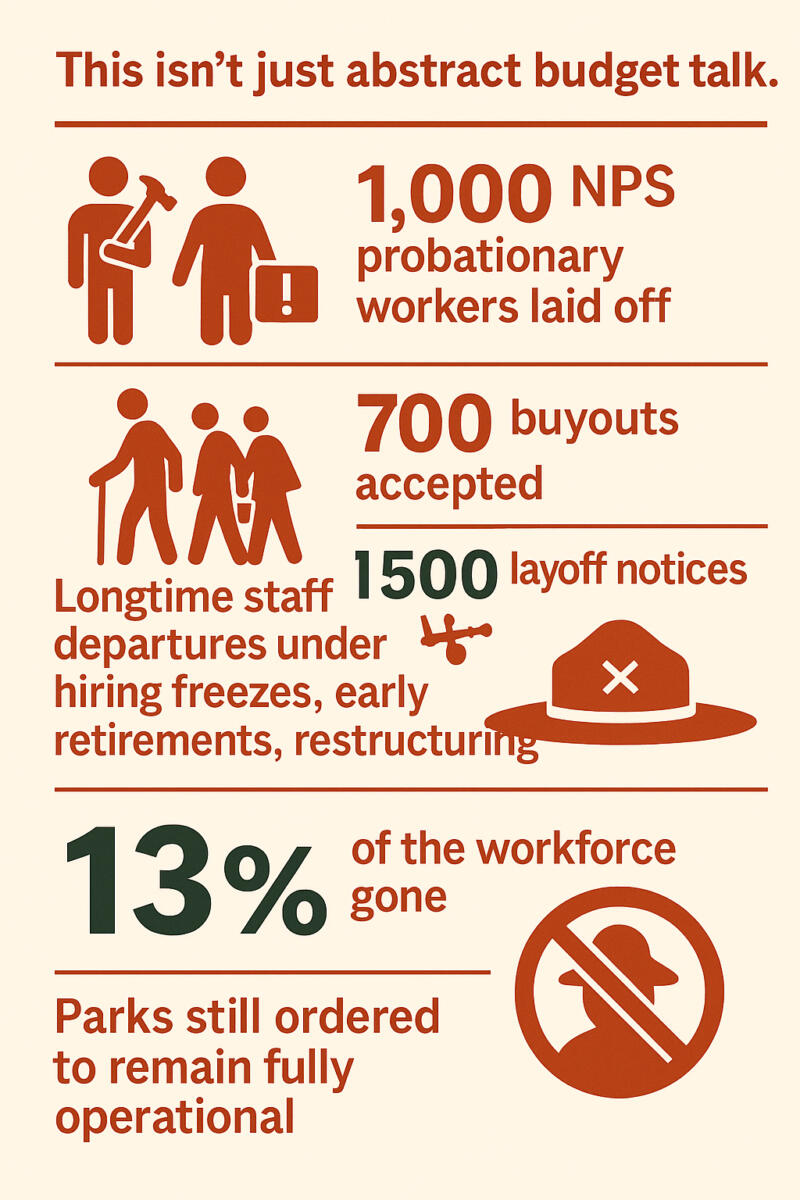
Outside groups stepped in. The National Parks Conservation Association (NPCA) used government data to report that since January, the National Park Service lost 24% of its permanent staff.
Of 8,000 seasonal workers promised this year, only 4,500 were hired. The NPS manages 433 park units, including 63 major parks across 85 million acres. It employs just over 20,000 people, with seasonal staff making up a large share.
“These staffing losses are not just deep, but also indiscriminate,” said John Garder, NPCA’s senior director of budget and appropriations. He said archaeologists, historians, scientists, and more than 100 superintendents—the park CEOs—have left.
Garder warned the problem goes beyond this summer. “The challenge is far greater than that,” he said. “We’re concerned about the long-term ability of the park service to protect these natural and historic resources.”
Fritzke added, “To the public, it looks like everything is fine. Everything’s not fine. There are people cleaning toilets who really need to be collecting data about the resources.”
Neither the National Park Service nor the Department of the Interior would confirm the staffing numbers, and the Deseret News could not verify them. A longtime park employee, speaking anonymously, said the impact varies widely by park. “Overall things are pretty normal this year,” they said.
No parks have closed or lost protections this summer. Some changed hours, but remain open, though at lower or more “efficient” staffing levels.
“Make America Beautiful Again”
On the day the NPCA report was released, President Trump signed an executive order called “Making America Beautiful Again by Improving Our National Parks.” It aims to increase revenue by raising fees for foreign visitors, lowering costs for U.S. residents, and expanding access. The order also tackles years of deferred maintenance—billions in overdue repairs caused by limited budgets.
The order directs the Interior Secretary to fully use the National Parks and Public Land Legacy Restoration Fund, created by the Great American Outdoors Act. This could release $1.3 billion annually for five years to help fix maintenance backlogs.
However, the President’s broader goal with DOGE is cutting government spending by shrinking the federal workforce. The National Park Service had more than 20,000 permanent staff and 138,000 volunteers in 2024. DOGE cut 1,000 employees in February 2025. Some roles—like firefighters and law enforcement—were protected, but most others were eligible for layoffs or buyouts. By May, NPCA reported a 16% loss of personnel, rising to 24% by July. Some laid-off staff have been rehired, but how many permanent losses remain unknown.
The One Big Beautiful Bill Act signed July 4 cut $267 million from the park budget—less than the $900 million first proposed, but still 8% of the budget.
Dollars decrease, visitors increase
Phil Francis, former deputy superintendent of Great Smoky Mountains National Park, experienced similar cuts in the 1990s. Now retired, he chairs the Coalition to Protect America’s National Parks. “I actually have experienced a reduction in force,” he said. “Although I think today is even worse.”
Francis noted that park visitation has grown steadily while funding and staffing have declined. In the early 1990s, parks saw between 255 and 274 million visitors yearly. In 2024, that number reached a record 331 million, with Yellowstone having its busiest May ever.
Before these latest cuts, Francis said, the park service already started each year with a “huge deficit” caused by past underfunding. “Now, cutting employees by some 30% is on top of that.” Garder agreed, saying staffing has been falling since 2010. “Workforce capacity fell by over a fifth in the last 10 years.”
The “collateral duty” Fritzke described earlier is now common everywhere, Garder said. “You have archaeologists cleaning bathrooms because they lost janitors. Law enforcement officers are parking cars because they lost visitor services staff,” he said. “People work two or even three jobs because there aren’t enough employees.”
Despite what visitors may see on the surface, national parks across the country are feeling the strain of deep staffing cuts. Employees are stepping up in extraordinary ways—juggling multiple roles, working longer hours, and doing tasks far beyond their original job descriptions—just to keep parks running. But behind the scenes, the system is stretched thin.
As longtime park professionals warn, the loss of skilled workers and shrinking budgets are not just short-term challenges—they threaten the very mission of the National Park Service to protect and preserve America’s natural and cultural treasures for future generations.
RELATED
- National parks face devastating cuts, with majority in jeopardy
- Interior Secretary orders national parks to stay open amid staffing cuts
- National park visitors face reduced access and services across the country
- 2024 national park visitation reaches new heights; officials told not to publicize
- Interior Secretary discusses National Park Service cuts
RVT1218b

Thank you for trying to attach numbers to the actions, Russ and Tina! The lack of transparency is troubling as it gives rise to numerous and often contradictory “stories.” It seems as though the reductions in staffing coupled with financial initives may be an attempt to substitute capital for labor. I guess we’ll see, maybe. Have a great day and safe travels!
This is great news. Thanks for sharing it, R&T. Keep the “feel good” and the “great news” stories coming.
Happy trails.
Sounds like what happens periodically in any organization, particularly one as bloated as your typical government bureaucracy. Trim the fat, become more efficient with reduced operating costs, eliminate redundancies and come back stronger than ever. People will grumble, quit or simply do their assigned tasks. The key will be to refrain from gaining back the fat…just like dieting. 😉
In the large international I spent nearly 40 years at, this was an annual event. As an employee, you had to strive to continually learn new skills and produce more with less. The bottom 5 to 10% of performers were given the boot each year. Hiring occurred, but on critical projects only.
My brother spent 42 years in the Minnesota State Parks. His main job was leading infrastructure teams building and maintaining buildings & trails. Guess what else. As needed, cleaning toilets, staffing the visitor center desk, EMT, rescue, you name it. So even for Gov’t parks, this is not new.
“juggling multiple roles, working longer hours, and doing tasks far beyond their original job descriptions”
Just like i do in privately owned business.
This is nothing compared to the austerity international bankers will impose should the country default on its debt.
I have a completely different take on this and I’m sure I’ll get a lot of backlash. I live in the midst of the “Mighty Five” and used to visit the parks often. However, in the last 8 -10 years or so, they have become so crowded and overrun, that they have lost their allure to me. I’m just wondering, with this huge increase in visitation, where is all the money from all the extra entry fees going to? I’m sure a lot of people buy the passes, but that’s incoming money also. Honestly, these parks haven’t been kept up for years, but there are always lots of rangers and employees standing around. I think everyone became a little too comfortable with their jobs.
No backlash from me. Nail on the head, Suru.
This is an atrocity. There is no feel good to what is going on. These rangers aren’t paid enough to go through this. Our whole country should be absolutely ashamed of the National Parks being at risk.
The sky is falling (again).
Technology and innovation have helped workers do so much more than their predecessors. Any organization will either need to become more profitable or cut expenses. This is what is finally and rightfully happening in the US Government.