


Tires do not fail because of “magic.” They do not fail because the tire company has a certain ZIP code. In my 50 years in the tire industry, I inspected an estimated 20,000 to 25,000 “failed” tires in my job of doing “Failed Tire Forensics” aka “tire autopsies.”
With my unique background in the tire industry, and based on close inspection of these tires, I was able to identify the basic reason for the claimed “failure” was some external cause or condition. The one exception was a single factory error which I discovered and reported, which resulted in a “recall” of 8,000 tires. In well over 95% of the cases, I was able to identify a specific “root cause” for the tire failure. The vast majority could be identified as being run at lower pressure than the tire needed for the load that was placed on the tire by the owner.
Two basic causes of tire failure
However, tires fail from two basic causes:
- Low air pressure and/or
- Long term degradation of the rubber usually from excess heat.
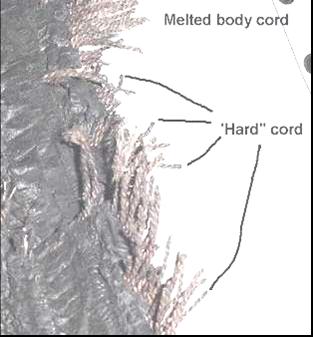
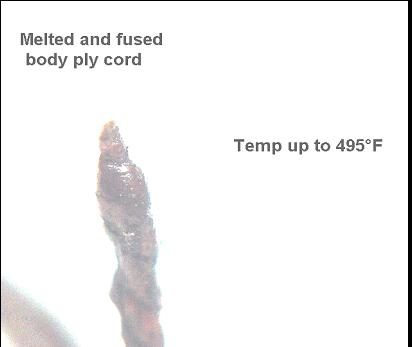
Low pressure (improper setting, or active leak from puncture, or loose valve stem or valve core are most common reasons) can lead to a sidewall flex failure or more commonly called a “blowout.” In extreme cases, the sidewall cord can melt (polyester), as seen here:
or fatigue (steel) as seen in these electron microscope images:
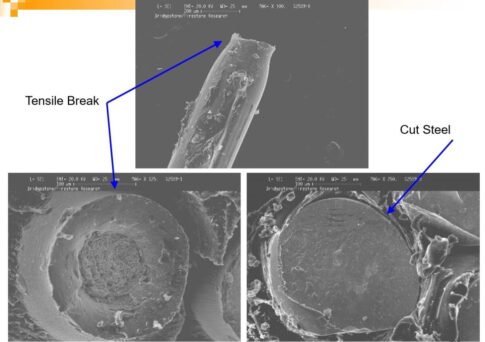
The sample on the top and the left failed from fatigue due to a Run Low Inflation condition. As reference, the lower right shows cut steel.
A tire pressure monitoring system is good insurance
Many travel trailer owners fail to realize that they will never “feel” the results of a tire losing air until it is too late. Then they are surprised when the sidewall “lets go.” The rapid air loss “bang,” even when the tire only has about 10 to 20 psi in it, is a big surprise IF they even hear it. A tire pressuring monitoring system (TPMS) can provide warning of air loss, so is good insurance and can easily pay for itself.
The long-term degradation of the rubber at the edges of the belts can lead to a belt and/or tread separation, as seen in this tire.

Even if the tire keeps its air, you can have this type of failure, so a TPMS will not provide a warning. This degradation comes with age, as rubber is always losing flexibility. Just think of those rubber bands you found in the back of the desk drawer. Even in a cool and dark location, they got brittle.
Causes of increased heat generation in tires
However, running at, near or above the load capacity of a tire will result in increased heat generation. Increased heat actually can accelerate the aging process with a doubling of the rate with each increase of 18 F. Running a margin of at least 15% between capacity and measured load is a good first step. However, running at higher speed will also generate excess heat.
Realizing that more than half of the RVs on the road have one or more tires in overload is one main contributor to the high tire failure rate. Simply thinking that a tire will fail because the tire plant building is painted blue rather than green is not logical.
Buying the lowest-cost “no-name” tires is, in my opinion, a major contributor to poor results. If the main objective is the lowest-cost tire, why would anyone be surprised with short tire life?
Compare warranty and service support
Just paying more, however, is no guarantee of better quality. I believe the best tool available is comparing warranty and service support.
Can you get multi-year warranty on the tires? Is it possible to get road hazard coverage? Is there a nationwide network of dealers who stock the brand you are considering?
One step you can take to avoid a surprise “blowout” on the road is to do a “free-spin inspection,” as covered in detail in this blog post.
Roger Marble
Check out my Blog www.RVTireSafety.Net
Read more from Roger Marble on RVtravel.com.
HAVE A QUESTION FOR ROGER?
Send your inquiries to him using the form below.
##RVT1169

Great article! As a retired rural mail carrier (nearly 1.5 million miles on mostly gravel roads) I wore out and ruined hundreds of tires and after nearly 40 years on those country roads I learned through experience that the information you shared is spot on! As you pointed out, zip code is not nearly the issue that under inflation and age are. The one thing I might add is exposure to sunlight is a huge factor in the degradation of tires, especially trailer tires, they tend to rot before they wear out. Thanks for the great information.
“Buying the lowest-cost “no-name” tires is, in my opinion, a major contributor to poor results.” Winner…winner …chicken…dinner.
With TPMS becoming so mainstream these days, I’m surprised road hazards haven’t displaced the sins of the past
Dont get wrong, improper weight distribution and inadequate pressure management certainly happen to some (maybe even to many) but nobody and I mean nobody is excluded from smacking a pothole or accidentally driving across debris.
”Stone bruised” is a term I learned after driving down I-17 out of Flagstaff…..
As always, great article. I’m sure you have articles about tire buying and date codes. I just got new tires for my truck at Sam’s Club. Not my usual “go to” tire dealer. But they could get the less-than-usual tires I wanted at a good price and at the time they were running a deal for free install. Everybody is charging $20-30+ for installation so they can advertise low prices. The tires came in and I went for an install BUT first I looked at the date codes. I refused 3 out of 4 due to their age. The staff people were great. They sent them back and called their warehouse. Came up with three more that were close enough. I was pleasantly surprised.
Thank you, Roger! 🙂 Our RV came with a tire-pressure-monitoring-system. The sensors are mounted on bands placed around the inside of the wheels. We subsequently added them to our Jeep so that it could be monitored while we towed it. Thanks again, have a great week, safe travels, and safe stays! 🙂