


By Chris Dougherty
It’s something we all dread … the possibility that we’ll be involved in an accident. It’s even worse in an RV when your “home,” whether temporary or permanent, is involved. But, should the event arise, being prepared and having certain things in order can help make a bad situation a little easier.
Safety first
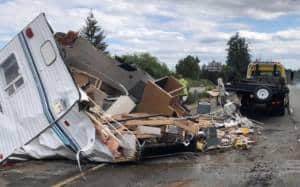 The most important thing you can do is protect yourself. Always wear seatbelts. Any passengers in the coach need to have a seated position with a seatbelt. Keep all items in the cabin of a motorhome secured, as any object can become a projectile in the event of a crash. Of course, never, ever allow anyone to ride in a trailer. It’s illegal in most states, and if you have a crash the trailer will not hold up at all.
I’m always concerned about LP gas being on in the event of a wreck. I don’t recommend having the LP on while traveling unless your coach is equipped with a 12-volt electric safety valve. Make sure the LP gets turned off ASAP if you’re in an accident. If you can’t do it, tell the first first-responder you see. Turn off the generator, inverter, refrigerator or any other power source or auto ignition appliance, as the sparking igniter could light off fuel vapors.
Priorities
Obviously the first thing you’ll want to do is make sure everyone is OK. Don’t panic. Worry first about you and anyone else in your RV. Situational awareness is important. Where are you? What hazards are there? Fire? Smoke? Electrical wires down? Heavy or additional traffic? Call 9-1-1 and get help on the way.
Moving a patient with injuries can make their condition worse, especially if they have spinal injuries. Only move people out of the vehicle if they’re in imminent danger. If you do have to move someone who is injured, do so carefully and keep their head and spine in a neutral position if possible to avoid further injury.
If the accident is minor and there are no injuries, it is best, especially on a busy highway, to walk away from the vehicle and well off the side of the road.
If you are able, make sure any oncoming traffic can see you. Put out safety triangles or flares between your vehicle and the direction of oncoming traffic.
Help yourself by being prepared
Your insurance company and roadside assistance service will help you get settled after an accident. You should have your medical history and medication list on your person so it can be found by first responders. If you have a serious chronic condition, consider having a medical ID bracelet or necklace.
Your cellphone can help first responders make emergency notifications. Program your phone with family and emergency contacts, and put ICE, for In Case of Emergency, as their job title on the contact file. You can also number them in order of importance as ICE1, ICE2, etc. Also, have your RV insurance company and roadside assistance programmed into your phone. In the contact information have all your vehicle information listed, including license plate, policy/contract number, VIN, etc.
Law enforcement will make sure your vehicle is towed to an appropriate facility, and they’ll advise you of where that is. You can get back to it later after you and your family are cared for. If you’re carrying valuables, it’s always best to keep them in a safe. When I was a full-timer I always had two small safes. One was a fireproof document box; the other was a combination safe. There are safes available that can be permanently mounted in the coach if you prefer.
Also very important is your insurance. Many RVers don’t have specialized RV coverage and that is a mistake, in my opinion. RV insurance is written to cover the RV, its contents and special RV accessories, as well as provide you with emergency funds for lodging and a ride home. Also, RV towing can be very expensive, so you want to make sure your policy will pay for your vehicle to be towed.
Personal property rates vary depending on the policy, so talk to your company or agent about what options you have. Many RV insurance policies come with roadside assistance, and I highly recommend it. If you can’t get it with your policy, subscribe to it on your own. Again, make sure it’s an “RV friendly” service.
Whatever you do, wherever you are, if you’re ready, you can survive a disaster! Be Disaster Aware and Take Action to Prepare!
For more information on being prepared at home, school, work or while on vacation, visit Ready.gov.
Chris Dougherty wrote this when he was the technical editor of RVtravel.com.
##RVDT1342

Excellent article. Thanks for posting this.
I have been doing some extensive research with the NHTSA on RV Accidents!
The actual numbers are hard to decipher. But, approximately, 75,000 to 80,000 RV Accidents with Injuries happen each year! Now, this does not include Fatalities, so this is where the numbers get slightly skewed!
The 2 Main Factors for these accidents and there are about 10 Factors, but the 2 main factors are INEXPERIENCE and AGE Related. Which in many cases go hand in hand. Nothing is described about the AGE factor in terms of how old the person or persons were. But, I ran across a little information about those people in the 60 to 80 year old category, as being contributing factors. Those people who have NEVER owned an RV before, Driven Large Vehicles before or Towed Large Vehicles before.
You don’t hear allot about these accidents in the Media, unless it is a major devastating accident!
Safety these days has just gone away! Truly Sad!
Wow, I just realized that this article is a year old.
I believe that the info coming from NHTSA stating that AGE is a main factor in accidents is flawed. I’m more likely to believe that age is a statistic, due to the fact that there are many people in that age group traveling. I do believe that as we age, our reaction time usually diminishes, but simply stating that just age is a factor, NO.
Now, maybe I’m reading more into Jeff’s comment, but I’ve met many RV’ers in that age group who are VERY experienced driving RVs. I would venture to say that many of them can outdrive a commercial trucker. And no, I’m not in that age group, but I’m getting there quickly.
I think you’re on to something, Tom.
“I’m more likely to believe that age is a statistic, due to the fact that there are many people in that age group traveling“.
I totally agree with your assessment. And as a retired trucker with over 30 years on the road, I like to think I still retain the ability to look far ahead and see trouble developing long before your average driver.
One additional comment. We were in an accident that left our RV looking very much like the one pictured at the start of this article. We lost everything. Your suggestions to keep info on your phone only works if your phone survives the accident and can be located. Seat belts saved us. We and our pets walked away with just bruises. Our RV was covered in full but we were seriously underinsured on contents. No one anticipates losing EVERYTHING. We had no RV, no car and no clothing on a Sunday in a very small town in GA. We were lucky enough to find a wallet while they were loading what was left of our RV into a series of dump trucks. Be prepared to front the money for food, lodging, rental cars and essentials. Most insurance policies will not reimburse for replacement items until you supply receipts for the purchase of the item. And read the fine print of those Coach Net and similar policies about transportation home. Most of the coverage is for human airfare…not rental cars and pet transportation. When you can go home…we were a week in a hotel while working with police, insurance and salvage yard before we could head home. It was well over 6 months before the claim was finalized.
Definitely agree with Jeff. Very few people have experience towing trailers or driving large motor homes. They have never driven anything larger than the family sedan. There should be some driving courses for RV drivers, just like motorcycle riders have to have. The RV manufacturers have blocked laws that would call for this training. It might hurt sales of motor homes and 5th wheel trailers.
As the holder of a Class A CDL and have had to go through training to operate commercial motor vehicles, I think RV owners should be required to have training in driving them.
Protect yourself, get a dash camera. It will help doing the reconstruction of who did what. I’m thinking of an additional one for rear/side view.
I recently learned that some roadside assistance policies only cover mechanical breakdowns, not accidents. You should check your policies to be sure you have the towing coverage you think you do.
It seems like it might be time for an Insurance Industry expert write an article about what to look for in an insurance policy or questions to ask. Including how to determine the value of contents to make sure you are covered.