


I’ve been following a forum from one brand of RVs that was discussing a tire that failed. At the end of the thread, one person said the tire was “defective.” I decided to post a generic article on “tire defects.”
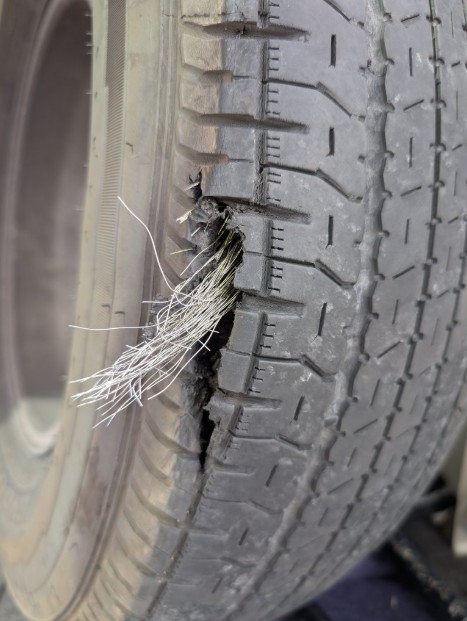
Tire failures
It is easy to claim some “defect” in a tire that has failed, until you are asked to describe the specific “defect.” Having been involved in a number of class-action lawsuits, it is interesting to note how many plaintiffs start with a claim that “the tire was defective.” Yet, when asked for a specific description of what the “defect” was, I usually got the sound of crickets back.
In my 45 years as a tire design and forensic engineer, I have personally inspected and done “autopsies” on many thousands of tires at “end of life.” I have made presentations to many car company engineers who start the meeting with the question of, “What was wrong with the tire?” and end up with an understanding that external actions were usually the “root cause” for the tire’s condition.
There are some tire manufacturing errors
Not all tires are error-free, and I have seen tires with manufacturing errors. In fact, it was my personal inspection of some brand-new tires that resulted in a recall of some 3,000 tires. I was able to identify the “mistake” or mis-production that occurred. I did not simply say the tires were “defective,” but was able to identify the specific mistake and even identify what step in the production process resulted in a group of tires being classified as “defective.”
It only took a couple of weeks to accumulate production data and identify that 86 tires contained the improper rubber compound in a specific location of the subject tires. DOT was notified and they accepted the results of our inspection and analysis and approved a recall.
If I had simply said “The tires have a defect,” it would have been impossible to identify the error and identify the tires that were produced with the mistake.
Tires don’t fail because of “magic”
Tires do not fail because of some “Black Magic.” But if you want to make a claim of some mysterious “defect,” you will probably be mistaken.
If you insist on claiming there was a defect, then, in my professional opinion, you should be prepared to identify the specific error that was made during manufacturing. Or else just say, “It’s magic.”
If you review these posts here and in my blog RVTireSafety.net you will see that I have not made the claim that the tire failed due to some mysterious magical “defect.” I am hoping to educate people on the steps to take to prevent a future tire failure. The “defect” claim helps no one, in my opinion.
Roger Marble
RELATED
- Is a tire sidewall ‘bulge’ a sign of a ‘defect’?
- Is this a tire ‘defect’ or driver’s fault?
- ‘Defective’ tires: Just what is the ‘defect’?
- People still erroneously blame ‘defective’ tires for ‘blowouts’
- RV Tire Safety: Are your tires ‘defective’?
- Do you think tires ‘magically’ fail? Here are some facts
*****
If you have tire questions, check out Roger’s posts on RVtravel.com. There are hundreds of posts covering everything to do with tires.
If you still have a question for Roger after searching the above posts, send your inquiries to him using the form below.
RVT1257

Most of the time the ‘defect’ is caused by user error.
Not checking inflation pressures regularly, “curbing’ a tire when making tight turns into parking lot or driveway and not visually checking a tire for damage.
One of the biggest problems is tire age. Just because the tire looks good, doesn’t mean it’s safe to use. Look for any tell tale signs of cracks around the edge of the rim and the inner edges of the tread.
It’s called, “operator headspace.” Any good Army lt. can tell you what that means.