


Sometimes people apparently think tires “fail” because of “magic.” Or, at least “magic” seems to be the only explanation if you do not understand tire design, materials and engineering.
The real reason for tire failures can many times be traced to a force we Tire Engineers call “interply shear.” Here is a picture of a radial tire that is in the process of coming apart as it fails.
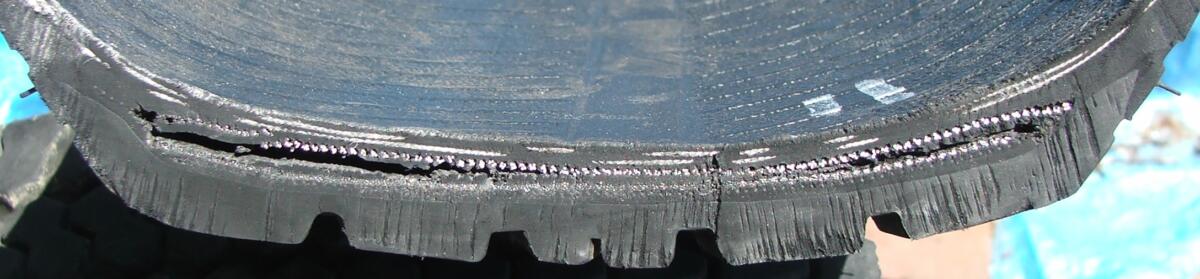
This particular tire was discovered while we were doing a “free-spin” inspection. You can clearly see the steel belts were in the process of coming apart.
Do a “free-spin” inspection on your tires
You can find out if your tires have started to come apart by doing a “free-spin” inspection, as shown in this video. Doing a free-spin inspection would be part of what I would consider a BASIC annual tire inspection of your tires after they are two years old.
You can do this inspection by blocking the tires on your vehicle and applying the parking brake. Jack up one tire and slowly rotate the tire, and watch for “out of round” or “side to side” movement, as seen in the video. Do one tire at a time.
If you see any significant movement, I would consider that tire suspect. I would have it dismounted to confirm and/or replaced, if there was additional evidence of the tire in the process of failing.
It is true that “run-low-sidewall” failure can occur when the load is greater than what the tire can tolerate at the inflation pressure being used. “Interply shear” can occur even when the tire is properly inflated for the measured load.
Rubber in tires loses strength
Rubber in the tire structure loses strength. The RATE the tire loses strength is a function of TIME and temperature, with higher temperature causing faster degradation of the rubber strength. The “shear” or rubber tearing starts at the molecular level and NEVER repairs itself. This tearing will continue to grow until the tire is removed from service.
I have been able to confirm the above, in laboratory testing, by subjecting tires to 100°F with higher than normal inflation. Two tires failed after a few weeks. The failures occurred within hours of each other. It is very rare to get that level of repeatability in tire testing.
Why do tires fail this way
So, the next part is: “Why do tires fail in this manner?” People need to remember that rubber is an “organic” material, so its level of strength includes a “time” function, unlike steel.
Here (pdf) is a reference for how to calculate the strength of an inorganic item like steel. If you look at any of the formulas, you will not see a “T” or Time function. Most materials, like metals or stone, do not change or lose strength as the item gets older, unless we see other degradation or damage being done to the item.
Organics, like wood, plastic or rubber, do lose strength over time. This is part of the reason we see old wood structures falling down, while stone or metal structures can still be used when they are hundreds of years old.
Rubber, as used in tires, is only good for a few years. The time limit gets shorter as we increase the temperature.
I hope this post hasn’t been too technical for you
Roger Marble
MORE POSTS ON INTERPLY SHEAR
- RV tire air pressure – Part 3: Interply shear is why tires fail
- ‘Interply Shear’ and other techno babble explained
- Interply shear – Am I spreading fear?
- Video shows why tire interply shear happens
*****
If you have tire questions, check out Roger’s posts on RVtravel.com. There are hundreds of posts covering everything to do with tires.
If you still have a question for Roger after searching the above posts, send your inquiries to him using the form below.
RVT1265
