


Recently I posted an article about 240 volts present at the interior outlets on Paul’s rig with some information from a couple of electrical experts. I also got a response from Dennis at Progressive Dynamics, whose expertise and opinion I highly regard as one of the best and most knowledgeable in the industry. He must be the best, since most of the time I have no idea what he is saying! It sounds like Charlie Brown’s teacher… wah wah wah wah.
Also, I got an update from Paul and he found the issue.
But first, here is what Dennis had to say:
Info from Dennis at Progressive Dynamics
Hi, Dave,
I read today’s article. It’s not a subject touched on very often.
There is another reason the outlet reads 240 VAC. It does not require any wires shorted together.
In fact, all that’s required is an open neutral wire between the campsite Main panel and the RV Main panel. While operating the RV, the open neutral wire will cause an imbalance between L1 and L2. For example, say we have an operating 120-volt water heater on L1 and a converter/charger on L2 and is only supplying power to a few circuits. The heavier load on L1 will cause its voltage to drop while the voltage on the lighter load L2 will rise.
At the campsite Main panel, Commercial power is brought in on three wires, L1, L2, and Ground.
In the Main panel a neutral wire is bonded to the Commercial ground. From the panel out to the RV, the ground and neutral wires are never connected again. The ground is there for safety and the neutral provides the path for current to return to the Main panel at the campsite. Three wires into the Main panel and four wires out to the pedestal and the RV. Measuring from L1 to L2 will be 240/208 VAC, and L1 or L2 to ground/neutral will be 120 VAC.
All power in the RV is dependent on three wires
All power in the RV is dependent on three wires: L1, L2 and Neutral. An open neutral wire will cause the voltages on L1 and L2 to float when measured to the neutral bus bar as there is no reference back to the Commercial Grid. In the example above, L1 could measure between 120 to 0 VAC and L2 could measure between 120 and 240 VAC when measured to neutral. That is dependent on the difference between the loads. If you add the measurements from L1 and L2 together, the voltage will be 240 VAC, which would be the same as the measurement between L1 and L2. However, if the loads are equal or no load at all, the voltages will appear normal.
Now, if you measure from ground to L1 or L2, the voltage will appear normal at 120 VAC on each leg. This is because the ground wire is tied to the Commercial ground. A measurement from ground to neutral could be a few volts to 120 VAC. Again, this is due to the load imbalance caused by the open neutral wire. “ALL” appliance voltage measurements must be made from neutral to either hot wire for proper troubleshooting.
As to the reader’s clues: The loud “POP” could have been caused from a component failure in one of the appliances. They will want to ensure all the appliances are working properly, including the converter/charger. The EMS previous alarm of P06, L1 below 104 volts could indicate a problem at the pedestal or upstream. Did the EMS have any other previous faults such as L2 above 135 volts? A fault downstream would not be detected by the EMS. —Dennis, Progressive Dynamics
Cause of the issue
I received this from Paul:
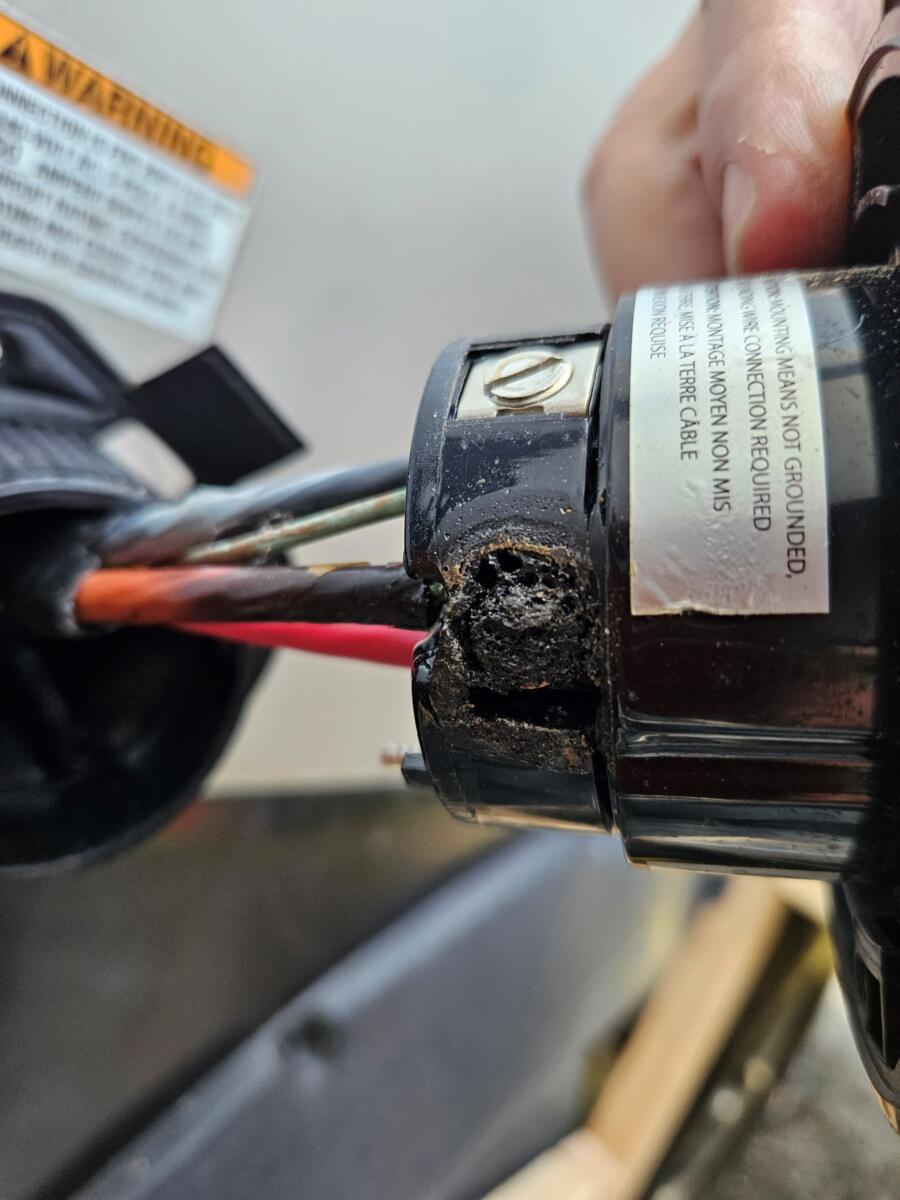
Found the problem—bad neutral. Thanks again for your help. —Paul
You might also enjoy this from Dave
Can I plug into 50-amp pedestal with “Y” adapter to run 30-amp TT and outside heater?
Dear Dave,
If a 50 amp is available at the campground pedestal, it will have “two 30-amp legs.“ is there a dogbone-type splitter that provides two 30-amp female plugs: one to go to my camper and the other to go to an outside electric heater? Or is this not recommended? —Joe, 2024 Imagine 2500RL
Dave Solberg is a leading expert in the RV industry and the author of the “RV Handbook.”
Read more from Dave here.
HAVE A QUESTION FOR DAVE?
Send your inquiries to him using the form below.
##RVDT2535

As always fact based articles. Thanks Dave.
Thanks Dave, good articles.
Our converter died a few weeks ago and we lost all 12v power in the RV. I had the tools and could have done my own replacement, but my time was tight and we needed that converter replaced NOW, so I called a mobile tech service. The 1st thing the tech checked was both ends of the shore power connection. I had also already checked, but was pleased at his approach. It was indeed a dead converter.
Side note: I’ve never had to reset an AC breaker in this RV. The converter was behind the power center. In checking connections before remounting the power center to the wall, we discovered the factory had mirrored left-right so L1/L2 labels are reversed. Relabled.
Thank you for the rest of the story, Dave! Happy new year and safe travels!