


One of our mothers-in-law used to chirp: “You watch the pennies and the dollars will take care of themselves.” When it comes to keeping the rig toasty in cool weather, pennies can add up. When boondocking, there isn’t much choice as to what to heat with—LP is the only game out of town. But in an RV park where you can heat with electricity, is there a situation where shore power might be better? Gas or electricity for heating?
Gas or electricity—in one case, it’s a hands-down
If electricity is included in your RV park rate, then the answer is clear. The least expensive route will be space heating. But hang on, there are some safety caveats we’ll get into a little further down the line. But if you pay for your electricity use separately—as many parks do if you’re staying more than just a few nights—it’s calculator time.
We’ll use a real-world scenario for RVers staying in Quartzsite during the cool, winter season. At this point, the average price of RV park electricity runs somewhere between 20 and 22 cents per kilowatt hour. Propane prices typically range from $3.05 to $3.25 per gallon. We’ll plug those figures into “just how much bang do you get from your buck” for each type of heating “fuel.”
The unit we use to measure energy is the British thermal unit, or Btu. A gallon of propane produces about 91,500 Btu. Electricity produces 3,412 Btu per kilowatt hour. To compare these apples-to-oranges energy sources, let’s convert them both to something more useful—the cost per million Btu.
How the numbers shake out
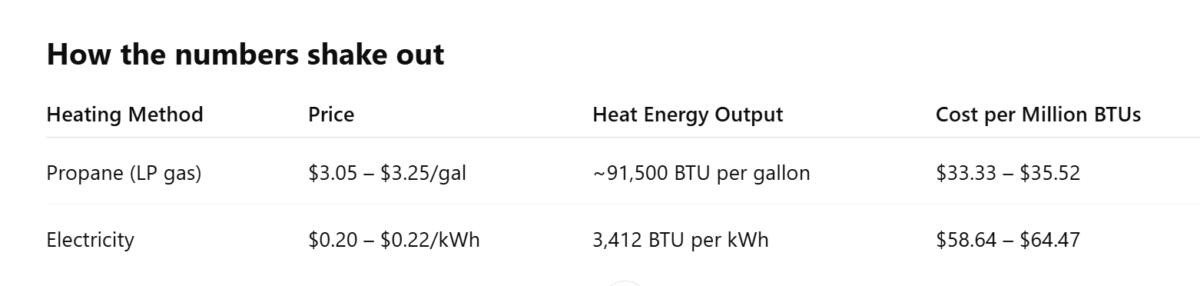
Using real-world Quartzsite numbers, propane is hands-down a whole lot cheaper than electricity in the gas or electricity match. The latter costs nearly 57% more than LP gas. But that’s not the end of the matter. There is the matter of just how you heat with propane. If you heat your RV with the factory-equipped gas furnace, you’ll find contemporary models are around 70% to 80% efficient. That is, around 25% of your heat energy goes outside through the exhaust port.
So, factoring in a 25% loss of heat, then those million Btu would cost about $45.91. Still much less expensive than heating with an electric space heater. We could take it a step further. If you heated with LP, not with a factory furnace but, say, an LP catalytic heater, your heat “losses” would be less. “Cat” heaters range in efficiency from 80% to 95%. (Your mileage may vary. See specific manufacturers’ makes and models.) For comparison, electric space heaters are 100% efficient—every dollop of electricity is converted to heat.
But if you need heat in a hurry
In the gas or electricity scenario, there’s a big “however.” If you want heat in a hurry, and you want it as even as possible throughout your rig, your factory gas furnace wins. It can crank out heat at a much faster rate than cat heaters (or even “Blue Flame”-style heaters), and much more quickly than electric space heaters.
With catalytic or Blue Flame heaters, take into consideration safety. Cat heaters still consume oxygen and produce some carbon monoxide. Both catalytic and Blue Flame heaters need some outside air to be safe—hence, cold outside air coming in. Both types of units get hot and cause burns. They can cause combustibles to catch on fire if close enough.
Electric space heaters can get hot, cause burns, and catch combustible items on fire. A 1,500-watt space heater draws 12.5 amps. If you plug more than one in a circuit served by the same breaker in your RV, you’ll surely trip the breaker. RVs with 30-amp service will find running more than one of these power hogs at a time a virtual impossibility if they want to use other electrical consumers at the same time. NEVER plug a space heater into an extension cord, nor a multi-tap.
Living on the back-achers
Of course, other factors come into play: If you buy your LP “in the park” or delivered, you’ll probably pay a lot more money. But if your back disagrees with the idea of lifting and tossing a big, heavy LP container, electricity may be better for heating, and less need for the heating pad.
Gas or electric for heating? You’ll need to look at your situation and crunch your numbers.
RELATED
- Clip-on fan for Mr. Heater Buddy heaters cuts propane usage in half
- Space heaters under motorhome lead to fiery explosion
- The best electric heaters under $25 for small RVs
RVT1230

Safety hint. Place your space heater on a large pizza pan. Keep combustible items away.
Another factor is whether your LP furnace is ducted to keep your holding tanks from freezing. If it is, heating with electricity could result in frozen tanks on cold nights.
Our primary heat source is a heat pump. Because it pumps in heat from the air, it is 300 to 400% better than an electric space heater. For temps below ~35F the gas furnace augments the space heater.
-35f ? Wonder if that isn’t +35f ? If you have a -35f unit please advise the name and model as I will switch my heating system ASAP. ND is not a warm place in Dec, Jan, Feb!. Heating is a major expense!
~, not – is what Robert wrote.
Ok, Thank you Dan! Looking at Robert’s entry again now reveals the symbol vs a dash. Makes me think it might have been corrected? I perhaps read it too fast as I got pretty excited to see if there was a unit like -35. Anyway, thanks for the correction – appreciate it.
Hi, Doug. No, it didn’t get corrected. The ⁓ (tilde) can mean “approximate”, but it looks very close to the – (sometimes minus), especially when it’s so small (and especially when I need new glasses!). Have a great day. 😀 –Diane
You can get home units that go that low, but efficiency falls off, they’re not much better than regular electric heat, but as you go up from their minimums, they get more efficient.
The campground we use in Texas charges 11¢/Kwh for electric. Propane costs vary but are generally +/- $3/gallon (many places sell propane by the pound, so multiple by 4.2 for gallons). I’ve done the calculations (in fact Dave Solberg published them here a couple years ago). For me electric costs less than propane. However, as other posters have mentioned, some RVs depend on parasitic heat from the propane furnace to avoid water line freeze. We still primarily use propane for heat, for cooking, and occasionally if we need a fast recycle on our otherwise electric water heater.
I wish for a propane fireplace instead of the electric one. Would be very nice when boondocking
I only use electric heat as my motorhome has no propane on board, but if I am dry camping I can use my diesel generator to charge up the batteries and run the electric heater inside. But when in a campground I always just use their electricity.
Cost comparison:
You’re not taking into consideration the fact that RV Gas Furnaces have a flue and approximately 40% of every dollar you put in goes out the flue. In fact if you see on your flue where it turned a little blue or purple and according to the law of physics that doesn’t happen until metal reaches 550 to 600 Deg F. So, when you run a flue gas analysis with the proper test equipment, you’ll find that you only get about 60% of what you’re paying for. If you check the national average for electric rates through the nation, you’ll find that it’s 17.47 cents per Kilowatt ( https://www.energybot.com/electricity-rates/).
SAFETY
For more information http://www.rvcomfortsystems.com to cheat out their trade name CheapHeat System.
We normally use a small space heater and a fan to help circulate the warm air. The heater we use has a thermostat that completely shuts down the heater when temp is reached, and comes back on when needed.
Works fine down to about 45º.
If we have electric included, usual for us, as we are typically short term at RV Parks, 1 to 7 nights. We do a space heater. Also, we seldom camp where it gets real cold, like down into the 30’s. If electric isn’t an option, boondocking, then we use our propane furnace. One other tip I didn’t see mentioned. If it’s pretty cold, have your slide(s) in. RV will hold the heat a little better.
I am a little disappointed that the person that wrote this analysis did not to a better job of researching on the subject before they wrote this article. (See comments in the 2 entries below)
We deleted the furnace and installed a $80 diesel heater.. game changer. Refueling isn’t convenient but its pennies we are counting not sweat drips.
Glaring in its omission are diesel heaters. Economical, efficient, DRY heat, no interior combustion, no interior vapors. Best investment I’ve ever made. Camped on several occasions for 7~10 days skiing in temps ranging from 0~16 degrees F. Interior temps got to 70 degrees +, actually had to turn the heat OFF.
You missed one important note. For those who have a heated underbelly, 40% or so of your gas heat from your furnace goes into the under belly of your camper, not in your living space. So if it is not freezing outside when you run your gas heat, you waste a lot of heat in the under belly. A heat pump puts all the heat into your living space and does not waste it into the underbelly. A heat pump is much more efficient than resistance heating like your fake fireplace..
One caution, if you’re using electric space heat. Keep a close eye on the plug & outlet ,maybe even change the cheap RV outlet to heavy duty well made one. No extension cord. Don’t be that fire….