

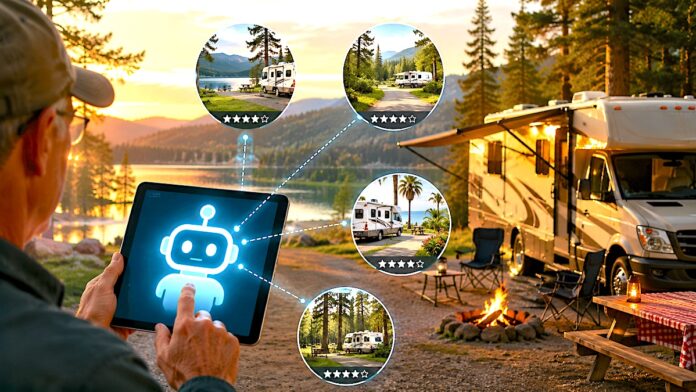
AI is about to change how RVers choose campgrounds. Is your favorite park ready?
For years, RVers have found campgrounds by searching Google, browsing campground directories or reading reviews on sites like Campendium, RV LIFE Campgrounds and Tripadvisor. Increasingly, however, many travelers are simply asking AI.
Questions such as “What’s the best RV park near Glacier National Park?” or “Recommend a quiet campground in northern Michigan with full hookups and shade trees” are becoming common. The answer may not come from a traditional search engine. Instead, it may come from an AI assistant that delivers a handful of recommendations—and often only one or two stand out.
That shift could have major implications for the RV park industry.
A new analysis published by Hospitality Net found that AI-generated hotel recommendations are surprisingly fluid. Researchers at Kollective asked AI systems the same hotel question multiple times and found the top recommendation changed about 45% of the time. Even more striking, different AI platforms rarely agreed on the same “best” hotel.
While the study focused on hotels, many of the findings likely apply to RV parks and campgrounds.
One recommendation could become priceless
Traditional Google searches typically return dozens of campground options. AI often doesn’t.
Instead, an AI assistant may recommend just three to five parks, complete with a short explanation of why they were selected. If an RVer accepts one of those suggestions, every campground left off the list may never be considered.
For campground owners, visibility may become more valuable than website rankings alone.
Reviews matter more than ever
AI systems draw information from many sources, including online reviews, campground websites, travel articles and business listings.
That means inaccurate information, outdated websites or unanswered negative reviews could have a larger impact than they do today.
Parks with consistently strong reviews, detailed descriptions, current amenities and accurate operating information may be recommended more often.
Independent parks could face new challenges
Large campground chains already invest heavily in marketing, search optimization and online reputation management.
Many independent RV parks, by contrast, rely on repeat business and word-of-mouth referrals.
If AI increasingly becomes the first stop for trip planning, smaller parks that don’t actively maintain their digital presence could become harder for travelers to discover.
That doesn’t necessarily mean chains will dominate. AI often favors highly rated niche properties that consistently satisfy guests, regardless of size. But it does mean every campground’s online reputation becomes increasingly important.
AI doesn’t always give the same answer
One reassuring finding from the hotel study is that AI recommendations aren’t fixed.
The same question asked twice may produce different answers. Different AI platforms also emphasize different sources and ranking signals.
That’s good news for campground owners. A park that isn’t recommended today could appear tomorrow as AI models update information and incorporate new reviews.
What RVers should know
AI can be an excellent starting point for finding campgrounds, especially when searching for parks with specific features such as lakefront sites, large pull-throughs or easy interstate access.
But RVers shouldn’t rely on a single recommendation.
Checking recent reviews, comparing campground policies and confirming amenities directly with the park remain important steps before making a reservation. AI can summarize available information, but it can also overlook hidden gems or repeat outdated details.
A new marketing reality
The campground business has already adapted to online reservations, mobile apps and social media.
Now comes the next shift.
As more travelers begin planning trips by asking AI instead of typing keywords into Google, campground owners may need to think less about traditional search engine optimization and more about what marketers now call “AI visibility”—ensuring their park is accurately described across the internet and consistently earns positive guest feedback.
The best campground in town may no longer be the one with the biggest billboard on the highway.
It may be the one AI decides to mention first.
RELATED
- Yosemite campground reservations sold out in minutes. Are you out of luck?
- Some of America’s best-rated campgrounds are still free. Why more RVers may be looking for them
- Campgrounds keep adding amenities. Are RVers getting more value—or just higher rates?
- RVers discuss: Should you pay less for fewer/unavailable campground amenities?
RVT1269b

Aaaaaaakkkkkkkkkkkk! Nooooooo! AI is so often wrong, who would count on it! I tried to set up a trip in Newfoundland with no more than 3 hours driving and seeing sights. It gave me a12 hour drive!
Thank you for the cautionary information, RV Travel. This may have little effect on DW’s booking of campgrounds for us. She tends to use conventional sources and only sometimes does web searches to augment her information. Also, much of our travel is along relatively familiar paths. Still, we will be on our guard. Already, I skip past Google’s AI response to links to actual websites. Have a great day and safe travels!
The funny thing is: When I’m looking for a campground I generally open Google Maps and zoom in on the towns and highways near my desired destination to look for campgrounds from “the air”. They’re usually pretty obvious as I zoom in closer. Then, if Google Maps has a name for one I’m interested in (it usually does), I can often find the campground’s website and check for features, amenities and reviews.