


Dave Solberg is a leading expert in the RV industry and author of the “RV Handbook” as well as the Managing Editor of the RV Repair Club. Today he discusses a leaking AC.
Dear Dave,
I have 1997 Prowler 29S with a single Coleman AC unit, which cools great on the hot days of Texas. However, the unit leaks on the ceiling in the RV when it is running. I have cleaned the holes in the drip pan and tried to level the unit. What can I do to stop the leak? —Shelby
Dear Shelby,
The leak is coming from condensation at the drip pan area, which could be caused by several things. I would start by taking off the outer shroud and the evaporator coil metal protector to see the whole story.

This picture is a Coleman model and it shows the evaporator coil, drip pan, and moist air return opening. This is where the warm moist air from the inside of the rig is drawn up by the fan on the other side of the evaporator coil. As the air is drawn through the evaporator coil, the coolant lines “flash” and moisture is removed and the air is cooled and forced back into the rig on the other side.

Drip pan can overflow
The moisture should collect in the drip pan and flow to the drip rails. However, I have seen some very contaminated drip pans and evaporator coils that would keep the moisture from going to the drip rails and overflow back through the opening.

This is a unit out of an older Bounder that is coated with body powder! I have also seen dog hair and other stuff that get sucked up into this area. You need to inspect this area and clean everything out. Also look for any cracks in the drip pan which would cause a leaking AC.
Inspect inside the leaking AC
If you have ducted ceiling vents, I would also suggest inspecting the plenum (air distribution box) by removing the return air cover and filter to make sure everything is secure and routing the way it was designed. Roof AC manufacturers build a generic model that can be used for both ducted and non-ducted versions and supply a baffle that goes in the cool return air cavity to divert the flow. If this is loose, or cut wrong, it can divert the air back around and it just circulates and can cause all types of issues from inefficient cooling to additional moisture buildup.
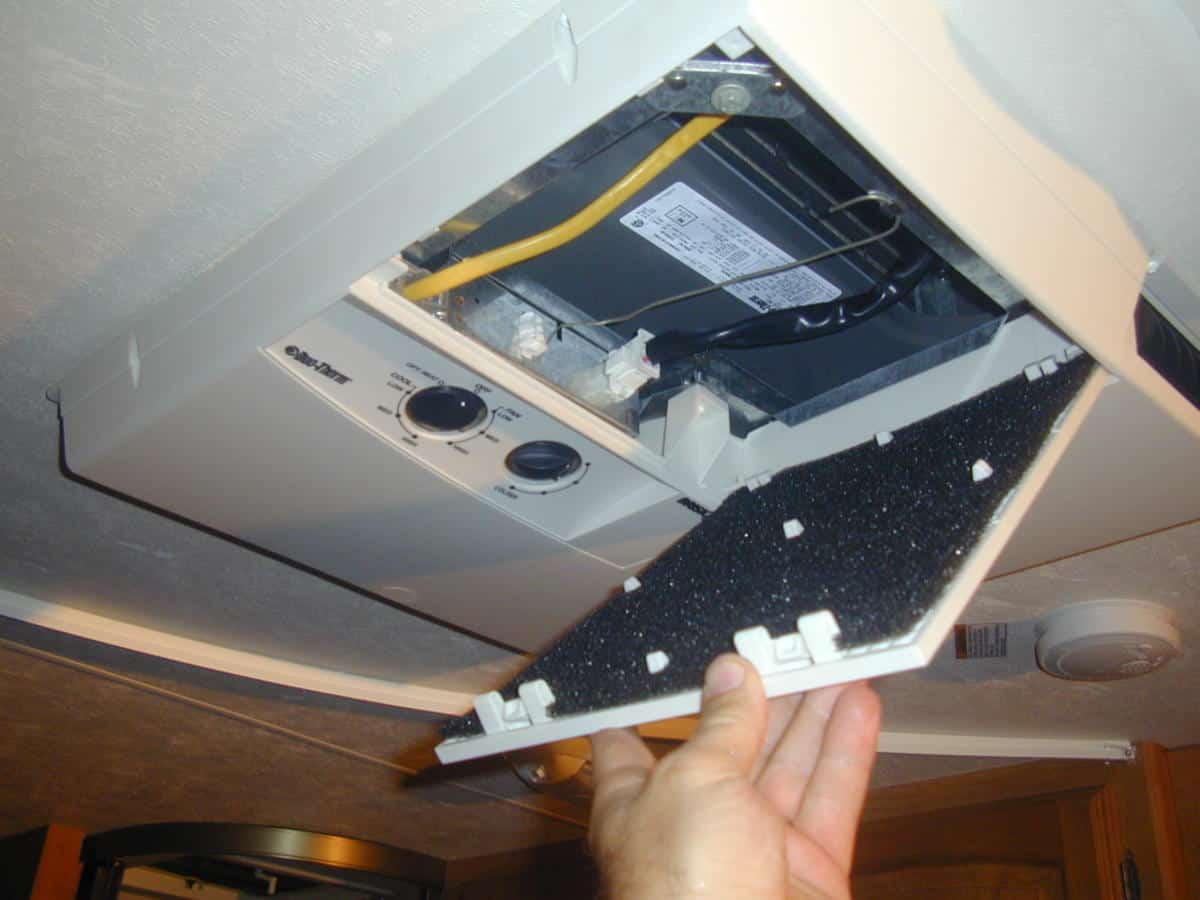

Whichever version you have, ducted or non-ducted, make sure everything is secure and no metal ductwork is exposed. This unit had exposed ductwork everywhere and you can see the condensation dripping down. We covered everything with thin ductwork insulation sheets and eliminated it.
Read more from Dave here.
HAVE A QUESTION FOR DAVE?
We have started a new forum link for Ask Dave. Please be as brief as possible. Attach a photo or two if it might help Dave with his response. Click to visit Dave’s forum. Or send your inquiries to him using the form below.
##RVDT1765


We had a similar leak on the bedroom A/C with ducted air, 2 trips to the local dealer and his service fees didn’t fix it. Finally my son in law and I cleaned the dust out of the drip pan and found a crack in the plastic pan. We cleaned it up with alcohol and applied WATER PROOF epoxy(that’s important) over the cracked area. No more waking up with my feet soaking wet as it dripped on the foot of the bed where I slept. Apparently the dealer didn’t listen when I told him it leaks when it’s running because he removed it and put a new gasket underneath. Then the next time he tightened it down some more, had he started the unit he would’ve seen it only leaked when running. He is now on my black list.
First, and easiest, thing I would do is make sure the four hold down bolts are tight and compressing the mounting gasket sufficiently to keep water from the outside from entering. If the gasket is not compressed enough the condensate draining out from the A/C can flow right past the gasket and into the RV.
Be careful not to overtighten the four bolts for the mounting gasket. I did, and whenever it rained, we had a leak.
In a unit that old, the gasket that the air conditioner sits on (mentioned in the comments below) is likely dried out and cracked. They need to be replaced periodically, maybe every 5 to 10 years.