

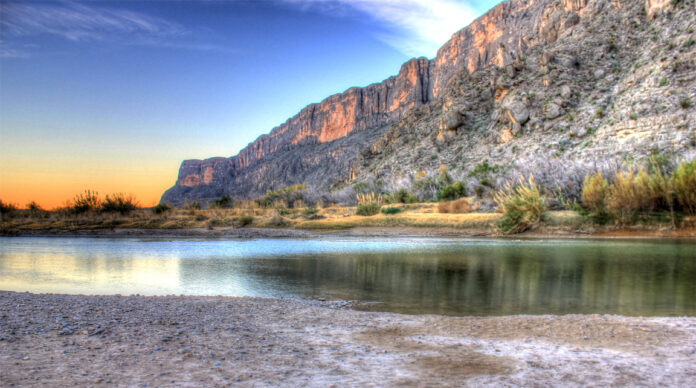
A controversial proposal to build a section of the U.S.–Mexico border wall through Big Bend National Park appears to have quietly disappeared from federal planning maps. It’s an outcome that could matter to thousands of RVers who visit the remote desert park each year.
Earlier federal planning documents from U.S. Customs and Border Protection (CBP) showed a potential wall corridor stretching roughly 100 miles across the Big Bend region of West Texas. The route raised alarms among park supporters, local tourism operators, and conservation groups who worried that a steel barrier could disrupt scenery, wildlife migration, and access to one of America’s most remote national parks.
But a recently updated CBP planning map now shows that stretch of border labeled for “detection technology” rather than physical wall construction. This suggests the agency may rely on surveillance systems instead of new fencing in the Big Bend area.
For RVers planning a trip to the park, that shift could preserve the wide-open landscapes that make Big Bend such a unique destination.
Why the issue mattered to RV travelers
Big Bend draws visitors specifically because it feels wild and undeveloped. The park spans more than 800,000 acres along the Rio Grande, offering long desert drives, expansive views, and some of the darkest night skies in the United States.
Many RVers visit the park during winter months when the desert climate is mild. Campgrounds such as Rio Grande Village and Cottonwood are popular bases for exploring the area, while nearby gateway communities like Terlingua host additional RV parks and services.
Opponents of the wall proposal argued that a large steel barrier cutting across the park landscape would fundamentally change the visitor experience. Some tourism businesses worried the project could discourage visitors who come to Big Bend for its natural scenery and international river corridor.
The Rio Grande also functions as a natural boundary in many parts of the park. In several locations the river is narrow enough that visitors can easily see across into Mexico, creating a unique cross-border landscape that has long been part of the park’s identity.
What the new map suggests
The updated federal map does not appear to show a physical wall planned through the Big Bend stretch of the border. Instead, the area is marked for technology such as sensors or monitoring systems that can detect movement.
Border enforcement activity would still continue in the region. Agents from U.S. Border Patrol already operate throughout the park and surrounding desert, and visitors regularly encounter checkpoints on highways leading away from the area.
Using surveillance technology instead of a physical wall could allow security operations to continue while avoiding construction inside the national park landscape.
However, the change has not been widely announced, and federal agencies have not issued a major public statement explaining the shift. As a result, some observers caution that border infrastructure proposals can change as political priorities shift.
What RV visitors should know
For now, travelers heading to Big Bend are unlikely to see major construction related to a border wall inside the park.
Visitors should still expect a noticeable border-security presence in the region. Permanent immigration checkpoints operated by U.S. Border Patrol sit on major highways leading north from the Big Bend area, where agents briefly stop vehicles for routine questions before travelers continue inland.
Otherwise, the experience of visiting Big Bend remains much the same as it has for decades: long desert drives, remote campgrounds, dramatic canyons carved by the Rio Grande, and vast night skies that draw stargazers from around the world.
For RVers who treasure the park’s quiet landscape, the disappearance of the wall proposal from federal maps may come as welcome news—even if the long-term future of border policy in the region remains uncertain.
RELATED
- 10 best things to do in Big Bend National Park
- Big Bend National Park closes Chisos Basin area, including campground
- Worth a stop: The beautiful painted churches of Texas
- Find Europe in these charming Texas towns
- Texas approves one of the largest RV parks in the U.S. Will snowbirds come?
- Visit Love’s in West Texas; explore Hangar 25 Air Museum nearby
- Palo Duro Canyon State Park: The Grand Canyon of Texas
- Find 12,000-year-old pictographs at this Texas campground
RVT1252b

Good call!
Good, don’t need to spend the money on a wall.
Cartels traffic where deterrence is weakest.
If Big Bend becomes the preferred location, the park will become too trashed and unsafe to visit. The villages on the other side of the border will suffer an equal demise as the Cartels move in to exploit the opportunity. The serenity you’re hoping to protect will be replaced with illicit activities and the “hikers” you encounter on the trail will not share the same purpose for being there.
Not trying to change your mind, just sharing the unintended consequences of “preserving” the park in which the traffickers will exploit.
Have you been to BBNP? Not much of an opportunity even for cartels. The terrain is flat out too remote, rugged, hostile. And huge.
Yes sir. In fact, my commentary comes from a conversation I had with a Texas CBP down there.
How he described the resourcefulness of the Cartels to use the river and remoteness was enlightening to say the least. He said the Coyotes are quite adept at setting up hand off spots, using drones and defeating detection equipment.
He equated it to “whack a mole” and said the last place you or I would consider a drop is usually the preferred place for the traffickers. Maybe I’m gullible but I believed him Jim.
Several years ago, we spent some time in Terlingua and Big Bend where we followed a short trail to the river which was shallow and slow. On rocks were hand-crafted items for sale on the honor system with cans to drop money into. A very small Mexican village was clearly visible across the river and obviously the source of the items. There was nothing we could possibly use but I feel chagrined that I didn’t drop a couple of dollars into a can.
I will be interesed to see the number of RVers that meet up with illegals in the park.
Our national security is way more important than a little bit of a view for you nature lovers. There is plenty of beautiful US to enjoy
In 2024 the government arrested 100 people for illegal entry in Big Bend NP. There are only a couple very remote villages on the Mexican side. BBNP is huge rugged extremely hostile terrain. Very unique. See the post here about hand-crafted items. The villagers cross illegally, place their goods on the U.S. side and go home. I suspect these were most of the 100 arrests. Further, I suspect they were the same dozen people. Last year the government sent 500 guard troops to stop illegal crossings in BBNP, and likely tore up fragile desert environment. How much did I pay for this as a taxpayer for people who were barely inside the U.S. periodically for a few minutes and left the way they came?
First time an RVer, camper gets murdered, raped, etc everybody will be saying why didn’t they build the wall.
Thank you for this, Russ and Tina. DW has expressed interest in traveling to this particular national park, so news of it is especially welcomed. Have a great week and safe travels.