

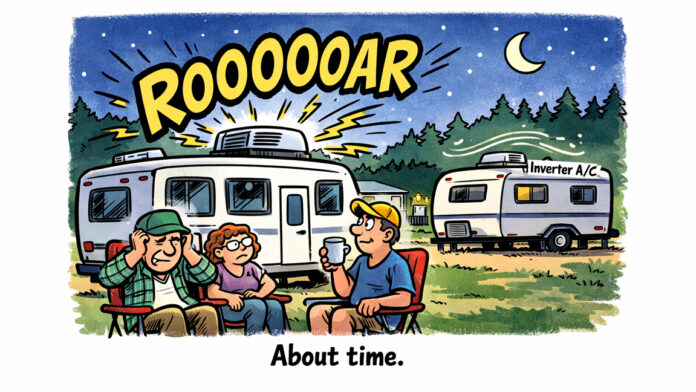
For decades, RV air conditioners have been loud, power-hungry boxes that don’t change much from year to year. If you’ve camped in a crowded RV park on a hot night, you probably know the sound.
Now one small RV builder says it plans to try something different. Encore RV of Elkhart, Indiana, announced it will begin offering the Breezonic rooftop air-conditioning system from Eberspächer on its RŎG and VENŪ adventure trailers.
The system uses an inverter-style compressor—the kind many modern home heat pumps use. That may not sound exciting at first glance. But for RVers who have tried to sleep through the roar of a rooftop A/C unit kicking on at midnight, it could matter.
A familiar appliance that hasn’t changed much
Walk through almost any RV park in July and you’ll see them. That familiar white box sitting on the roof of nearly every rig looks about the same whether the trailer is brand-new or 20 years old.
Inside that box is a design that has stayed surprisingly similar for decades. Most RV rooftop air conditioners use a fixed-speed compressor. When the thermostat calls for cooling, the compressor turns on at full power. Once the temperature drops, it shuts off again and waits for the next cycle.
The system is simple, which helps keep the units durable and relatively inexpensive. But it also explains why many RV air conditioners are noisy and why they pull a big surge of electricity when they start.
Anyone who has tried running one from a small generator—or watched campground lights flicker when several units kick on at once—knows what that startup surge looks like.
Inverter compressors work differently. Instead of switching fully on or off, the compressor can slow down or speed up to match how much cooling the RV actually needs. That allows the system to ramp up gradually and maintain a steadier temperature once the coach cools down.
What Encore plans to install
Encore says it will begin offering the Breezonic rooftop system on its adventure-style travel trailers. The unit delivers roughly 13,500 BTU of cooling, which is similar to many conventional RV rooftop air conditioners.
The system also includes a heat-pump function capable of delivering about 13,000 BTU of heating when the trailer is plugged into shore power. Like many modern heat-pump systems, the Breezonic includes several operating modes such as eco, night, and turbo settings, along with dehumidification and ventilation functions.
Encore says its trailers will still include a propane furnace for colder weather. The heat pump is intended mainly for moderate temperatures when electricity is available.
The company builds its RŎG and VENŪ trailers in Elkhart, Indiana, widely considered the heart of the U.S. RV manufacturing industry.
Why the change could matter
Inverter air conditioners are common in homes and in many overseas RV markets, but North American RVs have been slower to adopt them. The pressure to improve RV cooling systems has grown in recent years.
Many newer trailers now include lithium battery systems, solar panels, and large inverters. Traditional rooftop air conditioners were never designed with those systems in mind, and their heavy startup surge can strain smaller generators and battery setups.
Noise is another frequent complaint among RVers. When the compressor kicks on in the middle of the night, a typical rooftop air conditioner can sound like a small jet engine starting up above the bed.
Variable-speed compressors don’t eliminate noise completely, but once the RV cools down they can run at lower speeds that are noticeably quieter. That could make summer camping a little easier on everyone within earshot.
Can RV owners upgrade their own air conditioner?
The announcement may raise an obvious question for current RV owners: Can you replace your existing rooftop air conditioner with something similar?
A few options are beginning to appear, although choices remain fairly limited. European RV supplier Truma now offers its Aventa rooftop air conditioner for certain aftermarket installations in North America.
The system focuses on quieter operation and improved efficiency compared with many traditional rooftop units. RV owners can learn more here.
Another option sometimes used by RV owners is the Houghton inverter-style rooftop air conditioner sold through aftermarket retailers such as RecPro. Those systems are designed to fit the industry-standard 14-inch roof opening used by most RV rooftop air conditioners. Examples can be seen here.
In many cases, installing one of these systems may require professional installation or compatibility checks with the RV’s existing ducting and control systems.
Some RVers—particularly van-conversion owners—have also experimented with battery-powered rooftop air conditioners originally designed for long-haul truck sleeper cabs. Those units run directly from 12-volt battery systems but generally produce less cooling than conventional rooftop air conditioners.
Cost is another factor. Traditional replacement RV air conditioners can often be installed for around $1,000 to $1,500, while newer inverter-style systems may cost considerably more.
A market that rarely changes quickly
The RV industry tends to stick with components that are simple, durable, and easy for dealers to service. Rooftop air conditioners from major suppliers such as Airxcel and Dometic dominate the market and appear on everything from travel trailers to large motorhomes.
Those systems are designed to fit the standard 14-inch roof opening used on most RVs. That compatibility makes them easy for manufacturers to install and relatively simple for owners to replace.
But the same factors that made rooftop air conditioners so common have also slowed innovation.
A small step, but possibly a signal
Encore is a relatively small RV manufacturer compared with some of the industry’s larger brands, but smaller builders often experiment with new equipment first. Adventure trailers in particular attract buyers interested in off-grid camping, solar power, and quieter gear.
If inverter-style rooftop air conditioners prove popular with those buyers, larger RV manufacturers may eventually begin offering similar systems.
For now, the Breezonic installation represents just one builder trying something different. But in a part of the RV world that hasn’t changed much in decades, even a small change can be worth watching.
RELATED
- What are the three best RV air conditioners? A tech magazine answers
- What to use to power RV roof air conditioner when dry camping
- RV has 2 roof air conditioners, 1 battery. Is this enough power to boondock?
- How can I make RV’s central A/C work better when it’s 115 out?
- Help! My RV air conditioner sounds like a ‘dying cow’
- What to use to power RV roof air conditioner when dry camping
- Why does air conditioner ‘cycle’ several times before staying on?
- When using generator, why does RV roof air conditioner drain house batteries?
- Can we test RV roof air conditioner with 110-volt outlet?
RVT1252b

You know that Lippert/Furrion is already installing this type of air conditioner in thousands of RVs right on the production line and we covered the Furrion Chill Cube here. In fact I have one in my own RV and it’s quiet and I can run it from battery power for hours.
Further Coleman/Mach showed off an inverter-style AC unit at Quartzsite and is on the precipice of offering those to the industry as well.
We took a completely different approach when our Coleman-Mach heat pump-AC had a meltdown. Forget compressor ACs, inverted or not! I replaced it with a $600 12v TurboKool evaporative cooler. We live and RV in the low-humidity SW U.S. for which evaporative coolers were designed. In fact, we have had one, that I installed, cooling our house for 49 years. The TurboKool uses ~4.5 amps, which is far less than our solar panels and 210A-hrs of Li batteries can provide on sunny days.
Steve, as a kid who grew up in the Mojave, I agree with the benefits of swamp coolers for stationary locations but my jury’s out on mobile applications.
How do you keep the water in the pan from sloshing into your rig when traveling or do you drain it first? Also, how do you keep the humidity at the base of the cooler from rotting your roof opening?
The Furrion chill cube has an inverter compressor and is available now. Brinkley and many others are offering this as standard equipment.
We have a Coleman Mach paired with our 1000 watt solar/lithium battery power supply system. It’s like pairing a carbureted engine with a Tesla. That AC is loud and inefficient and makes our cutting edge off grid system struggle. I hope to upgrade to something better soon but want to make sure of new AC reliability first.
Thank you for the information, Russ and Tina. Have a great week and safe travels.
As Tony Barthel and others have stated, the Furrion Chill Cube is an inverter Air Conditioner and is currently available.
The RecPro RP‑AC3800 RV Air Conditioner is not an inverter-compressor air conditioner. It’s a traditional single-speed compressor rooftop RV AC (similar to Coleman, Dometic, etc.), although it’s often marketed as quieter and more efficient than older units. RecPro does make an inverter-style RV air conditioner, but only in their 48 V DC models, not their standard 120 V rooftop units.
The Truma Aventa series is one of the highest-quality rooftop RV air conditioners, but it is not a true inverter-compressor system. It uses a conventional fixed-speed compressor.