

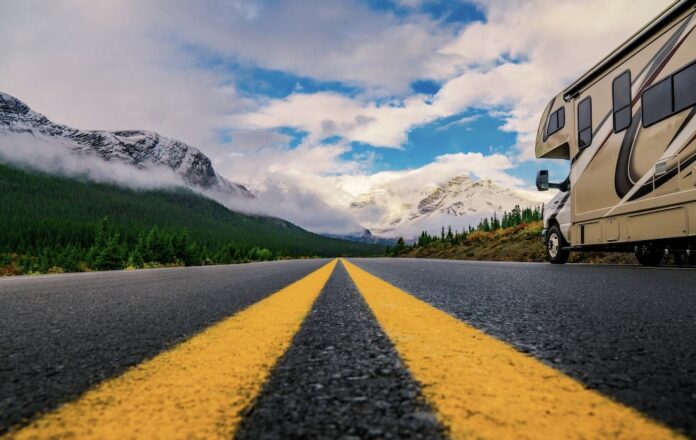
If you’re an RVer, blue highways may be best for you. What are “blue highways”? Read on to find out!
A bit of history
The term “blue highway” originated from early Rand McNally atlases. The map company noted smaller secondary roads using blue ink. On maps today, these roads are shown using a wide range of colors—not just blue.
The phrase “blue highway” became more prominent after William Least Heat-Moon published his book Blue Highways: A Journey Into America (1982). The book became a best-selling travel memoir. It tracked a 13,000-mile trip on those quiet, out-of-the-way routes and turned what once was cartographic color into a way of traveling and seeing the country.
Today’s blue highways include state and county roads. Most of these roads are well-maintained and experience much lower traffic volumes than interstate highways, which were built to transport vehicles quickly and efficiently across the nation.
Changes
Blue highways aren’t marked blue on most maps now, and traveling them has changed, too. Numerous blue highways have seen major upgrades. For example, the Avenue of the Saints that runs north from St. Louis, MO, to St. Paul, MN, used to be a two-lane road. Now it’s a well-maintained, four-lane divided highway.
Pros
For RVers, the blue-highway approach to traveling can offer them a very different kind of trip. It can turn a drive into an experience and change the way they see the country. Here’s how and why it often makes sense for RVers to travel the blue highways.
• More scenic, varied landscapes and small-town charm. Blue highways often pass through rural terrain, woods, and lesser-visited stretches of the country. Instead of high-speed monotony, you get to experience farmlands, old towns, country stores, and quiet rest stops. You’ll rarely find these along interstates.
• A slower pace and less stress behind the wheel. Driving on smaller roadways generally means less heavy traffic, fewer semis, and a more relaxed speed. For many RVers, it means fewer stressful lane changes, along with less constant acceleration or deceleration. Some see it as an easier, calmer way to handle a large vehicle like an RV.
• Greater access to unique, authentic stops. On blue highways, you’re more likely to pass through small towns, experience roadside diners, and visit local shops. Chances are good that you can also see historic villages and other hidden gems, which offer a travel experience rich in local character.
If you only travel on interstates, you’ll miss out on visiting many of those places. Heat-Moon’s own journey highlights how much life and culture you miss when traveling only on the fast lanes.
• Potential for better camping experiences. Less-traveled roads can make it easier to find more peaceful campsites, small state or county parks, rural campgrounds, or even pull-outs where you can park and enjoy a slower tempo.
For RVers looking for solitude and stars overhead, the backroads often offer some of the most relaxing and memorable stays.
• A chance for immersive travel. Traveling the blue highways enables RVers to engage with local people, history, and unique places. The slower pace and local-road rhythm invite conversations, rewarding detours, and discoveries that don’t always fit an interstate schedule.
Cons
Not all RVers prefer blue highways. Here are some of the reasons why:
• Some backroads may be narrow or rough. Not all blue highways are smooth ribbons. Some might be potholed or poorly maintained. Handling an RV on such roads can be tricky and uncomfortable.
• Potential issues with clearance, width, and safety. Older roads might have tight curves, small tunnels, or old bridges. They become dangerous when you’re in a long or tall motorhome. What’s fine for a car might be a headache or hazard in an RV.
• Fuel, services, and amenities may be sparse. Smaller roads and rural areas often mean fewer gas stations, fewer repair shops, and long stretches without services. This can be a challenge when you drive something big that needs special attention.
• Slower progress. Taking the backroads almost always means you’ll cover fewer miles per day compared with interstates. If you have limited time or a tight schedule, this might frustrate you rather than feel relaxed.
• Risk of the unexpected. Some backroads may be unpredictable. Detours, sudden dead-ends, or poor signage can be more common than on interstates. You’ll want to be prepared to adapt or backtrack.
Tips for traveling on blue highways
If you decide to embrace the blue highways for your next RV trip, a few tips can help make it worthwhile:
- Know your rig’s exact dimensions and capabilities.
- Check ahead for low-clearance tunnels and narrow bridges.
- Map out fuel and service points carefully before you set out.
- Build in flexibility. Be ready to slow down, detour, or even turn around if needed.
- Check official state or county travel sites for conditions and vehicle restrictions before you go.
Are blue highways best for you? Tell me using the comments below.
RELATED
- The best interstate routes for cross-country road trips rated
- 5 beginner tips for planning a cross-country road trip
- 7 easy ways to save money on a road trip
- Book review: ‘Are We There Yet?: Family Road Trip Guide to America’s Roadside Oddities’
- Visit America’s weirdest small towns on your next road trip
RVT1243

Got to love Blue Highways. You get to see the Real America. Interstates can be mind numbing boring. For a Class B or C, they present no real major problems. Just don’t speed, some small police forces act like sharks going to blood in the water.
We prefer Blue Highways when towing our travel trailer for all the reasons you listed. We rarely have any issues with these roads in the Northwest. But, one “state highway” got so narrow there was no center stripe (or guardrails) for about 10 miles and fortunately we only had about 2 cars coming the other way during that white knuckle stretch of road.
Years of working on the road leave me getting off an interstate as quickly as possible, no plan, no timeline, just going somewhere at an easy pace
Leave the interstates for the truckers. As long as the speed limit states at 70-80mph. I will travel the blue roads.
While all this is true, (beauty, scenery, etc.), we’ve had more scares happen off the interstate than on. Inattentive drivers popping out from rural side roads, deer, farm equipment at 5 mph just around the bend and so on. In fact, our only accident in 10 years resulted from a work truck blowing through a red light at an otherwise unoccupied, rural intersection. It’s worth it, but it still requires a high level of attention to hazards. Our many thousands of miles on interstates, while harrowing at times, have been incident free.
Many of the eye-dash-hell highways run somewhat parallel to the older U.S. and State highway systems. Most also run through highly urbanized areas with heavier traffic. We use interstate highways only when other routings are less practical. Our semi-annual N-S migration of almost 1700 miles uses less than 50 miles of interstate highways. 350 miles a day. Beautiful landscapes you can actually take the time to enjoy rather than tensely watching traffic, painted lines and bill boards.
Fran and I are the caretakers of a 1968 Ultra Van and we take blue highways even when it takes more time and is out of the way! We do this for the reasons stated in your article and because we travel at a slower pace than most people. We keep our speeds at 55-60 and enjoy the scenery because we know we may not pass this way again. By the way you can find out more about Ultra Vans at http://www.ultravan.org
One additional benefit of “blue highways”: Fuel prices are often cheaper than those at interstate interchanges.
We prefer blue highways for all the positive reasons mentioned. Add a sense of extra safety since we are not driving with semis going 75 mph. Top choices:
Highway 50 through Nevada rather than Interstate 80 when traveling to and from CA; or Highway 36 from Hannibal to Denver rather that Interstate 70 when traveling from St. Louis. Note Google Maps makes finding blue highway alternatives extremely challenging, if you want the benefits of highway driving in larger urban areas. I find that I have to plug in several cities along highway 36 before google will give me directions on that highway, and I have to do the same to get the program to map highway 50 in Nevada.
Our major reason for using U.S. (blue) highways is speed. I only drive 62-65 mph because it is the most fuel-efficient speed in our diesel Class C. So, blue highways with 60-65 mph speed limits make it easier to travel at the same speed as the majority of the generally light traffic. That speed is easier to stop in an emergency, especially in rural areas. On Interstates, that speed range also makes it easier to for RVs to stay with the trucks in the right lane without needing to pass. Having had a driver’s license before most Interstates were completed also means I “grew up” knowing how to pass on 2-lane roads, without needing an Interstate to get from Pt. A to Pt. B!
In 2024, on our trip from MN to the OR coast, we mostly used U.S. and state highways meandering across Montana, Washington, and Oregon. Last year instead of Indiana’s horrible I-90 “stop at all toll booths” tollway, we came back across U.S. 20.
In the past we’ve used interstates more than secondary roads, but more and more now, going slower and traveling fewer miles per day, U.S. and State Hwys will get much more of our attention. 👍
Amen! You’re truly preaching to the choir. The only area of the country where you just have to suck it up and drive the slab is heading to Maine from the south. There are options but mostly the option is narrow windy roads with low speed limits and one small town after another. Turns a five hour trip, albeit sometimes a moving parking lot, into at least two days.
I have a 40′ DP and love to “See America”…and the interstate system is not “Seeing America”. Even in our big beast towing a car, we rarely have problems. Get off the interstates and explore the real America and the real American people.
Just as the interstate system was completed, with no stop signs or stoplights, one commenter said, “You can now travel the US coast without seeing anything.”
Coast to coast
Another plus is those roads are often in much better condition. We try to use the U.S. Highways, if we don’t use the Interstate System. When we leave home in Spring Hill, FL and head straight N or out to the W, we take US 19 up to I-10, just E of Tallahassee. We’ve driven US 287 from the Ft Worth area, up to Amarillo, several times. Also US 98/49 from Mobile, AL to Jackson, MS several times.
We love the slower pace of the blue highways and all the interesting little towns along the way. Only drawback is missing the State Welcome Centers, where the attendants are often full of interesting places to visit and are happy to chat.