

By Gail Marsh
Off or on? That seems to be the question RVers face when it comes to travel days. Do you keep your RV refrigerator on or off while traveling down the road? This was the latest topic for discussion around the campfire.
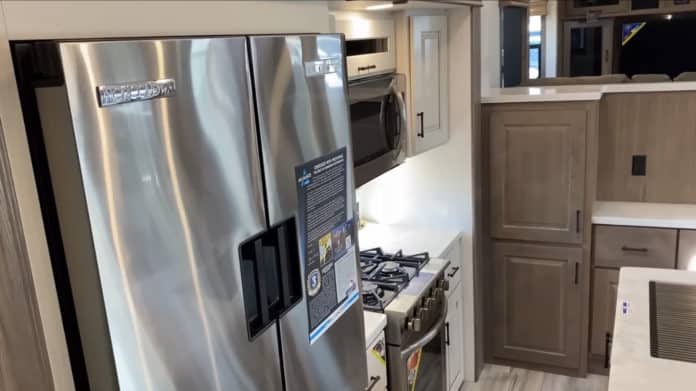
Residential model
Dave began, “We have a residential refrigerator in our rig. We keep it on while traveling because we always pack food along. We like to enjoy a cold one after we get set up at the campsite.”
Sharon agreed. “Our RV also has a residential fridge,” she said. “On long travel days, we keep it turned on. On short travel days, it doesn’t really matter. The food I pack inside the fridge is cold to begin with and the fridge will keep it cold for a short length of time even when it’s turned off.”
Marty spoke up in dissent: “I’ve learned the hard way to keep food inside a cooler until I set up at a campground. Stuff inside the refrigerator can bounce around on the rough roads, no matter how carefully I pack it. Broken glass and spills make an unnecessary mess to clean up. I see no sense in taking the risk.”
Propane RV refrigerators
“I think RV propane or absorption-type refrigerators need special consideration,” Mary offered. “Our Dometic manual says the fridge must be kept level or nearly level. If you travel uphill or around curves while in transit, couldn’t that damage the refrigerator if it was turned on?”
“I don’t think you’d hurt the unit,” Dan said. “I worry more about safety. If your propane is turned on and someone hits your RV, there could be significant damage! A spark could trigger an explosion or fire. No one wants that!”
Mary questioned, “Isn’t it against the law to travel with your propane turned on?”
“It can’t be against the law,” Dan countered. “There are vehicles on the road today that are fueled by LP!”
“But couldn’t propane lines jiggle loose when in transit? Especially on some of the rough roads we’ve traveled over!” Mary replied. “A propane leak inside the RV is also dangerous. I’m playing it safe and keeping my fridge off when we’re in transit.”
Dan shrugged. “To each his own.”
Traveling with an RV refrigerator conclusion?
Our campfire discussion didn’t reach any definitive conclusion. The next day I found an article I had forgotten about that Dave Solberg wrote. Read what Dave has to say about driving with propane fridges on.
##RVT1088
To each their own is right. What ever makes you feel comfortable. The article only mentions the fridge being off. Does it assume the entire LP system is off? Personally I leave mine on and have for years when travelling (except for fuel stops). I would assume that while the fluid is moving around in the absorption coils any areas of buildup in the coils would be loosened and maybe prevent the buildup of hotspots.
Have to agree.
The expression used to be ‘to each his own’, but the gender neutral stuff turned it into ‘their’, which is plural.
So?
Their is single or plural, depending on context.
I used to put a block of ice in my Propane fridge in a small plastic tub, along with my food, and leave propane off till I got to camp. I’ve seen too many fatal accidents. I can see both sides of the story, including how long food will stay cool with propane off. However, now I have an electric residential refrigerator and travel with it on. Less hazard, and is why some manufactures are only installing the residential 120V refrigerators, using the inverter while traveling, making it safer.
I worked for the Indiana State Police for several years and saw a lot of fatal accidents but never saw one caused by an LP refrig running in transit.
No. They are installing residential fridges because that is what the buying public wants. RV type fridges are old tech and don’t cool well. There is a reason they are called Nevercold.
We turn off our frig (Propane type) when traveling for the day. Simple reason – the frig stays cold enough for the 5 or 6 hrs we are on the road and we don’t want to run the risk of anything going wrong due to the motion of the rig while we are traveling. This may be overly cautious, but if it isn’t needed, why run the frig?
Compressor frig, 12v. I never turn mine off, ever. In my class B, solar and frig are always on, whether plugged in or not. Never have an issue.
Before our RV fridge died and we replaced it with a 120v ac fridge, I used to run the fridge on the ac side when traveling. Worked fine. When the fridge died and we couldn’t find another RV fridge available nearby (and it was 106 degrees in Houston that day!), we bought a perfectly sized 120v ‘residential’ type. It was only $450 compared to $1000-1500. Got it installed and couldn’t be happier. I’ve tested it running on battery and inverter power and don’t see that there will be any problems when traveling or boondocking. We’re actually glad the old one (10 years old) died. This new one is actually much bigger inside, and ice doesn’t stick together or form clump ice – ha.
Tommy, what is the type and specs for our fridge?
It’s a Haier fridge. We bought it at Lowe’s.
9.8-cu ft Top-Freezer Refrigerator (Black)
Model #HA10TG21SB Item #970843
2.5 amps Defrost power 145 watts
If you go to Lowe’s website, you can put this info in and the fridge will show up.
Hope this helps.
Here we go again. I run my fridge on LP when traveling 40 minutes to our favorite camping spot. The LP tank has an excessive flow restrictor if the hose is severed . The gas tank of my tow vehicle has 18 gallons of extremely flammable GASOLINE in it and I travel with it pretty much full. I personally have never seen an explosion of LP gas on a travelling RV even though I know it has happened. I have seen more accidents involving stupid drivers will Cell Phones in their face than RVers so lets put this in perspective.
The last couple of trailers that I’ve had have the propane line running along the side of the wheel wells on one side. If a tire blows out, the propane line will be a part that can be torn open, and result in a fire, if the propane tanks are left open.
Part of my pre trip inspection is making sure that I’ve turned off the tanks. As soon as I stop for the night, I open the tanks.
The difference with lp powered vehicle is that there is no open flame, not much different than a gasoline engine.
LP is on while traveling in our 21 foot camper. We have a full height RV AC/LP refrigerator & freezer. In addition to touring, our camper is used as a ‘rolling hotel room’ for our semi-annual north-south migration (we have a house in the north, and a larger RV TT in the south). This means we often have road days in sub-freezing temps.While we can run electric heat when on shore power, we need that LP furnace to prevent water system freeze and damage while driving. And for other parts of the trip, we want to make sure items in our freezer don’t start to thaw as repeated freeze/thaw will damage many foods.
The camper’s LP line is next to the inside of the frame. Other than the rubber connection to the regulator/tank, it is all rigid line. I view the risk as no greater than the tow vehicle’s fuel line between tank and engine.
The thing I hear is you have to turn it off before entering a gas station. To those of you who drive with yours on raise your hand if you stop down the street from the gas station and get out to go turn the propane tank at the valve. If you have brought it up to running temp. before loading it and you stick a couple of frozen water bottles in will still have a cold fridge when you arrive if you don’t keep checking to see if the lights on.
I admit I never turn it off, although I rarely fuel up with the rig attached.
I turn on the refrigerator the day before traveling so that it’s cold. On the morning of travel, I fill it with cold and frozen foods along with ice and those refreezable blocks. Then I turn off the refrigerator and propane just before leaving.
The refrigerator is then like a big cooler until we arrive at our campsite and turn it all on again. This works well during weekend and week-long trips.
I keep refrigerator/freezer thermometers in each compartment to be sure that the temperature is below 39 degrees in the refrigerator and below 30 degrees in the freezer.
I set mine on auto when I open the trailer up in the spring and do not shut it off until I winterize in the fall when everything comes out of it.
Both our RVs were/are all-electric. We leave the power to the refrigerator “on” while we travel. I never considered flipping the breaker on the circuit for the refrigerator to “off” before traveling, nor will I. We have never had a problem with the contents of the refrigerator being unduly disturbed during/by travel.
After having our residential fridg repaired($287). Our technician stated that it should be left on always, just like in your house. The turning off and on causes the control board to heat and cool causing corrosion on the circuits, thus they will fail as ours did. It’s been on for the the last three years trouble free. Now while traveling we have an inverter, we will not run it for the first three to four hours and it stays cold inside, any longer, we turn it on and run off the inverter until we get to our next stop where we can plug in to shore power.
We have the propane refrigerator and we leave it on while traveling.
When we traveled in our prior motor homes with typical RV absorption fridges we gave a second thought to shutting down the fridge while on the move. Why have one if that was the case? Now with our DP and a residential fridge being powered by a 2000-watt inverter that conversation has become moot point for us.
I will NOT take the chance to leave propane on while traveling. I watched a TT burn on the side of the road once, on I40 in New Mexico. Not pretty. The owners were hysterical as there was nothing anyone could do.
My MH was made in 1977. It has the original Dometic 3-way fridge which still works good. I shut off the propane tank and switch it over to 12 volts when I’m traveling.
In 40 years of RVing with a propane fridge we’ve always turned it off while moving .. whether travelling in 90°+ weather or changing campsites. We’ve seen too many ash piles and charred pavement spots on the side of the road to do otherwise.
Always had cocktail ice and cold beer out of the fridge even after 6 hours or so of driving.
Most of those ash spots are from a malfunction under hood .
Off, too dangerous to run with it on. I don’t drive more than 3 to 5 hours anyway, so it’s not going to get hot inside the fridge. I also shut off the main valve on the LP tank always. I have a gas model motorhome and I need to shut it off anyway when I get gas.
My secret to the RV fridge is frozen gallon jugs of water. I keep a few in our basement freezer at home. When I leave on an RV trip, I put them in the RV freezer. When we arrive at our site, the fridge isn’t exactly cold but it isn’t hot. This allows the fridge and freezer to cool down to operating temp quickly once we set up the RV. This goes quickly when we put in the frozen and refrigerated food, which stay in coolers during the outbound drive. Once things are cooled down again, we put the gallon jugs back in the freezer. If you stay in the same place for a day or so, the jugs freeze again, ready for the next move.
Always turn your propane off when you move your RV.
We have for 30 yrs always left the frig running while traveling with no problems….HOWEVER, I’m thinking some of you may have changed my mind.
Our fridge is the below counter type so we just put in two ice packs while travelling and that keeps everything cool. The freezer is too small to be much use so we just keep 4 ice packs and frozen berries in it.
I always turn off my propane tanks when traveling. The fridge runs on electric when hooked up to my tow vehicle.
Not unless it has a 12 volt compressor.
A three way fridge works on propane ,120 or 12 volts.
Recycled story!
Reading on I commented 1year ago on this same story!
A subjr that will never be solved.
My Norcold gets turned on 2 days before we leave on a trip and gets turned off when we get home and unload it.
It still surprises me how many people say “I’ve been doing for x years and…” when common sense or the risks involved dictate a safer approach.
As far as fridges with some kind of refrigerant, to me it doesn’t seem good for them to be on when compressor oil and/or refrigerant is sloshing around. After all, they always tell you to let the fridge sit for specific time after moving it. For that reason I shut mine off now before moving.
ALL refrigerators have refrigerant. for residential refrigerators, the recommendation I have heard is that if your fridge was on it’s side or upside down, it should sit upright for a period of time before being turned on. This allows the oil in the system to drain down to the bottom, where the compressor is. The purpose of the oil is to lubricate the compressor. If all the oil is at the top or sides, the compressor will run dry. The time it needs to be upright allows the oil to drain back down.
As far as RV fridges are concerned, the entire cooling system is gravity fed. If it’s not level, gravity works against normal operation and can cause the refrigerant to crystalize. There is no lubricant because there is no compressor. When operating while moving, being level is not important because the bouncing around prevents the refrigerant from crystalizing.
Unless instructed otherwise by the manufacturer, I don’t see a reason to limit use beyond that.
Do you run the air conditioning while driving? It is the same exact system for a fridge.
I worry about the gas fridges being on when fueling at the gas island. is this not an open flame?
we turn ours on the day be for and turn it off we take off the next day turn it back on when we stop for the night
The Norcold N2175 DC compressor fridge in my trailer is on nearly full time. The only time I switch it off is when I’m going to clean it.
My 360W solar panel normally provides enough power to fully recharge the batteries daily, so I’m not worried about power, and even without sun, the batteries can run the fridge + everything else for at least a week. When I load the fridge before a driving day, I’m careful how I put things like bottles and cans on the door shelfs, it has adjustable retainers to keep things from moving, and the food in the freezer and fridge compartment is generally placed in such a way that no amount of road motion will cause any problems.
Its so nice to have hard frozen ice and ice cold beverages when we arrive in camp after a long day on the road….
I wonder if an insurance company would deny a claim if they knew the RV was traveling with gas on (for the fridge) and a fire developed? Might want to read the fine print because these unexpected fridge fires have happened enough times that insurance carriers may have some disclaimer within.
Does the operating manual state to turn it off while traveling? I think not.
You travel with the gas on for the engine ? One leaky fuel line and “poof”.
My 12 volt compressor refrigerator is on 24/7….no problem.
I loved the comment about the number of propane vehicles on the road, great point.
NO, it’s not illegal to drive your vehicle with the propane on….. UNLESS you are in a specific area like a tunnel where they have specific regulations for turning it off.
Otherwise, go ahead and run the propane system. Oh, one more thing…the dangerous conditions you are “fear mongering about” are wildly exaggerated.
Propane tanks are a lot safer than you think they are.
Propane is actually safer than gasoline I had to laugh at the propane restrictions someone listed for tunnels. The low information tribe that watches too much Hollywood are something special.
Dometic had a fix it recall on the gas RV model I have in my MH. I took it to a dealer for another issue, not related to the fridge, and the technician said he needed to fix it and it would be free. I’m not sure what it was but I think it had to do with them catching on fire when left on while traveling. I leave mine on while traveling but I keep an eye on the mirror for signs of smoke and keep several fire extinghusers handy. I have seen them sitting on the highway with flames coming out of the side. Not pretty.
fyi…
LP-GAS PROHIBITED:
Maryland/Baltimore:
Baltimore Harbor and Fort McHenry (I-95) tunnels. Alternate route for RVs with propane over the Francis Scott Key Bridge is I-695.
Massachusetts/Boston Harbor:
All tunnels.
New York/East River:
Between Manhattan and Brooklyn: Brooklyn Battery Tunnel.
Between Manhattan and Queens: Queens Midtown Tunnel.
New York and New Jersey/Hudson River:
Between Manhattan and Jersey City: Holland Tunnel.
Between Manhattan and Fort Lee: Lower level George Washington Bridge (I-95 South) and George Washington Bridge Expressway. Lower level Verrazano Narrows Bridge.
Between Manhattan and Weehawken: Lincoln Tunnel.
LP-GAS RESTRICTIONS:
Virginia/Chesapeake Bay Bridge/Tunnel: RVs equipped with ICC-approved compressed cooking tanks not exceeding two 45-pound capacity tanks (or two permanently mounted containers with maximum total capacity of 200 pounds) may cross the facility provided that, in the opinion of the toll collector or police sergeant
Wow! Thanks for the great info, Irene! We, and our readers, appreciate it! Have a good night. 😀 –Diane at RVtravel.com
Guess RV’ers won’t be using the FSK bridge anymore, nor will anyone else!
Yep. You said it before I could…
Our latest travel trailer comes with a 12V only fridge and the associated documentation states that one of the reasons is so that it can be used while underway. Of course, the battery(ies) need to be topped up &/or charged by the TV or solar panels. We had lived with an all-electric power cruiser for 16 years, so can probably transition, but our previous trailers always had 2 or 3-way fridges. Sometimes we towed with the fridge on, other times not, as circumstances required, except through the tunnels of course – no issues (except of course for the one time the fridge door opened while underway, with a major milk spill, etc.).
No one has mentioned what happens when you are fueling your rig and the propane fridge burner comes on…. Gas fumes plus an open flame 🔥
You are supposed to turn it OFF. Many fuel station s have signs posted.
Some people can’t or don’t read.
Not brave enough, or maybe stupid enough, to travel with my propane on. It’s just not worth the risk. I wish I had a 12 volt fridge.
Turn your fridge to 120v and run on down the road. We did that until the fridge died and we replaced it with a 120v fridge (which we love). See my post way down below about which one we bought
People who ask this question have never actually read the instruction manual for the refrigerator they own.
Being residential, our fridge runs 24/7 just like the one at our house. Never gave it a second thought. The fridge’s ice makers do get turned off when it’s in the barn since we store with the plumbing dry but that’s it.
When in motion, we turn the propane off. Not so much for avoiding explosions but rather the thought of arriving to the middle of nowhere with a leaked out tank is just too much for me….LOL
It always amuses me when people talk about the awful build quality of RVs, but then have no problem with bouncing down the road with the propane on.
We’ve done many 8-hour travel days during summer “heat bombs” with the fridge off most of the day without any problem. RV fridges are very well insulated and if everything is frozen and/or cool to begin with, then you will be fine.
I still turn mine on in the spring when I open up and do not shut it off until I winterize. But now we have a 12v compressor fridge.
I added “Gas stops” to my LP tanks to shut off flow in the event of a leak and they have the added benefit of indicating the fuel level. So I’ve been traveling with the fridge on propane without worry. However I’ve changed my mind since I read Dave ‘s article saying it’s dangerous and illegal to have any open flame device at fuel stations.
Regarding the question of leaving a propane fridge on while traveling. We have owned a rv for over 40 years and have always traveled with the fridge on propane. Never had any issues. Always check your propane connections to make sure they haven’t loosened up.
Thank you, Gail! 🙂 We have an all-electric RV and keep the refrigerator “on” all the time. We have the generator set to autorun if there is a power interruption. We do drive some pretty rough interstates, but no breakages yet. Thanks again, safe, sunny travels! 🙂