

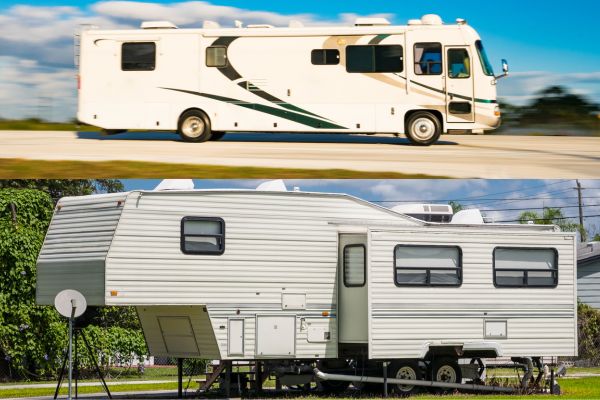
Buying a big RV can feel like choosing between a condo on wheels and a rolling suite.
In the video at the end of this post, our favorite certified RV inspector, Duane of the RV Inspection And Care channel, compares two top picks for people who want lots of space, slides, and comfort: a large Class A motorhome (often a diesel pusher) and a larger fifth wheel. He also notes that many of the Class A points apply to Super C motorhomes, too.
Class A motorhome advantages (especially diesel pushers)
• Weight ratings are mostly handled for you: One underrated perk of a Class A is that the builder has already worked out the weight setup. With a fifth wheel, the buyer has to match RV weight, tow ratings, and truck limits. With a Class A, the main job is simpler: You can load cargo smart and stay under the cargo carrying capacity.
• Kitchen and bathroom access while traveling: A Class A allows passengers to use the bathroom and often reach the kitchen while still on the road. For many travelers, bathroom access is a big plus on drive days.
• Tow a small “around-town” vehicle: A Class A can tow a small car behind it, which becomes the easy errand vehicle once parked. That can beat driving a large tow vehicle into tight lots and smaller streets.
• Backing up feels more familiar: Backing a motorhome is more like backing a big vehicle. A fifth wheel adds a pivot point behind the truck, and that takes practice. Some people never get comfortable with it.
• Panoramic windshield view: The front windshield and higher seating position make the drive part of the experience. Duane mentions one tradeoff: The windshield can add heat in direct sun, but adjusting the air conditioning can help.
• Storage and a factory-installed generator: Large Class A rigs usually have strong exterior storage, often including basement-style pass-through bays plus extra compartments along the side. Many also come with a built-in generator designed for the coach. In diesel pushers, it commonly runs off the main fuel tank, so there’s no separate fuel to store.
Fifth wheel advantages
• Lower total cost in many cases: Fifth wheels often cost less for the whole setup, even after adding the truck. Duane estimates a new fifth wheel plus a new tow vehicle can land around $200,000 to $250,000. New diesel pushers often start around $300,000 and can climb fast.
• Easier repairs and more repair options: A fifth wheel’s engine is the truck’s engine, and most shops can work on it. Diesel pushers place the engine in the rear, and some shops avoid that work, which can limit repair options on the road.
• More built-in safety features in the tow vehicle: Tow vehicles often include airbags and other modern safety features. Class A motorhomes usually have seatbelts, but airbags are less common, and the front seats are close to the front of the coach.
• More floor plans, better family layouts, and kitchen islands: Fifth wheels tend to offer more variety in layouts. Class A floor plans are more fixed because the cab is always in front.
Fifth wheels also commonly offer: Kitchen islands for extra prep space and bunkhouse or loft-style options that work well for families.
• More living space when parked: Fifth wheels can use deeper slides because they do not need walk-through access when traveling. High ceilings also add to that roomy, apartment-like feel.
Where the two options are pretty similar
| Category | Class A motorhome vs. fifth wheel |
| Maintenance costs | Often similar overall |
| Fuel costs | Often averages out close |
| Insurance | Often similar once both parts are counted |
| Campsite setup time | Similar, especially if the Class A tows a car |
Final takeaways
A Class A tends to win on travel-day comfort, storage, and convenience. A fifth wheel often wins on price, floor plan choice, repair access, and interior space when parked. The best pick comes down to how someone travels day to day, and what they want to feel easy every time they hit the road.
RELATED
- Class A motorhome pros and cons: Is it the right RV for you?
- RV inspector recommends the 3 best brands of used Class A motorhomes
- Why fifth wheel frames crack, and how to prevent it
RVT1245

Having owned a bumper-pull camper and a 5th wheel, I can only compare the two. A class-A rig seems very appealing but the prices are daunting. The author also fails to note that driving a 5th wheel is very easy… it goes where the truck goes! Turning radius is superior and backing into tricky spots can be easier for most. However, being able to pull into a rest stop and chill in a class-a with almost zero setup would be very, very convenient. Good article.
I’m trying to understand why anyone would spend $300k+ for an RV? I bought a 10-year old (2005), Winnebago, 34-foot Class-A, gas motorhome, 10 years ago with 7k miles on it for $45,000 from a local, used RV lot. It now has 55,000 miles on it, is 20 years old, and still delivers a perfect RV’ing experience. I will say you may need to know a bit more about vehicle maintenance and installed RV systems, over a 5th wheel. But, the overall conveniences and more storage are hard to beat. You simply need to look for good deals, then find someone to do a safety check for you if you are concerned about buying “used”. I tow a Jeep Liberty, get 8 miles/gallon towing, and pass diesel pushers on hills
My “A” is 38 years young, back when they were built swell! ( Winnie) I’ve been quite happy over the years as I can do almost all the maintenance.
Oil-filter-L.O.F. me: $50.00 v.s. shop: $200.00. I trust my work too! I wish I could lop-off the rear 5′, but sometimes my twice widowed little sister lets me haul her out into the woods.
That view out of the front windshield of a Class A while on the road is the most underrated thing ever! We are transitioning back into a Class A from our 5th wheel, and I’m excited to get that view again.
Also when parked.
A disadvantage with most 5th wheels is that with most- the bed is in a slide, making it very cramped.
This article is biased towards motorhomes. There is no way fuel cost and maintenance will average out the same. You are towing an extra 2-3 tons of toad. Plus toad maintenance.
We have only had Class A’s and agree with all the positives that were mentioned. One of the things not mentioned was that when getting to the campsite or wherever we are parked for the night, the coach is already cooled down if it’s hot, or nice and warm when it’s cold. Also, if it’s raining or dark out, we don’t even step out of the MH until daylight.
One other big difference is you can back up a fifth wheel but should not back up a toad (unless it’s on a big heavy car carrier) when you have to.
It takes me about 5 minutes to unhook, I take maybe 10 minutes to put things back together. Being too fast calls for errors. Yikes!
I started out with Vans, 3 Dodges, then got married and went to a ’68 Alladin, used, low cost, no bathroom. Just to see if we liked it. Then a new ’97 19′ Terry TT. Loved it. Wife lost her health and went to a Class A, so she could just swivel the seat when we got somewhere. Now she is gone and I wish I could go back in time,(age too),to another Van,
Of course no way would I get any $$$$ for my older “Lucy” ( the “A”). So I’ll just keep traveling along, as I know what I have. A well serviced rig, and I figure we both have some miles left in us! Come -On Spring!