

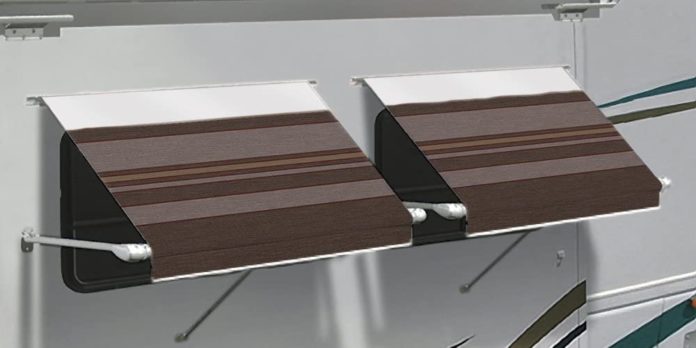
Cleaning your RV’s awning is essential if you want it to look good and last a long time. If you clean your awning often, pull it in during bad weather, and fix small rips or tears right away when you notice them, you’ll extend the life of your awning. Awnings are expensive to replace, but if you take care of yours, it might last as long as you own your camper.
First steps
Before you begin any cleaning regimen, you’ll want to check your RV owner’s manual. RV awnings are made of either vinyl or acrylic material. Both can be damaged by applying the wrong detergent, using the wrong brush (use a soft brush for vinyl, a stiff brush for acrylic), and scrubbing too vigorously.
Once you’ve determined the kind of fabric on your RV awning, it’s time to decide on a cleaning agent. There are many commercially made products for awning cleaning (this one from Camco works well). You can also make your own cleaning solution, using a mild dish soap (like Dawn) and water. Always check any cleaning product on a small portion of the awning first to make sure it won’t damage the awning’s finish.
Time to begin
Choose the optimal conditions. Park in an open area if possible. After cleaning you’ll want to dry the awning completely, so be sure to tackle your awning cleaning on a bright, sunny day.
Use a new lawn and garden pump-type sprayer to apply the cleaning product. It’s best to buy a new sprayer and dedicate it only to RV cleaning. Otherwise, you’ll need to completely clean your previously used sprayer to make sure no fertilizer or weed-killing agent is inside. A simple spray bottle will work to apply soap, but the process will be much slower, not to mention the potential strain on your neck and back.
Start cleaning
Open the awning completely. Remove all loose debris from the awning top using a broom or leaf blower. You may need to use a step stool.
Get both the top and underside of the awning wet using a hose spray nozzle. Then switch to the pump sprayer to saturate the entire awning – both top and underside – with the cleaning product.
When the fabric is fully treated with soap, retract the awning completely. Let the cleaning solution sit on the rolled-up awning for 10 to 15 minutes, or as long as directed by the manufacturer. If it’s been a while since you cleaned your awning, or it’s especially dirty, let the detergent sit a bit longer. Or reapply the “soap and soak” process a second time.
When time is up, fully extend the awning. Use a sponge or rag to wipe away dirt from the top and underside of the awning. A car wash brush with an extendable pole may help you reach more easily.
Rinse, rinse, rinse! Start by spraying clean water across the top of the awning. Continue rinsing, back and forth until you reach the bottom of the awning and no soap remains. (Fabric can be damaged if not rinsed off thoroughly.) If you used a solution containing bleach, be sure to rinse off your RV and the surrounding grass as well.
Let the awning air dry completely before retracting. Don’t try to hurry things along with a hair dryer! The heat can damage some awning fabrics.
When the awning is completely dry you can apply a protectant, if desired. Just make sure the product is compatible with your type of awning fabric.
Stubborn stains
Tree sap, bird droppings, mold, and other stains usually can be removed by using isopropyl alcohol or a cleaner like Formula 409 or Clorox Clean-Up. For more difficult stains, gently scrub the cleaning agent into the fabric with a toothbrush. Rinse thoroughly. Again, be sure to pretest any cleaner on a small area before treating the entire awning.
Keep it clean
Here are some tips for keeping your RV awning clean between washings:
- When at all possible, avoid parking under trees where falling sap, leaves, insects, and bird droppings are a given.
- Always sweep or blow off the top of your awning before retracting it.
- Never retract your RV awning when it is wet. If this can’t be helped, try to extend the awning as soon as possible afterwards to allow it to dry. Dry it completely before storing the RV.
- Periodically check your awning. The quicker you remove sap and other persistent stains, the easier it will be to clean.
##RVDT2164

Thank you, Gail! I’ll try doing this. Our awning may be made in such a way that it frustrates cleaning attempts; we’ll see.
Good luck, Neal. Hope it works out for you.