


As we get to even more summer heat, I read more and more posts on various RV forums where people are confused and/or concerned about having a tire “blowout” because the tire pressure got too high.
Before the introduction of tire pressure monitoring systems (TPMS), which report tire temperature, people were not presented with the temperature or inflation pressure as they drove down the road. While we did have a few people who were incorrectly bleeding pressure down on their tires after checking with a hand gauge, luckily, only a few did that and stopped bleeding pressure off after suffering tire failures.
Cold inflation pressure
CIP, or cold inflation pressure, is the pressure in the tire when it is at ambient (the surrounding) temperature. This is the pressure found in the Load & Inflation tables which are available on the internet or on tire company web pages.
For those that think posts from other RV owners are providing correct information, I would ask why would you follow that information when the TRA aka The U.S. Tire & Rim Association clearly says this in the front section of inflation tables:

The tire companies, through their Industry Association, are telling us that when the tire is at ambient temperature is the correct time to set tire pressure. This is before the tire has been in direct sunlight or warmed from being driven on for the previous two to three hours.
Once you set your tires, you can simply review your tire pressure and you will see the pressure go up and down as the tire temperature changes.
Tire pressure change due to temperature change
Tire pressure will change by about 2% for every change in temperature of 10°F.
If you want to question this relationship, I have published the mathematical “proof” for this in a few posts on my blog HERE.
As a Tire Design Engineer I can assure you that we Engineers take the increase in tire temperature and pressure due to running into consideration. For example, if a tire were to increase in temperature by 150°F, we might see an inflation pressure increase of 30 PSI. Our test laboratories usually are heated to 100F and our test tracks are many times in West TX or Mexico so we can evaluate out tires outdoors with temperatures above 100°F.
Confirm CIP every morning with TPMS
Running a TPMS eliminates the need to get out to measure and adjust your inflation pressure every stop. I advise that once you set your pressure you can confirm the CIP every morning by just turning the TPMS on and it will report the current PSI. If the outside temperature has gone up, you will soon note that your pressure has also increased by about the 2% I have predicted. If you set your CIP to 10% above the minimum PSI required to support your measured load, you can see that the ambient temperature would need to drop by 50°F before you would need to add any air.
But what happens when the ambient temperature goes up by 50°F? Well, that means the pressure might have also gone up by 10%, which certainly is nothing to be concerned with. So, you can see that we have a 100°F ambient temperature band that we can operate in before we need to make any adjustment to tire inflation.
What temperature the TPMS actually reports
TPMS also reports temperature, but that number is really the temperature of the metal wheel and not the temperature of the tire. Since metal conducts heat very well and rubber is an insulator, it is the heat from the brakes and bearings that warms the wheel up. The hot spot in a tire is seen in this graphic.
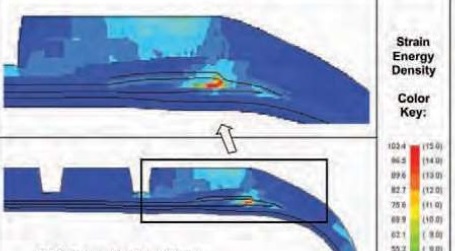
As you can see, this “hot spot” has a lot of insulating rubber around it. I have said previously that I wish vendors of aftermarket TPMS would not claim they were reporting “tire temperature”.
BUT this temperature reading can be useful as it may warn you of a bearing or brake dragging problem. For tires, I would depend on the pressure. As long as the pressure of your wheels was set based on measured load and all the tire pressures are consistent with your historical readings, you should be good to go.
Roger Marble
Check out my Blog www.RVTireSafety.Net
Read more from Roger Marble on RVtravel.com.
HAVE A QUESTION FOR ROGER?
Send your inquiries to him using the form below.
##RVT1164

Thanks Roger.
Is there any advantage to running 65lb max stamped on the trailer tire versus 40lb recommended by the inflation chart for my weight?
The only advantage is you’ll get to visit the folks at the tire store more often. It won’t kill your tires but it won’t help them last longer.
Over-inflating will “crown” the tire absent the weight to flatten it. That crown will carry all the load instead of the full width of the tire. It’ll wear there faster than if properly inflated.
Under-inflated is similar except it’ll “cup” from the weight on the not being displaced across the tread face and will wear on the outer edges first and faster.
While over-inflation can result in faster center wear there will be very few RV that will be forced to buy new tires significantly more frequently than they might to avoid having tire failure. I believe the “Fast wear” concern is significantly overblown.
Thank you, Roger! 🙂 Have a great week, safe travels, and safe stays! 🙂
I’m confused…When are you supposed to set your tire pressure? I always check mine first thing in the morning before direct sunlight and warmer daytime temps occur and correct as needed. After that I just monitor and realize the PSI will increase with driving and higher daytime temps. As seasons change, so does the morning PSI. I always try to keep my tires at manufacturers recommend levels and obviously living in the Midwest, I make adjustments as the temps change.
You do not need to change tire pressure every day IF you have included a “Margin”. We are trying to prevent Under-inflation and a slight “over-inflation” is not a serious issue. In the past I have driven from Ohio to MT then OR then Canada and back. With all the temperature changes over the 10-week period I only needed to adjust (add) about 5 psi once. I do check my inflation each morning by turning on my TPMS and in about 10 minutes all 6 sensors have registered the current PSI. As long as no tire reported to be under the MINIMUM inflation for that position I did not add air. Since I run a +10% margin that allows a 50 degree temperature drop before I need to add air.
Thank you! Makes sense. I do have a margin (5 psi’s sounds about right) and only change PSI a couple times of year, usually with change of seasons. Thank you gain!
I use an aftermarket TPMS on my camper, made by EEZ. I have found that the tire pressure will increase more than 10% on hot days. I run my tires at 80 psi (toyhauler 5th wheel) due to the load, and have found my TPMS to report tire pressures over 100 psi. I don’t get concerned, as the TPMS is a cap on the valve stem, and may or may not be the most accurate going down the highway. However, it will at least give me a good indication if I am losing pressure in a tire. I use a non-contact thermometer to check hub temps at every stop.
I have found the TPMS on my truck tires (2019 GMC) to be much more accurate that the one on my camper.