
Small-trailer shoppers usually have to pick between price, weight, and build quality. The Modern Buggy Hopper series tries to keep all three in the same conversation.
Built through a partnership between Bish’s RV and Modern Buggy RV, these travel trailers stay easy to tow and more useful than their size suggests. The lineup started with four models, each aimed at campers who want flexibility without a stripped-down feel.
In the video at the end of this post, our friend Josh the RV Nerd at Bish’s RV gives us the lowdown.
How the Hopper series came together
The Hopper name fits because these trailers are small, lightweight, and designed to move from place to place without much fuss.
The bigger story is the business model. Bish’s RV developed the floor plans through its Wayfinder program, then worked with Modern Buggy RV to build them. Instead of keeping the concept exclusive, Bish’s opened the lineup to other dealers. Higher production volume should lower per-unit cost, which helps keep pricing aggressive without bargain-basement construction.
Hopper 1 and Hopper 2 focus on flexibility
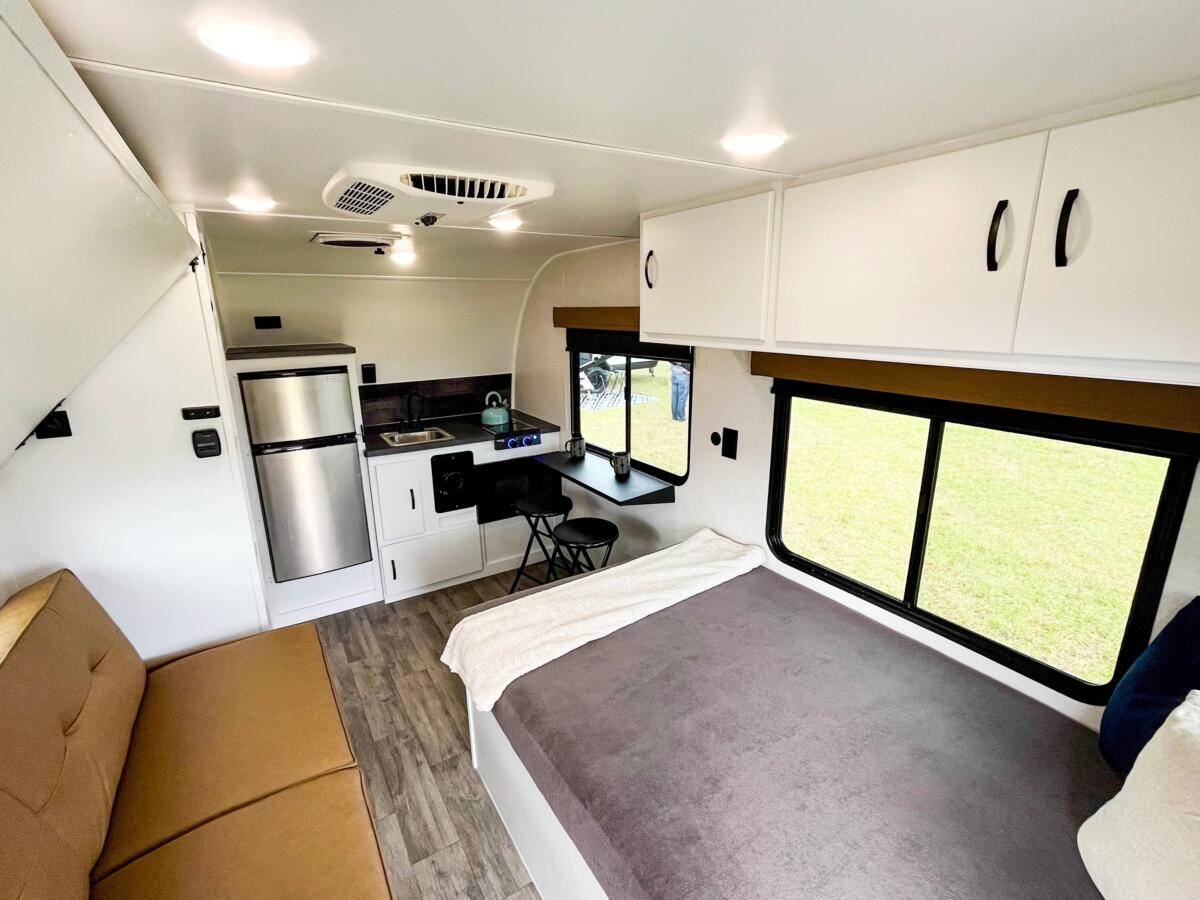
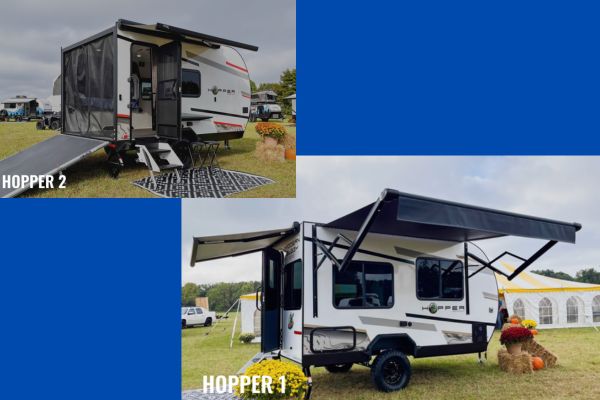 Hopper 1 traces back to the Go-Lite Cloud Breaker, a floor plan first created for a company vice president. It fits solo campers, couples, and small families because the layout is compact but flexible. Compared with the older version, it brings better materials, more cargo capacity, strong window coverage, and full awning reach. There is still room to improve, especially around the bathroom and the idea of a folding cargo-style bed.
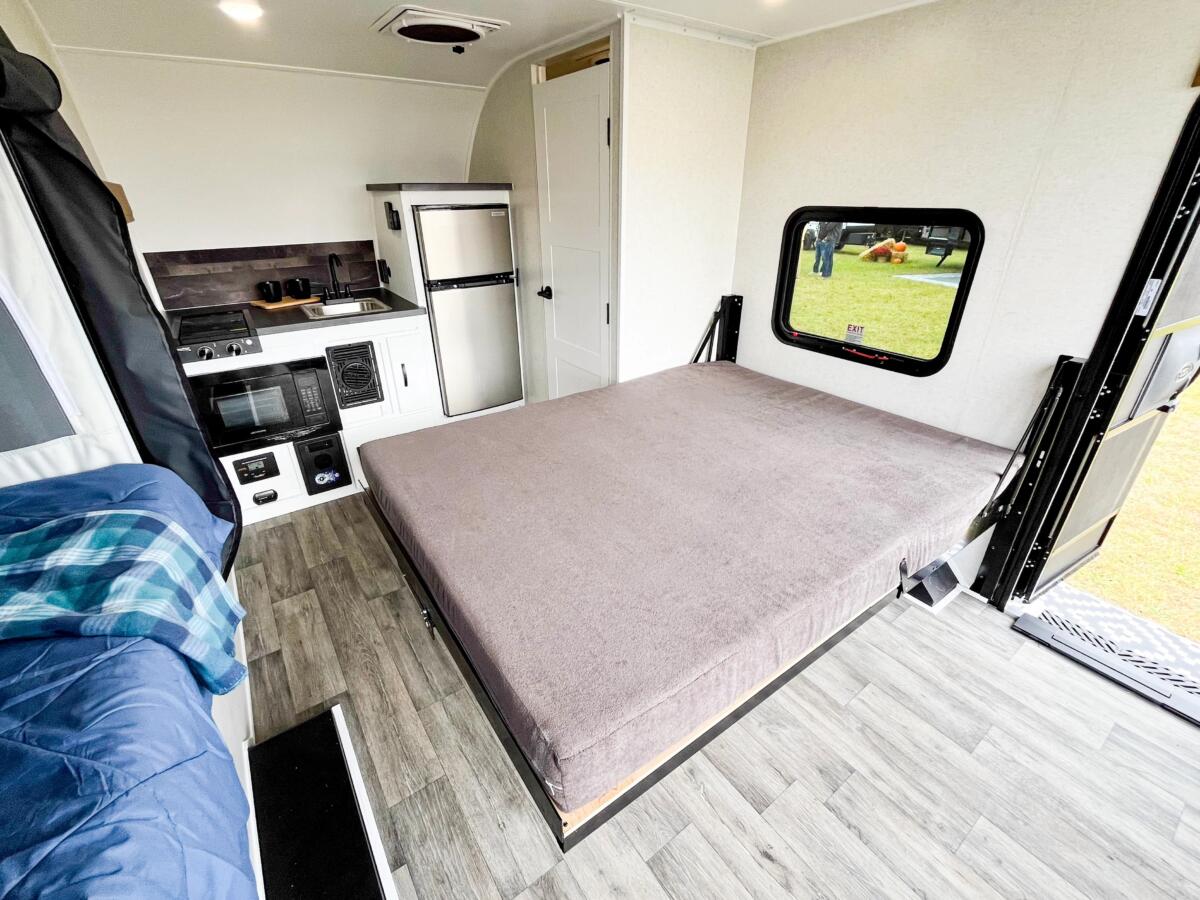
Hopper 2 comes from the old Boulder Back concept. It is a smaller hauler, and few trailers in this size and weight class offer a rear ramp. It is not meant for giant side-by-sides. The bed and entry door were swapped to open the interior, while a 12-volt fridge, 200-watt solar package, standard side pop-out bed, and 8-foot-wide body add usability.
The construction mixes cost control with better materials
Construction is a hybrid. The nose uses a welded aluminum cage because that front wall takes the brunt of the wind. The rest stays stick-built to control cost and weight, but the walls still use double Azdel construction. That mix is the point. The Hopper series is trying to feel better than entry-level without climbing out of reach. More all-aluminum options are planned later.
Hopper 3 and Hopper 4 push the lineup forward
Hopper 3 and Hopper 4 were shown in prototype form, but the direction is clear. The Hopper 3 uses flex-space thinking, with a cargo bunk system that can open room for e-bikes or other gear when bunks are not needed. It also adds wall outlets where they make sense, a welded steel bunk ladder, a sturdier telescopic dinette post, larger beds, and a much better roof fan. It is 8′ wide and about 6’6″ tall inside, with an enclosed, non-heated underbelly and a large rear bumper for sewer hose storage.
Hopper 4 is the couples model. Its north-south bed avoids the usual corner-bed squeeze, and the slide makes the cabin feel much larger than a typical single-axle trailer. A heavier axle gives it about 1,100 to 1,200 pounds of cargo capacity. The lineup also keeps pushing for multi-use storage, even if details like the knobby tires may still change.
Where the Hopper lineup stands now
The strongest idea behind the Hopper series is simple. Small and light does not have to mean flimsy or stripped down.
This four-model launch looks like the first layer of a larger Bish’s RV and Modern Buggy RV partnership. More model-specific walk-throughs are expected, and the team is already asking campers what layouts should come next.
Learn more about Modern Buggy Hopper travel trailers here.
RELATED
RVDT2933