

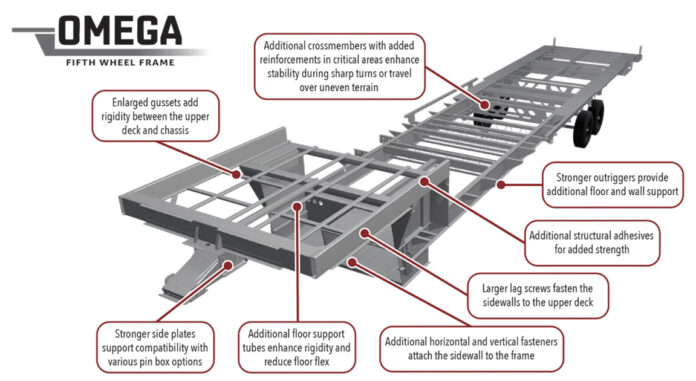
Grand Design is loudly promoting its new Omega fifth‑wheel frame. Its redesign says it uses thicker steel, more fasteners, and added structural reinforcements. But the rollout lands in the long shadow of Grand Design frame failure issues that have fueled owner complaints, federal scrutiny, and ongoing litigation over the past several years.*[1][2]
* Numbered footnotes are noted at bottom of article.
Grand Design says the new Omega frame, built by Lippert Components, features thicker steel, more robust fasteners, larger lag screws, and additional adhesives meant to exceed industry standards. The company frames the upgrade as part of its pledge to give RVers “the peace of mind to just get in and go.”[1]
A history of structural complaints and official scrutiny
Owner reports of excessive frame flex in Grand Design fifth wheels have circulated for years across forums, Facebook groups, and YouTube channels. These reports documented cracked welds, sagging floors, shifting slide-outs, and entry or baggage doors that suddenly misaligned.[9]
The National Highway Traffic Safety Administration (NHTSA) opened a Preliminary Evaluation (PE24029) after collecting numerous complaints alleging “excessive frame flex causing entry or cargo doors to open or partial extension of any slide out while in transit.”[3] The agency’s opening letter notes 23 owner-reported incidents, including 22 reports of doors opening while moving, and six of partial slide‑out extension.[3]
In its resume of the investigation, ODI (NHTSA’s Office of Defects Investigation) reports that Grand Design defines “excessive” flex in a technical service bulletin (TSB) as more than 3/8‑inch vertical movement in the upper deck, though Grand Design characterizes many of these as “cosmetic” concerns (e.g., binding doors, cabinet damage).[4] Some reports suggest Lippert (the frame manufacturer) disagrees with Grand Design’s “only cosmetic” framing. Lippert reportedly believes the flex may affect more critical structural zones, including the front axle.[5]
Legal pressure mounts
In April 2025, Weitz & Luxenberg filed a class-action lawsuit against Grand Design (and its parent, Winnebago), alleging that Grand Design sold RVs with defective frames, knowing the problem, and used aggressive marketing tactics—“… not only knew its RVs were defective, but marketed them deceptively and aggressively.”[1][2] The lawsuit targets Reflection, Influence, Solitude, and Momentum models built from 2020–2023, asking for compensation, punitive damages, and even a recall.[1]
According to reporting, plaintiffs claim Grand Design’s warranty—while expanded—was difficult to use in practice. Some owners say they were forced to haul their trailers to a specific facility in Indiana for structural repairs.[6]
RV Trader also covered the class action and quoted a key line from the filing: “These RVs are structurally unsound and unreliable when moving from one place to another.”[8]
There’s also an older (but related) class-action complaint alleging design defects in certain Grand Design travel trailers’ slide-box seals, though this is distinct from the frame‑flex cases.[7]
Owner reaction: frustration, skepticism and mixed outcomes
On Reddit and other forums, many owners remain deeply skeptical. One post from an owner of a 2021 Reflection 28BH said:[9]
“Broken welds all over … spongy floors … lag bolts … stripped out again … Grand designs fix was … go from 3/8 to 1/2” lag only to hold into a piece of pine.”
Another owner pushed back on Grand Design’s warranty messaging:[10]
“HUGE news … our … 5‑year frame warranty … is … transferable … effective immediately …”
Still, others remain wary of the brand altogether:[11]
“I would stay away, they still have not fixed their frames … I have only been able to use my trailer for 5 nights in the last 2 years.”

The Omega frame: Grand Design’s attempt to turn the page
Grand Design’s Omega frame claims to address the very issues raised by owners and in lawsuits. According to Grand Design, the new design includes:
- Thicker steel in primary frame components[1]
- Larger gussets to reinforce the joint between the upper deck and frame[1]
- Stronger outriggers to support floor and wall load[1]
- More crossmembers in high-stress areas[1]
- Upgraded side plates for compatibility with multiple pin box options[1]
- A 5‑year transferable frame warranty, retroactive to 2020[1][6]
These enhancements are explicitly targeted at the failure modes that have plagued prior frames—weld fatigue, sagging deck, and fastener pull-out.
Related guide: Concerned about frame flex in your RV? Check out our practical tips for spotting structural issues early in “10 ways to spot frame flex and structural issues in your RV”.
What remains unknown — and where the risks lie
Independent testing — While Grand Design claims extensive engineering and durability evaluation, there’s no publicly available third-party test report quantifying how much the Omega frame reduces flex or structural risk.
Regulatory outcomes — The NHTSA PE24029 investigation is still active. If ODI concludes that a safety defect exists, Grand Design may face a recall or mandate repairs.[3]4]
Legacy‑model risk — The Omega frame applies to newly built units. Pre‑Omega models (2020–2023) still rely on the warranty and potential litigation for structural fixes—there is currently no announced universal retrofit plan.[1][2][6]
Reputation recovery — Even if the new frame proves robust, rebuilding trust will take time. Owners who experienced repeated issues may remain wary, and long-term field data will be decisive.
Bottom line for RVers
Grand Design’s Omega frame and expanded warranty represent a clear corporate response to persistent structural complaints: engineering upgrades, more robust materials, and a stronger warranty are all part of the package.[1][6]
But the fix isn’t fully proven, yet. Independent data is lacking, the NHTSA investigation is ongoing, and previous owners face uncertainty. If you’re buying now, make sure your unit is built with the Omega frame, document its structural behavior from day one, and stay plugged into owner communities. If you own a pre‑Omega model, understand your warranty rights, track regulatory and legal developments, and consider a professional inspection to assess flex risk.
Sources
1. Weitz & Luxenberg — Grand Design RV Frame Failure Lawsuit
2. Weitz & Luxenberg — Class‑Action Filing & Allegations
3. NHTSA Preliminary Evaluation Letter (PE24029)
4. NHTSA PE24029 Investigation Resume, including Grand Design’s frame-flex definition in its TSB
5. Nomadic News — Dispute Between Grand Design and Lippert Over Flex Severity
6. RV Miles — Grand Design Extends 5-Year Frame Warranty Retroactively to 2020 Models
7. ClassAction.org — Slide-Box Seal Defect Complaint
8. RV Trader — Class Action Lawsuit Coverage
9. Reddit — Owner report: 2021 Reflection 28BH frame flex, broken welds, and lag bolt repair issues
10. Reddit — Owner reaction to transferable 5-year frame warranty
11. Reddit — Owner expressing skepticism about repairs
RVT1236b

Here is an example of a company taking positive action to correct a defect – sadly it probably did take negative actions to accomplish that turnaround. An alternative could have been bankruptcy – another negative! Everyone is well aware of the problems they have experienced. Now try to look at a positive article on this matter.
By introducing this new and improved frame did Grand Design just admit that their previous frame was defective?
Is GD going to offer a full price buy back for the defective ones if you purchase the new model?
I think not.
Plus, who’s to say how long the ‘repaired’ units will last before another failure.
Great article to keep the GD community abreast of what’s going on with their multiple frame issues.
Too little too late. Use to be big supporter of Grand Design. I will never purchase another one. Traded my 22 Reflection in for an Alliance Avenue.