

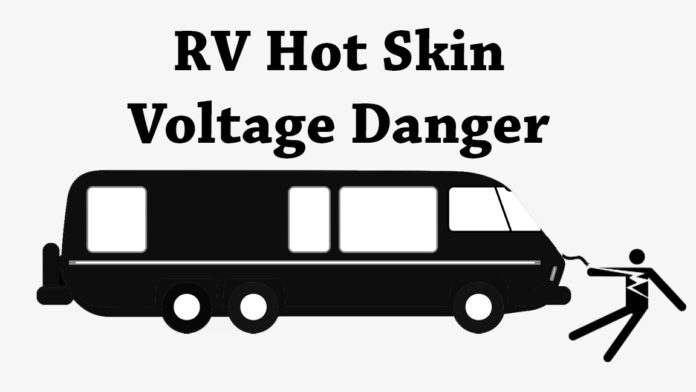
RVtravel.com has published several articles about the dangers of RV hot skin. Not familiar with the term? Simply put, an RV with hot skin is one where a metal part, such as the door handle, bumper, or even the siding, is carrying electrical current that it shouldn’t. Many RVers have experienced hot skin when receiving an electrical shock from their RV. RV hot skin conditions are more than just annoying—they can be deadly. Starting in 2026, RV manufacturers must include new protection systems to ensure RV hot skin prevention.
Ground monitor interrupter key to RV hot skin prevention
The mandate to protect RVs against hot skin conditions comes as the National Electrical Code (NEC) updates its standards. The code, revised every three years, sets guidelines for safely installing electrical wiring and equipment in the U.S. The 2026 update, to be released later this year, will require RVs with either 30- or 50-amp electrical service to include a device known as a ground monitor interrupter (GMI).
How will the GMI stop the danger of RV hot skin?
RVs have many internal electrical connections and appliances, all of which can leak a small amount of electrical current to the rig’s chassis. This current accumulates, and without a grounded plug, an RV can leak between 1 to 10 mA (one milliampere [mA] is equal to 1/1000 of an ampere) to its chassis. Normally, this isn’t an issue because the current is redirected to ground through the ground pin on the RV’s shore power cord.
However, problems can arise, leaving the skin or chassis components electrically hot. This creates the potential to injure or kill someone who touches a “hot” component while standing on damp ground. What could go wrong? For example, the grounding pin on the RV’s power cord might be removed, a ground wire in that cord might break, or an RVer might use a “dog bone” adapter to connect to shore power, but the adapter fails to maintain a proper grounding connection. In these cases, the safety system fails, and the RV’s exterior becomes electrified, creating a dangerous situation.
How does a GMI work?
The upcoming required GMI will automatically detect a faulty RV ground. If an RVer plugs into an electrical supply with a bad ground, the GMI will prevent electricity from flowing into the RV. It will also work in a “safe” ground situation but continuously monitor for issues. For instance, you might initially be fine when plugging into an RV park, but if the ground wire in your shore power connection breaks after you’re plugged in, the GMI will detect this and shut off the RV electrical system.
Even if the ground system in your RV is intact, the GMI will protect you from outside problems. For example, if you arrive at an RV park with a faulty ground system, the GMI will detect the issue and prevent electricity from flowing into your rig when you plug in.
Difference between GMI and ground fault circuit interrupter
You might be wondering, “Do I really need this? Don’t I already have a GFCI system in my RV?” The GFCI (ground fault circuit interrupter) system that comes with most RVs is different. The GFCI measures the current flowing into and out of a circuit. If the difference exceeds a small threshold, as little as five milliamps, the GFCI shuts down the power. However, not all onboard shore-power circuits in an RV are protected by GFCIs, and as mentioned, current leakage can add up. Your RV’s GFCI won’t always protect you against hot skin dangers.
What can you do now if your RV doesn’t have a GMI?
While the ground monitor interrupter will be mandatory on RVs built in late 2026, owners of older RVs should still be aware of the risks associated with RV hot skin. You should never feel a “tingle” when you touch your RV. If you do, you have a hot skin problem, and there’s a bad ground somewhere.

It’s wise to periodically test for ground issues, and it’s not expensive. All you need is a non-contact voltage tester, like this one on Amazon for about $10. With your RV plugged into shore power, turn on the tester and bring the tip near any metallic part on the outside of your rig. If the tester lights up, you likely have a bad ground. Disconnect your RV from shore power and have it fixed. Taking this simple step could save your life—or the life of a loved one.
RELATED
- Child dies from hot skin condition by touching the family RV
- For more on testing for hot skin voltage, click here.
- For more on the NEC ground monitor interrupter requirement, click here.
- For more posts about hot skin on RVtravel.com, click here.
More articles you might really like
- Lessons learned from the theft of our RV in storage
- Epic dump station design failure: Gross!
- Is it time to quit RVing? Our readers respond
- RV electricity: How to install a 30-amp RV outlet at home
- Elon Musk is not launching a $17,000 e-motorhome
- Don’t try staying with your RV at this RV park
You should enjoy the results of these RVer polls
• For couples: How many times a day do you kiss your partner?
• Do you lock your RV when you take a 10-minute walk around your campground?
• How would you describe the quality of workmanship on your RV?
• Should drivers with RVs 40 feet or longer need a special driver’s license?
• How far away do you store your RV when not using it?
##RVT1196b

We bought our first motorhome, a new Bounder in 1987. A couple of years later I experienced a hot-skin problem. Unlike now, then I didn’t know why. Since I didn’t detect the situation at subsequent campgrounds, on hindsight I believe that it was a campground fault, most likely in the power pedestal. I am sure we all have found power outlet plugs that were heavily worn, even chipped and cracked. Spring tension on such plug’s contacts was probably long gone with poor connectivity for one or more pins. It should have been replaced and if not could set up a problem of legal jeopardy for the campground.
It takes two to create a hot skin. You must have both a poor or broken ground connection AND electrical leakage to the chassis of the RV. It would occur at every subsequent campground that had a ground problem at the pedestal.
This is an excellent safety requirement that protects the consumer but I’m sure the current administration will kill it.
If you are that concerned, did you not see the advertisement on the Non contact voltage tester you can buy for $10?
The National Electrical Code is not a federal government standard. It is published by the National Fire Protection Association and adopted by the states or municipalities. The current administration has no authority over it, except as it may be adopted by federal agencies or federal funding may help states enforce it.
Thank you for the news of the impending elevation of the electric standards affecting RVs, Russ and Tina! Nice that the RV electrical sytems are becoming more safe. Have a great day and safe travels!
Don’t depend on non contact voltage testers to tell you if there’s a problem. They are unreliable especially when used by anyone that isn’t familiar with their use and electrical issues. Just get an EMS (Electrical Management System) surge protector. It will constantly check and shut down the electrical feed if there’s any wiring or voltage problems that are unsafe or that can ruin your appliances. They can be used on the shore power feed pole or better yet get a hard wired one installed so you never have to worry.
Something I’ve been wondering about regarding the hot skin issue is the growing popularity of Snap Pads. As I understand it, you have to be in contact with both the ground and a metal part of the trailer to experience a shock in a hot skin condition. If you attach rubber snap pads you lose the ground contact that four metal stabilizer jacks provide to the RV. Maybe not foolproof but wouldn’t that provide some grounding protection from a hot skin condition. Electrical is not my forte’ so I’m all ears to someone who knows better.
Snap pads do nothing to keep YOU from contact with the ground. The word ground is a poorly chosen term to refer to the path electricity must take to get back to its source – for an RV, the shore power pedestal or campground transformer. We call them electrical CIRCUITS because the electricity has to get back to the source. With a hot skin condition, anyone who touches the RV while THEY, not the RV, is in contact with the ground can become part of the return path.
That’s my point. The snap pads make the RV less grounded.
Hi, Keith. Here is Part 1 of a 2-part article that electricity expert Mike Sokol wrote for RVtravel.com a few years ago regarding whether or not SnapPads protected an RV’s electrical system from a nearby lightning strike. (Part 2 is linked at the bottom of that post.) I haven’t read those posts recently so don’t remember if they would have any info relative to your question, but maybe they’ll help. Have a great day. 😀 –Diane at RVtravel.com
so why not have a ground rod at the pedestal and cable to rv chassis instead of relying on the ground via power cord at pedestal? the detector will tell you there’s an issue and that’s it, now one has to find where the ground break is, so does everyone have the electrical schematic to their rv and do they know what the symbol for ground is, is it accessible, is it covered in corrosion, how to clean and properly secure the ground and seal it from the environment? most over tighten terminals which twist the eyelet and strain the wire crimp which over time can separate or break yet again causing the issue. the GMI is helpful to a degree, in the end now the real work begins in finding the cause
Thank you, Russ and Tina, for the news of the new requirement. Thanks even more highlighting a simple way of testing for “hot skin.” My understanding that a metal RV frame can make fiberglass sidewalls “hot skin” too. Have a great week and safe travels!
If you decide to use a non contact voltage tester ( or any type of electrical test device) be sure to test FIRST on a known live circuit like a cord or receptacle that is live. A neighbors shore power cord for example.