


Dear Dave,
Can you get a ticket for running a yellow light that turns red? —Robert
Dear Robert,
Should you speed up or stop at a yellow light? It depends.
We all have opinions about what to do when approaching a yellow traffic light. When the light turns yellow, it signals that the green (go) phase has ended and the red (stop) light is about to follow. Some drivers see this as a cue to speed up and make it through the intersection before the light changes. Others recognize it as a warning and choose to stop, avoiding the risk of entering the intersection as the light turns red.
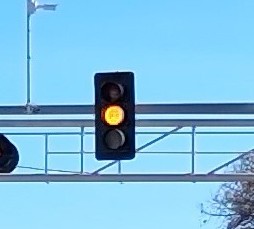
In reality, the yellow light is meant to give drivers enough time to make a safe decision—either continue through the intersection or come to a controlled stop. Its purpose is to reduce sudden braking and help prevent rear-end collisions.
When is it legal to proceed through a yellow light?
Traffic laws generally state that drivers should stop at a yellow light if they can do so safely, without causing abrupt braking or creating a hazard for vehicles behind them. Several factors come into play, including posted speed limits, road conditions, traffic flow, and your distance from the intersection. If a citation is issued, these same factors are typically considered by both the officer and the court.
It is usually considered acceptable to proceed through a yellow light if stopping safely is not possible or if you have already entered the intersection when the light changes.

Why do some yellow lights seem longer than others?
According to the Federal Highway Administration, national yellow light timing mandates are mostly nonexistent, However, they have developed a Manual on Uniform Traffic Control Devices that provides guidance for state Department of Transportation (DOT) engineers, which is from 3-6 seconds.
These include the speed limit (higher speeds require longer stopping distances), the width of the intersection, and overall traffic conditions. Busier intersections may have slightly longer yellow lights to account for increased activity and potential distractions.
According to the manual, the following yellow light intervals are recommended.
25 mph — 3.0 seconds
30 mph — 3.5 seconds
35 mph — 4.0 seconds
40 mph — 4.5 seconds
45 mph — 5.0 seconds
50 mph — 5.5 seconds
55 mph — 6.0 seconds
Each state sets standards for signal timing, and local officials generally cannot arbitrarily shorten or extend yellow light durations. Despite common belief, yellow lights are not shortened to increase ticket revenue.
It is widely accepted that entering an intersection on a yellow light is not a violation. The violation occurs when a driver enters or remains in the intersection after the light has turned red.
However, this is at the interpretation of an officer and you could receive a citation. This could be contested in court if you feel it is unjust. However, my experience has shown it is difficult to prove that and I have paperwork to show for that.
What about red light cameras?
Many cities are installing red light cameras, which are designed to reduce the attempts to run a red light. However, most drivers believe they are designed to issue more citations. Legally you can drive through a yellow light but a red light camera will start to record when it senses a higher speed through an intersection when the yellow light is on and will capture the car, license plate, and light condition when it turns red. No fighting that one.
You might also enjoy these posts from Dave
- What can I do to reduce blind spots when driving my older Class C?
- Essential LP cylinder safety tips
- Are Tyron tire safety bands worth the price?
- Does driving with the RV refrigerator running impact its efficiency and safety?
DAVE HAS ANSWERED MORE THAN 1,000 readers’ maintenance and repair questions. Read a directory here. There is so much to learn!
Dave Solberg is a leading expert in the RV industry and the author of the “RV Handbook.”
HAVE A QUESTION FOR DAVE?
Send your inquiries to him using the form below.
RVDT2881

Dave, your opinion is as valuable as any other but citing some actual ordinances would be better. In my state of residence the legal wording is that you may not “enter” an intersection when the light is red. To me (opinion) that means if you are already in the intersection when the light changes to red, you are not committing a violation. Nevertheless, safe practices dictates that we should avoid entering if we know the light is changing.
Tim, that’s my interpretation of state laws as well but as Dave mentioned, some states consider being in the intersection when red as “unlawful occupancy of intersection” and cite the drivers. I always look at the pedestrian crossing sign. If it’s flashing, a red light is eminent and I slow down. Doing that gives me a warning that the yellow light is coming.
Just have to be very careful. Around here, running red lights is the normal procedure.
That’s why we have dash cameras on all venicles.
The fact that folks “push” the yellow light is why I will always count to three before I venture into the intersection from my stopped position.
If I can safely stop, I try to. If I cannot safely stop, and will end up blocking the intersection, I go through, brakes on, horn blowing.
The red-light camera, and the violation, should be based on whether you have cleared the intersection when the light turns red. For example, at 30 mph you are going 44 feet per second, so in the 3.5 seconds of yellow light you will travel 154 feet. If you are that far from the intersection when the light turns yellow, you should be able to stop easily. If you are within 154 feet of the other side of the intersection you will clear it, and very few roads are that wide. 3.5 seconds doesn’t sound like much, but it is really a pretty long time to be able to react and stop.
We have numerous red light runners and many result in T-bone crashes – winter, summer = same. My understanding of ND rules are the vehicle must be out of the intersection when the lite turns red. Some yellow lites are only on about 2 seconds and with a dash cam in court – you will win, because that isn’t fair either.
This article by Dave, is a very welll done article.
Once your front bumper crosses the white stop bar (that white line painted on the surface across your lane) you are considered “in” the intersection. If the light is yellow at that point, it doesn’t matter when the light changes to red.
I am grateful for the yellow warning light signaling a change to red or stop. I remember when signals were a rectangular box that raised either a red blade with stop printed on it or a green blade with go printed on it. I believe they were known as semaphore signals. When one blade or arm went down and the other up a bell would ding, and you could hear the motor whirring. On the face of the boxes, they also had a red light on top and a green light below that changed with the arms. No yellow or amber change of signal existed. Thank you to whoever invented the yellow light. As you can guess I have been around for quite a while.