

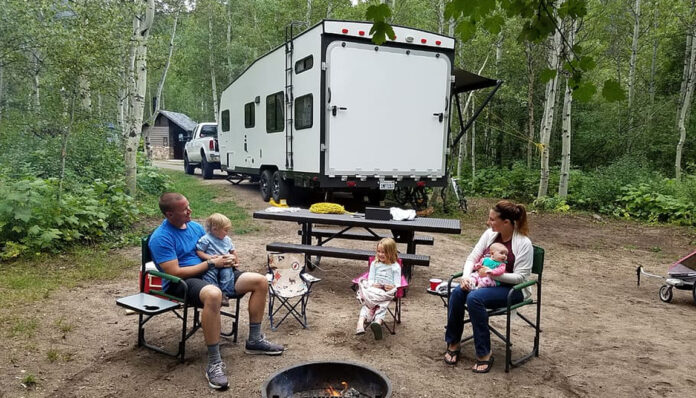
Is RV travel cheaper than other types of vacations? The RV industry says yes. According to the RV Industry Association (pdf), a family of four can vacation by RV for 27% to 60% less than trips that rely on hotels, flights, and restaurant meals.
The claim appears frequently in industry reports and promotional materials and is often cited as one of the major advantages of RV travel.
But ask experienced RVers about that claim, and you’re likely to hear a familiar answer.
It depends.
Where the savings are supposed to come from
The RV industry’s argument isn’t entirely without merit. RV travel can reduce several expenses that typically drive up the cost of traditional vacations.
For example, families traveling by RV may avoid:
- Airline tickets
- Rental cars
- Hotel stays
- Restaurant meals for every meal
- Pet boarding fees
Instead, RV travelers often cook their own food, sleep in their own beds, and bring along everything they need for the trip.
For families traveling together—especially those with children—the savings can add up quickly.
And for RVers who already own their rigs and stay in reasonably priced campgrounds, the math can work out favorably.
Where the math starts to get fuzzy
Where many RVers start to question the industry’s claim is in the costs that are harder to capture in simple vacation comparisons.
For starters, there’s the RV itself.
Even a modest travel trailer can cost tens of thousands of dollars. Larger fifth wheels and motorhomes can run far higher. When purchase price, financing, insurance, and depreciation are factored in, the financial picture becomes more complicated.
Fuel is another major variable.
Large motorhomes commonly average 8 to 10 miles per gallon, and heavy tow vehicles pulling trailers aren’t much better. Long-distance trips can burn through a lot of fuel in a hurry.
Then there are campground fees. Once known for modest prices, many campgrounds now charge:
- $40 to $80 per night in many areas
- $100 or more at some popular destinations
Maintenance adds another layer. RV owners quickly learn about the ongoing costs of:
- Tires
- Roof sealing
- Appliance repairs
- Routine servicing
Those costs rarely appear in simple vacation comparisons.
A clue hidden in the industry’s own numbers
Interestingly, the RV industry’s own shipment data offers a hint about how travelers are responding to those financial realities.
In 2025, roughly 342,000 RVs were shipped to dealers in the United States, according to the RV Industry Association. Of those, about 89% were towable RVs, such as travel trailers and fifth wheels. Only about 11% were motorhomes.
That imbalance likely isn’t accidental.
Towable RVs typically cost far less than motorhomes and can be pulled by vehicles many families already own. For buyers trying to keep RV travel affordable, trailers often represent the easier entry point.
In other words, the market itself may be quietly adjusting to the same cost pressures RVers talk about around campfires.
For many RVers, it’s not really about the money
Even so, many RV travelers say the real appeal of RVing has never been purely financial.
Instead, they point to advantages that don’t fit neatly into a cost comparison.
RV travel allows people to:
- Bring pets along
- Sleep in their own beds
- Cook their own meals
- Change travel plans at a moment’s notice
- Stay close to national parks and outdoor destinations
For many RVers, those benefits outweigh the question of whether the trip costs a little more—or a little less—than another kind of vacation.
The bottom line
RV travel can be cheaper than other types of vacations. But the answer depends heavily on factors such as:
- The type of RV
- How often it’s used
- Fuel prices
- Campground choices
In other words, the industry’s claim isn’t necessarily wrong.
It’s just not the whole story.
And as many seasoned RVers will tell you, the real value of RV travel isn’t always measured in dollars. It’s measured in places visited, sunsets watched, and the freedom to go wherever the road leads next.
Many RVers eventually reach the same conclusion.
The real question isn’t always whether RV travel is cheaper—
It’s whether it’s better.
RELATED
- Cost of RVing so high it was *GASP* cheaper to stay in an oceanfront hotel!
- Around the Campfire: The true cost of RVing
- 7 steps for managing the cost of full-time RVing
- 13 smart tips for keeping costs down while RVing
RVT1252b

For us, RV travel costs about the same as flying/driving. However, that only takes into account the travel expenses for the trip, not the costs of buying/maintaining an RV. We save by utilizing BLM, FS or other free sites, if possible. We save the most if it’s a short-distance trip to a state park (hurray OR/WA!) and staying for a week+, though prices are increasing there. But, we sleep and eat much better traveling in our RV, plus seeing the country and connecting with friends beats flying-over every day in our book, though it takes more time.
From California we have been both part way and all the way across the country and back in our motorhome several times. Without it we could never have experienced what for us were the many stops along the way. With another couple with their RV was a wonderful experience traveling to and around Alaska. We have had interesting and educational times with several conducted RV tours. None of this would have been possible by air or car alone. Overall, travel with an RV may be more expensive but that is offset by a far richer ability to learn and explore, plus being more comfortable, less stressful, and higher up on the happiness chart. Now, in my 90’s, no more long-distance travel.
I hope you get to take short trips or have someone tow you to a place you can still enjoy. I want to be you when I grow up!
We belong to an FMCA (now FRVA) chapter that goes to Thousand Trails campgrounds in northern California. At 92 (wife starting Alzheimer’s at 86) I will be leading a chapter rally at Russian River in May. Our secret through 64 years of marriage is to stay best of friends, avoid stress, both sides be able to compromise, maintain a sense of wonder, be involved in diverse activities, and more. I like to read historical fiction, memoirs and biographies, science fiction, mysteries, westerns and whatever seems interesting. I was an aerospace publications engineer (tech writer) and my wife was an attorney who mostly served those who could not afford an attorney.
told this story before. Migrated to the south with our TT. family death had us return north within a few weeks, but now snow season. We drove the same route/stops using mid-hotels that allowed our pets. Apples to apples comparison. We saved a whole $200 in travel expenses towing. It isn’t the cost savings, it was the convenience and comfort of we and our pets being in the same place each night. Priceless.
We do not have pets, but completely understand. To have my own bed, cook food, go vend and come home each night to a deserted venue parking lot that has security is priceless. No cost.
For us, who work on the road vending at festivals, it is way to go. The perfect event is where we stay on venue overnight, dry camping. Everyone leaves to continue the parties at the hotels and we get quiet nights sleep. We are there to work, not party, so it works out great.
After 10 years as fulltime travelers, we sold the 5er and travel exclusively using hotels and restaurants. While both ways of travel can be good, we much prefer the RV. Sitting in a hotel room is no comparison to sitting in your own RV, cooking your own meals, and using your own shower. Coordinating reservations must still be done. It’s different, not cheaper or easier!
I can’t speak to a family of four, but for my wife and me there is no doubt in our minds that traveling around the country in our motorhome is less expensive than other travel modes . I include our average daily cost of ownership plus maintenance and insurance in my trip analysis expenditures, and the RV wins hands down.
RV travel is not cheaper. There are “travel hacks” to fly, get hotels, and rental cars and the only thing you pay are taxes and fees. There are travel reward credit cards out there that offer great travel perks. There are a lot of cards out there. A friend mine flew from Texas to Florida, stayed at a Hyatt Resort, and a rental car for taxes and fees only. She paid less than $80 for round trip flight, room, and rental car for a 4 night trip. But to do these travel hacks you’ll need more than one card. She has quite a few. Different cards offer different perks. I currently have enough points for my wife and I to fly to Hawaii and it will cost less than $50 for 2 round trip tickets.
We do dog trials with our dogs or is it they do dog trials with us? To be determined! We dry camp at the trial site and no longer have a house sitter to pay now that we have a Motor Home. It’s how you RV for what reasons that determines your costs and if it is worth it or not. Personal preference.
If you believe anything the RV industry tells you ; you are a fool.
My wife and I like to camp, travel, and see things far from home. However, winter weather necessitates winterizing and covering our camper. Therefore, winter trips are guaranteed to require a hotel/motel. We don’t do “fleabag” joints, but we also don’t opt for the most expensive ones either. All in all, the price mostly evens out, because we use less gas traveling without the trailer, but the motel rooms tend to cost more than campsites.
Thank you for the information and discussion, Russ and Tina. For DW, dog #3, and me RVing is more expensive than traveling by car and staying in hotels. Tweaking an RV to suit one can become expensive, as is upkeep. We do try to travel 3 or 4 nights monthly to lessen the conclusion that RV #2 is an expensive paperweight. Have a great week and safe travels!