


By Dave Solberg
Dear Dave,
I recently put my rig in storage and within two weeks, the house batteries went dead and the disconnect switch was OFF. Prior to storage, I was plugged into shore power at a park where my battery charge lights showed full charge. Apparently, they must show full charged when plugged into shore power.
Is there a “meter” that I can connect to the batteries which would show their actual charge? Something that I could mount in the rig to check the charge. Thanks. —Michael, 2017 Forest River Georgetown
Dear Michael,
When you are plugged into shoreline power, one of the circuit breakers provides 120-volt power to your converter. It is either designed into the distribution center, or is a standalone model somewhere under a cabinet or the bed pedestal.
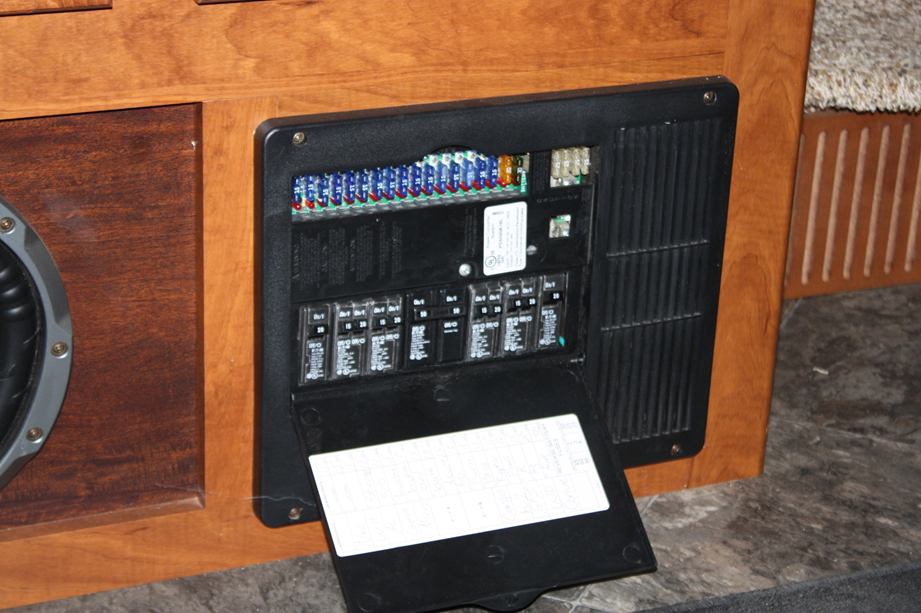
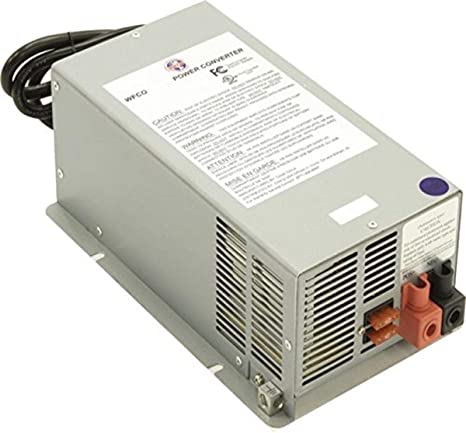
Battery monitor doesn’t necessarily show condition of battery
When you are plugged into shoreline power, the converter will always provide a 12-volt charge to the batteries. If they are low, it will be at 13.7 volts until the batteries show 12.6 volts and then drop to 13.2 volts.
The LED lights you typically see at the monitor panel just see what charge is at the battery. Therefore, it will show fully charged, not the condition of the batteries.
I get this comment often, that people state they took the battery to a service center and they told them they were good. As you draw down a flooded lead acid (FLA) battery and recharge it, sulfur coats the plates.
The average converter/charger doing the 13.6 volts and then dropping to 13.2 volts does not break up the sulfation. It gets thicker every time until the battery cannot store much energy other than a 12.6-volt “surface charge”.
Use a multi-stage charger
When a load is applied while dry camping or not connected to shoreline power, the batteries will drop immediately, just as you are experiencing. The only way to condition these batteries is to use a multi-stage charger that does a high voltage “bulk” charge to break up the sulfation, then an equalizing and float charge.
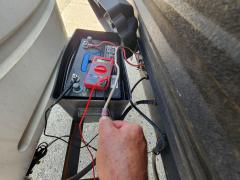
Even with the battery disconnect, the LP leak detector typically will draw down the battery. It is a good idea to test for a parasitic drain using a multimeter. Disconnect the negative cable and put the meter on DC Amps, touch one lead to the battery terminal, the other to the cable and record the draw. An LP leak detector will draw about 1.5 amps, so anything larger than that needs to be identified.
I recommend disconnecting the negative cable to make sure nothing is drawing from the battery while in storage. However, if your batteries are sulfated, they will naturally drain down in a couple of weeks even when disconnected.
The monitor I suggest
To monitor the state of charge (SOC) as well as the charge going to the battery, I suggest the Go Power! GP-BMG Battery Manager Kit. It will show the charge, remaining Ah, and time until empty.

You can find more information on the Go Power! site here as well as on Amazon.
MORE POSTS FROM DAVE ON RV BATTERIES
- Why did RV’s AGM battery die so soon?
- What is the best house battery for my RV?
- How to install a battery disconnect switch in RV
- My RV needs a new engine battery. What brand and size should I get?
- When storing 5th wheel, what is the best battery maintainer and how do I connect it?
HAVE A QUESTION FOR DAVE?
Send your inquiries to him using the form below.
RVDT2848
Easy install and peace of mind.
That Go Power system is insanely expensive when the AiLi shunt and monitor provides the same information for under $40.
I also have the AiLi shunt and it works perfectly! I have had it for nearly six years. Sometimes people think the most expensive item is of the highest quality. Just look at Battleborn batteries! I have LiTime batteries at a fraction of the cost and they are amazing!