

By Dave Helgeson
What is a DC to DC charger and should my RV be equipped with one?
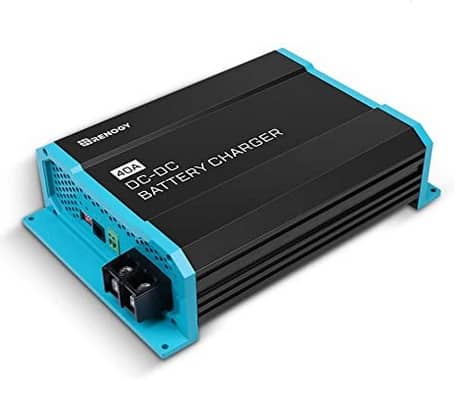
Before that question can be answered, you will need to understand what a DC to DC charger is and what functions it performs.
Many of you reading this use an autoformer to ensure the incoming shore power is at the proper voltage for your RV. As most of you know, low shore power voltage can damage the compressor in your air conditioning system and/or residential refrigerator, or cause a host of other problems. An autoformer adjusts, or what some say “conditions,” the voltage to the ideal level for your RV.
A DC to DC charger functions much the same way as an autoformer by conditioning the 12 volts from your alternator to the ideal charging voltage for your house batteries.
What has recently changed that now requires a DC to DC charger on tow vehicles?
To meet mileage requirements, vehicle manufacturers began using “smart alternators” (aka variable voltage alternators) several years ago. In simplified terms, a smart alternator saves fuel by only supplying the immediate electrical needs for the vehicle. Reduced electrical load by the alternator equates to less mechanical load on the engine, which equals better fuel mileage.
Unfortunately for RVers, a smart alternator is basically useless for charging auxiliary batteries in a travel trailer, fifth wheel or house portion of a motorhome. Even those with older “dumb” alternators can benefit from improved charge rates provided by a DC to DC charger.
Determining if your tow vehicle or motorhome has a smart alternator is rather easy. Click here to learn how.
Do I need one? Below are scenarios to consider
If you hook up your RV equipped with lead-acid house batteries to shore power every night, you probably won’t benefit from installing a DC to DC charger. Since the converter/charger in your RV keeps your house batteries charged while plugged in, your batteries will likely contain enough energy to supply your 12-volt needs while traveling between campsites.
However, if you dry camp often or use a considerable amount of 12-volt power* while traveling between hookup campsites, you should definitely consider one. (*Running the slideouts in and out, residential refrigerator, 12-volt refrigerator, operating the RV furnace, using other appliances via an inverter, etc.)
Here’s why: A DC to DC charger installed on your RV acts like a 3-stage RV converter/charger powered by your alternator. It will condition or “step up” the voltage from the alternator to maximize battery charging, then step down and maintain the voltage as the house batteries reach full charge. This will charge your house batteries faster and more efficiently via the alternator when driving compared to not utilizing one.
May need to consider a DC to DC charger
If you are considering installing lithium house batteries, especially in a motorhome, you will want to seriously consider a DC to DC charger.
Here’s why: Due to less internal resistance, lithium batteries can be charged and discharged much faster than conventional lead-acid batteries.
A discharged lithium battery can demand more amperage than your alternator can readily supply. Overloading and damage to your alternator can occur when this happens. This is especially true when the house batteries are located in close proximity to the alternator, as you will likely find in a motorhome.
This is due to less voltage drop over a shorter length of wire. Longer lengths of wire, as you would find between the alternator of a tow vehicle and the towable RV house batteries, typically provide enough resistance to protect the alternator.
This is another case where you will want to condition the 12 volts to an appropriate level. Just as a DC to DC charger can increase the charge rate to better charge your house batteries quicker, it can also limit the charge rate to protect an alternator when excessive power is demanded to charge lithium house batteries.
Installation is relatively easy
If you decide to install one, installation is relatively easy for do-it-yourselfers.
Hopefully, this short introduction to DC to DC chargers has helped you to understand what they are and how you might benefit from one.
Special thanks to REDARC for supplying a charger to the author for review and testing.
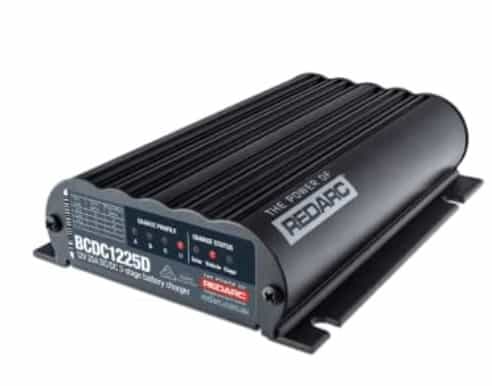
Here is just one of the DC to DC chargers REDARC offers on Amazon.
YOU MIGHT ALSO LIKE:
- The most deadly RV electrical mistakes
- RVelectricity: Always unplug your RV while working on wiring
- Know your plugs: 50A vs. 30A RV hookups—When 50–30 doesn’t equal 20!
- Inverter vs. converter – What’s the difference?
RVDT2848

LifePo4 doesn’t suddenly cause a smart alternator to become useless. LifePo4 doesn’t change the regulated output of an alternator simply because it can demand more amperage and lastly LifePo4 doesn’t need “conditioning” like a lead acid battery does.
A DC to DC charger is useful on a towed RV to prevent elevated amperage through the tow harness connector. Installing one on a motorhome to “protect” the alternator is akin to saying you need to put ice in your fridge to protect the Freon compressor. It’s funny how alternator manufacturers don’t suggest DC to DC chargers but DC to DC charger folk sure do….
Vince, your comment on motorhomes is simply untrue. Whether you need a DC-DC charger to limit the draw on the alternator depends on the size of the battery bank, the maximum charging rate of the battery bank, and the maximum output of the alternator available for “accessory loads”, such as charging batteries. Exceeding that can overheat the alternator.
Switching from lead-acid to LiFePO4 batteries can dramatically increase the charging amperage draw on the alternator. A good rule of thumb is that any battery bank above 200Ah capacity should have a DC-DC charger installed, and it won’t hurt anything to install one on a lower capacity bank.
I have had a Redarc 50 amp DC charger for several years. I mounted it in the battery compartment of my 5th wheel.
I have run wires from my truck batteries to the bumper so I can plug in while driving. I also have a set of wires from the hood area so that I can charge when I am dry camping, as I don’t want to have the back of the truck underneath my bedroom when I am charging stationary.
It works brilliantly! It is the size of a shoe box lid and weighs about five lbs., AND charges just as fast as my Honda inverter/generator.