


RV startup Lightship RV says it’s rolling out “America’s first all-electric” RV. A travel trailer that not only breaks the RV industry mold in appearance, it shakes things up by adding some measure of self-propulsion. Imagine towing a travel trailer without the typical loss of fuel economy. No need to stop for LP: heating, cooling, cooking—all run on electricity. Lightship’s new rig is revolutionary. But it’s not without some serious drawbacks. The new Lightship RV is classified as “remains to be seen” in our book.
Three models of Lightship RV coming, most expensive first out the door
When Lightship first touted its new concept back in 2023 it was called the SXSW. Then it was changed to Lightship L1, which we reported on. Now the name is a bigger mouthful, the AE.1TM Cosmos Edition. A bigger name—and a bigger price tag. Initially Lightship said it would produce two “flavors”—a stripped-down model for $125,000 and the self-propelled model that “starts at $151,500.”
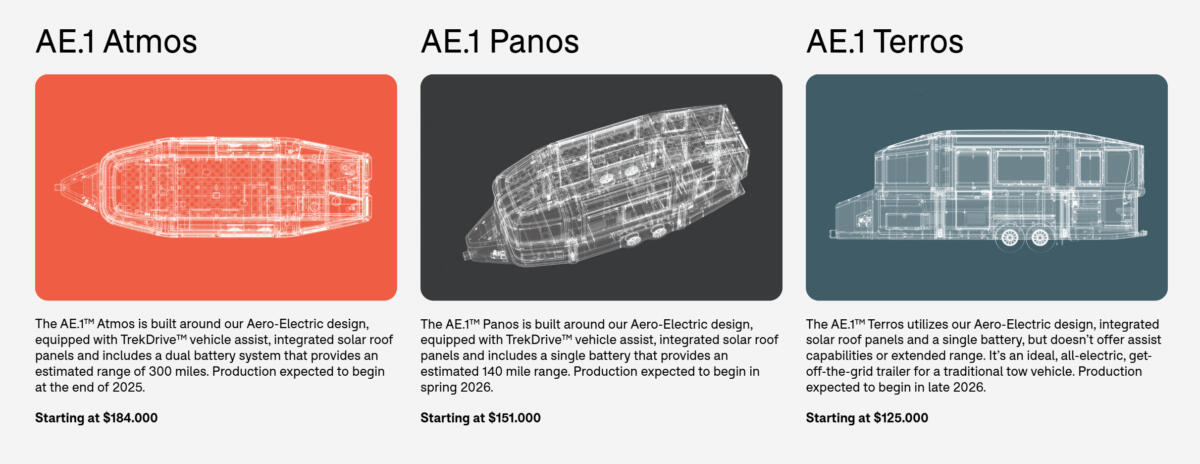 Today the Lightship website lists three different rigs. The entry level rig, with no self-propulsion, is called the Terros. It still starts at $125,000—but won’t be available until 2026. The low-end self-propelled rig, also in a holding pattern until 2026, “starting at $151,000,” is the Panos, with an estimated range of 140 miles. Atmos, said to be available at the end of 2025, offers a 300-mile range, starting at $184,000.
But Lightship is now promoting its first release, the “Cosmos Edition.” With its e-propulsion it will set you back $250,000, “or $239,900 after available tax credits.” This first-edition experiment will be rolling out to customers by this summer. Cosmos is the upgraded trim package.
So what does a quarter-million buy? Here’s what Lightship has to say in today’s media release.
What the company has to say
“The superior aerodynamics and the TrekDrive™ power system in the AE.1 deliver near-zero range loss for EV drivers and less miles-per-gallon drain for gas vehicles.
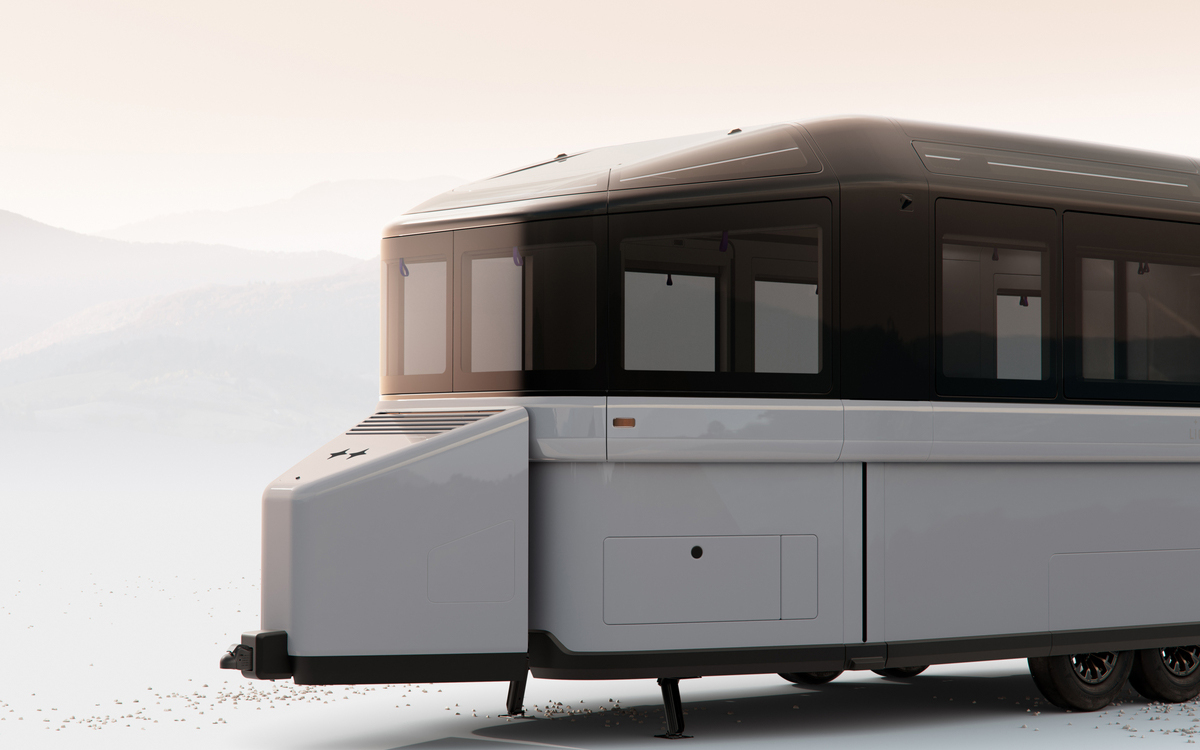 “The premium interior of the AE.1 Cosmos Edition achieves new standards in sustainability, function, and spaciousness. The battery and integrated, full-solar roof design deliver an all-electric camping experience without the noise of a generator or the hazard of onboard propane tanks. With power capacity built for off-grid living, the AE.1 sleeps four, brings the comfort and refinement of an automotive-grade HVAC system, a spacious, fully outfitted bathroom, and a Galley Kitchen equipped with a dishwasher, refrigerator, microwave, convection oven and induction cooktop.”
You can reserve one—Just pony up $7,500
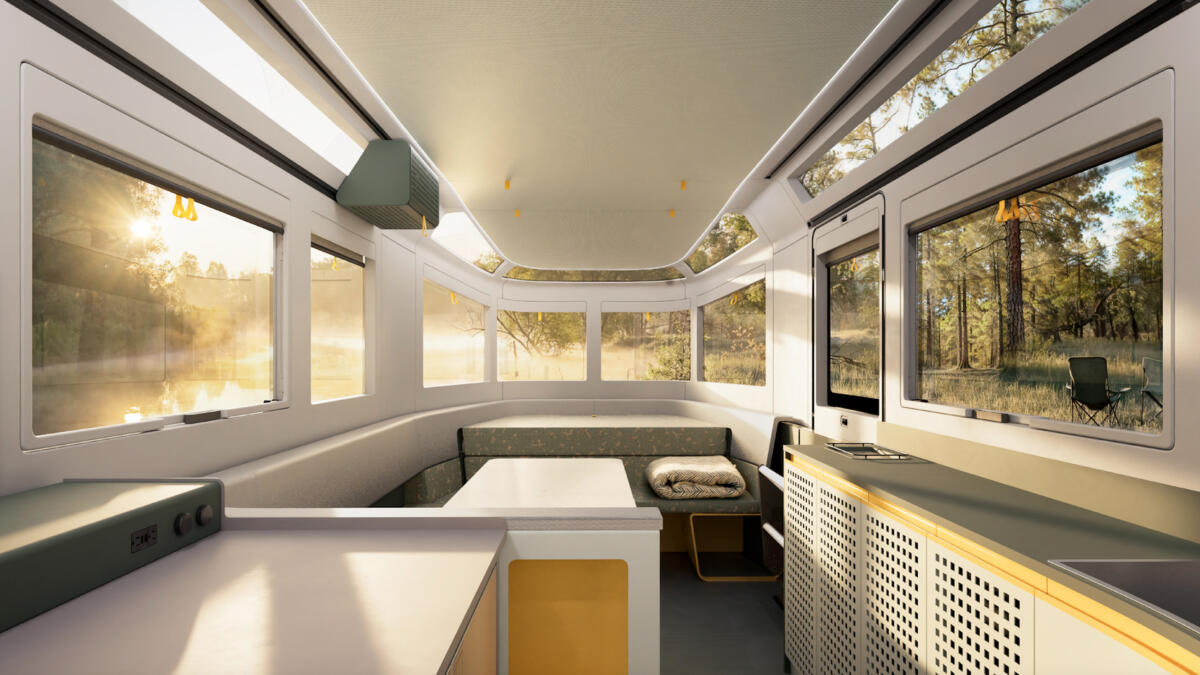 Lightship provided a wealth of promotional photos. And they are intriguing. Lots of windows to bring in the light—and the scenery. Sleek, very much no-boxy lines. Unlike the huge majority of travel trailers on the road today, Lightship trailers in “travel mode” sit a lot closer to the ground. Once on location, users will need to raise the roof to have room on board for normal activities. We couldn’t tell whether the interior of the rig could be accessed when in travel mode.
Between the promotional text and the pictures, one could see how some perhaps not familiar with the nuts-and-bolts of RVing could easily plunk down the $7,500 reservation fee to be in line to get one of the 50, limited edition, Cosmos rigs—in one of “two unique colorways.”
What’s not stated raises serious questions
But let’s talk about those nuts and bolts for a minute. We asked Lightship for information not spelled out in its news release, and isn’t found on the company website. Foremost in our minds was weight. We figured this rig would have to be a lightweight to have the ability to be towed without a lot of drag on an EV, or to meet the company claims “improved fuel economy” for those towing with an internal combustion rig. We asked for specs, and here’s what we got back:
 “Unloaded vehicle weight: The AE.1 Cosmos has a dry weight of 7450 lbs., and an estimated 8300 lbs. fully loaded. Its tongue weight is 820 lbs. An RV’s dry weight is the vehicle’s total weight without any fluids, passengers, cargo, or optional equipment. This includes empty fresh water tanks, fuel tanks, and waste tanks.”
“Estimated 8300 lbs. fully loaded” must translate to the rig’s GVWR (gross vehicle weigh rating). GVWR minus dry weight equals cargo carrying capacity. Which is—850 pounds.
What else could make a difference in that figure? Some other all-important specifications. The AE.1 Cosmos comes with a 50-gallon fresh water tank, a 35-gallon gray water tank, and a 30-gallon black water tank.
Assuming you hit the road with empty waste tanks, and a full fresh tank, your “new” cargo carrying ability works out this way: 50 gallons of fresh water at eight pounds per gallon equals 400 pounds. Cargo carrying capacity, 850 pounds, less fresh water, now reduced to 450 pounds.
How much capacity is enough?
450 pounds for food, clothing, personal gear, and aftermarket “optional equipment” is completely insufficient for the average RVer. And let’s do a “what if.” Let’s say you’ve been out for a week camping, and now your black tank is half-full. It’s too soon to dump it, without risking a “poop pyramid.” So you fill up your fresh tank—400 pounds, and have a half-full black tank—60 pounds. Now your “cargo” capacity is down to 390 pounds, assuming you dumped your gray tank.
One RVer weighed his rig, just to see how much gear he and his wife would take for a weekend getaway. “Sewer stuff, chocks, BBQ, kitchen stuff (dishes, cutlery, toaster, food, etc.), clothing, bathroom stuff, couple dozen bottled water, books & DVDs, some tools, etc., etc. The weight of all the cargo added to the TT came to 555 pounds.” If he used the Lightship Cosmos, with a full fresh tank, and his usual gear, he’d be 105 pounds overweight. Yet, Cosmos says it’s ready to accommodate four passengers.
Other specifications you might want to know.
Battery capacity: “Lightship trailers are equipped with an advanced battery system including 77 kWh of Lithium Iron Phosphate (LFP) battery storage.”
Solar power output: “Lightship trailers are also equipped with 1.8 kW of integrated rooftop solar power capabilities to run your climate control and appliances, delivering a week or more of off-grid living.” We’d call that a “remains to be seen” statement. 1,800 watts of solar power on the roof sounds impressive, but that depends on how much cooling you need—and how much reserve in the battery bank you’ll need to leave to get back to a charge station to keep that self-propulsion going.
Not RVIA member—Does that make a difference?
 Finally, we were interested in certifications. We asked if Lightship RV is an RVIA (RV Industry Association) member? If it is, then each rig should come with the RVIA “shield” assuring that the rigs meet industry standards. We were told, “While we are not currently RVIA members, we have designed all of our Lightship travel trailers to meet or exceed RVIA standards.”
That could make a difference. While often seen as an RV industry promotional gimmick, the RVIA certification shield makes a difference. Some RV parks won’t allow a non-shielded RV on their premises. Getting an RV loan on a non-certified rig can be problematic. And while experienced RVers know that the RVIA shield isn’t worth a hill of beans in terms of assuring a quality build, there is a certain level of safety assurance. An outside group inspects 500 points for safety in an RVIA member plant. Are you willing to just take a builder’s word that they “meet or exceed RVIA standards”?
A quarter million dollars for a never-before-produced travel trailer? A quarter-million dollars with a pittance of cargo-carrying capacity? If we had a quarter-mil, we’d wait and see how things turn out for Lightship RV buyers of this first-generation experiment in e-RVing.”
Updated: Corrected error that showed “Lightship” as “Lighthouse.” We regret the error. 12/12/2024 at 1059 a.m. PST
##RVT1187b

Once the trailer is set up, you will want to be inside it part of the time, at least. YOU count as “cargo”. Better start seriously dieting!
IF I had a quarter mill I would not be looking to unload it on anything I can tow. Not sure I want it pushing me around a curve I’m trying to slow down for. Have a hard time trusting that brand new tech.
Very thorough reporting. Think I’ll wait until it’s up to snuff, and not so darned expensive. Maybe they’ll upgrade to hybrids.
I BEG your pardon? I bought my ALL-ELECTRIC molded fiberglass LilSnoozy in 2016! 17 feet. Wet bath. Elec heater and it came with elec spaceheater, H2O heater& induction cooktop, black water Thetform casset toilet, A/C & option of 12V fridge. Mine was #192 of the originals, newr are Snoozy2. Not totally dry weight was 2463 lbs, I wish I could quit reading about FIRST ALL ELECTRIC RVs when they AREN’T 1st!
Or this one…
https://www.winnebago.com/all-electric
Sounds like a great sales pitch.
Provide us 1/4M$ of venture capital, and we just might provide with a return (aka product) in, maybe, a year.
This doesn’t seem to fit the RV customer demographic.
My biggest issue would be the “sleek” black & glass being low to the ground when traveling. I’ve owned black cars, and they need constant washing. All that road spray? No thank you. Even without actually seeing it, looking out those windows after a travel day horrifies me!
The world isn’t looking for an overpriced overweight toaster campgrounds will charge extra for power but a missing RVIA sticker isn’t the problem.
I still think this is “pie-in-the-sky” stuff. This race to battery powered everything is not supported by our power grid.
Or by common sense……..
Common sense would be having a complete personal solar power system if you live in Nevada.
Pretty awesome. Obviously expensive for the first release but this company, along with Pebble, shows great promise for the future of RVing. I hope they can push everyone in the industry to better EV RVing down the road. It is the future & is so much better. Once you go EV you never go back.
Hi Dave. Do you RV in an EV? I think the future could be promising, but the lack of charging stations in most parts of the country, the range degradation of towing, and the expense of EVs are all very real challenges that make RVing more than 40-50 miles from home unrealistic for now. But, that can change.
I look forward to being able to RV in an EV. Not yet but hopefully in less than 3 years. Feeling optimistic for the future.
Propulsion. Not much mentioned in the article on what it does or what it actually is. Does it assist the mother ship or park itself? This was definitely a slick marketing article with too few details. I’ll stick to the Class A DP.
This thing looks like a giant coffin. I hope it doesn’t turn out to be one!
Good job making it sound absolutely horrible. I bet you thought those new fangled auto-mobiles, microwaves and cell phones were a horrible idea also.
Someone, obviously not the authors, are going to buy them, and it’s either going to flop, or improve with the subsequent generations.
What am I missing? It still needs to be towed by a vehicle.
With enough batteries to propel it hundreds of miles, it’s hard to believe it comes in at only 7450.
This industry does need some innovation. But it also needs realistic specs too.
This is OUTSTANDING and with only a few minor modifications like removing 80% of the batteries and adding a generator, it would most likely disrupt the current market and allow for other than single use foam plates and foam cups in cupboards. This simple modification would add another 500-800 lbs of cargo capacity and allow you to park under a tree in the summer. I imagine that the Second generation model, we will see this minor alteration for this unique platform.
Counting down the days until viable solid state batteries are available at a reasonable cost.
I won’t have “buyer’s remorse” because I’ll never own one. We just need someone to build a basic quality camper worth the money. Too many quality issues being manufactured into RV industry.
Thank you, Russ and Tina! Gear?!? We don’t need no stinkin’ gear! 😉 Don’t need this RV either. 🙂 Thank you for getting the rest of the story! Happy new year and safe travels! 🙂