

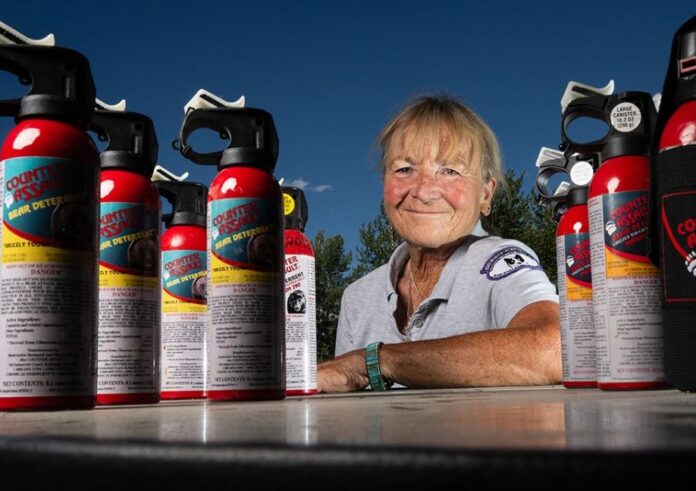
Before bear spray, human–bear encounters often ended in gunfire. That began to change in the 1980s when University of Montana graduate student Carrie Hunt developed a new, nonlethal deterrent, which most of us know as “bear spray.”
Hunt grew up in Chile and later studied zoology in Montana, where she became fascinated by animal behavior. After college, she worked with the Interagency Grizzly Bear Study Team in Yellowstone National Park and watched many bears she knew relocated or euthanized after conflicts with people. Realizing the scale and seriousness of the problem, she returned to the University of Montana in 1981 to study under biologist Dr. Chuck Jonkel.
The use of pepper spray
With only $500 in funding, Hunt began testing deterrents. Early trials ranged from mothballs and flares to human urine and boat horns. Her breakthrough came with Halt, a pepper spray used by postal workers on dogs.
A Canadian biologist had tried it on a charging polar bear, so Hunt tested it on grizzlies at sites like trash dumps. The results were consistent: the spray turned away every bear, though the narrow 6-foot stream forced testers dangerously close.
Seeking a better delivery system, Hunt teamed up with Vietnam veteran Bill Pounds, who helped redesign the canister to project a wide cone of spray up to 20 feet. Pounds later founded Counter Assault, the first EPA-registered bear spray brand. Hunt handed over the formula in exchange for free spray for life.
Federal bear spray standards
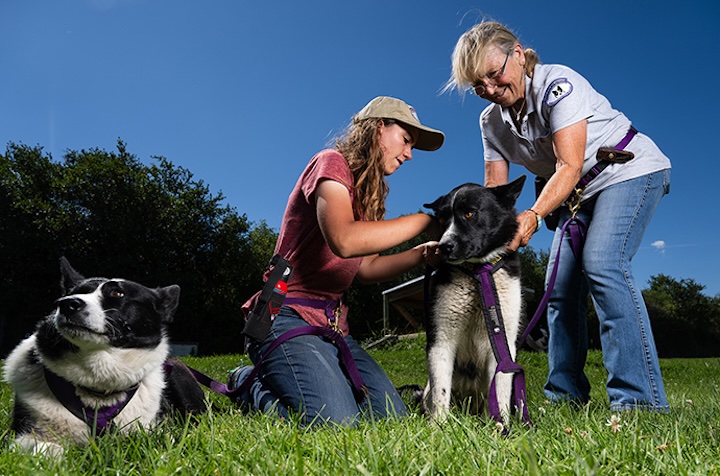
Hunt published her findings in 1984, laying the groundwork for today’s federal bear spray standards. She went on to develop nonlethal methods like rubber bullets and trained Karelian bear dogs, eventually founding the Wind River Bear Institute in 1996. For decades, she has trained biologists and dog-handling teams, shaping modern human–bear coexistence.
“When I started all this, there was no science of human-wildlife conflict,” Hunt said. “I wanted to make a difference for bears and for how humans and animals relate to one another.”
RELATED
• Bear chases hikers; bear spray no help
• Keeping bear spray in your RV can have disastrous consequences
• Bear safety: How to use bear spray scenarios and demos you MUST SEE!
• Lake Tahoe bear breaks into RV, injures camper
• See what damage a bear can do to an RV
• How fast can a bear run? Very fast!
• As wildlife moves into urban areas, people and pets at greater risk
• See wildlife up ahead? Great! Here are some tips for safely observing wildlife
RVT1236

Good for Carrie!!! There will always be situations where humans and bears accidently find themselves in the wrong location at the same time. Needless slaughter of either shouldn’t be the result. For the rest of the potential situations, humans need better training before entering bear habitats. Our domicile is in black bear territory. Just like natives in rattlesnake territory, we don’t fear the critters but sure do respect them. Tourons needlessly get themselves in trouble.
Thanks for sharing this article!
wonder if it might be possible to train a grizzly, or any bear for that matter – to fear humans? If they could scared off by a human, or human shape with odors, firing many loud rounds and also spraying them with various products which they don’t like or irritates them. Maybe someone can do some research on that and prevent some bear euthanizing. Such magnificent and smart animals.
I’m not sure why the headline for this article refers to the “unlikely inventor” of bear spray. I sure hope it wasn’t because she’s a woman. But thanks for the interesting article.
No, Laura, I thought when I wrote the headline that most people, if asked, would have thought it would have been a big company that made other products for the outdoor industry. Certainly it was not because she’s a woman. A woman doing exceptional work in any field is hardly news today. Maybe a hundred years ago, but not today.