


Want to get inspired as you shape your hamburger patties and mix up the ‘tater salad for your 4th of July celebration? Maybe you want some inspiration while getting ready to attend the fireworks celebration? If you answered “yes” to either question, I have the ultimate 4th of July music playlist for you. It’s eight hours of continuous patriotic music. Enjoy!
4th of July music: The Star-Spangled Banner
Our national anthem is probably one of the most recognizable pieces of music on the planet. I learned as a child that Francis Scott Key wrote our national anthem. What I didn’t learn were all of the underlying details—his inspiration for penning the words. Here’s a brief summary for you.
Baltimore Harbor
On a rainy September 13, 1814, the skies over Baltimore Harbor lit up with the ferocious bombardment of Fort McHenry. British warships, relentless and determined, unleashed a downpour of shells and rockets onto the American fort, a barrage that lasted a grueling 25 hours.
This intense assault, known as the Battle of Baltimore, unfolded mere weeks after British forces had attacked Washington, D.C. At that time the British set fire to the United States Capitol, the Treasury, and the White House (or President’s House). It was yet another dramatic episode in the ongoing War of 1812.
Francis Scott Key
Just a week before this pivotal battle, a 35-year-old American lawyer named Francis Scott Key found himself aboard the flagship of the British fleet on the Chesapeake Bay. His mission was a delicate one: to secure the release of his friend, physician William Beanes, who had been recently arrested by the British.
Key’s negotiations were successful, but his timing was very precarious. Because Key knew about the impending attack on Baltimore, the British decided to hold Key and his companion. Beanes and Key were allowed to return to their own nearby vessel, but they were closely monitored by British soldiers.
Chaos
On September 13, as the fierce bombardment of Fort McHenry began from a distance of some eight miles, Key and Beanes had front-row seats to the unfolding chaos. The sky erupted in a relentless display of firepower.
As night fell, the only visible light came from the red glare of the rockets, casting an eerie red glow over the harbor. Key, like many, feared the worst—believing the British would surely claim victory by dawn.
First light delight
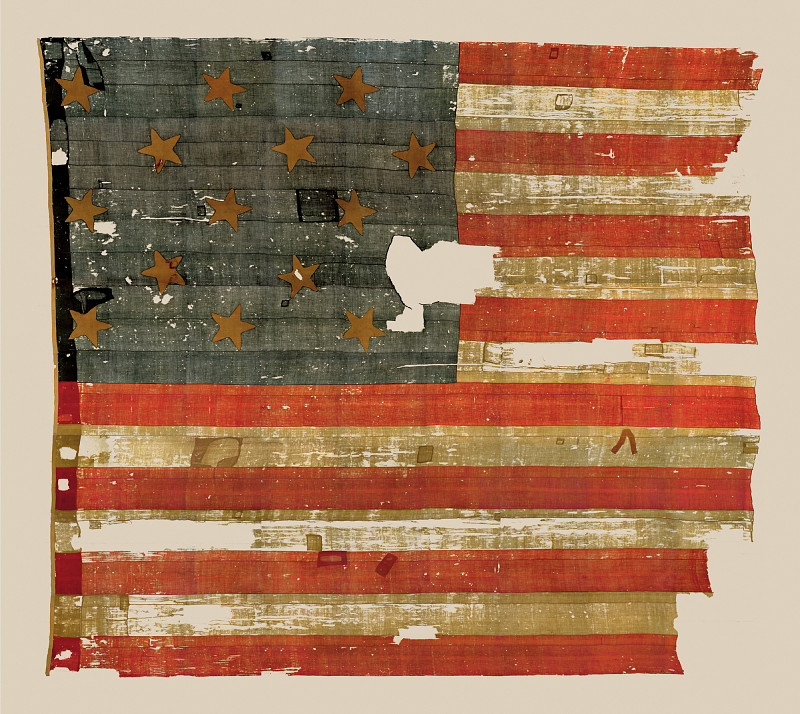
As the first light of September 14 crept over the horizon, the smoke cleared, and a remarkable sight met Key’s eyes. Flying proudly above the battered fort was not the British Union Jack, but the American flag. This resilient symbol of defiance and hope signaled an unexpected American victory.
The song
Overwhelmed by the sight, Key was moved to pen his thoughts on paper while still on board the ship. He set his stirring words to the tune of a popular English song. His brother-in-law, who commanded a militia at Fort McHenry, read Key’s composition and quickly arranged for its distribution under the title “Defence of Fort M’Henry.”
The Baltimore Patriot newspaper soon published it, and within weeks, Key’s poem, now known as “The Star-Spangled Banner,” spread across the country. His evocative words captured the spirit of the moment and forever immortalized the flag they celebrated.
Civil War
Throughout the 19th century, “The Star-Spangled Banner” gained popularity, emerging as a symbol of unity during the Civil War. However, it was not until 1931 that it was officially adopted as the national anthem of the United States.
Flag remains
Today, the very flag that inspired Key’s timeless words remains a cherished artifact. Though fragile and worn by time, it is preserved with great care. First lent to the Smithsonian Institution in 1907, this historic symbol is now displayed in a state-of-the-art gallery at the National Museum of American History (NMAH).
Take a moment
I hope you’ll take a moment or two this 4th of July to reflect on the wonderful country that we’re privileged to see and enjoy via our RVs. Even with our flaws, there’s no other place I’d rather live.
Listen to the best 4th of July music in the playlist below.
##RVDT2419

Thank you for writing this article, Gail. It should be perused and appreciated by many! In that spirit, I hope you don’t mind that I am sharing it with all the attendees of our 4th of July celebration here at the Indian Lake compound. Credit to you and RV Travel given, of course.
Thank you, Gail! 🙂 I hope that you’re having a wonderful Independence Day! Thank you for recounting the story of the writing of the Star Spangled Banner. That war did not go all that well for the fledgling US, but certainly the writing of the song’s words was one of the highlights. Thanks again, safe travels, and safe stays! 🙂