


Good morning, Dave,
My wife and I are planning to become snowbirds in a couple years, and I’m trying to prepare our rig for dispersed camping. Many solar setups seem to charge the rig’s 12-volt battery only. Is it practical to eliminate that battery and put a separate solar system (12 or 24 volts) and wire the 120 volts directly to the rig’s shore power? The system I’ve been considering is from SunGoldPower, a 3000-watt off-grid system. I know it would depend on what we use for power in the rig, and I don’t know that yet. Thank you for all you do. —Joe, 2019 Grand Design Imagine 2250RK
Hi, Joe,
I assume you are referring to the house battery. No, you cannot remove that battery as it needs to store power for 12-volt components or 120-volt through an inverter.
As RVs have become more sophisticated and technical with the different batteries available, solar panels, inverters, and all the Bluetooth options they have also become more confusing. In our homes it’s easy: We can plug in and run just about any appliance, don’t have to worry about charging the batteries, and no worries about the LP unless we live in a remote area that has a large outside tank.
Asked an expert on solar panels
When I read your question, since I am not an expert on all the various solar panel systems and arrays and definitely not 24 volts, I had several questions regarding what you were trying to accomplish.
So, I sent the question off to one of my contacts at a solar panel provider. He suggested starting with a little tutorial on how the 12-volt house system works with a solar charging system, as you had indicated eliminating the house battery.
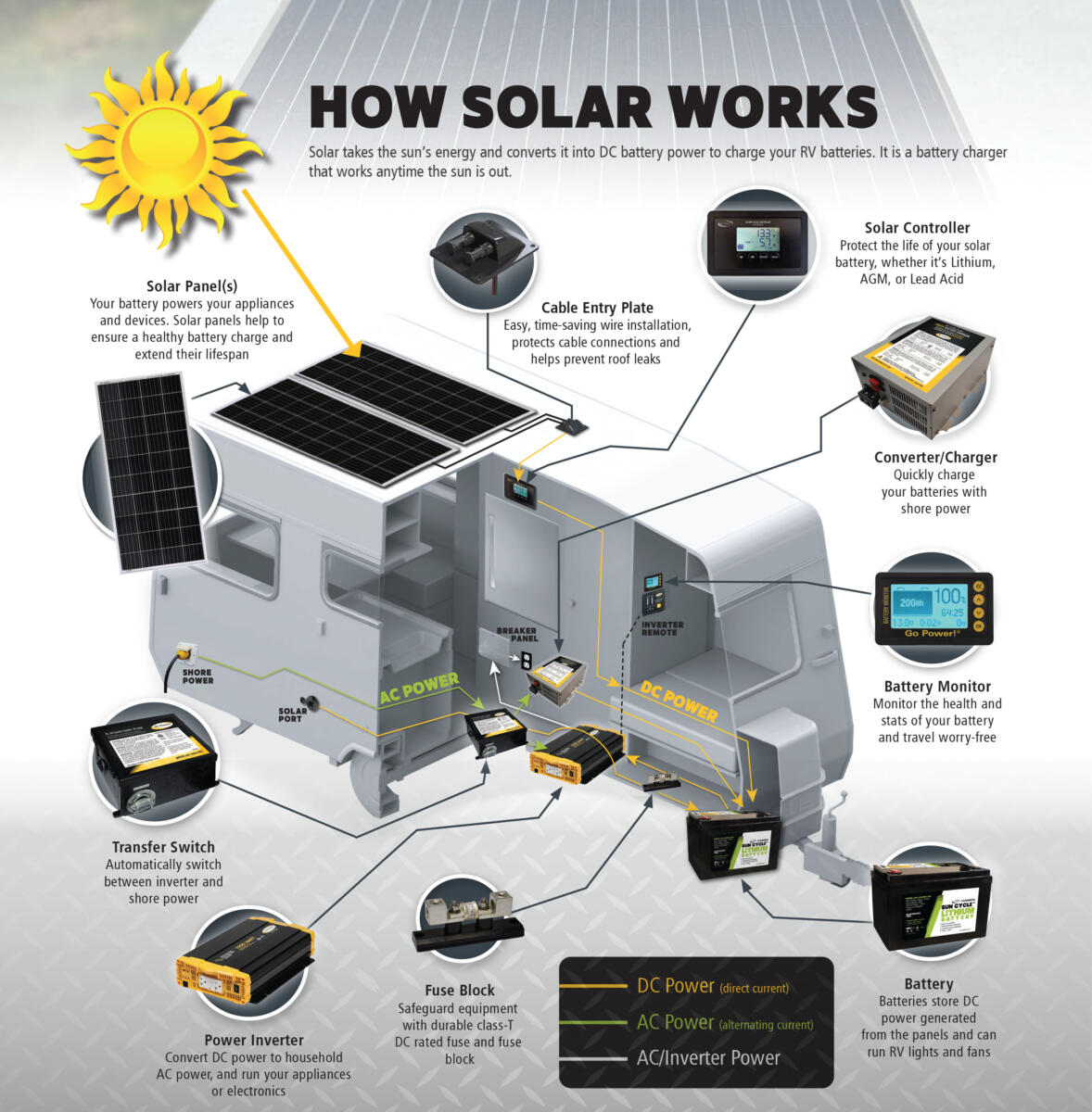
The house battery or batteries are simply storage devices and provide 12-volt power to the distribution center for components such as interior lights, roof vents, water pump, and any appliance that runs on LP. An absorption refrigerator running on LP needs 12-volt power for the module board, thermistor, and eyebrow board to open and close the gas valve, ignite spark, and determine temperature. The furnace needs 12-volt power for the same reasons but also to run the fan motor.
12-volt power can also be converted by an inverter to provide 120-volt power to outlets that run a residential refrigerator, TV, microwave and other appliances. All this comes from the battery when dry camping. If you do not have a deep cycle house battery or batteries, the only way you can power these components is by being plugged into a 120-volt source (shoreline) and getting 12-volt power from the converter/battery charger.
If you “eliminate that battery,” which I assume you are referring to the 12-volt house battery, you have no storage device and would need to be plugged into shoreline power all the time.
How solar panels provide power
To me, it’s all “moon dust and monkey glands.” I do not understand the technical aspect, but, in a nutshell, solar panels have crystals that convert the sun’s rays to 12-volt power. This power is transmitted through cables and typically a charge controller to the house batteries. They do not produce 120-volt power, but rather 12-volt power to charge the batteries.
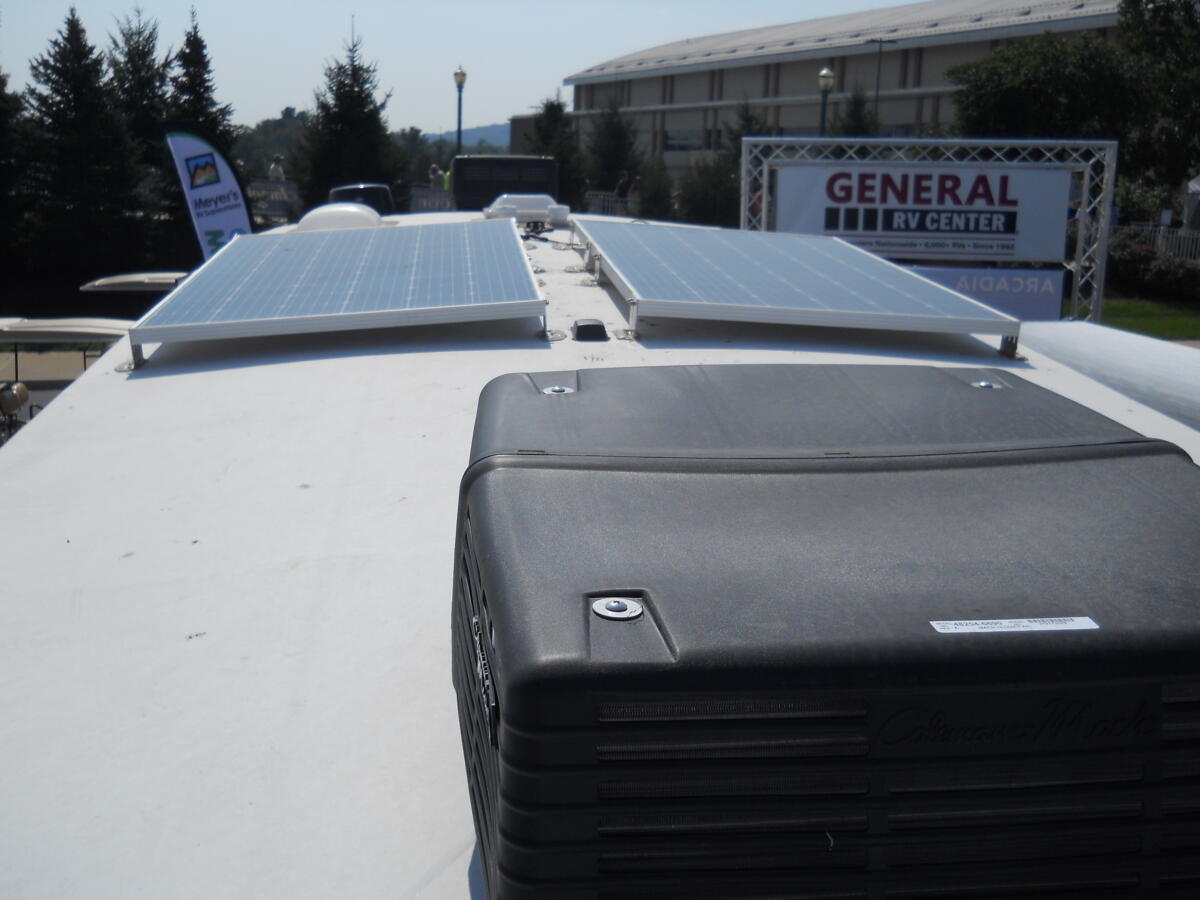
So, unlike the shoreline cord that provides continuous 120-volt power to the rig and 12-volt power to the batteries through the converter/battery charger, the solar panels would not be able to provide continuous 120-volt power.
However, as I have stated many times, never say never when it comes to the RV industry. I will do more research, but I do not know of any solar panels that would provide 120-volt power directly. But I never thought a car could drive itself, either! Plus, there would be no power at night and during heavy overcast or limited line of sight.
You might also enjoy this from Dave
When using RV solar panel, should I turn off inverter when plugged into shore power?
Dear Dave,
I have 300 watts of solar on my rig. I would like to use this solar-generated power in lieu of 120-volt shore power while I’m plugged into shore power. Does this occur automatically, or do I need to turn off the inverter somehow? Thanks. —Fermor, 2017 Coleman 185RB
Dave Solberg is a leading expert in the RV industry and the author of the “RV Handbook.”
Read more from Dave here.
HAVE A QUESTION FOR DAVE?
Send your inquiries to him using the form below.
##RVDT2537


Solar doesn’t produce AC, so things that require 120 AC power will not function properly, if at all. House battery pack is a must.
Another fact based article. Thanks Dave.
Just as you should never simultaneously be running a generator and plugged into the grid, I would think the same would be true of using any non-grid power source. The needed switching could be automated, but is still needed. With an RV’s so called 12vdc (actually the voltages tend to be a tad higher) solar system, I would think there would be a switch (a couple big diodes) to prevent back feeding into the 120vac to 12vdc converter. Power to recharge the battery would at any time come from one or the other, but not both simultaneously.
The output of solar cells is not consistent. The voltage varies with the amount of sunlight hitting the cells. This the reason for batteries to store the power. And an inverter is still required to convert the DC to AC. It would take a LARGE solar array, massive battery bank and inverter to produce enough power to for a 30 amp supply.
Thank you, Dave! Good answer. Among my running buddies were several engineers in the Energy Efficiency and Renewable Energy Office. One did solar, another wind, and a third geothermal. They all had the same complaint, in that all these sources only intermittently provide power. This means that the limiting factor in terms of usefulness for all is battery technology. It remains so and will. Alternate energy is a hostage to battery technology. Storage (=battery capacity) is key to solar power having value. Happy new year and safe travels! 🙂