

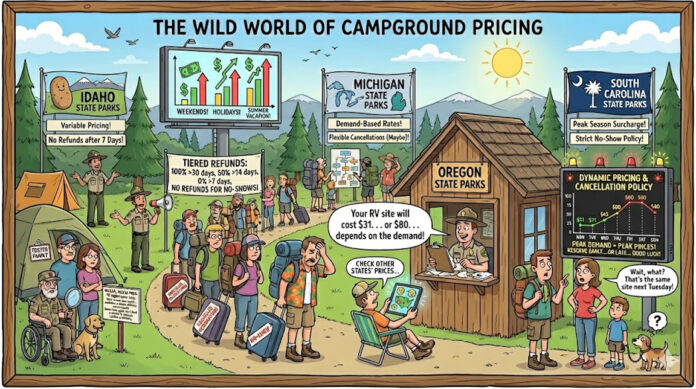
If you’ve ever struggled to snag a campsite in a popular state park, Oregon’s latest move might catch your attention. Facing a multimillion-dollar budget gap and fed up with empty sites caused by late cancellations, the state is weighing a major overhaul of how its parks operate—from refunds to pricing to perks for passholders. And for campers watching from other states, the big question is unavoidable: Could these changes be coming your way next?
The Oregon Parks and Recreation Commission voted in November to reopen its rulebook as it confronts an $8 million budget shortfall. The agency is proposing tighter refund rules, smaller free-camping benefits for certain passholders, and permission to use dynamic pricing for busy campgrounds.
A public comment period runs through January 15 (submit comments by email to OPRD.Publiccomment@oprd.oregon.gov), with a virtual hearing set for December 15. If approved, the changes would take effect March 1, 2026, according to the department.
No-shows take plenty of blame
Crowded campgrounds and last-minute cancellations are driving much of the change. The parks department says roughly 30% of all reservations are canceled, often too late for another camper to pick up the site.
At a November meeting, Oregon parks spokesperson Katie Gauthier told commissioners that the current system—which allows full refunds for cancellations within three days of arrival—has contributed to empty sites at high-demand parks. The commission is considering a tiered refund system that rewards early cancellations and eliminates refunds for no-shows, a central part of its state parks dynamic pricing and cancellation policy overhaul.
The agency also wants the flexibility to adjust campsite prices by season, day of the week, or demand. Oregon officials emphasized during the meeting that they aren’t planning immediate increases, but want the option as costs rise—another component of the proposed state parks dynamic pricing and cancellation policy.
Other states are already moving in this direction
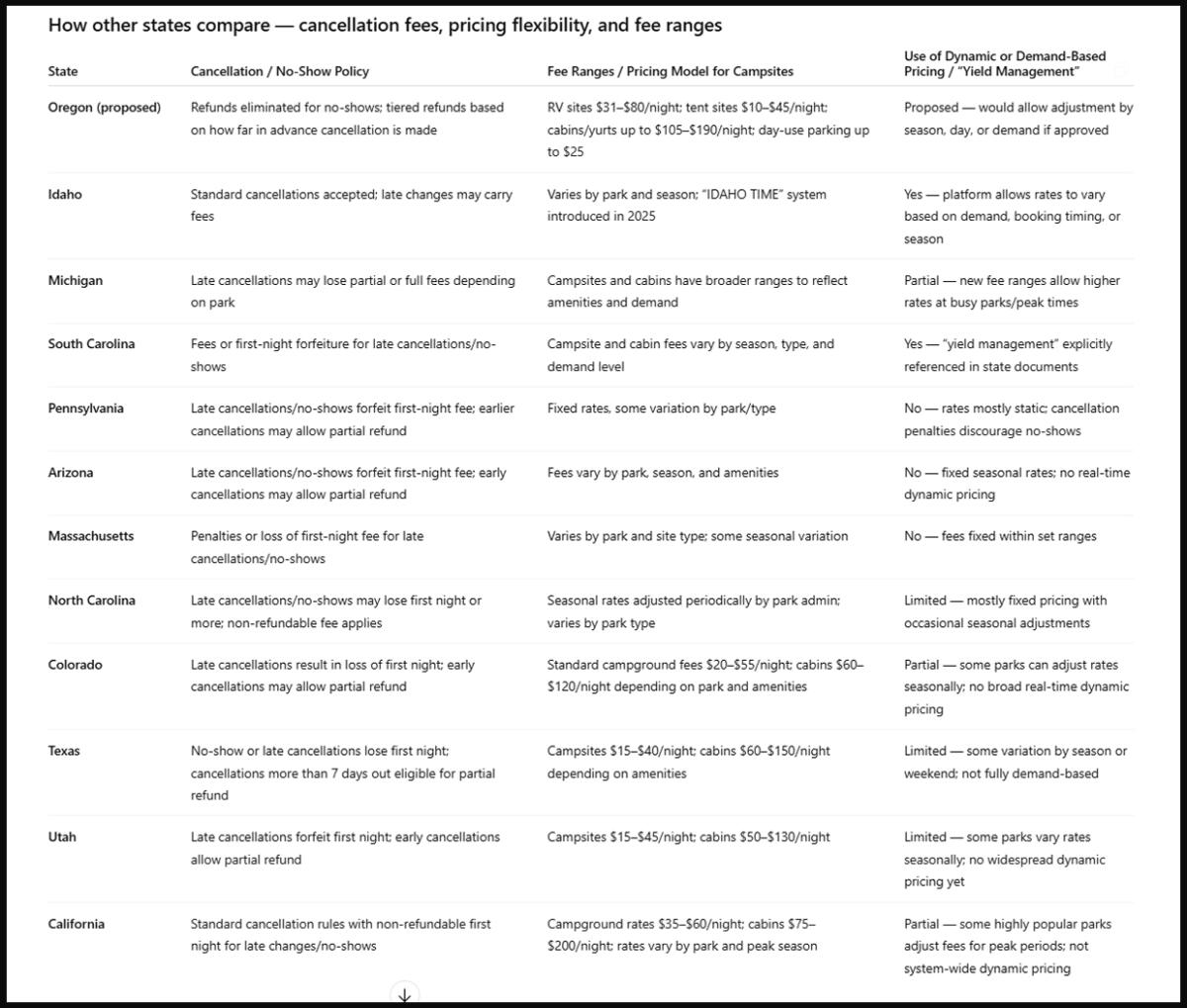
Oregon isn’t the first state to try this, and in some cases, it’s playing catch-up. Across the country, other states are experimenting with state parks’ dynamic pricing and cancellation policy adjustments to manage crowded parks better and maximize revenue:
- Idaho launched a new reservation platform in early 2025 that allows campground prices to vary based on demand, booking timing, and season, according to the Idaho Department of Parks and Recreation.
- Michigan updated campsite and cabin fees for 2025, creating broader ranges to reflect popularity, location, and amenities. While not officially “dynamic pricing,” the ranges allow managers to raise rates at high-demand parks.
- South Carolina explicitly uses “yield management” in state documents, giving managers authority to raise or lower rates based on demand.
- Pennsylvania, Massachusetts, and Arizona already impose escalating cancellation penalties and keep the first night’s fee for late cancellations or no-shows.
Will most U.S. states follow Oregon’s lead?
Probably not all at once—but the trend is clear. States are facing surging visitation, aging infrastructure, and rising costs. Dynamic pricing and stricter cancellation rules are increasingly common, and the adoption of state parks dynamic pricing and cancellation policy measures is likely to grow, while scaled-back freebies for veterans and foster families remain more sensitive and less likely to spread quickly.
Taken together, Oregon’s proposal mirrors what many states are already experimenting with: keeping campsites full, discouraging last-minute cancellations, and capturing more revenue during peak demand.
Whether these ideas become the norm in a majority of states will likely hinge on how early adopters fare and how much pushback they get from campers who worry that state park trips could start to feel more like booking an airline ticket.
Sources include The Salem Reporter
RELATED
- Camping at Southern Oregon’s beautiful Harris Beach State Park
- Oregon to increase camping rates to highest level at nearly 30 parks
- Oregon’s Silver Falls State Park campground reopens
- The 10 most popular state parks in the U.S., according to Google Maps
- RVtravel.com readers reveal their favorite state parks
- RVers share their favorite state parks
RVT1238b


This is an incomplete story. Why would you talk about a hearing and public comment and not give links to that information?
We apologize for the unintentional oversight, James. Links have been added. Have a great day. 😀 –Diane at RVtravel.com
What’s wrong with the old way, First Come-First Served? It worked for my family and me for years.
Exactly. If you want reservations, go to an RV Resort.
First-come, first-served always takes care of itself, and at the end of the day, you know what it will cost. On a fixed income, every dollar counts, or you stop going.
I personally don’t care if a refund for cancellation is given or not. In decades of camping, only once have we cancelled and it was due to a mechanical issue.
Where I draw the line is dynamic pricing. When reservation systems try that on me I just back out and quit the reservation. If everyone did that the process would soon be a thing of the past for all of us.
Think about it…if I accept some dynamic outrageous rate based on “current” reservations booked, and then 30% cancel, my dynamic rate was grossly out of line as the real demand never materialized. I paid for others’ cancels. Screw that!
A 30% cancellation rate will falsely overstate occupancy thus incorrectly driving up the dynamic pricing rate. Oregon’s budget deficit will only widen….
If our plans changes for any reason, we always cancel.
Given that reservations are managed by software, folks who do cancel should receive a refund if someone reserves the canceled site. Doing so might encourage others to cancel even for a partial refund.
I was on a “wait” list for canceled sites at a state park this summer for 3 different weeks. Anytime I received notification of an available site, I checked. They were always booked.
I don’t buy the comments about the extra work, etc. It’s all done by software, not humans. If they can do dynamic pricing, then they can issue refunds if a site is booked by someone else.
In some locations you may be correct. In Utah, WY, MT, many/most USFS sites have no elec., water, sewer or communications at all. Reservations are hand delivered to the host about every 3 days.
I just hope state parks don’t try real dynamic pricing. Bad enough they can raise prices based on “popularity”. Since they’re at least PARTLY funded by taxes, they should have less leeway in increasing prices. For that matter, state parks should give significant discounts to veterans, active duty military, and first responders, IMO…