America’s Byways is a great website for RVers and is especially useful for those of us that boondock in the western United States. The website lists National Scenic Byways and All-American Roads across America. The website offers a wealth of information to the traveling public featuring the archeological, cultural, historic, natural, recreational and scenic qualities available along each designated route. By clicking on one of the Byways you will receive a listing of all the things to see and do along the route as well as suggested itineraries, distance and travel times. Links for each attraction are provided for those wishing to learn more.
Outback Scenic Byway — Helgeson
Since the majority of western byways meander through portions of public land, boondocking is quite often an option while traveling these byways with an RV. Sidebar links list the public land agency administering the land and quickly take you to their website, where with a little research you can locate their “dispersed camping” aka boondocking guidelines. It truly is one-stop shopping for the active boondocker. Give it a try when planning your next RV outing.
“Tire blowout: A rapid loss of inflation pressure of a pneumatic tire leading to an explosion.” – Wikipedia
Having a blowout while driving your car can be a nerve-racking experience. Now, in your mind, put yourself behind the wheel of a motorhome and the gut-wrenching imagery increases exponentially. Still, a blown tire on an RV, regardless of its size or type, is not a “game-ender.” Keeping a cool head and reacting properly can mean a safe — and stable — outcome. It’s a matter of understanding and applying some simple rules.
First, prepare yourself, and your motorhome. Blown tires on RVs are most likely to occur because either the tire was overloaded, or underinflated. It’s wise to weigh EACH tire on your rig to ensure it is not beyond its rated weight. On the road, it’s best to check your tire pressure daily, before you hit the road. Test your tire pressure COLD — that is, before you’ve driven on it that day.
Next, once in the driver seat, ALWAYS buckle your seat belt. This isn’t just to protect you in case of an accident, it could well PREVENT an accident. If you blow a tire, you’ll need to stay fixed firmly in the driver seat, not sloshing around. Properly adjusted, the seat belt will help keep you where you belong — behind the wheel and in control.
So when the awful thing happens, what’s to do? It’s probably counterintuitive. Most of us, on hearing a blown tire and feeling the reaction, want to stop, NOW! That’s the WRONG thing to do. Your RV has been moving forward happily, not giving you any trouble. Your control of the RV is partially due to the forward momentum. When a tire blows, the rig will naturally pull in the direction of the blown tire — off the road, or possibly into oncoming traffic.
Getting off the gas or stepping on the brake simply gives more “force” to the pull of the blown tire. The thing to do is to actually step on the accelerator. You’re not trying to speed up dramatically, but by increasing the forward momentum, you are actually helping to keep the rig stable. At the same time, you’ll want to steer to correct for the “pull” of the vehicle. This part you already know — when a side wind pushes against the rig and steering is affected, you automatically correct for it with the steering wheel. The same is true for the force of a blown tire — correct with the steering wheel.
Once you have the RV back in control (and it may take some effort with the steering), THEN you can start planning an out. Look for a safe place to pull the rig over and get off the road. You can moderate your speed, simply by moderating how much you’re mashing on the accelerator. Make a controlled pull off, and stop the rig.
These simple rules for handling a blowout apply in all situations. It doesn’t matter if the blown tire is up front on a “steering” wheel, or on a rear “drive wheel,” on a straight stretch, or in a curve. Apply these rules, and your chances of coming to a safe stop are greatly enhanced.
Chris Dougherty is a certified RV technician. Here is a letter he received from a reader while he was serving as RVtravel.com’s technical editor.
Dear Chris, I viewed the RV Doctor’s video on “combination compartment locks.” Most locks come with a “flat” as well as an “offset” cam to hold the door shut. The combination locks that I looked at previously showed the locks with only a “flat cam.” Is the flat cam permanently attached to the lock or can a screw be removed to exchange the different “offset” cams? (From the locks that I currently have and would be replacing as I need the offset cam.) Thanks. —Jerry
Dear Jerry, The product you are referring to is the Combi-Cam lock and, yes, the cam can be replaced, as it is attached with a screw. The lock comes complete with two straight cams and an offset cam in the box. That said, I am not certain if the cam attachment dimensions are the same as with standard cam locks, but it would be worth a try, if one of the included ones won’t work. If they were not to work, the company offers a number of accessories, including cams for various applications. They can be found at combi-cam.com or on Amazon.
There is a big difference between stabilizing and leveling an RV. You need to know the difference to properly use the equipment on your particular RV.
Leveling a coach is to bring the unit to a comfortable level position for camping. This requires lifting the weight of the coach from its normal driving position to a level position.
Andersen Levelers
Stabilizing a coach is to reduce the amount of undesired movement in the coach while in use by making a physical connection between the coach’s frame and the ground.
Valterra stabilizer
Please understand that if your new RV is equipped with stabilizing jacks, they absolutely cannot support the weight of the coach. You must first level the coach by backing the wheels onto boards or Lynx Levelers, etc., to get side-to-side leveling. For front-to-back leveling, use the tongue jack/landing jacks. Then deploy the stabilizing jacks to minimize the bouncing/rocking movement of the coach.
Lippert stabilizers
If your coach is equipped with hydraulic leveling jacks, they are designed to take the weight of the coach, but you must follow the manufacturer’s directions closely.
As a general rule, if it’s hydraulic, it levels; if it has an electric motor or a manual crank, it stabilizes.
In all cases, make sure your coach is parked on stable ground, and that the wheels are chocked properly at all time while stabilized or leveled.
More information on your particular system can be found in your owner’s packet or by asking your orientation technician or service advisors.
Information can also be obtained from your coach manufacturer, or the individual component manufacturer, such as Lippert Components, HWH, Power Gear and so on. You can also see a video from the RV Doctor, Gary Bunzer, explaining leveling systems and stabilizer jacks. Watch the video.
Article courtesy Diamond RV Centre, West Hatfield, Mass.
By Mike Sherman
Having full-timed now for 5 months, we have learned a lot. Here’s an overview of our experience and lessons learned.
After 30 years of RVing, we finally reached retirement and jumped at the opportunity to sell our home and belongings and see America full time. We started out with a 12′ trailer many years ago and gradually moved up….or longer….having gone through a 22′ and then a 24′ travel trailer. Then it was on to a 32′ Class A motorhome which was a real pleasure and made RVing easier. No pop-outs, automatic levelers and all the creature comforts. It worked well….we did not pull a ‘toad’, and were not concerned about the lack of additional floor space offered via slide outs mainly because we were still employed and restricted to time limits on the road…..one of two weeks max.
Choosing the right retirement ‘housing’ was difficult. We settled on the concept of a truck and 5th wheel for maximum usable living space and having a vehicle to drive after setting up our campsite. The difficulty was the struggle to determine the right truck and trailer combination. Knowing the decisions would be permanent with no options to look back, we took our time in determining exactly what truck and exactly what trailer we wanted.
Which came first, the chicken or the egg?
Do we buy the truck first, then a trailer, or the trailer first, then the right truck to tow it with? We concluded that the truck would be just as important as the trailer. We did not want to be restricted in what trailer we could choose due to a lack of towing capacity, so we bought the truck first, and went big….a Ford F-350 1-ton dually extended cab (for the dog – she gets the back seat) with the famous 7.3 liter diesel, a 6-speed manual transmission and an engine brake. We placed ourselves in a position to choose and tow just about anything we wanted.
After a couple of months of shopping, we found what we thought was the perfect unit. Our thinking at the time was we need space….storage and living space, since it would be our permanent home for the foreseeable future. So we went big….40 foot long with 4 slideouts. After loading up everything, we were relieved to discover our weight factor was within the proper limits. So off we went. Right smack dab into major problems.
Our motorhome had a generator, so dry-camping for a day or two was not an issue if the temperature climbed upward. Our new 5th wheel lacks a generator. We did not feel we’d need one as we dry camp only in transit situations. Weight and fuel issues for the generator was also a determining factor on taking a pass on that accessory.
We discovered almost immediately we perhaps bought too big. We can’t fit in a lot of campgrounds. We need full hookup with 50 amp service whenever it is hot. Campgrounds that could meet our needs were usually full. It was a struggle finding adequate facilities because it seems everyone now has an RV. We were used to camping mostly in the off season, and seldom needed to make reservations at our destinations. It is obvious more campgrounds are needed!
So we are faced with having to avoid certain roads due to our size, we can’t fit into many of the campgrounds, and finding a vacancy is difficult. Those that do have an opening are not always acceptable due to a variety of factors.
We have had to alter our perceptions based on the reality of our decisions that cannot be reversed. However we are not discouraged, it just provides us with challenges and other opportunities to overcome our choices. We love the truck and new home, so we adjust. When we find a suitable place, we stay longer. It is more relaxing and the set up/breakdown of the campsite is not as stressful.
We have learned our 5th wheel is really not an RV…..one does not recreationally do sightseeing with a 40-foot house attached to the truck while traveling from point A to point B. We are, in fact, towing a house. Buying fuel, groceries and parking is a challenge, so we are learning to land somewhere, disconnect, then shop and run errands. Unfortunately, the destination does not offer many services and one must stop while enroute for essentials.
In the meantime, we are fortunate to be in a position to camp host for the State of California, on the coast, and not deal with miles and miles of traveling at this juncture. We will have a few months at the ocean to sit and enjoy. This will enable us to lay out a new strategy for our eventual adventure of seeing America because we still have every intention of going here and there….we just have to have a better plan than expected.
Chrysler (FCA US LLC) is recalling certain model year 2015-2016 Jeep Renegade vehicles manufactured August 25, 2014, to June 25, 2016, equipped with a factory-installed optional trailer hitch package. The trailer hitch assembly may have been attached with only a single fastener per side, not three per side as required.
Without the proper amount of fasteners, the trailer hitch assembly may separate from the vehicle, and any towed vehicle may no longer be properly connected, increasing the risk of a crash.
Chrysler will notify owners, and dealers will install two additional fasteners per side, free of charge. The manufacturer has not yet provided a notification schedule. Owners may contact Chrysler customer service at 1-800-853-1403. Chrysler’s number for this recall is S62.
Owners may also contact the National Highway Traffic Safety Administration Vehicle Safety Hotline at 1-888-327-4236 (TTY 1-800-424-9153), or go to www.safercar.gov.
Forest River, Inc. is recalling certain model year 2017 Coachmen Freedom Express trailers, models FET28SE, FET282BHDS, FET282BHDSLE, FET281RLDS, FET281RLDSLE, FET29SE, FET292BHDS and FET292BHDSLE, manufactured May 16, 2016, to July 19, 2016. The vehicles may have insufficient space between the slideroom driveshaft and the driver’s side tires, causing the tires to rub.
If the driveshaft rubs against the tires, tire failure may result, possibly causing a loss of control and increasing the risk of a crash.
A remedy plan has not yet been determined. The recall is expected to begin September 16, 2016. Owners may contact Forest River customer service at 1-574-825-8205. Forest River’s number for this recall is 220-07192016-0229.
Learn about RV camping, RV travel, RV news and much more. This newsletter, now in its 15th year of continuous publication, is funded primarily through advertising and voluntary subscription contributions from our readers. Thank you!
Issue 756 • Week of Aug. 20-26, 2016
Editor’s corner With Chuck Woodbury Chuck (at) RVtravel.com
It’s Thursday. I’m typing in my new motorhome in between packing. My head is spinning with story ideas. I don’t have time to write them. I’m too busy moving out of my condo.
For some reason I can’t explain, the right portion of my brain (the creative part) has opened so big and wide that I’m “writing” stories in my head all day long. And I’m waking up in the middle of the night with ideas. Because I’m semi-old with a 15-second memory, I must write these ideas down fast or they zoom away to word heaven. I’m losing some sleep. But no complaints: I will have much to write about once I hit the road.
It now seems almost certain that the sale of my condo will go through. If so, I should be moved out in two weeks and into the motorhome. I will post pictures of the Winnebago after I get settled in. Actually I will take you on a video tour, too.
CHANGING THE SUBJECT, three days ago I got new prescription eyeglasses. I have been fumbling around with “readers” for a long time for my close-up vision. Then, awhile back, my distance sight started going. My world has been slightly out of focus.
There was a benefit, though, because while I knew my friends were getting older, they didn’t seem to age. Yes, I was fully aware they were sporting new wrinkles. But with my slightly blurred vision, I couldn’t see those wrinkles. So I just blocked out the idea that they were even there. Everybody looked great!
Then, three days ago, yipes! I’d meet a friend, then another, and right on their faces were wrinkles. They were all over the place! Reality had reared its ugly head thanks to eyeglasses. I found myself staring at these people. I wanted to say “Geez, Patty, you sure do have a lot of wrinkles!” But of course, I would never do that lest Patty give me a whack!
Through the years, since I began to seriously ponder the aging process, I have often thought that it’s good we age gradually rather than, say, in ten-year increments. By aging so slowly we don’t see ourselves change, except when we get a new driver’s license and then compare it with the one five years before. For me, this prompts about 24 hours of depression which I combat by drinking massive amounts of root beer. If I were to age in 10-year increments instead of minute by minute, on the day I changed, after looking into my mirror and seeing myself a decade older, I would scream and then run to a shrink and beg him/her to do something to keep me from driving off a cliff.
* * *
Deluxe cabin at KOA. RV parks often position these over former RV campsites.
I considered writing more this week about the problems in the RV industry, but I decided to take a break. But I’m not done. One subject I have written about lately is the lack of campsites to accommodate you and me plus all the newbie RVers. One reason is CABINS. Read my short article about why cabins at RV parks are bad news.
That’s it for now. Please tell your friends to sign up to receive an email alert for this newsletter. The first time they visit this website they’ll get a giant “subscribe” prompt. And be sure to tell them we don’t send junk mail (spam). Never! We run a clean operation.
Happy Birthday! Happy Anniversary!
Wish your special someone a Happy Birthday or Happy Anniversary and we’ll post your well-wishes and your short comment right in this newsletter. It’s super easy to leave your greeting. Just click here.
See this week’s greetings near the bottom of this newsletter.
Exclusive Offer: Expand Your RV Protection Education!
Is reading this newsletter worth 10 cents to you?
Our staff works hard to bring you an entertaining and informative newsletter every Saturday. The readers of the newsletter help make it possible with their voluntary subscriptions. Even a pledge of $5 a year would be appreciated — that’s less than 10 cents an issue! Many readers pledge more — $10 a year is less than 20 cents an issue! We appreciate any amount. Enter a voluntary subscription.Use a credit card, Paypal or mail a check.
THIS WEEK’S CONTEST Win the book “Travels with Charley”
Most RVers who have read this classic book by John Steinbeck consider it one of the most inspiring accounts about traveling America in an RV. In his case, Steinbeck had the camper built on the back of his truck — way back in the early 1960s! Delightful!
We’re giving away TWO BOOKS with the winners picked at random out of a maximum of 600 entries. The contest ends at midnight Sunday (PDT) or earlier after both prizes have been awarded. You can only enter once, so hurry so you don’t miss out! It takes about 20 seconds to participate. You’ll know instantly if you win. Only residents 18 and older of the 50 United States or the District of Columbia are eligible to enter. We’ll announce the winners in our next issue.
What RV do you drive or tow? Send us a photo of your RV (and tow vehicle) with a 150-200 word description of where and how often you travel with it, and what you like or don’t like about it. Include your name(s) and hometown. We’ll post them to RVtravel.com. Send to assistant editor Diane McGovern at Diane(at)RVtravel.com .
CLICK HERE to see last week’s RV Travel Reader RVs.
Reduce air drag and boost fuel efficiency — Airtab® your RV! Just peel and stick Airtabs™ to the rear sides and the rear roof of your RV coach or trailer to create swirls of air that reduce aerodynamic drag, save fuel and improve stability. Airtabs™ dramatically reduce trailer ‘fish tailing’ and crosswinds pressure to RVs from passing trucks, while improving fuel efficiency 2% – 5%! Click on the video.
U.S. sales of motorhomes rose slightly in June, when compared to June 2015. Statistical Surveys Inc. notes that registrations rose a little over 3 percent. In the mix, Class C registrations went up 6.5 percent, while Class A registrations flatlined with no year-to-year increase.
Mix a state fair with 5.5 inches of rain and you can imagine the outcome. The rain forced the Illinois State Fair in Springfield to close early Friday, August 12, and many RVers staying in the fairgrounds found their rigs afloat. A total of 54 RVs were declared “uninhabitable,” although, happily, nobody was hurt.
The Commissioner of Public Lands has issued a statewide burn ban as of Aug. 17 that applies to Washington state forests, state parks and forestlands protected by DNR firefighters. All outdoor burning, including campfires in fire pits and the use of charcoal briquettes, are prohibited at all Washington state parks. Liquid or propane camp stoves that do not use solid briquettes and have on/off controls are permitted. The ban is in effect through Sept. 30, 2016.
A “stinky can of worms”? That’s what one council member fears is going to be opened as it’s suggested that the Havelock-Belmont-Methuen (Ontario, Canada) council look into residents’ views of parking RVs in the area. Under present bylaws, RV parking in waterfront areas is verboten unless in a “commercial trailer park” zone. One councilor confessed he himself has two trailers parked — evidently unlawfully — in that same waterfront area. At this point, the councilors want to hear from property owners about their feelings on the matter.
City fathers in Sprague, Conn., are gingerly exploring getting into the campground management business. Salt Rock State Campground, located in town, shut down last month because of state budget cuts. Now inquiries are being made asking to see the state park balance sheets, with the idea of the city taking over management of the park provided that the expenses it incurs would be covered from park fees. The earliest the park would open under city management would be 2017.
When a cougar snatched a 4-year-old girl from her family’s campsite, there was a quick — and lifesaving — response. On Friday, August 12, a family camping at Green Canyon Hot Springs near Rexburg, Idaho, watched as a cougar grabbed the girl. They immediately began yelling at the cat, which dropped the prize and ran off. The cat was later tracked down and shot by game officials. For the record, only three humans on the planet have reportedly been killed by cougars since 2000.
Folks in Beaver Dam, Wis., have made a warm spot in one RVing couple’s hearts. Bob and Cheryl Schwartz had stopped their motorhome in Beaver Dam to meet friends. When Cheryl got out of the rig to grab a cup of coffee, she was terrified to see it catch fire while Bob, a double-amputee, was stuck inside. Locals responded quickly, three of them risking their lives to get Bob out of the rig. Others volunteered to help them out in smaller ways. All of it caused Cheryl to write the local paper: “Our faith in the goodness of the people of this beautiful country is alive and well in Beaver Dam, Wisconsin.”
Locals weren’t too sure if they were happy about the opening of the Schoodic Woods Campground at Acadia National Park in Maine. Memorial Day marked the opening and, already, local business folks are seeing some direct benefits. Just one example: Since the campground has no showers available, the folks who own Winter Harbor Inn have opened a shower facility for visitors and, so far, 60 have taken advantage of it. Forget your quarters — a 45-minute session in the private shower facility for up to three folks costs $20.
RVers in the Seattle area looking for a place to store their RV when not using it now have another location option, the Port of Edmonds. Storage includes a 30-amp hookup. Learn more.
Kelowna, British Columbia’s, experiment with allowing farmers and agricultural providers to offer overnight RV camping appears to be heading toward its end. The Kelowna council will no longer sanction “agri-tourism accommodation,” and an area urban planning manager says the majority of the existing 15 sites could be in trouble. Of the 15, five are on the block for possible legal action, four “are of concern,” and only four are compliant with applicable law. The other two have yet to begin operating.
SnapPad – World’s only permanently attached jack pad for RVs Install it just once, then leave it on — forever! No more crawling under your RV to set up! SnapPad XTRA installs in seconds and will not retain any standing water. Widens your jack’s footprint on any terrain, yet dampens vibrations when you move inside your RV, giving a feel that’s solid, but soft. Compatible with LCI’s ‘Level Up & Ground Control 3.0’ leveling systems.Learn more here.
More News
An RV park that bills itself as “an Adirondack Paradise” has suffered its own “Paradise Lost” scenario. Pine Lake RV Park and Campground in New York’s Fulton County was hit with a microburst Saturday, August 13, that caused at least a million dollars worth of property damage. At least 30 RVs and 50 other structures were destroyed. The storm came while an estimated 1,000 people were attending a music festival. Eight people were injured, two of them described as “seriously.”
Photo: Strawberry Fire, National Park Service
Planning a trip to Nevada’s Great Basin National Park? Check ahead before going. A wildfire broke out last week and as of press time the Strawberry Fire had closed down Wheeler Peak Campground and the Wheeler Peak Scenic Drive. “Burned over” by the fire was Strawberry Creek campground.
A Penticton, British Columbia, RV park owner is up in arms over competition from — what else? — the local Walmart. “During our off-season in May and June, sometimes Walmart has more customers [RVers] than we do,” complained Harvey Anweiler during an interview with The Daily Courier in Kelowna. Anweiler said local RV parks charge between $40 and $50 per night, then stated the obvious: “It’s hard to compete with free.” Penticton city officials note that overnight RV parking on store lots is a code violation.
Camping price hikes could be in the offing for some Bureau of Land Management (BLM) sites near Salem, Ore. The uptick could be as small as $4 to $6 for single campsites, while group sites could rocket up to as much as $70 per night. BLM officials say campgrounds in the area aren’t being kept up because the money isn’t coming in to support them. The fees will “improve services and add amenities desired by visitors,” says an agency media release. For full details, and to send feedback, click here.
A law banning overnight RV parking in Santa Cruz, Calif., has been shot down after the California Coastal Commission wouldn’t bless it. The decision so disappointed city councilwoman Richelle Noroyan that she shouted at the commission as she exited the meeting.
Photo: Joseph Rizzo, Jr. on facebook.com
Do bears walk in the woods? Sure. Do bears drive cars? In Old Forge, N.Y., maybe they’re trying. A family reports that a black bear and her cubs showed up at the Old Forge Camping Resort and Mama started jumping up and down on the car hood. That set off the car alarm and somehow this triggered the door locks to open. Mama then climbed in the car — and as the car was parked on an incline, the door slammed shut, separating Mama and cubs. Mama went berserk, destroying the interior of the car. Police were called and extricated the bothered bruin.
Because Coco came home, a Canadian couple is going to Alaska. Stephan and Robyn Tschurthschenthaler are newlyweds from Vancouver, British Columbia. They scraped together enough money to buy a 40-year-old camper van they dubbed “Coco” and had plans to head out to Alaska. But alas! Someone kiped Coco! TV network CTV picked up the story and two days later two viewers spotted the misappropriated motorhome a few blocks from where it was purloined. Aside from a few pilfered property items, Coco is ready to go — and so are Stephan and Robyn.
Keep up with RV Industry news throughout the week at RVbusiness.com.
Light up your RV with Boogey Lights! RV accent lighting is all the rage! Just look around the RV park! Enter Boogey Lights®! These robust, super-bright, state-of-the-art LED lights with hi-tech controller technology represent the next generation in LED lighting for RVs. The AWNING & UNDER-GLOW LIGHT KITS are specifically designed to withstand harsh operating environments. Don’t waste your money on junk! Get Boogey Lights! You can even control them with your Smart Phone! Learn more or click the video for a demonstration.
RV Quick Tips
Simple, soothing sleep aid
Noisy campground and earplugs just don’t cut it for trying to sleep? Dan Bakke recommends turning on a fan — the soft droning can lull you right off to sleep. Thanks for the “sound” suggestion, Dan!
Corralling and organizing medicine cabinet contents
RVers Alan and Cheryl Day read an earlier suggestion on corralling your medicine cabinet shelves. They have a “transparent” approach for the “fence.” Use 1/8-inch Plexiglas instead of wood. A good Day suggestion! And reader Wendy W. says they also use clear Plexiglass and double-faced tape it in place. Wendy adds, “Most home improvement stores will cut the Plexiglass for you. Add a few small plastic baskets and it’s all organized.” Thanks, Wendy!
Use caution when using park’s sewer port
Don’t shove your sewer hose into the park’s sewer port more than just a few inches. Push too far and you may obstruct the flow in the system with horrific results.
RVs & Electric Bikes – the perfect match! An Electric Bike is the perfect, simplest and most affordable way of sorting all the ‘challenges’ of RV’ing. Get around camp effortlessly, visit the sites or town nearby without unhooking or simply enjoy a fun ride with fellow campers! Click here to discover our electric bikesand get free shipping & returns, and 0% financing on any new EVELO.
Avoid yucky problems with this RV sewer dumping technique
Here is a very handy tip regarding when and how to empty your black and gray tanks when you have full hookups, and some possible consequences if you perform this chore some other way. Eww! Learn more.
Tiffin recalls more than 10,000 motorhomes
Tiffin Motorhomes is recalling certain model year 2007-2011 Allegro, Allegro Bus, Phaeton, and Zephyr motorhomes, 2007-2010 Allegro Bay motorhomes, and 2010-2011 Allegro Breeze motorhomes. The windshield wiper arms on the affected vehicles may break off. Approximately 10,300 vehicles are involved in the recall. Learn more.
An easy way to save up to 10 cents per gallon at the pump
RV tire expert Roger Marble explains a very easy way to save up to 10 cents a gallon every time you stop to fill up your car or RV’s fuel tank. You should be taking his advice for other reasons, too. Watch the video.
Even the simple maintenance — Tighten your appliance screws Like most of us, Rich “The Wanderman” drives his RV lots of miles. It’s no wonder that the major appliances and their mounts in the RV are going to come loose or even break free from all the vibration, not to mention bumps and jolts. It really pays to check the mounts frequently. Here are some tips to keep the screws, and appliances, in place. Learn more.
Weigh your RV properly — axle by axle Chris Dougherty, certified RV technician, received this question from a reader while he was serving as RVtravel.com’s technical editor: “I have read a lot about checking the weight of your RV. My question is: Where does one go to have your RV weighed one axle at the time?” Read Chris’ response.
RV Parts and Accessories
Give Dyers a try on your next purchase of RV parts or accessories. Large selection, great service, low prices and fast shipping. Visit our website.
Some Winnebago Views and Itasca Navions recalled
Winnebago Industries is recalling certain model year 2017 Winnebago View and Itasca Navion motorhomes manufactured November 16, 2015, to June 23, 2016. In the affected vehicles, the grommet around the liquid propane (LP) line may not be properly sealed to prevent carbon monoxide and/or LP gas from entering the living quarters. Read more.
RV shopping? Think used
Thinking about buying a new RV? We don’t mean “new to you,” but rather fresh-from-the-factory new. There are advantages, sure enough, but there are also drawbacks — which we’ve heard a lot about lately. Here from Russ and Tiña De Maris are even more reasons to consider buying a used RV. Learn more.
A timely warning — trailer hitch breaks apart
Many RVers have a safety checklist they go over when pulling out on the road. For some, it’s a paper checklist; others just keep it all upstairs. Tail lights working? Antenna down? Sewer port cover in place? But how about that trailer hitch? Larry Lang thinks all travel trailer owners ought to add another little item to that safety checklist – and Larry is a man who speaks from experience – scary experience. Read more.
RV Industry Death Spiral, part 8: RV media falls asleep In this final installment of his often critical view of the RV industry, Greg Gerber discusses the RV media, and why it must take its share of the blame for the problems that plague the RV industry today. Read more.
Dish TV Discount Program for Military and Veterans
DISHForMyRV.com is your partner for getting DISH HDTV in your RV. We offer the hardware solutions including a wide variety of portable satellite antenna solutions. Our specialized agents are experienced with RV setups and equipment and are knowledgeable in the DISH Pay As You Go programming options. This month we are honoring our Military Active Duty and Veterans with our new Military Discount program. Learn more.
This week in history Week of Aug. 20-26 Compiled by Dell Bert
1904 — Patent for tire chains issued.
1939 — “The Wizard of Oz” debuts.
1939 — First televised Major League baseball game.
1944 — The liberation of Paris.
1959 — Hawaii becomes 50th state.
1974 — Charles Lindbergh dies.
1975 — Viking 1 launched to Mars.
2004 — Michael Phelps wins eighth medal (he now has 28 total, including 23 gold).
America’s Largest RV Consignment Dealer Buy or sell your used motorhome, diesel pusher, fifth wheel or travel trailer hassle free at PPL Motor Homes. And check our huge selection of parts! PPL is the largest RV consignment dealer in the USA, selling more than 24,000 consigned RVs since 1972. Visit the PPL website.
RV Clubs Here are some RV clubs from our extensive directory which you may be interested in:
Born Free Leap’n Lions RV Club.
The Born Free Leap’n Lions RV Club, a chapter of FMCA, is a brand-specific RV Club open to Born Free Motorcoach owners only, with members in six regions of the United States.
Alfa Roadrunners.
The purpose of the Alfa Owners Club and the Roadrunners chapter is the promotion of good fellowship, fun, and companionship along with the exchange of information and ideas to enhance the enjoyment of RVing in your Alfa. There are several chapters of the Alfa Owners Club. Most are regionally based. The Roadrunner chapter is for those Alfa owners who don’t identify with a specific region. They may be full-timers, part-timers, or anyone else. All are welcome.
Westfalia Owners.
An international club (blog and forum) for VW Westfalia (Westy) owners since 1996.
Dogs love camping too! We love pets who camp, and welcome well-behaved dogs, cats and their responsible owners. Enjoy year-round camping at Thousand Trails’ network of family campgrounds where you’ll find spacious campsites, hiking trails, fishing amenities and lots of family fun. So grab your furry friend and get out and camp! Click here to receive 10% off your next stay!
Bumper sticker of the week Seen on Budget Blinds vans in California and Pennsylvania: “Caution: Blind man driving.” —Thanks to Mike H., from Oley, Pa.
Funny/clever business slogan
“Nobody knows the truffles we’ve seen.” — Truffle Shop, Nevada City, Calif.
Have you seen a funny bumper sticker or business slogan? Send it to Diane(at)RVtravel.com
The New TireTraker™ TT-500 with a Lifetime Warranty The new TireTraker™ TT-500 is the most innovative & user friendly TPMS on the market with an unprecedented “Lifetime Warranty”, the only TPMS company in the industry to do so. The TT-500 features a larger, easier to read display, continuous pressure & temperature monitoring, automatic update, & monitoring up to 22 tires on your motorhome, trailer & tow vehicle from 0-232 psi ! Seven day per week sales & technical support & over 12 years of experience. List price (4 tires) $389. Our price only $289. SAVE $100! (Additional Sensors $35 each). Learn more or order. Read testimonials.
Upcoming RV Shows See the list of upcoming RV shows for 2016 and 2017.
Websites of the Week We like these websites. Check ’em out. More next week.
Here’s a sample: Watch out for these tourist traps in all 50 states. Plus summertime stuff.
‘Best club for motorhome owners!’ The Family Motor Coach Association (FMCA) is THE “best club, hands down, for motorhome owners.” That’s the word from RVtravel.com editor Chuck Woodbury, who has been a member for 25 years! The group has many local and special interest clubs, national rallies, valuable member-only web content, and a wonderful monthly magazine. A normal first-year membership is $50 per family, but FMCA is offering a special rate of $40 to RV Travel readers who click this link to join.
Good reading from RV123.com
• Walt Disney World is the perfect family getaway filled with magic around every corner.
• Who says you can’t cook great food while camping?
• Watch this video for 12 clever ideas to use on your next camping trip.
Handy jewelry box Just $1.91 plus free shipping This highly rated, plastic jewelry box organizer will really come in handy when you’re on the road. Use it to store other small items, too, including pills, fly fishing lures or other mini supplies. And for $1.91 plus free shipping — what a deal! Learn more or order.
Ask the RV Shrink
RV kitchen storage a real headache
Dear RV Shrink:
We are now in our third week of the RV lifestyle. The excitement is starting to wear off, especially when we stop and I start opening cupboards and the refrigerator. Bouncing down the road seems to make our food items jumpy. I opened the cupboard above the dinette today and put an ugly looking dent in my husband’s head, not to mention the table.
I know I am not the only first-timer that has experienced this problem. I know you can’t fix my husband’s head (it’s way too late for that), but how about some storage advice, tips, hints, ideas? —A bit road jumpy in Joplin
Locate services at Interstate exits The 2016 Next Exit is the most complete USA Interstate highway exit directory ever published for every exit of major and most minor routes. Find what’s located at upcoming exits on your route — gas, food, lodging, camping, shopping, hospitals, Walmarts and much more. A best-seller year after year. Learn more or order.
RV Tech Tips from Mark Polk
How to avoid carbon monoxide poisoning
The on-board generator makes your RV fully self-contained. It allows you access to 120-volts when there is no shore power available, but keep in mind that carbon monoxide is deadly! Test the carbon monoxide detector every time you use the RV. Know what the symptoms of carbon monoxide poisoning are: dizziness, vomiting, nausea, muscular twitching, intense headache, throbbing in the temples, weakness and sleepiness, and inability to think coherently. If you or anyone else experiences any of these symptoms get to fresh air immediately. If the symptoms persist seek medical attention. Shut the generator down and do not operate it until it has been inspected and repaired by a professional.
Mark Polk is the owner of RV Education 101, the premiere source of educational DVDs about buying, maintaining and using an RV. Learn more.
Latest fuel prices Here are the latest U.S. average prices per gallon of gasoline and diesel fuel: Regular unleaded gasoline: $2.15 (on Aug. 15). Change from week before: None; Change from year before: Down 57 cents. Diesel: $2.31 (on Aug. 15). Change from week before: Down 1 cent; Change from year before: Down 31 cents.
Easily brew a single cup of coffee This is great for RVers! Brew a single cup of coffee without the high cost of an expensive coffee maker with the MyJo Single Cup Coffee Maker! Just fill reservoir with hot water from tea kettle, or heat water in a microwave. Assemble, place K-Cup pack in base, attach the water reservoir and pump. Watch the video for a short demonstration or learn more or order at a big discount.
RV Travel Reader Pets
Do you travel with a pet? We’d love to introduce your pet(s) to fellow readers. Send a photo or two of Fido or Boots and a 150-200 word description of your furry friend(s), along with your name(s) and hometown to Diane(at)RVtravel.com .
Click here to see the current issue of RV Travel Reader Pets.
Airtight food containers
are perfect for the RV kitchen
These Snapware Airtight plastic food containers are 100% airtight and leak-proof — perfect for your RV cupboards. Their stackable design is convenient and space-saving over typical round containers. Microwave, dishwasher and freezer safe, too. Comes in two pack. Learn more or order.
This classic recipe deserves to be revived often, especially for RV cooks who love to serve great meals while taking shortcuts. Make one batch of dough, then bring out pillowy, homemade biscuits every morning. The secret is a hybrid recipe that uses both baking powder and yeast. Get the recipe.
JUST PUBLISHED! Essential for big RVs! 2017 Rand McNally Motor Carriers’ Road Atlas If you drive a big RV — extra long or extra tall — then this truck driver’s road atlas will be a huge help in knowing where you can drive without encountering a low bridge or getting stuck hanging over a cliff. This is an essential aid even if you have a GPS! Coverage: United States, Canada, and Mexico. Learn more or order.
App of the Week
How to reset your cellular connection for a better signal If you believe your phone is not getting the best signal possible, you can “kick it” and force it to reacquire its cell signal. This is like hanging up from a phone call with a bad connection, then calling back and most likely getting a better connection. Not always, but often. Watch this quick-tip video from Geeks on Tour for “rebooting” your cell phone.
The special offer for RV Travel readers is back!
Become a member of Geeks on Tour and get a 20% discount. Click here.
Guide to RV Camping in State Parks Learn about more than 1,730 state parks, forests & recreation areas for RVers. Book includes maps, locator charts, reservation & fee info, plus contact details & website. Plus park location, directions, GPS coordinates, contact info, type of hookups, season, RV length limit & availability of showers, dump station, Wi-Fi, etc. Learn more or order.
Ask the RV Doctor The RV Doctor, Gary Bunzer, answers your questions
RV slideout wants to keep sliding in
Dear RV Doctor: I have a 1998 5th wheel RV with a slideout living room. My problem is that there must be a relay somewhere that is sticking when I attempt to close the slideout. I have talked to numerous RV repair shops, even the factory itself, and no one can help me.
When it is coming in, it does not want to stop when I release the switch. The in-and-out switch is okay. It has a DeWalt hydraulic pump that operates the slideout. It is one that you can electrically bring the slide in or you can manually pump it in. Could the pump itself have the relay inside of it? Your help will be most appreciated. —J.R.M, USAF Retired
Walmart Locator:
Find stores for shopping and overnight stays
This is an invaluable aid for RVers who occasionally spend a night in a Walmart parking lot. State maps identify where the stores are located in the USA. Detailed information includes city or town where each store is located, type of store (Walmart or Supercenter), availability of gas and diesel fuel, distance from Interstate if within 10 miles, and more. Published 2016. Learn more or order.
Boondocking tips with Bob Difley
How to stay cool this summer
When the heat gets too oppressive, head up — in elevation that is. The higher you go, the cooler it gets — one degree for every 100 meters of elevation. Also park your rig so that the breeze , if any, will hit the side with the most windows. Open all your windows so that circulation is at the maximum. Select a campsite that has afternoon shade when the sun is hottest. Buy a roll of insulation (reflective silver on both sides, core of spun glass) from a hardware store and cut to fit windows on the sunny side during the hottest part of day. It stores away flat under the mattress.
HALF-PRICE CAMPINGat 1,900 RV parks across the USA. Learn more.
Gadgets and Gizmos
Collapsible, easily assembled kayak fits into RV locker
If paddling a kayak has you intrigued but you weren’t sure you wanted to heft a kayak up and down off your tow vehicle, and the idea of blowing up an inflatable kayak didn’t appeal to you, the Pakayak may be your answer to going paddling — the easy way. Pakayak is a high-performance hard-shell kayak that just happens to come apart and pack down to 3.5 feet. Read more.
Easily clean those stubborn bugs off your RV The Microfiber Mesh Bug and Tar Sponge has millions of tiny fibers embedded in the microfiber cloth that grabs and holds the dust and dirt. It is so effective it even cleans without chemicals, saving both time and money. The secret of this sponge lies in its unique, double-layer microfiber mesh. Older nylon bug sponges can harm your clear coat, but this one is completely paint safe. Learn more or order.
Upcoming RV Shows
• No. Carolina RV Dealers Association RV Show, Aug. 26-28, Raleigh, NC
• Utah RV Supershow, Sept. 8-11, Sandy, UT
• Fall RV Show & Sale, Sept. 9-11, St. Louis, MO
• Ohio Outdoor RV Bargain Expo, Sept. 9-11, Cleveland, Ohio
• Vermont State Fall RV Show, Sept. 10-11, Essex Junction, VT
• America’s Largest RV Show, Sept. 14-18, Hershey, PA
• Fall Maryland RV Show, Sept. 15-18, Timonium, MD
• Portland Fall RV & Van Show, Sept. 15-18, Portland, OR
• Southwest RV SuperShow, Sept. 15-18, Dallas, TX
• Greater Iowa RV Show, Sept. 16-18, Des Moines, Iowa
• Springfield RV Mega Show, Sept. 16-18, Springfield, MO
See the list of all upcoming RV shows.
Casino Camping: Guide to RV-Friendly Casinos
Discover hundreds of RV-friendly casinos throughout America. Learn which casinos have an RV park and which ones allow free overnight parking. RV parks at casinos are popular because they offer modern, upscale facilities at reasonable rates (and often free!). Boondockers seek casinos for a quiet, safe place to park. Learn more or order.
Videos you’ll like
Wow! RVing has changed lot since 1937
See what it was like in this newsreel.Watch the video
Choosing the right sealant for your RV
RV sealants are essential for keeping out moisture and maintaining a firm bond between the components of your RV. Which is right for y0u? Watch the video.
Don’t buy the wrong truck for your towable RV
RV Safety and Education Director Walter Cannon offers a formula for buying a truck to tow a fifth wheel or travel trailer. Buying the truck or the RV the wrong way can significantly reduce your options on getting the RV that’s right for you. Watch the video. HOW TO WATCH YOUTUBE VIDEOS USING VERY LITTLE BANDWIDTH.
Lightweight vacuum perfect for RVs
This Dirt Devil Simpli-Stick Lightweight Bagless Stick Vacuum is compact and it works great. Plus it converts to a hand vacuum in a snap! It’s the vacuum of choice in the RV Travel motorhome. Weighs less than 4 pounds. Learn more or order for about $20.
Trivia
Brad Pitt and President Barack Obama are actually ninth cousins, linked back to 1769 by Edwin Hickman of Virginia.
Stupid statements of yesteryear “We don’t like their sound, and guitar music is on the way out.” —Decca Recording Co. rejecting the Beatles, 1962.
Random RV Thought Never park so close to another RV that its generator exhaust has even a remote chance of blowing into your RV. That’s a potentially dangerous, even deadly situation from carbon monoxide poisoning. Equally important, never park so close to another RV that your generator exhaust may enter its living space.
SUPER HANDY! Add an outdoor water faucet to your RV! This lead-free outdoor faucet is really handy. If you don’t have one, here’s a super inexpensive way to add one. No tools required and it installs in a minute (just screw it on). Brass T included with the plastic faucet, just as it’s shown in the product photo. Learn more or order.
Worth Pondering “The finest literature in the world is the unwritten stories told around the campfire.”— Raymond Carlson in “Arizona Highways”
Effective against Zika virus
Best protection from mosquitoes
The Repel 100 uses a 98.1-percent DEET formula to provide complete protection from mosquitoes, ticks, gnats, chiggers, no-see-ums & biting flies. Use in areas of high infestation or prolonged periods of up to 10 hours. Repels mosquitoes that may transmit Zika and other viruses. Learn more or order.
RV Travel staff Editor and Publisher: Chuck Woodbury. Assistant editor: Diane McGovern. Contributing editor: Russ De Maris. Contributing writers: Greg Illes, Bob Difley, Richard Miller, Richard Mallery, Janet Groene, Roger Marble and Julianne Crane.
ADVERTISE on RVtravel.com and/or in this newsletter. Contact Chuck Woodbury at Chuck(at)RVtravel.com.
About the RVtravel.com editor Chuck Woodbury has explored America by RV for nearly three decades. In the ’90s he published the quirky travel newspaper Out West, and was an “on the road” writer for the New York Times Syndicate. His book, “The Best from Out West” is available at Amazon.com. Woodbury’s RVing adventures have been profiled on ABC News, CNN, NBC’s Today Show, and in People Magazine, USA Today and in hundreds of newspapers. Nowadays, he lives near Seattle, where he drinks massive amounts of coffee and travels often in his motorhome and sometimes by plane when vast expanses of saltwater would turn his RV into a leaky submarine. He is the host of the Better Business Bureau DVD “Buying a Recreational Vehicle,” the definitive guide to purchasing an RV the right way.
Everything in this newsletter is true to the best of our knowledge. But we occasionally get something wrong. We’re just human! So don’t go spending $10,000 on something we said was good simply because we said so, or fixing something according to what we suggested (check with your own technician first). Maybe we made a mistake.Tips and/or comments in this newsletter are those of the authors and may not reflect the views of RVtravel.com or this newsletter.
Our offices are located at 610 5th Ave. S, Suite F, Edmonds, WA 98020.
This website utilizes some advertising services. Sometimes we are paid if you click one of those links and purchase a product or service. Regardless of this potential revenue, unless stated otherwise, we only recommend products or services we believe provide value to our readers. Amazon and the Amazon logo are trademarks of Amazon.com, Inc . RVtravel.com is a participant in the Amazon Services LLC Associates Program, an affiliate advertising program designed to provide a means for sites to earn advertising fees by advertising and linking to Amazon.com.
RVtravel.com includes links to other websites. We cannot control the content and/or privacy policies of those sites. Please be aware when you leave this newsletter or any other section of RVtravel.com to read the privacy statements of any of those websites that collect personally identifiable information. Our own privacy policy applies only to RVtravel.com and its affiliated blogs.
This newsletter is copyright 2016 by RVtravel.com
TODAY’S DEALS ON RV PARTS & ACCESSORIES AT AMAZON.COM. Click.
Do you travel with a pet? We’d love to introduce your pet(s) to fellow readers. Here’s what we need: a photo or two of Fido or Boots (or you with your pet) and a 150-200 word description of your furry friend(s) — name, breed, age, how long you have traveled together, what makes them special? Go ahead and brag about them if you wish! Do you have any tips for other RVing pet lovers about traveling with pets that you’ve learned along the way? Don’t forget to give us your name(s) and hometown. Send to Diane(at)RVtravel.com .
Issue 29; Posted August 20, 2016
From Mary Masters and Robert Brewster, Mount Laurel, New Jersey
We have two German shepherds and one cat who go camping with us. Heidi is a 13-year-old white German shepherd whom I adopted when she was a year old. Ali is my dark girl who was adopted at 5 months. They both are used to traveling since they used to compete in agility trials, and barn hunt. Simba, the orange cat, is 8 years old.
They all love to travel, and we put up a fence so they can be outside safely. We put chicken wire under the trailer to prevent them from escaping that way.
The girls love to take walks around the campground and check out all the new smells. Simba is so laid back he gets in the trailer and just acts like he’s home! He also likes to be in the yard seeing the sights. We camp in the pines and at the shore.
Update from Mary, Aug. 18: Sadly we had to let Ali go to the rainbow bridge two weeks ago. She had cancer. At least she got to camp a couple times this year. We even made it to the dog beach! [Photo at left.] She had a good life and we miss her so much.
Editor: We’re so sorry, Mary and Robert.
GET YOUR PET SUPPLIES FROM AMAZON.COM Huge selection. Great prices. Click here.
From Karen and Joe Schneider, Asheville, North Carolina
Rudy is a wonderful travel companion. He’s 2 years old, and is a Lab-Bassett mix. We rescued him from a local shelter. He had a badly deformed leg, which we were able to help somewhat with surgery. He provides us with so much joy!
Rudy travels with us on three or four week-long trips and a month-long cross-country trip each year.
When not traveling, Rudy is VP of Customer Relations and goes to work in our flooring store every day. Customers and staff love him, and he works for treats.
MORE IN A COUPLE OF WEEKS — send in your pet stories
Thinking about buying a new RV? We don’t mean “new to you,” but rather, brand-new, fresh from the factory new. There are advantages, sure enough, but there are also drawbacks, which we’ve heard a lot about lately.
David Prasad on flickr.com
A few years back, in the dark corners of the “Great Recession,” buying a new RV was kind of a crapshoot. A lot of RV manufacturers went down the drain and shuttered their factories. This left folks with a seemingly-new RV, and an in-force warranty in a pickle. If nobody stepped up to the plate and assumed the warranty, well, they were just up the creek. Happily, it seems we’re past the days of “building today, bankrupt tomorrow,” so the warranty is probably worth a bit more than the price of the paper it’s printed on.
Still, even with a new rig and a warranty, life isn’t always a bed of roses. Tap in on the conversations on RV forums and you’ll find a common denominator among ‘brand new’ RV buyers: Repeated returns to the dealers to fix things that should never have had to be fixed in the first place. Sad to say, industry-wide, quality control is just NOT a big thing. Buy new, expect that your rig will spend time back at the dealer getting things fixed. If you bought from a “local” dealer, then you’ll likely find it a lot easier to live with this situation.
If you bought on price-point and, say, drove 1,000 miles or even more to buy from a dealer to save big bucks, you may find a problem. If you bought from Sam 1,000 miles away, don’t bet that Fred the Dealer in your hometown is going to bend over backwards to get your rig into the shop to fix it – warranty or not. You may find you’ll be standing in line a long time, waiting, while your precious vacation time fritters away.
Putting the warranty issue aside, then there’s that little thing called “depreciation.” Face it, when you buy an RV, you will NEVER get anything close to what you paid for the rig back when you sell it or trade it, even if it’s just a few months down the road. It’s like buying a car – drive it off the lot, drop the value in a hurry.
So what’s the alternative? Buying a gently used, older RV may be the trick. Let the original owner waste his time waiting for his rig to come back from the dealer “getting the bugs worked out.” Let some other poor schlep be the guy who paid dearly for the status of having a “brand-new RV” watch his interest payments balloon, paying for depreciation.
Of course, you buy used, you’ve likely bought without warranty. That means, set a little money aside to have that “older but wiser” RV properly inspected. Top to bottom, side to side, and all appliances in safe, working condition. No water leakage. Good rubber on the road. Wheel bearings packed and brakes in good condition. No, it may not have that “factory fresh formaldehyde” essence but, hey, you may have saved yourself thousands of dollars, and months of frustration.
When you have full hookups, leave both the black and gray water valves closed. This allows solids and tissues to start breaking down and liquefying so they will flow better.
When your black tank is about half full, empty it followed by a good flush from your gray tank. The gray water will thoroughly clean out your dump hose.
When you leave the valves open you are likely to have bad odors, create a build-up just below your toilet discharge valve, accumulated waste will collect in your dump hose causing even more odors, and un-flushed matter will collect on the bottom of your holding tank and harden becoming almost impossible to clean out.
Use a board or commercial product (like the Slinky shown in the photo) to lay your hose on that will maintain a slant between your hose outlet and the dump station to create a better gravity flow and no low spots where waste will collect.
Many RVers have a safety checklist they go over when pulling out on the road. For some, it’s a paper checklist, others just keep it all upstairs. Tail lights working? Antenna down? Sewer port cover in place?
But how about that trailer hitch?
Larry Lang thinks all travel trailer owners ought to add another little item to that safety checklist – and Larry is a man who speaks from experience – scary experience. Larry had hitched up his Forest River travel trailer to his SUV for a trip to the northern California coast. It became a trip he’d never forget – and the memories had nothing to do with the Redwood forests.
Westbound on Highway 20, just outside Grass Valley, California, Larry’s trailer and SUV tried to part ways – the Camco-made trailer hitch broke on a weld. The only thing holding the two rigs together were the properly rigged safety chains. Still, having safety chains in place did prevent the trailer from getting loose and possibly clobbering some other rig, but it did create major control issues. Larry’s “combination” (if you can still call it that) started into severe sway that eventually lead to a complete loss of control.
If it weren’t for a J-rail barrier, Larry, his wife, and dog might not be around to recount the tale. The rigs slammed into the guardrail, which prevented them from continuing down a steep slope – this after crossing over a lane of oncoming traffic. It would seem miraculous that no one was hurt in this mess.
Results? Larry’s insurance company issued him a check for multiple thousands of dollars. Concerned that other hitch owners might have a similar issue lurking, he tells us he contacted Camco Manufacturing. The company offered him $1,700 as “compensation,” with the proviso that Larry would sign off on a release that would release the company from any further claims. Concerned his insurance company would be the loser on a deal like this one, and in light of the fact it wouldn’t even cover the insurance deductibles on his two rigs, he turned the “offer” down.
Aside from thinking his future RVing days would probably be done with a Class C motorhome – and who could blame him after an experience like this – Larry thought about the rest of us who pull travel trailers. He writes, “I’ve been thinking that if I had closely inspected the hitch during installation I might have seen a potential weakness in the welded joint. The weld failure might have been occurring over a period of time without my knowledge.”
Whether or not that’s true, in any event, it does give us a reason to take just a couple of moments longer and eyeball our hitches. It could spare us an experience like Larry Lang’s – or one that could even be worse.
We use cookies to ensure that we give you the best experience on our website. By continuing to use our site, you consent to accepting cookies. We NEVER have or will sell reader's data. For more info, please see our privacy policy page.


 Having a blowout while driving your car can be a nerve-racking experience. Now, in your mind, put yourself behind the wheel of a motorhome and the gut-wrenching imagery increases exponentially. Still, a blown tire on an RV, regardless of its size or type, is not a “game-ender.” Keeping a cool head and reacting properly can mean a safe — and stable — outcome. It’s a matter of understanding and applying some simple rules.
 I viewed the RV Doctor’s video on “combination compartment locks.” Most locks come with a “flat” as well as an “offset” cam to hold the door shut. The combination locks that I looked at previously showed the locks with only a “flat cam.” Is the flat cam permanently attached to the lock or can a screw be removed to exchange the different “offset” cams? (From the locks that I currently have and would be replacing as I need the offset cam.) Thanks. —Jerry


 Choosing the right retirement ‘housing’ was difficult. We settled on the concept of a truck and 5th wheel for maximum usable living space and having a vehicle to drive after setting up our campsite. The difficulty was the struggle to determine the right truck and trailer combination. Knowing the decisions would be permanent with no options to look back, we took our time in determining exactly what truck and exactly what trailer we wanted.

 CHANGING THE SUBJECT, three days ago I got new prescription eyeglasses. I have been fumbling around with “readers” for a long time for my close-up vision. Then, awhile back, my distance sight started going. My world has been slightly out of focus.


 THIS WEEK’S CONTEST
 Didn’t win?

 U.S. sales of motorhomes rose slightly in June, when compared to June 2015. Statistical Surveys Inc. notes that registrations rose a little over 3 percent. In the mix, Class C registrations went up 6.5 percent, while Class A registrations flatlined with no year-to-year increase.
 When a cougar snatched a 4-year-old girl from her family’s campsite, there was a quick — and lifesaving — response. On Friday, August 12, a family camping at Green Canyon Hot Springs near Rexburg, Idaho, watched as a cougar grabbed the girl. They immediately began yelling at the cat, which dropped the prize and ran off. The cat was later tracked down and shot by game officials. For the record, only three humans on the planet have reportedly been killed by cougars since 2000.


 Camping price hikes could be in the offing for some Bureau of Land Management (BLM) sites near Salem, Ore. The uptick could be as small as $4 to $6 for single campsites, while group sites could rocket up to as much as $70 per night. BLM officials say campgrounds in the area aren’t being kept up because the money isn’t coming in to support them. The fees will “improve services and add amenities desired by visitors,” says an agency media release. For full details, and to send feedback,
 Keep up with RV Industry news
 RV accent lighting is all the rage! Just look around the RV park! Enter Boogey Lights®! These robust, super-bright, state-of-the-art LED lights with hi-tech controller technology represent the next generation in LED lighting for RVs. The AWNING & UNDER-GLOW LIGHT KITS are specifically designed to withstand harsh operating environments. Don’t waste your money on junk! Get Boogey Lights! You can even control them with your Smart Phone!
 An Electric Bike is the perfect, simplest and most affordable way of sorting all the ‘challenges’ of RV’ing. Get around camp effortlessly, visit the sites or town nearby without unhooking or simply enjoy a fun ride with fellow campers!

 Dish TV Discount Program
 America’s Largest
 Dogs love camping too!

 The new TireTraker™ TT-500 is the most innovative & user friendly TPMS on the market with an unprecedented “Lifetime Warranty”, the only TPMS company in the industry to do so. The TT-500 features a larger, easier to read display, continuous pressure & temperature monitoring, automatic update, & monitoring up to 22 tires on your motorhome, trailer & tow vehicle from 0-232 psi ! Seven day per week sales & technical support & over 12 years of experience. List price (4 tires) $389. Our price only $289. SAVE $100! (Additional Sensors $35 each).
  Upcoming RV Shows
 The Family Motor Coach Association (FMCA) is THE “best club, hands down, for motorhome owners.” That’s the word from RVtravel.com editor Chuck Woodbury, who has been a member for 25 years! The group has many local and special interest clubs, national rallies, valuable member-only web content, and a wonderful monthly magazine. A normal first-year membership is $50 per family, but FMCA is offering a special rate of $40 to RV Travel readers who click this link to join.


 RV Travel Reader Pets
 Airtight food containers


 Guide to RV Camping in State Parks
 Walmart Locator:

 Easily clean those


 Lightweight vacuum perfect for RVs


 We have two German shepherds and one cat who go camping with us. Heidi is a 13-year-old white German shepherd whom I adopted when she was a year old. Ali is my dark girl who was adopted at 5 months. They both are used to traveling since they used to compete in agility trials, and barn hunt. Simba, the orange cat, is 8 years old.
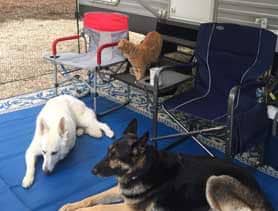 They all love to travel, and we put up a fence so they can be outside safely. We put chicken wire under the trailer to prevent them from escaping that way.
 Update from Mary, Aug. 18: Sadly we had to let Ali go to the rainbow bridge two weeks ago. She had cancer. At least she got to camp a couple times this year. We even made it to the dog beach! [Photo at left.] She had a good life and we miss her so much.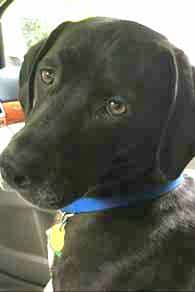

 When you leave the valves open you are likely to have bad odors, create a build-up just below your toilet discharge valve, accumulated waste will collect in your dump hose causing even more odors, and un-flushed matter will collect on the bottom of your holding tank and harden becoming almost impossible to clean out.
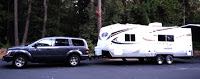 Larry Lang thinks all travel trailer owners ought to add another little item to that safety checklist – and Larry is a man who speaks from experience – scary experience. Larry had hitched up his Forest River travel trailer to his SUV for a trip to the northern California coast. It became a trip he’d never forget – and the memories had nothing to do with the Redwood forests.
 Westbound on Highway 20, just outside Grass Valley, California, Larry’s trailer and SUV tried to part ways – the Camco-made trailer hitch broke on a weld. The only thing holding the two rigs together were the properly rigged safety chains. Still, having safety chains in place did prevent the trailer from getting loose and possibly clobbering some other rig, but it did create major control issues. Larry’s “combination” (if you can still call it that) started into severe sway that eventually lead to a complete loss of control.
 If it weren’t for a J-rail barrier, Larry, his wife, and dog might not be around to recount the tale. The rigs slammed into the guardrail, which prevented them from continuing down a steep slope – this after crossing over a lane of oncoming traffic. It would seem miraculous that no one was hurt in this mess.
 Results? Larry’s insurance company issued him a check for multiple thousands of dollars. Concerned that other hitch owners might have a similar issue lurking, he tells us he contacted Camco Manufacturing. The company offered him $1,700 as “compensation,” with the proviso that Larry would sign off on a release that would release the company from any further claims. Concerned his insurance company would be the loser on a deal like this one, and in light of the fact it wouldn’t even cover the insurance deductibles on his two rigs, he turned the “offer” down.
 Aside from thinking his future RVing days would probably be done with a Class C motorhome – and who could blame him after an experience like this – Larry thought about the rest of us who pull travel trailers. He writes, “I’ve been thinking that if I had closely inspected the hitch during installation I might have seen a potential weakness in the welded joint. The weld failure might have been occurring over a period of time without my knowledge.”
 Whether or not that’s true, in any event, it does give us a reason to take just a couple of moments longer and eyeball our hitches. It could spare us an experience like Larry Lang’s – or one that could even be worse.