You know it’s cold out when, as my father-in-law suggested, “It’s colder than a mother-in-law’s kiss.” Yeah, that can be pretty cold.
For RVers, when it’s cold out, it can have a definite effect on our rig’s batteries. For the motorhomer, this can be a double-whammy, as when getting ready to up-and-go, a “click, click, click” noise from the starter is a sure-fire way to discover unhappiness. But for any of us, motorhomer or non-motorized user, cold batteries can result in more than just frustration — in some cases it can lead to a serious hit on the pocketbook.
Here’s the problem: Your battery is more than just a “bank” for power, it’s really a sort of chemical reactor. Cold temperatures tend to slow the reaction level down, make it more difficult to draw the needed power. That part of the problem is only compounded when a battery is called on for starting an engine. Why so? Because the colder the ambient temperature, the stiffer the lubricants in the engine become, creating yet more resistance to overcome when starting, hence, an even greater need for power.
But even for “house” batteries where turning over the engine is not an issue, cold weather still takes a toll. The demand for power in winter for an RVer tends to increase. The days are shorter, hence, more interior lighting is used. If you heat your rig with the factory-provided furnace, then you can be sure you’ll be pumping plenty of power to the furnace blower. A popular furnace produced by Suburban demands 8.5 amps per hour. Let’s say you run the furnace ten hours, at a 50 percent duty cycle. Run the math and you can say “Bye Bye!” to 45 amp hours. And with the ever-increasing popularity of electronic devices, the demand for battery power in our rigs just keeps growing.
But of course, we put it back in, right? If you are connected to shore power, then the power converter should be taking care of all our use, right? Perhaps, provided your use doesn’t outpace the ability of the power converter; in which case, you’re simply pulling that extra need from the batteries. And yes, the converter should act as a charger to start stuffing it back into those batteries, but again, not all converters are equal. Some converters charge at a rate as low as three amps.
But there’s another scenario to consider as well. When your RV is “at rest,” and not in use, if not hooked up to a charging system, the rig batteries will slowly run down. The matter is called “self discharge,” and can really make a difference. For common “flooded lead acid” batteries, the typical self-discharge rate runs about 5 percent of charge per month; more expensive gel batteries have a self-discharge rate between 2 and 4 percent per month. Let your rig sit for a few months and you may find on your return that it’s simply NOT ready to roll.
But worse, still, is that a discharged battery deteriorates faster than a fully charged battery. This is because of sulfation – and it’s part of that chemical reaction process we talked about earlier. Without getting into too much tech-detail, it works like this. The liquid in your battery, the electrolyte, contains two types of ions: hydrogen ions and sulfate ions. When the battery is called on to produce electricity, the sulfate ions move to the negative plates in the battery, while the hydrogen ions move toward the positive plates. Both join up with the lead in the plates, forming hydrogen sulfate. This material is an insulator, but happily, when the battery is charged, through the chemical reaction, much of this lead sulfate is put off. But if a battery is not charged, these nasty lead sulfate crystals grow and get harder. And the harder the crystal, the more resistant it is to going back into solution. The more this stuff builds up, the greater the resistance to charging, and the heavier it gets. Battery plates can literally break off; and the lead sulfate crystals then build up at the bottom of the battery, eventually reaching the base of the plates, killing the battery.
Add one more item to your list of battery problems: While a fully charged battery typically is freeze-proof, the more discharged a battery becomes, the greater the likelihood that it will freeze. Freeze the electrolyte, it expands; and expand it too much, break the battery. For some of us, breaking the battery can mean breaking the bank.
Bottom line: It’s essential to care for your batteries – they need to be regularly charged. And to protect it from overcharging, a “smart” charger, one which monitors the battery state of charge and reduces the charge current appropriately, is truly the only safe way to care for your expensive battery bank.
By Chris Dougherty Chris Dougherty is a certified RV technician. Here is a letter he received from a reader while he was serving as RVtravel.com’s technical editor.
Dear Chris,
We have the same problem with our Crossroads 34′ fifth wheel as we had with our Jayco 30′. The furnace (which is located near the steps going up to the front) keeps the bedroom and bathroom toasty, but the living area is still cold. Would covering certain vents to force the heat to the back cause an unsafe situation? If so, is there any way to get more heat to the rear of the unit? —Astrid
Dear Astrid,
This is a common issue with fifth wheels. The answer and the fix relate to the simple fact that heat rises. As the furnace dispenses hot air from the registers, the warm air rises to the highest point, and the cooler air falls to the floor. The problem is the floor of the upper bedroom and bathroom (or whatever room is in the higher level of the fifth wheel) is much higher than the downstairs floor. So, the warm air layers from the ceiling down.
What enhances this problem is that most of the ‘lower end’ fifth wheels have only a single zone for heat and air conditioning. The thermostat is usually located in a ‘central’ spot which will ‘average’ the temperature between upstairs and down. However, as I have found in my 5’er, and I assume you have as well, that average just doesn’t work when the temperatures outside start to get extreme. In this case, the upstairs gets downright warm, while the downstairs gets cool.
If it were a two-zone system, the fix would be easy: keep the door to the upstairs closed. The downstairs zone would stay at its set temperature as would the upstairs. But since it’s one zone, it requires some ingenuity to keep ahead.
Closing off registers in an RV is NEVER recommended. The reason is because the furnace is designed to work properly with a certain minimum amount of airflow to make it more efficient, and to keep it from overheating. Closing off registers reduces airflow and can lead to furnace overheating and cycling, as well as overheating of other components like duct work and other registers.
A small electric fan is one option to help circulate the warmer air from upstairs back downstairs. An RV ceiling fan would be another option.
Dear RV Doctor: We purchased a 2004 coach three months ago. From the moment we got it the slideout has leaked. It has leaked so bad that the wood trim around the interior of the slideout has all been removed due to mold and the laminate on the dinette table is all buckled. My husband tried to put some sealant on the top of the slideout but it did not work. This is the first RV we have owned with a slideout and we are just beside ourselves.
I am pregnant and my daughter is four; the last thing we need is mold around us. Do you have any suggestions on how to fix the slideout and where we would go to get replacement trim? We tried the dealership that we purchased it from that claimed to have a “rigorous leak detection test before release to a buyer” and they told us it just happens. So any advice on where we would start would be great! We just want to enjoy RVing without the “money pit” effect we currently have. —Chris A.
Dear Chris: I’m sorry to hear about your slideout leak. Water intrusion is indeed the number one maintenance consideration with any RV and, as you’ve found out, can be quite difficult to rectify.
It’s important to locate the actual entrance point of the water. Assuming the leak is at the slideout and not coming from a point above it, there are four possible locations along the room. The first thing would be to check the integrity of the slideout seals on both sides, the top and the bottom of the slideout. Remember, it must remain leak-free in two positions: with the room retracted and extended.
Another procedure is to have the slideout mechanism checked for proper operation. Ensure the slide moves in and out evenly without it “crab-walking” its way in or out. It’s quite possible that it’s time to replace all the seals on the slideout.
Was there any warranty offered when you purchased the coach? It’s apparent your dealer isn’t willing to accommodate you in any way without charging you. But check your warranty or other guarantees that may have been included in the purchase. You may have recourse there. It’s paramount a certified RV service tech inspect and rectify that leak as quickly as possible. Unattended, the leak will only get worse and more structural damage is likely. I wish I had better news, but barring any structural deficiencies in the room itself, it’s apparent the seals have failed and that they are in need of replacing.
Jayco is recalling certain model year 2013-2017 Redhawk motorhomes manufactured August 1, 2012, to June 24, 2016. The affected vehicles are equipped with shower curtains that may not adequately resist catching fire in the presence of an ignition source. As such, these vehicles fail to comply with the requirements of Federal Motor Vehicle Safety Standard (FMVSS) number 302, “Flammability of Interior Materials.” Approximately 2,400 RVs are involved in the recall.
A flammable shower curtain may further fuel a fire, increasing the risk of injury.
Jayco has notified owners, and dealers will replace the shower curtains with curtains made with fire retardant, free of charge. The recall began August 11, 2016. Owners may contact Jayco customer service at 1-800-283-8267. Jayco’s number for this recall is 9903318.
Heartland Recreational Vehicles is recalling certain model year 2016-2017 Wilderness and Mallard travel trailers, 2015-2017 Elkridge fifth wheel travel trailers, and 2017 Sundance and Torque travel trailers. The affected vehicles have an LED light on the front cap of the camper that may short circuit and overheat. Approximately 4,500 RVs are affected by the recall.
If the light overheats there would be an increased risk of a fire.
Heartland will notify owners, and dealers will replace the light with one that has built-in voltage protection. The recall is expected to begin on September 26, 2016. Owners may contact Heartland customer service at 1-877-262-8032.
Learn about RV camping, RV travel, RV news and much more. This newsletter, now in its 15th year of continuous publication, is funded primarily through advertising and voluntary subscription contributions from our readers. Thank you!
Editor’s corner With Chuck Woodbury Chuck (at) RVtravel.com
I’m a few days away from moving out of my condo and into my RV. As I’ve packed up one box after another to take to Goodwill, I’ve pondered the comments from hundreds of you about problems with your new-model RVs and with finding available campsites.
To keep up with record-setting demand for new RVs, manufacturers are cranking them out as fast as they can, many racing too fast to maintain quality, causing buyers inconvenience, not to mention headaches and money.
Part of the reason for the poor quality lies in Elkhart, Indiana, where most RVs are made. The RV makers there are struggling to find qualified employees to keep up with demand. At Dicor, a 130-employee company that makes RV parts and accessories, between 30 and 50 percent of job applicants fail the drug test, according to company president Gregg Fore. “On a bad week, it’s more than 50 percent. Five years ago, it was between 10 and 20 percent,” he told the South Bend Tribune.
The Centers for Disease Control and Prevention listed Indiana as one of the worst states in the nation for drug poisoning mortality rates. Kyle Hannon, president of the Greater Elkhart Chamber of Commerce, told the Tribune that failed drug screenings now are a “huge problem among Elkhart manufacturers.”
According to Fore, new hires typically lack soft skills, such as showing up to work on time. And they often quit after only a few months on the job. “People often don’t have the knowledge, training or family background that allows them to understand working is better than not working,” he explained. “They don’t understand working means we start at 6 a.m. every day — not just some days. It becomes an expensive ordeal to hire someone who decides to take every other Monday off, or thinks 6 a.m. is too early.”
U.S. Rep. Jackie Walorski traveled to Elkhart on Thursday to hear from leaders in the RV and boating sectors about the local labor crisis. Almost unanimously, wrote the Elkhart Truth, they lamented that they cannot find workers to fill vacant positions. Doug Smoker, president of Smoker Craft, an Elkhart County-based boat manufacturer, said the company could hire 41 workers right now if it found qualified applicants.
FOR RVers, with so many new RVs needing warranty work, the service departments of RV dealers are swamped, many short of qualified RV technicians, who are hard to find. It may take weeks, even months to get repairs. “We made an appointment in June for August 2nd for some work that should not take more than two workdays at the most. It has been there three weeks and not done yet,” said RV Travel reader John Stahl.
Reader Wayne Girard wrote, “We love RVing but our first two years as full timers has been a nightmare in our 2014 Winnebago Tour. Over 120 system failures – many major like the energy management system catching on fire, Aqua Hot replacement at 15 months, eight Lippert slide failures, front cap put on with no sealant, total of four weeks at the factory on two different occasions. Winnebago has been great fixing everything but we have been down for repairs for a total of six months in the last two years. Pretty tough when you live in it.”
Reader John Bolinski noted, “My latest RV purchase came with the following problems, awning switch hooked up backwards, the TV antenna switch hooked up backwards, the water pipes in the kitchen, bathroom and shower, backwards even though they are color coded. The rig came with three class C tires and one Class D tire. The factory would not correct the problems since I had back surgery, and did not find the quality problems until after the 1 year warranty.”
IF AN RV IS UNDER WARRANTY, good luck getting a quick appointment for a fix. RV dealers get paid less for performing warranty work than dealing directly with a customer. “We’re lucky sometimes to get 60 percent,” one dealer told me. While a dealer can get, say, $120 an hour charging customers directly, it may only get about $80 for that same work from a manufacturer on a warranty job. Guess which work gets priority?
As soon as my time frees up, I’ll explore these issues and many others in depth. I will also continue to promote the creation of a non-profit RV owners association to look out for you and me, not manufacturers, dealers or campground owners. There is no such group now, which is hard to believe (and unacceptable) considering the huge number of RVers in this country.
Is reading this newsletter worth 10 cents to you?
Our staff works hard to bring you a valuable newsletter every Saturday. Readers help make it possible with their voluntary subscriptions. Even a pledge of $5 a year is appreciated — that’s less than 10 cents an issue! Many readers pledge more — $10 a year is less than 20 cents an issue! Your contributions make it possible for us to write about important matters, not just fluff to make advertisers and RV industry big shots happy. . Enter a voluntary subscription.Use a credit card, PayPal or mail a check.
No contest this week: Last week’s winners of the classic book “Travels with Charley“ were Kenneth Ross and Linda Wharton. Congratulations!
Reduce air drag and boost fuel efficiency — Airtab® your RV! Just peel and stick Airtabs™ to the rear sides and the rear roof of your RV coach or trailer to create swirls of air that reduce aerodynamic drag, save fuel and improve stability. Airtabs™ dramatically reduce trailer ‘fish tailing’ and crosswinds pressure to RVs from passing trucks, while improving fuel efficiency 2% – 5%! Click on the video. Click here for more information about using Airtabs™. Click here to purchase Airtabs™.
Reader RVs
What RV do you drive or tow? Send us a photo of your RV (and tow vehicle) with a 150-200 word description of where and how often you travel with it, and what you like or don’t like about it. Include your name(s) and hometown. We’ll post them to RVtravel.com. Send to assistant editor Diane McGovern at Diane(at)RVtravel.com .
CLICK HERE to see this week’s RV Travel Reader RVs.
Light up your RV with Boogey Lights! RV accent lighting is all the rage! Just look around the RV park! Enter Boogey Lights®! These robust, super-bright, state-of-the-art LED lights with hi-tech controller technology represent the next generation in LED lighting for RVs. The AWNING & UNDER-GLOW LIGHT KITS are specifically designed to withstand harsh operating environments. Don’t waste your money on junk! Get Boogey Lights! You can even control them with your Smart Phone! Learn more or click the video for a demonstration.
RV manufacturers are likely to see themselves cut out of the market as the Federal Emergency Management Agency (FEMA) ships temporary housing to folks affected by the flooding in Louisiana. Instead of “FEMA trailers” with a bad reputation, FEMA says it’s shipping in a new generation of “manufactured housing units.” Photos show the new units are reminiscent of mobile homes with vinyl siding. Sized anywhere from 8 to 14 feet wide, the agency is hoping to shed the formaldehyde-related disaster image from the temporary housing units it shipped to Hurricane Katrina victims.
Don’t forget — Through Sunday, August 28, in honor of its 100th birthday, the National Park Service is offering free admission at all of its 412 national and historic parks across the country. Happy 100th Birthday, National Park Service! For more celebrations visit the NPS Centennial website.
A wildfire which had its start in early August is still having an effect on both Yellowstone and Grand Teton National Parks in Wyoming. At least 50 campers were evacuated from areas in Grand Teton earlier this week. The fire also forced the closure of the road heading into Yellowstone’s south entrance. No other roads were reported closed due to fire as of Friday. Check current road conditions at Yellowstone here.
Camp Verde, Ariz., town officials have awarded the town’s “Beautification Award” to an RV park. Trails End RV Park on Finnie Flat Road was recognized for being “immaculate on a regular basis.” The work done by park management has paid dividends — Trails End reports it has been full-up both winter and summer for the past three years.
Back in February, Sioux City, Iowa, residents told their lawmakers they favored the city’s plan to build an RV park. Now that the price tag has come in, city fathers are a bit staggered. A budget of $992,000 was set aside for the new park — but last week a consultant told the city council they needed to up the ante a bit — $3 million was closer to the mark. Officials still like the idea, but figure they’ll have to work out some of the details.
A week after two separate incidents of U.S. RVers trying to cross into Canada without declaring the firearms they were carrying, the Canadian government has issued a request: Please don’t. The exact wording: “It is strongly recommended that you not carry your firearm when traveling to Canada and/or transiting through Canada to reach another U.S. destination. However, should you choose to travel with your firearms, you must declare all firearms in your possession at the first Canadian designated port of entry.” The RVers who may have triggered the “reminder” were both fined, tossed out of Canada, and their firearms destroyed.
Viewing spots are filling up for the total eclipse of the sun on August 21, 2017. Its total phase will be visible only along a roughly 70-mile-wide track that extends from Oregon to South Carolina. By some measures, the absolute best viewing spot is Madras, Oregon. Online reservations for campsites in Oregon state parks open up on November 21, 2016, for the day of the eclipse. Fifteen state parks lie in the path of totality, and most of them will be taking reservations. The others will be first-come, first-served next summer. Read more on GeekWire.com.
Photo: bowlusroadchief.com
Combining the effectiveness of lithium batteries with the RVing lifestyle is an experiment that some RVers have been playing with. Now here’s a commercial option: Bowlus announces it’s releasing the Road Chief Lithium travel trailer. The limited edition rig’s lithium-iron-phosphate battery is said to power everything on the diminutive trailer, including an 8,000 BTU air conditioner. Get out your checkbook — there’ll only be 50 of these built, and the price tag is a modest $219,000.
We earlier reported on the case of Everett Leon Stout, a 74-year-old man who was accused of extortion in Alabama. Stout tried to buy a $300,000 motorhome from Dandy RV Superstore in Oxford. When the dealer refused the apparent bogus check, Stout field a lien against the dealer, offering to withdraw it for payment from the dealer. Now a jury has found Stout guilty of extortion, and he won’t be needing an RV for the next 20 years — after his sentence was handed down.
Some RVers travel with unusual pets, but a Walmart employee in Lancaster, Ohio, now has a firsthand experience as proof. The unnamed employee was in the store lot when he was accosted by a three-foot-tall primate “monkeying” around a cart return station. When the employee approached and attempted to detain the monkey, an excited woman ran up, telling him to let go of the monkey. She then grabbed hold of the simian and, hand in hand, walked it back to a nearby motorhome.
Not all’s fair at the New York State Fair — at least if you’re trying to get sewage out of your RV at the newly renovated campground. RVers have been complaining that the concrete fitment around RV dump connections stands a full 10 inches taller than the surrounding ground — and as most folks know, water doesn’t run uphill. Guests have been painstakingly lifting their drain hoses, foot by foot, to induce their waste water to flow into the receptacle. Managers have offered to pay for pump-outs, and say that after the fair, planned soil laying and grass planting will raise the parking level up to where the drain ports will be at “ground level.”
America’s Largest RV Show runs September 14–18, 2016 See, compare and shop over 1300 new RVs from virtually every major manufacturer! Visit hundreds of vendors including campgrounds, accessories and services. Attend seminars covering subjects for the beginner to the seasoned RV enthusiast. Location is Hershey, PA. For more information, click here.
More News
The Washington [state] Department of Fish and Wildlife (WDFW) is offering “free fishing” days until August 30 after temporarily suspending the sale of licenses while investigating the vulnerability of its sale system [i.e., a cybersecurity breach]. Anglers are not required to have fishing licenses to fish or gather shellfish in open fishing waters in the state and are also not required to have a vehicle pass to park at the nearly 700 water-access sites maintained by WDFW. Crabbers will also not need a Puget Sound crab endorsement until all requirements are back in effect on August 31. Lands managed by the Washington Department of Natural Resources and Washington State Parks will still need a Discovery Pass for access. Source: KING5.com.
Alberta, Canada, says it will pump $239 million into provincial park improvements in the next five years. The upgrades will include road fixes, trail upgrades and campground improvements, including expanding electric hookups.
Millennials love getting out into nature — as long as they have a cozy place to hang with their friends and somewhere to plug in their iPhones. That’s the theory behind the new-age camping cabins popping up at California state parks, part of a push to get more diverse demographics, including people born in the 1980s and 1990s, hooked on the Great Outdoors. Read more.
Early this month, Forest Service workers were busy removing what was described as a “deplorable message” etched in a rock at McKenzie Bridge Campground in Oregon’s Willamette National Forest. The racist slogan appeared to be related to a noose found hanging in a nearby tree. Both were quickly removed and a Service official spoke out through the media, “We will be watching, and we are out there.”
Image: Coby Spear on youtube.com
Dramatic film footage from a fireman’s body camera shows just how quickly an RV can burn up. Butler County, Kan., firefighters responded to a Class C on fire, and the camera was rolling even before they were off the truck. Interestingly, what appears to be discharges of propane from the rig’s LP tank can be seen as punctuated flame blasts. Check out the video.
A Washington state RV salesman is in hot water and faces felony charges of theft. No, he didn’t do a “consignment sale rip-off.” Instead, he’s charged with defrauding the state’s workers’ compensation fund. Bobby R. Johnson, 47, of Tacoma, slipped and fell on ice while working at a Poulsbo, Wash., RV lot two years ago. He applied for and started receiving workers’ comp, but later, when a cross-check was made against employment insurance payments, it was found Johnson had been selling RVs at other dealerships in addition to being a home caregiver, while claiming to be unemployable. An undercover agent spotted Johnson selling RVs at an RV show, too. The state says Johnson drew more than $81,000 in workers’ comp.
The New TireTraker™ TT-500 with a Lifetime Warranty The new TireTraker™ TT-500 is the most innovative & user friendly TPMS on the market with an unprecedented “Lifetime Warranty”, the only TPMS company in the industry to do so. The TT-500 features a larger, easier to read display, continuous pressure & temperature monitoring, automatic update, & monitoring up to 22 tires on your motorhome, trailer & tow vehicle from 0-232 psi! Seven day per week sales & technical support & over 12 years of experience. List price (4 tires) $389. Our price only $289. SAVE $100! (Additional Sensors $35 each). Learn more or order. Read testimonials.
A brand-new group is forming on Facebook for RVers in the Idaho area (or anywhere in the U.S.) looking for one or two couples to travel or meet up with. (They’re not interested in big groups such as in Good Sam, etc.) If you’re interested, check out “Idaho Baby Boomers RV Traveling” on Facebook.
Q13Fox.com
Have you seen them? Sonny and Patricia Ely are wanted by the Snohomish County, Wash., sheriff’s office after they allegedly finagled a motorhome from a bereaved widow. Authorities say the couple managed to sleight-of-hand the rig’s title from the woman, later forging the dead man’s signature, selling the rig to yet another party. Police were able to track down the stolen rig and want to track down the perpetrators as well. Sonny is 5’11″, weighs 209 pounds, and has brown eyes and hair. Call 800-222-TIPS with information.
Coming to a campground near you – a dishwasher? If Easy Be, of the Netherlands, has its way, you’ll soon be able to walk to a centrally located site in your RV park, toss your dirty dishes in a machine, drop in a token (given you by the park office) and five minutes later, your clean dishes are ready to go back to your rig. Easy Be dishwashing service machines are now in eight countries, and the company is pushing to add the United States to its passport.
Image: yovo68 on youtube.com
The infamous “11’ 8” Bridge” in Durham, N.C., has caught yet another slow-witted RVer. On August 13, a motorhomer tried to squeeze their rig under the train trestle — and they might have done it, if it hadn’t been for air conditioner units on the top of the rig. The bridge can’t go up because if it did, nearby rail crossings would have to go up. The road can’t go down, because a major sewer line runs only four feet under the pavement. It’s said the trestle claims about one victim per month, despite warning signs and flashing lights. Watch the video.
California Highway Patrol officers got a workout last week when a man found the keys in the ignition of a motorhome on a dealer lot too tempting. Paul Nelson, age 40, is accused of starting up the Class A rig at La Mesa RV, in Rancho Cordova. He then plowed the rig through the front gate and set off on what ended up being a high speed pursuit out of Sacramento County, through El Dorado County, and on into (and ending with spike strips) in Amador County. Nelson “voluntarily” surrendered after the deflation. He’s being held on a number of charges in lieu of an $85,000 bond.
Happy Birthday! Happy Anniversary!
Wish your special someone a Happy Birthday or Happy Anniversary and we’ll post your well-wishes and your short comment right in this newsletter. It’s super easy to leave your greeting. Just click here.
See this week’s greetings near the bottom of this newsletter.
Keep up with RV Industry news throughout the week at RVbusiness.com.
Even the simple maintenance — Check and replace smoke detector batteries
Rich “The Wanderman” explains why it’s important to regularly check smoke detector batteries and how easy it (usually) is to replace them. He reminds us: An ounce of prevention is certainly worth a pound (or many dollars!) of cure. Read more.
Why dual tires should be matched
Roger Marble of RVtireSafety.com discusses why dual tires should be matched and how to determine if they are. Watch the video.
Confessions of a newbie full-time RVer
Read this interesting and informative article by RV Travel reader Mike Sherman, who has been full-time RVing for five months after RVing part-time for 30 years. This is an overview of his experience and lessons learned. Read more.
Leveling vs. stabilizing an RV
There is a big difference between stabilizing and leveling an RV. You need to know the difference to properly use the equipment on your particular RV. Learn about stabilizers and levelers in this article supplied courtesy of Diamond RV Centre, West Hatfield, Mass. Learn more.
Surviving a tire blowout
Having a blowout while driving your car can be a nerve-racking experience. Now, in your mind, put yourself behind the wheel of a motorhome and the gut-wrenching imagery increases exponentially. Still, a blown tire on an RV, regardless of its size or type, is not a “game-ender.” Keeping a cool head and reacting properly can mean a safe — and stable — outcome. It’s a matter of understanding and applying some simple rules. Read this important information from Russ and Tiña De Maris.
Why aren’t there more recalls of bad RV tires?
In addition to writing the RVtiresafety.com blog, Roger Marble monitors a number of different RV forums for discussions on tires and related issues. He often suggests to people that they file a complaint with National Highway Traffic Safety Administration about their tire problems, but many times they respond, “Why bother?” In this article, Roger explains how the NHTSA complaint and recall process works (or not). Learn more.
Ford recalls 86,000 vehicles
Ford is issuing a Safety Recall for approximately 86,000 2013-15 Ford Taurus, Ford Flex, Lincoln MKS and Lincoln MKT vehicles with 3.5-liter gasoline turbocharged direct injection engines, as well as Ford Police Interceptor sedans, to replace fuel pump control modules. In the affected vehicles, the fuel pump control module could fail, which may cause an engine to not start or stall. In some cases, the engine could stall without warning while driving and without the ability to restart, increasing the risk of a crash. Read more.
Exclusive Offer: Expand Your RV Protection Education!
Certain 2015-2016 Jeep Renegades recalled due to trailer hitch assembly
Chrysler is recalling certain model year 2015–2016 Jeep Renegade vehicles manufactured August 25, 2014, to June 25, 2016, equipped with a factory-installed optional trailer hitch package. The trailer hitch assembly may have been attached with only a single fastener per side, not three per side as required. Without the proper amount of fasteners, the trailer hitch assembly may separate from the vehicle, and any towed vehicle may no longer be properly connected, increasing the risk of a crash. Read more.
Some Coachmen Freedom Express trailers recalled Forest River, Inc. is recalling certain model year 2017 Coachmen Freedom Express trailers manufactured May 16, 2016, to July 19, 2016. The vehicles may have insufficient space between the slideroom driveshaft and the driver’s side tires, causing the tires to rub. If the driveshaft rubs against the tires, tire failure may result, possibly causing a loss of control and increasing the risk of a crash. Learn more.
Jayco recalling some Alante and Precept motorhomes
Jayco, Inc. is recalling certain model year 2016–2017 Alante and Precept motorhomes manufactured October 13, 2014, to June 23, 2016. The affected vehicles have a driver seat that may loosen and detach from the seat base as a result of the seat having been swiveled around. The potential number of RVs affected is 1,230. If the seat detaches from the seat base while the vehicle is being driven, the operator may lose control, increasing the risk of a crash. Read more.
Boondocking along America’s Byways
“America’s Byways” is a great website for RVers and is especially useful for those of us that boondock in the western United States. The website lists National Scenic Byways and All-American Roads across America and offers a wealth of information to the traveling public. Since the majority of western byways meander through portions of public land, boondocking is quite often an option while traveling these byways with an RV. Learn more in this article from veteran boondocker Dave Helgeson.
Road service not up to par
Things that can mess up your RVing day: Motoring down the happy highway when a sudden “BOOM!” rolls out across the landscape. A quick glance in your rearview mirror reveals chunks of rubber blasting away from your trailer wheel well. Sure enough, you get to test out your emergency road service. Read about Russ De Maris’ experience and feel free to add your two cents’ worth. Read more.
Secure compartment locks — Can the cams be replaced?
Chris Dougherty is a certified RV technician. He received a question from a reader while he was serving as RVtravel.com’s technical editor about combination compartment locks. The reader wanted to know if the flat cams on his current locks could be replaced with offset cams. Here’s Chris’ response.
Unique RV overnight stops at wineries and farms With membership in Harvest Hosts® you can stay overnight at 500 wineries, farms and attractions across North America. Harvest Hosts offers an exciting alternative to traditional overnight stops where you can meet interesting people and learn about their lifestyle. Learn more at the Harvest Hosts website, or watch an interview with the founders by RVtravel.com editor Chuck Woodbury.
This week in history Week of Aug. 27-Sept. 2 Compiled by Dell Bert
1897 — Thomas Edison patents his Kinetograph movie camera.
1955 — “The Guinness Book of Records” debuts.
1963 — Martin Luther King Jr. speaks to 250,000 people at the March on Washington.
1969 — First ATM opens for business.
1982 — Actress Ingrid Bergman dies on her 67th birthday.
1987 — Director John Huston dies at 81.
2005 — Hurricane Katrina slams into Gulf Coast.
SAVE MONEY! Don’t toss away good batteries! Most RVers rely on battery-powered devices while on the road, whether flashlights, radios or cameras. But sometimes you just can’t tell how much life a battery has remaining so you toss it to “be sure.” This small, inexpensive tester will alert you in an instant to the condition of a battery, saving you money from needlessly tossing ones with plenty of remaining life! Works on AA, AAA, C, D, 9V and button-type batteries. Learn more or order.
RV Club of the Week Here’s an RV club from our extensive directory you may like.
SOI Motorhome Club.
The SOI Motorhome Club is an international motorhome club dedicated to fun and friendship. It is a non-profit group of RV owners and a chapter of the FMCA made up entirely of volunteers. Each year they hold rallies all over the United States, and their most popular rally is the annual 5-day extravaganza to the Pasadena Tournament of Roses Parade. This tour includes daily activities, float decoration, meals, and spectacular road-side bleacher seats so close to the floats you can almost touch them! Membership in SOI Motorhome Club is free to FMCA members.
Prevent hose crimping and strain . . . and extend RV hose life This Valterra 90-Degree Hose Saver eliminates unnecessary stress and strain on all RV water intake hose fittings. The elbow, with an easy-grip connector, is made of brass and is lead-free. Learn more or order for a great price!
Bumper sticker of the week
I childproofed my house but the kids still get in.
Funny/clever business slogan
“Get your buns in here” —Glenn’s Pastries, Gallup, N.M.
Have you seen a funny bumper sticker or business slogan? Send it to Diane(at)RVtravel.com
This RV water hose never kinks
This RV drinking water safe hose self-straightens with a reflex mesh design to prevent kinking. Solid brass octagon female coupling ensures a tight no-leak connection. The highly rated hose is FDA approved with a limited lifetime warranty. Fed up with water hoses that are always kinking?This is the answer. Comes in various lengths. Learn more or order.
Upcoming RV Shows See the Web’s best directory of upcoming RV shows for 2016 and 2017.
Websites of the Week We like these websites. Check ’em out. More next week.
Here’s a sample: 30 easy slow-cooker recipes.
Portable oven is perfect
for hot meals in your tow vehicle
You’re on the road in your pickup or other tow vehicle, and would like a hot meal without stopping. Do we have something for you — the HotLogic Mini Personal Oven! Enjoy a hot meal wherever your day takes you. Click the video to see the product in action or visitAmazon to learn more or buy it.
Good reading from RV123.com
• Watch these expert campers review and test four different camping stoves.
• This hearty meal is perfect for recovering from a day of exploration and adventure!
• Zion River Resort is one of Utah’s highest rated RV Parks.
Organize your RV’s shower! Quit hassling with shampoo and conditioner bottles RV showers are small! Hassling with bottles of shampoo, conditioner and soap are a pain! Make it easy with this Better Living Classic 3-Chamber Dispenser. It utilizes a “patented pump technology” and comes with a lifetime warranty. The liquid is stored in three 15 oz. refillable chambers. The right amount of product is dispensed with a stroke or two of the pump. Installs in minutes without tools. Learn more or order.
Ask the RV Shrink
Finding a campsite is getting
too nerve-racking — Any suggestions?
Dear RV Shrink: This RV lifestyle is supposed to be relaxing, but trying to get a space in a campground is nerve-racking. My husband and I have a method, but I am still shaking when it’s all over. We have a motorhome and pull a small car. As we get close to a first-come, first-served campground, he unhooks the car from the motorhome and waits while I go in and try to secure a site. Often I have to bother other campers and ask if they are leaving. Often there are others doing the same. It’s like a scavenger hunt. We see it only getting worse. Do you have any suggestions? —All shook up in Apgar
GREAT GIFT
RVs and Campers: 1900-2000 This entertaining book looks at the history and evolution of RVs and the lifestyle. Hundreds of nostalgic photographs show a wide variety of RVs through the years. See early auto tent-camping, converted buses, fold-out trailers, homemade campers and even traveling chapels with living quarters for pastors! This is a great gift for your favorite RVer! Learn more.
RV Tech Tips from Mark Polk
Things to check when towing a dinghy When you are towing a vehicle behind your motorhome try to get in the habit of making the following checks each time you stop. Check the tow bar, base-plate, safety cables and light plug to make sure everything is properly attached. Check the tires of the towed vehicle to make sure they are not too hot or losing air. If you are using a dolly or trailer, check the wheels to make sure they are not hot to the touch. If the wheels are hot, it may indicate a brake or bearing problem. Check all of the lights every day before towing.
Mark Polk is the owner of RV Education 101, the premiere source of educational DVDs about buying, maintaining and using an RV. Learn more.
Camco Wheel Chocks. Two Pack Wheel chocks are one of those “must have” basic items for all RVers. Hey, who wants to go rolling outta their campsite at 3 a.m.? For trailer owners, the chocks are designed to keep your RV in place so that you can re-hitch with confidence. The chalks are constructed of durable hard plastic with UV inhibitors and are easy to use. Learn more or order.
Latest fuel prices Here are the latest U.S. average prices per gallon of gasoline and diesel fuel: Regular unleaded gasoline: $2.19 (on Aug. 22). Change from week before: Up 4 cents; Change from year before: Down 44 cents. Diesel: $2.37 (on Aug. 22). Change from week before: Up 6 cents; Change from year before: Down 19 cents.
Improve performance of your diesel engine Diesel Kleen + Cetane Boost is a highly rated, technologically advanced, diesel engine performance improver that cleans injectors, boosts cetane and lubricates fuel injection components. The maximum horsepower formula restores lost power, smooths rough-running engines and improves fuel economy up to 8 percent. Learn more or order.
RV Travel Reader Pets
Do you travel with a pet? We’d love to introduce your pet(s) to fellow readers. Send a photo or two of Fido or Boots and a 150-200 word description of your furry friend(s), along with your name(s) and hometown to Diane(at)RVtravel.com .
Click here to see the last issue of RV Travel Reader Pets.
Fix it In Foil! Tasty Recipes. Easy cleanup! Easy prep, great taste, good nutrition, quick clean-up! “Fix It In Foil” includes 51 fantastic recipes to make in foil — plus instructions for cooking in an oven, on an outdoor grill, or on a campfire. Fix it in foil and forget about scrubbing pots and pans. And, with plenty of substitution suggestions, enjoy a whole new list of recipe possibilities! Great for RVing! Learn more or order.
The RV Kitchen with Janet Groene
Crustless Custard Pie Easy as pie.
You want pie. Your doctor says you shouldn’t have pie. Besides, it’s a lot of work to make pie crust. Try this yummy, lard-free custard pie instead and be amazed at the way it makes its own crust as it bakes. Get the recipe.
Effective against Zika virus Best protection from mosquitoes
The Repel 100 uses a 98.1-percent DEET formula to provide complete protection from mosquitoes, ticks, gnats, chiggers, no-see-ums & biting flies. Use in areas of high infestation or prolonged periods of up to 10 hours. Repels mosquitoes that may transmit Zika and other viruses. Learn more or order.
RV Fire Safety Tip
Galley fire safety
In a compact galley, all combustibles — from paper towels to curtains — are apt to be closer to the stove, so use even more caution in your coach than you do at home. A box of baking soda — the ingredient in powder extinguishers — can be used in lieu of a fire extinguisher for minor galley flare-ups. Courtesy:MacTheFireGuy.com
Editor’s note: Choose from a wide selection of fire extinguishers at Amazon.
Guide to RV Camping in State Parks Learn about more than 1,730 state parks, forests & recreation areas for RVers. Book includes maps, locator charts, reservation & fee info, plus contact details & website. Plus park location, directions, GPS coordinates, contact info, type of hookups, season, RV length limit & availability of showers, dump station, Wi-Fi, etc. Learn more or order.
RV Quick Tips
Slow cooker suggestion from a “road gourmet”
Regular contributor to RV Travel newsletters, and road gourmet, Greg Illes suggests slow cooker RVing enthusiasts consider the RoadPro cooker. Big enough for a two-person dinner but draws only 8 amps, running on 12-volt DC power. They’re available at Amazon.
Roll up your awning in a storm
Leaving your awning out in a rainstorm is a costly mistake. Bent awning hardware like roller tubes generally can’t be repaired.
Take care of your transmission
Don’t ignore your automatic transmission. Check the fluid level regularly. If you find the level going down, it could be a leak or (gulp!) a malfunction. Check with a transmission mechanic — and don’t hesitate to get a second opinion if the suggestion involves big money.
Do you have a handy Quick Tip? Send it to Diane (at) rvtravel.com.
Trivia Who was the first actor to play James Bond? Nope, it was not Sean Connery! So who was it? Answer below.
Ask the RV Doctor The RV Doctor, Gary Bunzer, answers your questions
RV delamination dilemma
Dear RV Doctor:
I have a 2004 RV with a wood frame. Last summer I noticed what I believe you call “delaminating” on the front section. The camper’s exterior fiberglass appeared to be rippling. I suspected this was related to a leak so I resealed the entire front of the RV. Recently, during a heavy rainstorm, I found some water in a closet which verified there was in fact a leak and also that I didn’t catch it when I resealed the RV. If I can get the leak to stop will the “delaminating” continue? Can you repair “delaminating” without peeling back the entire exterior? If I get the leak to stop, will problems continue (dry rot, etc.)? Am I in deep trouble or what? —Dennis D.
RV Camping in Corps of Engineers Parks
The U.S Army Corps of Engineers manages more than 12 million acres of land and water nationwide. In fact, it’s the largest federal provider of outdoor recreation in the nation. This book will guide you to more than 600 Corps-managed campgrounds with sites suitable for RV camping on nearly 200 lakes around the country. Many RVers believe Corps campgrounds are among the best out there! Learn more or order.
Gizmos and Gadgets
Braven BRV-BLADE Bluetooth outdoor speaker
Braven announces the immediate availability of the Brven BRV-BLADE, a new standard in outdoor Bluetooth® adventure speakers forged with toughness, aggressive design, and superior HD audio. Ideal for wet, wild, and extreme power sports, you won’t have to treat it gently living your RV Lifestyle. The BRV-BLADE boasts tank-like durability with a shockproof ABS construction and can also take a spill, splash or dunk with an IPX7 waterproof rating. Read more.
3-way LED lights now available for RV interior lighting
You can now vary the brightness of your cabin lights with the simple flip of a switch (no dimmer required), a press release from SalVinCo reports. Bee Green LEDs new Three Way G4 bi-pin LED bulbs offer you the option to choose among three levels of lighting from one bulb just by toggling the light off and back on with your wall switch or fixture switch. Learn more.
Essential equipment for many RVers! Camco TastePURE Water Filter with Flexible Hose Protector This best-selling product reduces bad taste, odor, chlorine and sediment in drinking water with a 100-micron fiber filter. Its durable in-line, exterior mount filter has a wider body to increase flow. Use it at your campsite to keep sediment out of your RV water tank and to improve the taste and smell of your drinking water for a whole season. Many RVers consider this essential equipment. Learn more or order at a big discount.
Upcoming RV Shows
Vintage postcard from the days when RVs weren’t self-contained (except this one).
• No. Carolina RV Dealers Assoc. RV Show, Aug. 26-28, Raleigh, NC
• Utah RV Supershow, Sept. 8-11, Sandy, UT
• Fall RV Show & Sale, Sept. 9-11, St. Louis, MO
• Ohio Outdoor RV Bargain Expo, Sept. 9-11, Cleveland, Ohio
• Vermont State Fall RV Show, Sept. 10-11, Essex Junction, VT
• America’s Largest RV Show, Sept. 14-18, Hershey, PA
• Fall Maryland RV Show, Sept. 15-18, Timonium, MD
• Portland Fall RV & Van Show, Sept. 15-18, Portland, OR
• Southwest RV SuperShow, Sept. 15-18, Dallas, TX
• Greater Iowa RV Show, Sept. 16-18, Des Moines, Iowa
• Springfield RV Mega Show, Sept. 16-18, Springfield, MO
See the list of all upcoming RV shows.
Keep your food cool with this RV fridge fan Every RV refrigerator should have one of these!
This small refrigerator fan from Valterra Products will help keep the food in your RV fridge cool and from spoiling. It cuts down initial cool-down time by 50 percent. Runs for more than 30 days on 2 D batteries. Don’t leave home without this! Learn more or order from Amazon.com.
Free nightly Bat Flight programs, plus Night Sky Parties at Carlsbad Caverns NP
Each summer New Mexico’s Carlsbad Caverns National Park hosts special programs. Two good ones, both free:
• 2016 Bat Flight programs: Every evening park rangers present informative programs about the Brazilian free-tailed bats that live in the caverns between spring and autumn. “The best bat flights normally occur in August and September …,” according to rangers. • 2016 Star Party events: Sept. 3, Oct. 1 and Oct. 29: “The park is a perfect spot for viewing the wonders of the night sky due to its location miles away from the lights of the local communities,” rangers report.
Liquefy solid wastes in sewer holding tanks
Happy Campers Treatment liquefies solid waste and household tissue. It’s a natural formula that’s environmentally friendly and biodegradable, with no formaldehyde or harsh chemicals. Basically, the good bacteria overtakes the bad bacteria to eliminate odor and accelerate the natural decomposition of waste. Because it is totally organic and odor free, you won’t be embarrassed by bad odors inside or when you dump. Learn more or order at Amazon.com.
Joke of the Week
An RVer goes into a bar in Yuma, Arizona, and orders a Bud. He hears a soft voice: “Nice shirt.” He looks around, but nobody’s there. He sips his drink. “Nice watch,” he hears in the same soft voice. Again, nobody’s around. He’s baffled. “Nice shoes,” he hears, same voice. He thinks he’s going crazy. He summons the bartender. “I keep hearing a little, soft voice,” he says. “Oh,” says the bartender, “don’t worry. That’s just the complimentary peanuts.”
Videos you’ll like
• Free Camping at Walmart: How to do it RV Travel editor Chuck Woodbury explains how this pavement “camping” option works. Watch the video.
Random RV Thought An excellent way to make instant friends in a campground is to walk with a cute dog (heck, even an ugly one!). Your fellow campers will comment, which opens the door to further conversation and maybe even a new friendship.
Worth Pondering
Why don’t sheep shrink when it rains? —Anonymous
TODAY’S DEALS ON RV PARTS & ACCESSORIES AT AMAZON.COM. Click.
Readers’ Birthday and Anniversary Greetings
Happy Birthday! •August 27: To Denise from Alan. Happy Birthday! I love you!! And I look forward to many more years of camping together.
• August 29: To Herb from Cindi. Happy 70-plus … I’m coming right behind you! Let’s celebrate by going camping.
• August 30: To Linda from Bud. A great gal to travel with, she is my navigator and is great at it. Plus all the other stuff she does. Love ya, bubbles.
Happy Anniversary! • August 31: To Gerry from Sandy Bronstein.Happy 30th wedding anniversary, Gerry. Looking forward to the next 30 years or longer.
Endorsed by Roger Marble of RVtireSafety.com! An excellent tire pressure gauge
The Accutire MS-4021B digital tire pressure gauge has an easy-to-read LCD display that provides pressure readings from 5-150 PSI. It’s ergonomically designed with an angled head and a rubber-coated easy-grip handle. If you forget to turn off the gauge, don’t worry, it will automatically shut off. The included lithium battery never needs to be recharged or replaced. And all this for less than $13! Learn more or order.
TRIVIA ANSWER:
Before Sean Connery was tapped to play the British agent on the big screen in 1962’s “Dr. No,” Barry Nelson played Bond in a one-hour TV adaptation of “Casino Royale” in 1954. He died in 2007 at the age of 89.
RV Travel staff Editor and Publisher: Chuck Woodbury. Assistant editor: Diane McGovern. Contributing editor: Russ De Maris. Contributing writers: Greg Illes, Bob Difley, Richard Miller, Richard Mallery, Janet Groene, Roger Marble and Julianne Crane.
ADVERTISE on RVtravel.com and/or in this newsletter. Contact Chuck Woodbury at Chuck(at)RVtravel.com.
About the RVtravel.com editor Chuck Woodbury has explored America by RV for three decades. In the ’90s he published the quirky travel newspaper Out West, and was an “on the road” writer for the New York Times Syndicate. His book, “The Best from Out West” is available at Amazon.com. Woodbury’s RVing adventures have been profiled on ABC News, CNN, NBC’s Today Show, and in People Magazine, USA Today and in hundreds of newspapers. He is the host of the Better Business Bureau DVD “Buying a Recreational Vehicle,” the definitive guide to purchasing an RV the right way.
Everything in this newsletter is true to the best of our knowledge. But we occasionally get something wrong. We’re just human! So don’t go spending $10,000 on something we said was good simply because we said so, or fixing something according to what we suggested (check with your own technician first). Maybe we made a mistake.Tips and/or comments in this newsletter are those of the authors and may not reflect the views of RVtravel.com or this newsletter.
Our offices are located at 610 5th Ave. S, Suite F, Edmonds, WA 98020.
This website utilizes some advertising services. Sometimes we are paid if you click one of those links and purchase a product or service. Regardless of this potential revenue, unless stated otherwise, we only recommend products or services we believe provide value to our readers. Amazon and the Amazon logo are trademarks of Amazon.com, Inc . RVtravel.com is a participant in the Amazon Services LLC Associates Program, an affiliate advertising program designed to provide a means for sites to earn advertising fees by advertising and linking to Amazon.com.
RVtravel.com includes links to other websites. We cannot control the content and/or privacy policies of those sites. Please be aware when you leave this newsletter or any other section of RVtravel.com to read the privacy statements of any of those websites that collect personally identifiable information. Our own privacy policy applies only to RVtravel.com and its affiliated blogs.
BRAVEN has announced the availability of the BRAVEN BRV-BLADE, a new standard in outdoor Bluetooth adventure speakers.
According to a news release, the speakers are well suited for wet, wild, and extreme power sports (such as dune-buggying, jet skiing, snowmobiling or 4×4 racing in the mud), you won’t have to treat it gently living your RV Lifestyle. The BRV-BLADE boasts tank-like durability with a shockproof ABS construction and can also take a spill, splash or dunk with an IPX7 waterproof rating.
Part of BRAVEN’s highly acclaimed outdoor audio series, the BRV-BLADE thrills with an ultra-rugged design and impressive HD audio. Unique in every form, the military, jet black styling securely conceals dual omni-directional passive sub woofers that wow with rich sound and impressive bass thanks to BRAVEN’s Bass Optimization technology.
“The BRV-BLADE is a bold and powerful speaker that can endure the most extreme conditions, and is also a jack of all trades,” says Andy Fathollahi, Chief Executive. “It can showcase the most delicate tunes with accuracy and then can immediately take it to the loudest level with our proprietary ‘Boost Mode’ that instantly cranks up the volume to the max.”
BRAVEN’s latest outdoor adventure speaker is slim enough to easily fit into a backpack or glove compartment, features a built-in speakerphone and a 4,000 mAh power bank to charge USB devices, and can pump music for 22-hours. The BRV-BLADE also comes equipped with tie down bars and a nylon performance strap with a built-in bottle opener to easily secure the speaker to a range of surfaces and all-terrain vehicles.
Send a photo of your RV and a 150- to 200-word description of it, how and where you use it, and what you like or don’t like about it, to Diane(at)RVtravel.com. Be sure to include your name(s) and hometown, or if you’re a full-timer. (These are posted in the order received.)
The RVs of RVtravel.com readers and how they use them
Issue 61; Posted August 27, 2016
From Alex and Sandy (and Mishka, the cat), Bonney Lake, Washington
We bought our new 2015 Class C Forest River Solera built on a Mercedes Benz Sprinter chassis because it is reliable, easily maneuvered and economical. Only 24 feet long with one slide, it’s surprisingly roomy. Though it’s very comfortable right out of the box, we added highly desirable upgrades such as gas shock absorbers, stiffer rear sway bar and an on-board surge suppressor to protect on-board electronics. We couldn’t believe how the Solera eased in and out of restaurant parking spots meant for pickups and cars. We use it for local events and festivals in the Northwest during the summer and escape the cold and rain by touring the Southwest during the winter months.
We chose the 2009 Smart Car because of its 1,700 lb. weight and automatic transmission which doesn’t require modifications for towing. Aesthetically, its color matches the graphics on our Solera, as does the “swoosh” steel cabin reinforcement. It gets around 40 mpg at our destination and only drops the RV’s mileage by 1 or 2 mpg when towing. It’s fun to drive, quite safe, surprisingly roomy inside and starts many inquisitive chats at campgrounds. Used, low-mileage Smarties are plentiful and inexpensive and are truly the perfect tow for two!
From Susan (and Mizz Bizzy) Gottfried, Central Florida
This is Music with her toad, Fergus, a Honda Element. Music is a 36-foot 2005 Gulf Stream Independence. I bought her in 2011 and live in her full time with my dog, Bizzy. I stay put in Central Florida for about a year, then I travel around the country for five to eight months at a time — until I run out of gas and campground money. I do take short (less than 300 miles) trips during my “saving for the next big trip” times.
We’ve definitely had our moments, but I have never regretted selling my S&B [sticks-and-bricks] and becoming a vagabond. I am a big proponent of “The Rule of Twos”: I leave two hours after peak rush hour. I always stop for a good get-out-and-walk-around break after two hours of driving. I try to keep my travel distance near 200 miles — or at least under 300 — in a day. I stop for the night two hours before peak rush hour. For every two one-night stays, I stay for two nights and relax for a day. It keeps the travel times pleasant and relaxed.
Music’s name comes from the Crosby, Stills and Nash song “Southern Cross”: “I’ve got my ship, and all her flags are a’flyin’. She’s all that I have left, and Music is her name.” Fergus is named after the nice guy I bought him from.
From Mike and Diana Sherman, Full-timers from Auburn, California
We have a 40-foot 2005 Dutchmen Grand Junction fifth wheel with four slides, bedroom in the rear, living room up front. We tow it with a 2000 Ford F-350 dually with 7.3 diesel, 6-speed manual transmission and an engine brake. It has an extended cab — the dog gets the back seat.
Having been full-timing now for only five months, we have learned a lot. After 30 years of RVing, we finally reached retirement and jumped at the opportunity to sell our home and belongings and go see America full time.
Choosing the right retirement “housing” was difficult. We settled on the concept of a truck and 5th wheel for maximum usable living space and having a vehicle to drive after setting up our campsite. After a couple of months of shopping, we found what we thought was the perfect unit. Our thinking at the time was we need space — storage and living space — since it would be our permanent home for the foreseeable future. So we went big — 40 foot long with four slideouts. … We discovered almost immediately we perhaps bought too big.
We have had to alter our perceptions based on the reality of our decisions that cannot be reversed. However, we are not discouraged — it just provides us with challenges and other opportunities to overcome our choices. We love the truck and new home, so we adjust.
In the meantime, we are fortunate to be in a position to camp host for the State of California, on the coast, and not deal with miles and miles of traveling at this juncture. We will have a few months at the ocean to sit and enjoy. This will enable us to lay out a new strategy for our eventual adventure of seeing America because we still have every intention of going here and there — we just have to have a better plan than expected.
You can now vary the brightness of your cabin lights with the simple flip of a switch (no dimmer required), a press release from SalVinCo reports.
Bee Green LEDs new Three Way G4 bi-pin LED bulbs offer you the option to choose among three levels of lighting from one bulb. Just by toggling the light off and back on (with your wall switch or fixture switch), you can adjust the brightness, the release stated.
The three way LED bulbs are available either as a retrofit G4 bi-pin bulb for your existing fixtures, or may be purchased in new fixtures. Parameters include a 10-30 volt DC operating range (for 12 volt or 24 volt systems), warm white 2900 kelvin color temperature (soft warm white), a beam angle of 120 degrees; and side pin or extra-long 1-inch back pin versions.
Operating at only 2 watts maximum, they offer three lumen settings of 197/129/65 (high setting of 197 lumens is comparable to 12 watts of halogen). Available in either the side pin model Lg4s963ww, or back pin model Lg4b963ww. Diameter is 1.18-inches.
A slightly larger 1.30-inch diameter back pin model Lg4b15123 offers brighter high and medium intensities at 275/220/55 lumens (high setting of 275 lumens is comparable to a 20 watt halogen). Maximum power is 3 watts.
For more information, visit the SalVinCo website. Information obtained from press release.
You can find Bob Difley’s RVing ebooks on Amazon Kindle.
Jayco, Inc. is recalling certain model year 2016-2017 Alante and Precept motorhomes manufactured October 13, 2014, to June 23, 2016. The affected vehicles have a driver seat that may loosen and detach from the seat base as a result of the seat having been swiveled around. The potential number of RVs affected is 1,230.
If the seat detaches from the seat base while the vehicle is being driven, the operator may lose control, increasing the risk of a crash.
Jayco has notified owners, and dealers will install a jam nut on top of the seat base nut, free of charge. The recall began on August 16, 2016. Owners may contact Jayco customer service at 1-800-283-8267. Jayco’s number for the recall is 9903310.
Things that can mess up your RVing day: Motoring down the happy highway when a sudden “BOOM!” rolls out across the landscape. A quick glance in your rear view mirror reveals chunks of rubber blasting away from your trailer wheel well. Sure enough, you get to test out your emergency road service.
R&T De Maris
Some time back, running that lonely stretch of Highway 95 between Quartzsite and Yuma, Arizona, that was my experience. I’d just gotten the rig back from a mechanic who’d worked on the suspension system, and I was running home to Quartzsite, late for supper. The street-side forward tire, not more than two or three years old, decided it was time to head off to the great “tire beyond.”
After limping onto a wide spot on the shoulder and setting out the safety cones to warn traffic, I texted my beloved to tell her not to hold dinner. Then I rang up the dispatch folks at Good Sam Emergency Road Service, looking forward to a short wait for a service truck to help me out of my predicament. Little did I realize that it would be a long time until I finally fired up the engine and headed for home.
We’ve had Good Sam service for a number of years. We’ve had a few adventures that required phoning in and waiting for a service guy. Sometimes we waited in a parking lot; once beside a very scary stretch of Utah’s Interstate 15 with traffic blasting past us like astronauts hell-bent for the moon. But this experience left me wondering: Is there something better?
I can understand that the outfit will have a central dispatch center somewhere. Texas isn’t as far from Arizona as say, New York City, but as far as “local knowledge,” the dispatcher may as well have been on the moon. It took nearly a half-hour of concerted effort to help the dispatcher find where we were. At first she had us spotted somewhere in California, then later, I “was” way north of where I really was. Happily, I had a GPS that would display my geographic coordinates, which I rattled off to her. “Oh, my system has located you now,” she told me. Future reference: Know how to get your own GPS to give coordinates; it could save you a lot of frustration.
Now knowing where I and the broke down rig are located is one thing; it’s quite another to find the nearest service provider. My dispatcher cheerfully told me she’d get back to me shortly to let me know who was coming, and when to expect them. Nearly an hour later, I called Good Sam back. Point number two: Terminology. When you get the cheerful soul on the phone, after the first call, immediately tell them: “This is a re-call,” or you can expect to go through a long ritual of giving all the same information you already gave.
The second fellow on the line seemed a bit put-out that I had yet to hear back. He put me on protracted hold. Now mind you, I hadn’t planned on being stranded beside the road – whoever does? So of course, I hadn’t brought a charge cable for my cell phone. Worried that I might run out of battery before a rescue arrived, I finally hung up after 10 minutes on hold. Happily, the second dispatcher did eventually call me back. His sad story: My original dispatcher was still working the phones, and she’d asked for “a different database,” of providers to call. A supervisor soon got involved.
An hour-and-a-half after my initial phone-in, I got the happy news: They’d called 21 different service providers, and the first 20 turned down the job. Good news: Number 21 would accept the job. Bad news: It could be a three-hour wait before they arrived. Given the name of the provider and their phone number, I settled in to watch the sunset. Worried, however, because it appeared that my trailer tail lights weren’t working. I called for reinforcements, and my dearest one arrived with a car to provide lights, and hamburgers and french fries to provide nourishment.
After a long wait I dialed up the service provider. He was happy that I had – because there was some confusion as to exactly where I was. Somehow – despite the dispatcher having our geographic coordinates and the fact that their “system has located you” – the tow guy figured I was somehow way north of reality. And that three-hour estimate? “No, we told them it might be four hours before we can get to you – I’m swamped at the shop and I’m having to call in backup.”
After one hamburger, numerous french fries, and several hands of pinochle, the service guy arrived. I won’t go into detail about how the spare tire rim froze up on the wheel, so that the poor guy had to remove the tire and remount it on a different rim, but I will tell you that the gentleman could tell me in years, months, and days how long it was until his retirement.
I’m happy we finally got away from that lonesome spot beside the highway. But it left me with a lot of questions. First, it seems there has to be a better way to “find” stranded motorists. This isn’t the first time we’ve had to hand-hold road service dispatchers. Second, why is it that it took 21 phone calls to find a cooperative road service provider?
We decided to question Good Sam about the matter. It took several days to get the answers, but to his credit, Frank Stofa, Good Sam’s Senior Program Coordinator for Roadside Assistance and TravelAssist, went the extra mile to dig up the “what happened,” with our peculiar case. Since the outfit records all calls to the dispatch center, Stofa took the time to listen to those calls, review the notes from the dispatch center, and finally render a judgment.
Stofa describes the experience as “a first magnitude of service errors,” that represent perhaps a quarter of one percent of all the calls that the organization handles. In our case, four dispatchers (instead of the typical one) handled my case. Among them there were poor communications and a failure to observe service rules. Net result: I got the dirty end of the stick. He was quick to point out this is NOT the way Good Sam typically handles service calls, where the goal is to see to it that a stranded member’s problem is turned around in 30 to 90 minutes.
How does Good Sam’s road assistance dispatch service operate? Your call is always handled domestically – never by an operator in, say, Bangladesh. Once your scene is located (having the precise geographic coordinates from your GPS system really helps), the dispatcher works a map system, laid out in concentric circles. Contracted providers in that first circle are called; if none can help, the next circle of contracted providers is called, and so on, until three concentric circles around your scene are worked. Still no providers? It’s at that point that the organization starts calling “non-contracted” providers to bail you out. In our case, none of the contracted providers would come. Stofa was at a loss to explain why none of the first 20 providers would come change a tire. He pointed out that when bad weather or other situations tie up a lot of providers at once, you’ll typically wait longer for service.
On behalf of the road service group, Frank Stofa seemed genuinely embarrassed by the poor performance on our call. To smooth the way, he offered to upgrade my basic membership to the “Platinum Plus” grade (instead of taking your rig to the nearest “capable and willing repair facility,” you can choose any spot within 100 miles), and tossed in a free membership to the club’s medical assistance program.
R&T De Maris
Oddly enough, during the days between our desert flat tire crisis and Frank’s call summarizing his findings, we had another chance to test out the road service program. Near the infamous Donner Pass in California, another tire let go in a blaze of rubber. Yes, we had carefully checked inflation and trailer loading – the contrary thing just blew. This time, a local tow company was on scene and had us on our way in about two hours. Not quite the “30 to 90 minutes” goal, but close enough.
How about you? Has your road service company lived up to your expectations? Drop us a line, Russ at sign rvtravel.com.
Dear RV Shrink: This RV lifestyle is supposed to be relaxing, but trying to get a space in a campground is nerve-racking.
My husband and I have a method, but I am still shaking when it’s all over. We have a motorhome and pull a small car. As we get close to a first-come, first-served campground, he unhooks the car from the motorhome and waits while I go in and try to secure a site. Often I have to bother other campers and ask if they are leaving. Often there are others doing the same. It’s like a scavenger hunt. We see it only getting worse. Do you have any suggestions? —All shook up in Apgar
Dear Shook Up: It is getting very interesting. More and more campgrounds are going to reservation only just to avoid all the disgruntled campers who reach a destination just to find out it is already filled to the gills.
We were just at Many Glacier Campground in Glacier National Park. That campground went to partial reservations this season. The sites that remain FCFS are in high demand. Every morning there is a line of rigs stretching from the entrance gate, down the road and around the corner. Those who know how it works get in line as early as 4 a.m. At 7 a.m. the hosts come out and allow in campers as sites become available. They have already quizzed site occupants the night before on whether they are leaving or not, and have an idea of how many sites will be available. They tell those far back in the line that they are most likely not getting a site and that they should move on and try to find other accommodations.
As sad as it is that there seems to be more demand than supply, I thought this was a well-organized attempt to take some of the pressure off people running willy-nilly through a campground almost fighting over sites and interrogating people on their intentions of length of stay.
Combat camping, campground bingo, and campground musical chairs — I’ve heard it all. On the front of our National Park handout we received at the gate, it says in large type, “FIND YOUR PARK.” What it should say is, “FIND YOUR PARKING SPACE.”
If reservations are not an option, my only suggestions would be to pick a day to move into a campground when it might be less busy, and more likely that people would be moving on. Sunday thru Wednesday are good choices. Try none-peak seasons, and arrive early.
The early bird gets to worm his way into the best sites.
My best advice is, “Never, and I mean never, let them see you sweat.” —Keep Smilin’, RV Shrink
We use cookies to ensure that we give you the best experience on our website. By continuing to use our site, you consent to accepting cookies. We NEVER have or will sell reader's data. For more info, please see our privacy policy page.


 Dear Chris,
 We purchased a 2004 coach three months ago. From the moment we got it the slideout has leaked. It has leaked so bad that the wood trim around the interior of the slideout has all been removed due to mold and the laminate on the dinette table is all buckled. My husband tried to put some sealant on the top of the slideout but it did not work. This is the first RV we have owned with a slideout and we are just beside ourselves.
 It’s important to locate the actual entrance point of the water. Assuming the leak is at the slideout and not coming from a point above it, there are four possible locations along the room. The first thing would be to check the integrity of the slideout seals on both sides, the top and the bottom of the slideout. Remember, it must remain leak-free in two positions: with the room retracted and extended.
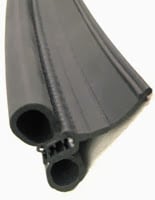 Another procedure is to have the slideout mechanism checked for proper operation. Ensure the slide moves in and out evenly without it “crab-walking” its way in or out. It’s quite possible that it’s time to replace all the seals on the slideout.

 Part of the reason for the poor quality lies in Elkhart, Indiana, where most RVs are made. The RV makers there are struggling to find qualified employees to keep up with demand. At Dicor, a 130-employee company that makes RV parts and accessories, between 30 and 50 percent of job applicants fail the drug test, according to company president Gregg Fore. “On a bad week, it’s more than 50 percent. Five years ago, it was between 10 and 20 percent,” he told the South Bend Tribune.
 Is reading this newsletter worth 10 cents to you?

 What RV do you drive or tow?
 RV accent lighting is all the rage! Just look around the RV park! Enter Boogey Lights®! These robust, super-bright, state-of-the-art LED lights with hi-tech controller technology represent the next generation in LED lighting for RVs. The AWNING & UNDER-GLOW LIGHT KITS are specifically designed to withstand harsh operating environments. Don’t waste your money on junk! Get Boogey Lights! You can even control them with your Smart Phone!
  RV manufacturers are likely to see themselves cut out of the market as the Federal Emergency Management Agency (FEMA) ships temporary housing to folks affected by the flooding in Louisiana. Instead of “FEMA trailers” with a bad reputation, FEMA says it’s shipping in a new generation of “manufactured housing units.” Photos show the new units are reminiscent of mobile homes with vinyl siding. Sized anywhere from 8 to 14 feet wide, the agency is hoping to shed the formaldehyde-related disaster image from the temporary housing units it shipped to Hurricane Katrina victims.
 Don’t forget — Through Sunday, August 28, in honor of its 100th birthday, the National Park Service is offering free admission at all of its 412 national and historic parks across the country.

 Some RVers travel with unusual pets, but a Walmart employee in Lancaster, Ohio, now has a firsthand experience as proof. The unnamed employee was in the store lot when he was accosted by a three-foot-tall primate “monkeying” around a cart return station. When the employee approached and attempted to detain the monkey, an excited woman ran up, telling him to let go of the monkey. She then grabbed hold of the simian and, hand in hand, walked it back to a nearby motorhome.
 America’s Largest RV Show runs September 14–18, 2016
 The Washington [state] Department of Fish and Wildlife (WDFW) is offering “free fishing” days until August 30 after temporarily suspending the sale of licenses while investigating the vulnerability of its sale system [i.e., a cybersecurity breach]. Anglers are not required to have fishing licenses to fish or gather shellfish in open fishing waters in the state and are also not required to have a vehicle pass to park at the nearly 700 water-access sites maintained by WDFW. Crabbers will also not need a Puget Sound crab endorsement until all requirements are back in effect on August 31. Lands managed by the Washington Department of Natural Resources and Washington State Parks will still need a Discovery Pass for access. Source: KING5.com.
 The new TireTraker™ TT-500 is the most innovative & user friendly TPMS on the market with an unprecedented “Lifetime Warranty”, the only TPMS company in the industry to do so. The TT-500 features a larger, easier to read display, continuous pressure & temperature monitoring, automatic update, & monitoring up to 22 tires on your motorhome, trailer & tow vehicle from 0-232 psi! Seven day per week sales & technical support & over 12 years of experience. List price (4 tires) $389. Our price only $289.


 Keep up with RV Industry news
 Confessions of a newbie full-time RVer
 Unique RV overnight stops at wineries and farms


 Organize your RV’s shower!


 Camco Wheel Chocks. Two Pack
 Improve performance
 Fix it In Foil! Tasty Recipes. Easy cleanup!

 Effective against Zika virus
 Guide to RV Camping in State Parks
 Slow cooker suggestion from a “road gourmet”


 Essential equipment for many RVers!
 Keep your food cool with this RV fridge fan
 Liquefy solid wastes in sewer holding tanks
 Joke of the Week
 Endorsed by Roger Marble of RVtireSafety.com!
 An excellent tire pressure gauge


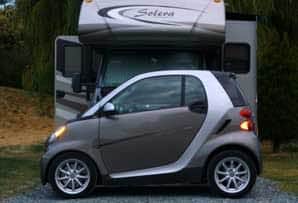 We chose the 2009 Smart Car because of its 1,700 lb. weight and automatic transmission which doesn’t require modifications for towing. Aesthetically, its color matches the graphics on our Solera, as does the “swoosh” steel cabin reinforcement. It gets around 40 mpg at our destination and only drops the RV’s mileage by 1 or 2 mpg when towing. It’s fun to drive, quite safe, surprisingly roomy inside and starts many inquisitive chats at campgrounds. Used, low-mileage Smarties are plentiful and inexpensive and are truly the perfect tow for two!
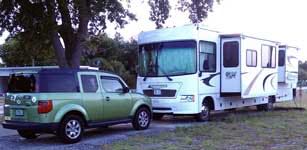 We’ve definitely had our moments, but I have never regretted selling my S&B [sticks-and-bricks] and becoming a vagabond. I am a big proponent of “The Rule of Twos”: I leave two hours after peak rush hour. I always stop for a good get-out-and-walk-around break after two hours of driving. I try to keep my travel distance near 200 miles — or at least under 300 — in a day. I stop for the night two hours before peak rush hour. For every two one-night stays, I stay for two nights and relax for a day. It keeps the travel times pleasant and relaxed.
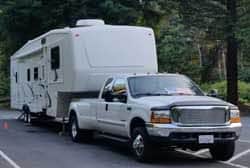 We have a 40-foot 2005 Dutchmen Grand Junction fifth wheel with four slides, bedroom in the rear, living room up front. We tow it with a 2000 Ford F-350 dually with 7.3 diesel, 6-speed manual transmission and an engine brake. It has an extended cab — the dog gets the back seat.
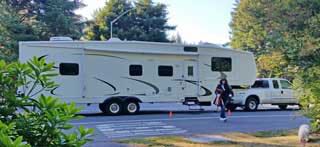 Choosing the right retirement “housing” was difficult. We settled on the concept of a truck and 5th wheel for maximum usable living space and having a vehicle to drive after setting up our campsite. After a couple of months of shopping, we found what we thought was the perfect unit. Our thinking at the time was we need space — storage and living space — since it would be our permanent home for the foreseeable future. So we went big — 40 foot long with four slideouts. … We discovered almost immediately we perhaps bought too big.