Dear Chris,
I am getting white streaks on the side of my Newmar Ventana RV from the water from the roof AC units. They are next to impossible to remove with anything that will not harm the finish. Newmar and others say the fiberglass roof oxidizes in the sun and the AC water picks up the resulting particulates, and that’s the cause. Hard for me and Wade Maid folks to believe my new coach roof would be doing that so soon (I took delivery July 2014). Another tech thinks minerals are from the metal in the AC Unit. Ideas? —Ed
Dear Ed,
Streaks from the roof are a common occurrence with RVs, and there are a few fixes that can help. First, the air conditioner is not the cause, and no metals are coming from it. I’m more in line with the roof oxidation theory, or a lot of dirt and environmental fallout causing the stubborn stains.
Wax is your best friend in this regard. A well waxed fiberglass or aluminum surface is much easier to clean, and is protected from soils settling into the surface, being difficult to remove. I think if you wash and then wax the fiberglass roof, and then the sides, any soils that find their way down will be much easier to remove.
I would advise using the highest quality wax for fiberglass you can find for the roof. There are a number of good ones, especially in the marine industry that might provide a longer lasting, more durable finish.
Although I am not familiar with Wade Maid, I agree that extreme oxidation with such a young unit is unusual, but by no means impossible. In fact, I really don’t see it happening the way you describe without exposure to a caustic substance.
If the roof finish is becoming rough or badly faded already, I would discuss the situation with the manufacturer and/or your selling dealer to get a visual inspection to make sure there is no physical problem with the fiberglass sheets used for the roof. I would do this sooner than later, so it is documented during the warranty period.
You don’t have to be new to RVing to be a bit confused by some of the things RV manufacturers do. Here’s a quote from an RVer, “I have a 2008 Pilgrim Lite. And in my old age I can’t remember which is my black tank lever and which is the gray tank. Front or rear? The bottom of the trailer is covered so I can’t see the pipes.”
Photo: Obsidian Soul on wikimedia
Bless RV manufacturers, for some reason they seem to like to do things on the cheap. If it cost a penny more for a dump valve handle that was anything other than black, they’d be sure to justify making both the gray water and black water handles black by saying they couldn’t afford the colorful one.
This leaves RVers with a “new to them” RV, or who’ve just can’t remember, in the unenviable position of trying to guess which lever to pull first. If you’re new to tank dumping, here’s something to learn and remember: Always dump the black water first, close the valve, then dump the grey water. Why? Because the gray water will then flush the nasty Klingons out of the sewer hose and make your life, oh-so-much easier.
Okay, here’s the case of knowing which valve handle is which. If you have an owner’s manual for your RV look there first. Chances are, if you bought a used RV, you don’t have the manual.
Next up, if your rig has “compartmentized” your dump valves (a lot of motorhomes do this), look in around in the compartment and on the inside of the compartment door for a diagram that may explain in Egyptian-style hieroglyphics which handle dumps which tank. Don’t understand hieroglyphics? Take a picture of them, and tell your significant other this is a great reason to take that vacation to Egypt to find a translator.
Seriously, if the above two steps fail, we’re down to down and dirty. Yep, crawl down to the ground level and hope against hope, that unlike the poor fellow with the 2008 Pilgrim Lite that your bottom isn’t covered and you can see your pipes. Well, be careful about that. Anyway, if you CAN see the pipes coming down to the dump valves, a giveaway for what’s what is that the black water line coming to the valve will be a BIG one, that is 3″ in diameter, while the line to the gray water is smaller, in the neighborhood of 2″ or maybe even less.
And what if you find that you can’t see what size pipes you have? Then it’s going to be (drumroll please), a CRAPSHOOT! Take your rig to a proper dump station, hook up your sewer hose to the outlet port, and repeat after me: “Eeny-meeny, miney-moe,” while pointing your finger back and forth between the two levers. With an assistant carefully observing the outfall of the sewer hose, pull one (just one!) of the levers, and have the assistant report what comes shooting out of the sewer hose. Once you’ve established what’s coming out the hose, you can associate the lever you pulled with the tank it’s attached to.
Now, using masking tape and other appropriate material, mask off the areas surrounding the dump lever that’s associated with grey water, and spray paint that handle with a color other than black. Gray might be an appropriate choice here. That way when dumping your tanks you can repeat the old acronym, TBOF – “Tug Black One First,” and you’ll be dumping your tanks in the proper order.
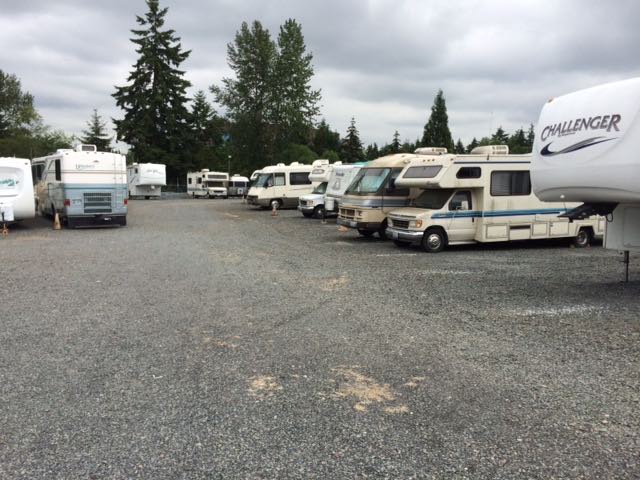
If you are planning to buy a recreational vehicle but are unsure where you will store it when not using it, you are asking for trouble. In many cases, finding a place to store an RV is as hard as or harder than finding a place to buy one.
If you are lucky enough to live in a single family home with space on the property suitable for parking an RV, that’s the best option. In communities where there are no laws that restrict where a recreational vehicle can be parked, any spot large enough on the property will do.
Short of having an enclosed garage, a shelter like this is an excellent place to store an RV.
Many RVers lay a special concrete or gravel pad that serves as home to their RV when it’s not rolling down the highway. Others purchase special shelters designed specially for RVs. In rare cases, a home will include a garage large enough to store the RV. Class B motorhomes, which are about the size of a pickup in size and height, are often easily stored in a regular car garage.
In many communities, storing an RV on residential property is illegal. But be warned about RV storage: Hardly a week passes that another community across North America does not pass legislation that dictates where an RV can or can’t be parked. The most “generous” laws prohibit an RV from being parked on the street in front of the owner’s property except for brief periods for loading and unloading. But often as not, the laws also prohibit RV owners from storing their vehicle on their property in any place where it’s visible to the public. So a front yard, driveway or even side yard would be off-limits. Violators pay a hefty fine.
Before buying an RV with the idea of storing it on your property when not in use, check with your city or county to see if there are any laws that deal with where an RV can be parked. If there are no such laws, nose around to see if any are in the works. The usual reason that “no parking” laws are passes are because of complaints that RVs are “eyesores” or they block motorists’ views and present a traffic hazard.
RVers who live in condos, apartments or homes where it’s either illegal to park on the property or physically impossible often opt to rent a space in a commercial storage facility. Some are dedicated to recreational vehicles only, but most are within a self-storage complex where customers store the miscellany of their lives in walk-in lockers and garages. Prices range from a low of $100 a month to as high as $400 depending on the size of the RV and the locations (more in big cities).
But beware of the downside of these places. In a survey at RVtravel.com, of the more than 2,400 responses, nearly one in six of the RVers noted that their rigs had been vandalized; about half of the RVers who left comments said that the crimes had occurred while their RV was parked at a storage facility, even in those “secure ones” enclosed by fences.
So where will you store your new RV? It’s not always so easy, so do your homework. Perhaps a friend or relative has room. You might need to keep it miles from your home because there is no space nearby. But the main thing new RVers should not forget is make sure they know darn well where their RV can be stored when it’s not in use.
For many RVers, the first big decision is whether to buy a motorized or non-motorized rig. The two most popular types are the travel trailer and the motorhome, with variations including the folding camping trailer (also called pop-up or tent trailer), truck camper and fifth wheeler.
There are many considerations to make when deciding which is best, but they boil down to two things: budget and how the RV will be used.
Class C motorhomes are designed more for vacations and light use. A Class A motorhome is generally favored by full-timers.
Beginning RVers, especially those on a budget, will often opt for a travel trailer, sometimes even a folding camping trailer, or pop-up. These come in many sizes, from very short and light pop-ups that can be pulled by just about any car, to longer and heavier travel trailers that require a more powerful tow vehicle.
Another version of the travel trailer is the fifth wheel trailer, which must be pulled by pickup truck. A 5th wheel trailer is the most popular towable among full-timers, who appreciate the extra room it affords over a travel trailer.
Perhaps the biggest advantage to any towable, whether a trailer, tent trailer or fifth wheeler, is that when you arrive at your destination you can unhook the tow vehicle from the trailer and use it to run errands or explore the local area. This is a huge advantage over a motorhome, where your home is also your motor vehicle, and once camped, it’s a chore to move again.
And foot-for-foot, a trailer or fifth wheel trailer is less expensive than a motorhome. This makes perfect sense because the towable has no engine — an expensive component of any motorized RV.
A motorized RV has advantages, too. For one, everything is in one unit — your home and your motor vehicle. Driving down the highway, it’s easy for passengers to walk back into the rig to grab something to eat, watch a video, or simply sit at the dinette and play cards. RVers with children find this especially nice, as it’s easier to keep the kids entertained on long trips (remember to be sure everyone is wearing a seat belt!)
Once at the campground, the motorhome can transform from vehicle to “home” in a matter of a few minutes. Just level it up, plug into the hookups (where available) and that’s it.
The disadvantage to the motorhome, besides being far more expensive than a towable, is that once you are parked for the night, you have no vehicle to drive to the general store to grab a quart of milk or to explore local attractions. For RVers who move around a lot, staying in one location only a day or two at a time, a motorhome makes perfect sense. But for those who spend weeks or longer in one place, a trailer with its detachable tow vehicle may be better. This is why many full-timers who stay months in one place, opt for a towable.
Some motorhome owners tow a small car behind, and use this for local exploring. This works fine, but can be costly, as there are two motorized vehicles to maintain instead of one. Options to pulling a car are to bring a long a lightweight motorcycle (or electric bicycle) or a bicycle. A two-wheeler can transport you to destinations too far away to reach on foot, and the cost is minimial beyond the initial investment.
Another option for motorhomers is to rent a car when staying in one place for an extended period. Rental cars are inexpensive and for motorhomers who usually move around a lot, but on occasion park for longer, the cost of a short-term car rental now and then is far less than towing a car behind all the time just to use every so often.
One final option is a truck camper. These units fit on the bed of a pickup truck. The larger ones are sometimes equipped with a slideout and can be roomy and packed with amenities. For RVers who already own a pickup truck, a truck camper is an inexpensive way to get into RVing. Most of the camper units can be easily detached from the truck at the campground, leaving the camper to be used as “house” and the truck as the motor vehicle.
If you’re in the market to buy a used RV, you may be interested in what the “rest of the crowd” is shopping for. Used RV appraisal guide book producer, NADA Guides, looked back over the year 2015 and broke out statistics on what rigs looky-loos were eyeballing on their websites. Here come the stats!
If you’re like me and wish you could go to Mars, well, you’re in for a disappointment. It’s not going to happen —maybe for our grand kids.
Still, I consider myself fortunate to have lived in a time when I am able to view amazing, high definition photos of the Red Planet taken by our rovers. It’s not like being there, but it’s pretty darn close and convenient considering we don’t have to take a four-month spaceflight to get there.
There is one place here on Earth, close to home for we North Americans, where someone can feel very much like they’re on Mars, and that’s Death Valley National Park in Southern California. If you have seen photos of Mars, then you can see by my photo above that Death Valley offers a very similar landscape. And good news: you can breath the air!
Not all of Death Valley looks like this. The Furnace Creek oasis, only about ten miles from where I took this photo, is studded with palm trees. Water gushes from the ground, providing plenty of life support for plants and humans, too. There are even fish in Death Valley, which you can’t say about Mars. But don’t bring your fishing pole. These are just little fellows, maybe an inch or so long. They’re called Pupfish. They’re endangered so don’t try bringing one home.
There are several campgrounds at Furnace Creek. Sunset Campground is huge — just a big flat parking lot. But it can hold hundreds of RVs (no hookups). If the other two campgrounds are full (Furnace Creek and Texas Springs) you can always hole up there. You can walk from all three of the campgrounds to the Furnace Creek village with its Park Visitor Center, general store, cafe, bar and museums. Furnace Creek Campground, by the way, has hookup sites.
You should avoid Death Valley in the summer. A cool day would be 100. But it’s usually hotter.
When RVers think of “pavement camping,” it’s often in terms of a “necessary evil,” sort of way. We need the sleep, we need a place to put up, and we don’t care to spend a small fortune to get a few hours of Zs. Walmart is likely to be the first place to drop anchor. But truck stops, too, can fill the bill. But few of us want to spend any more time than necessary in a truck stop. Trucks are running in and out, 24/7, and “reefer” units sounding off can just about kill even the hopes of the deepest sleeper. But hey, sometimes that’s about all that’s available to the weary wanderer. But are they a safe place for us?
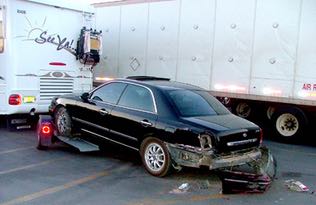
We’ve spent our fair share of nights in truck stops, and we know plenty that have. How safe staying in a truck stop often depends on the attitude of the commercial drivers who bring those big rigs through. Witness the case of Dave and Shirley, who rolled their motorhome into a big truck stop one night. They got a rude–and jarring–awakening at around five in the morning. Their car alarm was bleating like a sick sheep, and Dave, bailing out of the motorhome, watched a rapidly retreating semi-truck skating for the exit–just moments before he spotted the remains of the rear end of his toad car, lying in a number of pieces in the parking lot.
Witnesses told Dave that a semi-driver had looped around the rear of the toad car, which had been neatly mounted on a tow dolly. The trucker caught the rear of the car, working hard to yank it of the dolly. The driver then stopped–presumably for a better look–and then headed out of the lot. The mystery hit-and-runner was never caught. Dave’s insurance company paid the freight for the trucker, and the couple were toadless for several days while the car was repaired.
So is the moral of the story, “Don’t park in a truck stop”? Not necessarily. Commercial drivers mention that drivers rolling into truck stops are often tired out, bored, and under pressure to get their mandated off-road time done. Paying attention may not have as high a value as getting paid. If you park in a truck stop, try and find a quiet corner. If you have a rig you can back in (obviously out for Dave), you’re probably better off putting yourself in a back-in spot. Don’t park on a “corner spot” where your rig will be exposed to the danger of every passing rig making too close a cut.
Where truck stops–like Flying J for example–have a designated “RV” parking area, avail yourself of it. Nothing “chaps the hide” of a long-haul driver when he rolls into a truck stop that has dedicated RV parking and finds that instead of taking advantage of it, RVers are needlessly parking in the big-truck lot, which may already be crowded. All it takes is a hot-head with a grudge and 65,000 pounds of mass and 300 horsepower to ruin your whole day.
Says the RV salesman: “If you can drive a car, you can drive a motorhome!” While many of the “driving” principles are the same, driving a motorhome–or any other kind of RV–can present challenges to the fledgling RVer. In a series, we’ll discuss how to get used to driving (or towing) your RV. This is part 1 on how to ensure visibility in your RVing lifestyle.
Most of us RV because we yearn to see new places. But seeing in your RV is more than scenery, it’s also safe operating and not clobbering anything along the way.
Looking forward: If anything, the view from most motorhomes looking ahead is clear, and sometimes a mite distracting. If you have a penchant for sticking things on the windshield, make sure they don’t block your view. Keeping stick-ons low is best. Remember though, not all states are windshield “stick on legal.” Yes, radar detectors are legal in Arizona, but if you stick them (or anything else) on the windshield you can be pulled over, even cited. I know from first-hand experience having done a “ride along” with a state trooper.
Side swiped? When evaluating a motorhome for purchase keep a close eye on side view. This is where motorhome designers often come up short. Windshield pillars can be in “just the wrong place” and adversely your view to the side, giving unwanted blind spots. Some motorhome side windows are so small or blocked up with hardware they too, mess up the view. You can’t move them or eliminate them but you may think twice before buying a rig with “junk” in the way of your view.
While mirror is good in size, tying up half with a convex mirror defeats the purpose. R&T De Maris photo.
Looking back: Rear-view mirrors are a CRITICAL issue with RVs. You can’t just toss a look back over your shoulder to see what’s going on, you must rely on mirrors. Again, motorhome designers don’t always have it right, window frames can block the view of a mirror. It may not be necessary to pass up a motorhome that has this fault as you may be able to relocate the mirror for clear vision.
The larger the mirror, the better the view. One source tells us that they feel the minimum adequate size for a rear view mirror on either a motorhome or tow vehicle is 10″ x 7″. If you’re putting together a tow package and your OEM mirrors aren’t adequate, skip the idea of adding a fender mounted mirror. They’re just too far away from the driver’s position to give safe judgment. Whatever mirrors you use, make sure they’re mounted tightly and have no loose adjustments. A vibrating mirror will throw a distorted–even useless–image your direction.
Convex mirrors are a godsend to RVers. Giving a wide-angle view, they eliminate a lot of blind-spots where small cars may be hiding out and can keep you from a smash-up when lane changing. “Stick on” convex mirrors can be added to existing mirrors but they then reduce the amount of “normal” mirror image, making for an unsafe condition. You’re better off adding an auxiliary convex mirror above or below the existing mirror, fixed on its own mount.
You may need to add extensions for mirrors on tow vehicles to get them out far enough to see around the trailer. Some factory equipped tow rigs (recent Chevy Silvarados as an example) have a wonderful setup: Push a button in the rig and the tow mirror extends out from the side of the rig. Done towing? Hit the button to retract it.
Rear vision cameras add a high tech back view. Some motorhomes come with these gems direct from the factory; they can also be added as an aftermarket item. They can be a wonderful asset when backing up into a site, or keeping an eye on the “toad car.” Similarly, back up cams can be mounted in the bumper of a tow vehicle making it easier to back up to hitch a conventional travel trailer.
Learn about RV camping, RV travel, RV news and much more. This newsletter, now in its 15th year of continuous publication, is funded primarily through advertising and voluntary subscription contributions from our readers. Thank you!
Issue 739 • Week of April 23-29, 2016
Editor’s corner With Chuck Woodbury Chuck (at) RVtravel.com
I was interviewed by an RV trade magazine earlier this week. The editors wanted to know about this new, improved website, but they also wanted to know what I thought of the state of the RV industry.
RV camping, sardine style, in Southern California.
As you likely know, the RV industry is beside itself with happiness because a billion or so people are buying RVs every couple of days or so. The RV makers and dealers like that, of course, because they make lots of money. RV park owners like that because more people can cram into their already packed campgrounds so they make more money, too.
More people have jobs making those RVs now, which is excellent — most of them in Elkhart, Indiana, a pretty little town that looks a lot like Mayberry. Andy, Barney and Aunt Bee could walk by and you wouldn’t bat an eyelash — unless you happened to recall they’re all dead.
Well, I told the magazine that I thought that it’s totally understandable that people in the RV industry would be very happy. Everybody likes money, right? But I said that I wasn’t all that happy myself because all those new RVers are presenting a problem to me: There are just too many of them and they are squeezing me out of the campgrounds where I like to stay. I need to make a reservation to get a spot unless I want to pay $35 for some weed-infested plot of earth that somehow qualifies as an RV park, where people like me go only when they can’t get in anywhere else and its either there or sweating like a pig in a parking lot without my blessed air conditioning.
Arizona state parks, like many public campgrounds, still offer spacious campsites. But good luck getting a space without a reservation in the prime season.
I used to say it was nice to travel with an RV because you could be spontaneous and stay where you want and not have to search out a motel room. I don’t know if that’s true anymore.
Yes, you can stay in your RV in a Walmart or Cabela’s parking lot, which truly is a lifesaver sometimes. But, really, is that a nice camping experience? Do you get to sit around the campfire at night with all your new Walmart buddies, cook hotdogs over the fire, drink a little firewater and tell ghost stories? Well, no, you can’t do that unless you want to get booted out and then have to drive two miles to Kmart.
And the problem with a lot of these new RVers is they are buying newfangled RVs with outdoor kitchens and outdoor stereo boomboxes and my favorite — big screen TVs. Now, those things are fine for tailgating, but not, in my opinion, in RV parks where you are packed so tightly you can hear Bud and Mable next door going tinkle.
One night last summer on my trip across the USA, my very nice campsite turned into a movie theater when a family of at least 15 (actually, I think it was six) showed up. About 9 p.m., Mom and Dad exited the RV with their brood following. They sat down in various-sized lawn chairs, next to the campfire that, I might add, was blowing smoke into my RV, bringing back wonderful memories of growing up in Southern California and smog so thick I couldn’t see my backyard fence.
Anyway, the family took their seats in front of the outdoor TV, which was probably around a 50-incher, and then fired it up. And for the next two hours, the girls giggled and laughed as they savored every minute of “The Little Mermaid.” I wanted to walk out and say, “Would you turn that damn thing off?” But I love kids and they were having fun and, well, I just couldn’t be Mr. Scrooge. So I closed my windows and fired up the A/C. Ah, camping!
But enough whining. I was just going to write, “Okay, time to get serious,” then I realized I actually have been serious. But putting on my “glass half full” hat, I also must say that I am still head over heels in love with RVing. I still think it is the best way to travel in the world, especially in the off-season when you can still get a campsite without a reservation and avoid kids racing between your legs on their very cool, three-wheeled, all-plastic Hasbro tricycles.
Really, if an RVer heads out onto our public lands there are still millions and millions of acres of wide-open spaces, blue skies and fresh air — room aplenty to enjoy the great outdoors and our incredibly wonderful recreational vehicles.
Happy birthday! Happy Anniversary!
Beginning in a week or two you can wish your special someone a Happy Birthday or Happy Anniversary and we’ll post your well-wishes and your short comment right in this newsletter. It’ll be swell, when your husband (say his name is Al) is reading the newsletter and he sees a message from you that says something like “Happy Birthday, Al, my hunky hubby. I still love you, even with your gas problem! Love, Babs.” It’s real easy to leave your comment. Just click here.
It’s free! Come on, don’t be bashful! We’ll run your message in the closest newsletter before your special date!
RVs & Electric Bikes – the perfect match! An Electric Bike is the perfect, simplest and most affordable way of sorting all the ‘challenges’ of RV’ing. Get around camp effortlessly, visit the sites or town nearby without unhooking or simply enjoy a fun ride with fellow campers! Click here to discover our electric bikesand get $100 off, free shipping & returns, and 0% financing on any new EVELO using the code RVTRAVEL during checkout!
Would you pay 10 cents to read this newsletter?
Our staff works hard to bring you an entertaining and informative newsletter every Saturday. The readers of the newsletter help make it possible with their voluntary subscriptions. Even a pledge of $5 a year would be appreciated — that’s less than 10 cents an issue! Many readers pledge more — $10 a year is less than 20 cents an issue! If you care to chip in, please know we will be very appreciative. Just contribute what you think is fair. Enter a voluntary subscription.
A Perfect Match . . . RVs and Reverse Mortgages All Island Mortgage NMLS #3740 has been serving the industry since 1989. Licensed in NY, NJ, CT, FL and MT. We are reverse mortgage specialists with in-home service to every client. A reverse mortgage is a perfect way to acquire an RV and make NO monthly payments at all. Fully secure and FHA guaranteed. Call us at 888-660-3033 or visit our website and view the video and full 27-page catalog. And, yes, I am the owner and a camper since 1998. —Bob Schiano, President.
RV owners sue Dometic for
refrigerator defect linked to explosions, fires (April 22, 2016) — A group of RV owners has filed a nationwide class-action lawsuit against Dometic Corporation, stating that the company sold defective gas absorption refrigerators with cooling systems that can spontaneously ignite in RVs and boats, putting consumers at risk of deadly fires, explosions, loss of property and loss of the value of their RV/boat, according to consumer rights law firm Hagens Berman. Read more.
Reader RVs
What RV do you drive or tow?
Please send us a photo of your RV with a 150-200 word description of where and how you travel with it, and what you like (or don’t like) about it. (If you want, just send us your notes and we’ll put your story together for you.) If you have a photo of it in a scenic setting, that’s great. Be sure to include your name(s) and your hometown (unless you’re a full-timer). We’ll post them to RVtravel.com. Send to assistant editor Diane McGovern at Diane(at)RVtravel.com .
CLICK HERE to see last week’s RV Travel Reader RVs.
This Week’s Contest
We have a new format! Yippee! You don’t need to answer at a specific time of day. Answer anytime, and then again once a day through Tuesday.
This Week’s Prize: A Folding Metal Step Stool
Camco’s RV Folding Metal Step Stool is perfect for all those little jobs around the RV. It opens to 11-1/2″ tall. Its lightweight aluminum construction supports up to 200 lbs. If you don’t win the contest, you can order it here.
New motorhome sales in February showed an improvement compared to February 2015. Overall, a 5-percent bump-up was noted; Class A units accounted for an increase of almost 8 percent, while Class Cs inched up 2 percent. Source: Statistical Surveys Inc.
February marked a good month for new travel trailer sales. Comparing that month to February 2015, overall towable unit sales were up 8 percent, with travel trailers showing more than a 10 percent gain. Fifth wheels barely made the grade, showing little more than a half-point gain; pop-ups deflated more than 15 percent, and park models lost almost 20 percent. Source: Statistical Surveys Inc.
Spending by a record number of National Park visitors in 2015 provided a $32 billion benefit to the nation’s economy and supported 295,000 jobs, according to a report released on Thursday by National Park Service Director Jonathan B. Jarvis.
Crystal ball gazers in the RV industry say they foresee a 2-percent sales increase of new rigs this year, compared to the 2015 total of nearly 375,000 units. The prophets at the Recreation Vehicle Industry Association pin their prognostication on high hopes for travel trailers and Class C motorhome sales.
To celebrate the 100th anniversary of the National Park Service, PBS will rebroadcast Ken Burns’ documentary series “The National Parks: America’s Best Idea” from April 25-30. Check here to find out when it airs on your local PBS station.
Not even Escapees can escape the weather. Flooding at the popular full-time RVers’ club headquarters in Livingston, Texas, put the kibosh on the club’s phone system and killed off mail services for a day recently.
Exhibitor booths for the giant Hershey RV Show sold out in one day. This year’s edition is set to run Sept. 14-18, 2016, at the Giant Center in Hershey, Pa., with Industry-only Days scheduled for Sept. 12-13. Last year more than 52,000 people attended the event.
Tucson, Ariz., RV dealer Freedom RV is asking for help after two $200,000 motorhomes displayed at an area mall were stolen. One of the rigs was found – and two suspects were rounded up and charged with theft, burglary and joyriding. The other rig, a Newmar Canyon Star, is still unaccounted for.
A Breckenridge, Colo., man took out a loan to pay off his $23,500 restitution bill, and thus avoid criminal charges, for burning down 30 acres of trees on Bureau of Land Management lands. Ryan Huff admitted to setting off fireworks on public lands last August, catching the woods on fire at Dog Island in Ruby Canyon. Several area campgrounds had to be evacuated, and century-old cottonwoods went up in smoke.
Motorhome sales in Canada continue to deflate, reports Statistical Surveys Inc. Comparing February 2016 to February 2015, overall registrations nosedived nearly 23 percent. Class A sales took a beating, down more than 28 percent; Class C sales did better, down only 17.5 percent.
KOA headquarter employees in Billings, Mont., got an unexpected break from work – as in quarantine. Mail room workers found a suspicious white powder on opening some incoming mail, and the 43 employees were isolated while emergency responders worked on the problem. Not anthrax – cocaine – were the test findings.
A Seattle, Wash., RVer was startled when he drove to where he’d left his motorhome parked, only to find it gone. The RV was found over an embankment and held precariously in place by trees. Gary Ellis was able to rescue his dog, KK, from the rig, but he and his wife, DaVonne, are now left homeless. Apparently the motorhome’s parking brake failed, sending the rig to a destructive end.
Reduce air drag and boost fuel efficiency — Airtab® your RV! Just peel and stick Airtabs™ to the rear sides and the rear roof of your RV coach or trailer to create swirls of air that reduce aerodynamic drag, save fuel and improve stability. Airtabs™ dramatically reduce trailer ‘fish tailing’ and crosswinds pressure to RVs from passing trucks, while improving fuel efficiency 2% – 5%! Click on the video.
A generous RVer may be the hero of a major traffic snarl in Utah’s Virgin River Gorge. Last Saturday, northbound traffic on the narrow stretch of I-15 was tied up for nearly an hour when a semitruck ran out of fuel on a bridge in a construction zone. The truck couldn’t be moved – no air to release its brakes – and it was a long trip out for a big tow truck. Finally a motorhomer with a diesel engine volunteered to have fuel siphoned from his rig to clear the scene. The semi-driver was cited for “unsafe vehicle.”
Photo: Schodack Island State Park, nysparks.com
New York state has swung the gate open on its latest state park – Schodack Island. RVers will find 43 of the 67 sites offer electrical hookups at the campground on the Hudson River’s eastern shore, south of Albany.
If you think Quartzsite, Ariz., is crazy during the tourist season, it doesn’t end when the snowbirds leave. Highway patrol officers chased after an erratic driver on I-10 near Quartzsite last weekend and were quite concerned when the driver refused to pull over. A man towing a trailer used his rig to help troopers in a “wedge” maneuver, finally stopping the car. Turned out the car was rented to a Japanese tourist who didn’t know what those red-and-blue lights behind her meant. Troopers used Google Translate to communicate with her, admonishing her to brush up on U.S. driving customs, and sent her on her way.
If Alabama’s former state parks chief, Charles Grimsley, has his way, money from the BP oil spill judgment won’t be paying for a rebuild of the Gulf State Park Lodge. Grimsley has filed suit against several Alabama politicians, including Governor Robert Bentley, asking a court to stop the state from “unlawfully disbursing state funds” in the matter. Grimsley says the money was never authorized for revamping the lodge.
Photo: rv peddler; rvpeddler.com
The Bakersfield, Calf., RV dealer who says “We take anything in trade” is accused of taking customers for a ride. Local news media report RV Peddler has shut down, and one customers says when he traded in his old rig, he never got the title for the new one, and that RV Peddler didn’t pay off the loan on the trade-in either. Another customer says he consigned a rig with Peddler, was told it was sold, but never got his money. A sign at the dealership directs queries to a bankruptcy attorney.
Surrey, Sutton, England, police are facing a charge of animal cruelty after the arrest – and release without charge – of a British RVer. Nathan Young was arrested outside of his motorhome and expressed concerns about the welfare of his dog, Rocco. He gave his keys to arresting officers, and they were to pass the keys along to a friend of Young’s who would look after the dog. On his release, 19 hours later, Young found his keys still packed in with his personal belongings – Rocco had been left without food and water. Surrey police officials acknowledge “a breakdown in communications.”
More than 1 million households in North America started camping last year. Of the new campers, 18 percent are African-American, 11 percent are Hispanic and 44 percent Millennials, according to the 2016 North American Camping Report, an annual independent study supported by KOA.
Moments after an RVer stepped out of his fifth wheel, it blew up. Firefighters responding to the incident in Port Hadlock, Wash., say the RVer “was extremely fortunate,” noting, “If he had been inside, he would have most likely been killed.” The brand of the blown-up fifth wheel? Fireball.
RV Quick Tips Oven misbehaving?
RV oven burning stuff? Get an oven thermometer to verify the actual temperature and try cooking your stuff on top of a pizza stone to even out the heat.
Better batteries for walkie-talkies
Use walkie-talkies in and around camp? Some users report rechargeable batteries just don’t seem to cut it; alkaline throwaways reportedly last longer.
Check for “flying cargo” when you arrive at camp
When arriving at camp at the end of your road day, do an inside “walk around” by carefully opening each cabinet slowly. If contents have shifted and want to jump out, you can be ready.
No more roof leaks, for life, guaranteed!
Now with locations in TX, FL, MI, AZ and NC!
RV FlexArmor® is a sprayed RV roof that is 187 mils thick, has no more caulking joints and is the proven RV roof alternative for over a decade. Guaranteed not to leak for your RV’s lifetime! “Your company gets an A+.” —Marsha G., customer. Click on our new video showing how we handle air conditioners.
How to maximize RV tire life with minimum effort If you are new to the RV lifestyle or an old hand at it, there is one thing that is true: What you knew or learned about tires from years of car ownership probably did not prepare you for the task of maintaining the tires on your RV. In this very thorough article, RV tire expert Roger Marble offers some suggestions for years of problem-free travel with minimal maintenance of your tires.Learn more.
Another cool little LED light Rich “The Wanderman” admits he’s a sucker for inexpensive, little and bright flashlights — he just can’t resist them. He’s found a new one to add to his collection because it fits all his criteria, plus it looks cool. These are very inexpensive and could come in very handy.Read more.
What toilet paper is best for your RV toilet? Here’s the typical blurb used by RV toilet paper pushers: “Enjoy luxurious 2-ply comfort in an RV toilet paper that dissolves rapidly to help prevent clogs. Soft, snowy white XYZ Brand is highly absorbent and 100% biodegradable. Two-ply, yet it breaks up fast to make emptying your holding tank easier.” Just right? Yes, sounds good until you get down to the bottom line price: Roughly $2 a roll for that soft, luxurious feel that won’t clog your tank. So what’s a cheaper solution? Find out.
Discover the RV Warranty Taking the Community by Storm!
The best RV warranty coverage just got better: Introducing the Viking Protection Plan, a policy designed for maximum coverage and ease of use, all backed by the customer satisfaction guaranteed by RVer Favorite Wholesale Warranties. Ready to see what the ultimate in Peace of Mind might cost you? Get your FREE Quote for coverage today!
Can flea collars keep pests out of your RV?
The next time you’re buying a flea collar for your dog or cat, throw one in for your RV. It could save you from having to spend money on repairs to your rig’s propane system. Read more.
Will ice cubes in an RV sewer tank dislodge waste buildup?
A buildup of solids in an RV sewer tank is a bad thing. Most of us have heard that putting ice cubes down the toilet will do the job. So does it work? James of the Fit RV wanted to find out. See the results in this enlightening video.
Caulk tools: A must for RVers RV technician Chris Dougherty says these tools are essential for keeping your RV’s roof leak free. Find out what they are.
This week in history
1564 William Shakespeare is born.
1968 “Hair” premieres on Broadway.
1984 President Reagan visits China.
1986 Nuclear explosion at Chernobyl.
1986 Roger Clemens strikes out 20 batters in single game.
1990 Space telescope in orbit.
1995 Ginger Rogers dies.
2004 Comcast abandons bid to buy Disney.
Unique RV overnight stops at wineries and farms With membership in Harvest Hosts® you can stay overnight at 500 wineries, farms and attractions across North America. Harvest Hosts offers an exciting alternative to traditional overnight stops where you can meet interesting people and learn about their lifestyle. Learn more at the Harvest Hosts website, or watch an interview with the founders by RVtravel.com editor Chuck Woodbury.
RV Clubs Here are a couple of RV clubs from our extensive directory which you may be interested in:
Explorer RV Club.
The largest national Canadian RV club serving ALL RVers. Membership in the Explorer RV Club offers many benefits including: discounts on camping fees; discounts on home, auto, travel and RV insurance (in some provinces); discounts on hotel fees and on-the-road travel; discounts on emergency road service; and many more benefits.
Allegro Club.
Official membership organization of Tiffin motorhome owners.
America’s Largest RV Consignment Dealer Buy or sell your used motorhome, diesel pusher, fifth wheel or travel trailer hassle free at PPL Motor Homes. And check our huge selection of parts! PPL is the largest RV consignment dealer in the USA, selling more than 24,000 consigned RVs since 1972. Visit the PPL website.
Bumper sticker of the week
I’m not old — I’m chronologically gifted.
Funny/clever business slogan
“We curl up and dye for you,” Orchid Hair Salon, Delta, Colo.
Have you seen a funny bumper sticker or business slogan? Send it to Diane(at)RVtravel.com
Digital LCD Voltage MeterUse this handy flat plug meter for measuring the AC voltage in your home or RV by just plugging it into an AC 110V/220V outlet. Great for monitoring the voltage of appliances. LCD display makes it easy to read. Learn more or order.
Secret phrase for Spin and Win contest: Hillbilly Bill has a cow named Carl.
Upcoming RV Shows
See the recently updated, long list of upcoming RV shows for 2016.
Websites of the Week
We like these websites. Check ’em out. More next week.
May be required by law in some states! Essential for hooking up to a sewer
Many states these days do not allow an RVer to simply insert a sewer hose into an RV park sewer drain without it being sealed. This soft sewer sponge ring is the answer. Simply insert your sewer hose into the sponge ring, twist it to tighten, and then insert the sponge ring into the sewer hookup for a tight seal. Learn more or order.
Good reading from RV123.com
• Camp Gulf
• Featured App: TV Food Maps
• Egg and Sausage Casserole
Multipurpose Microfiber Duster
No more car wipes to dry up — this duster replaces all interior car products. The 10-inch dusting head is big enough to get your dash dust-free quickly, but small enough to leave in your glove box. The back of the duster doubles as a scrubbing sponge. Great for interior or exterior use on cars, RVs, motorcycles or in the home! Learn more or order.
Ask the RV Shrink
RV stove on the fritz? Or Fritz on the RV stove?
Dear RV Shrink:
Thank you for the reminder that we should have our alarms tested periodically. After reading your column we tested all of ours and had problems with two of them. Two months later we were glad we did the testing. It wasn’t something normal like a failed gas fitting. Our stove top burner “went on the fritz” just as we went to bed one night. I smelled gas before the alarm sounded. I jumped out of bed and started investigating just as the buzzer went berserk. In the kitchen I could hear the gas hissing from the stove. I knew exactly what happened immediately. The stove didn’t go on the fritz, Fritz went on the stove. … —Thank you in Zion
Liquefy solid wastes in sewer holding tanks
Happy Campers Treatment liquefies solid waste and household tissue. It’s a natural formula that’s environmentally friendly and biodegradable, with no formaldehyde or harsh chemicals. Basically, the good bacteria overtakes the bad bacteria to eliminate odor and accelerate the natural decomposition of waste. Because it is totally organic and odor free, you won’t be embarrassed by bad odors inside or when you dump. Learn more or order at Amazon.com.
RV Tech Tips from Mark Polk Gray tank maintenance Over time grease and residue builds up in the gray tank and it causes a foul odor, not to mention how it is affecting the tank and valve assembly. Periodically treat the gray tank with environmentally safe holding tank chemicals to avoid odors from the tank. When the tank is empty you can also add some dishwashing liquid down the drains to help break down grease and residue buildup. Mark Polk is the owner of RV Education 101, the premiere source of educational DVDs about buying, maintaining and using an RV. Learn more.
Visit our YouTube Channel. More than 500 great videos about RVing!
Latest fuel prices Here are the latest U.S. average prices per gallon of gasoline and diesel fuel. Regular unleaded gasoline: $2.14 (on Apr. 18) Change from week before: Up 7 cents; Change from year before: Down 35 cents Diesel: $2.17 (on Apr. 18) Change from week before: Up 4 cents; Change from year before: Down 62 cents
Headed to Alaska? Best resource: 2016 Milepost
This is THE mile-by-mile guidebook for RV or auto travelers headed to Alaska, the Yukon Territory, British Columbia, Alberta and the Northwest Territories. First published in 1949 as a guide about traveling along the Alaska Highway, today’s Milepost includes more than 600 pictures and more than 100 maps, and details every place travelers might eat, sleep or pull off the road for scenic viewing. Learn more or order.
RV Travel Reader Pets
Do you travel with a pet? We’d love to introduce your pet(s) to fellow readers. Here’s what we need: a photo or two of Fido or Boots (or you with your pet) and a 150-200 word description of your furry friend(s) — name, breed, age, how long you have traveled together, what makes them special? Go ahead and brag about them if you wish! Do you have any tips for other RVing pet lovers about traveling with pets that you’ve learned along the way? Don’t forget to give us your name(s) and hometown. Send to Diane(at)RVtravel.com . (Editor: No, that’s not a stuffed toy.)
Click here to see this week’s issue of RV Travel Reader Pets.
Temperature gun is ‘essential equipment’ for many RVers!
Just aim this non-contact IR temperature gun to measure the temperature of your refrigerator, tires, A/C output, or, heck, even your oven (and the list goes on). It turns on and begins reading the temperature in Celsius or Fahrenheit with one press of the trigger. A laser light aids in aiming, and can be turned on or off. Many RVers consider this essential equipment. Learn more or order at a huge discount.
The RV Kitchen with Janet Groene White Sauce Mix Stir up a money-saving time-saver. Basic white sauce mix is the basis for thousands of recipes, from gravy to casseroles. It’s costly to use a can of condensed cream soup and it probably has extra flavors, sodium or additives that you prefer not to use. When you have this homemade mix on hand, you’re in control of amounts, added ingredients and thickness. Get the recipe.
Protect your RV’s slideout with this rubber seal lubricant
If you don’t take care of your slideout you’re asking for problems including dangerous, costly water damage. This rubber seal lubricant from Thetford prevents fading, cracking and deterioration. It cleans, conditions and shines, keeping seals flexible and protected from sunlight destruction. It is also useful on door seals and window seals. It’s a mineral oil product and also acts as a lubricant. Learn more or order.
Beginners’ Guide to RVing
QUESTION: Is it hard to drive a motorhome? They look so big!
ANSWER: While some people are initially intimidated by the size of an RV, after driving one for awhile they report it isn’t much different than driving the family car. Because an RV is generally larger, there are special considerations to keep in mind — like watching for overhead branches and overhangs, using mirrors more often, and making wider turns than in the family car. A survey of RV owners by Lou Harris and Associates found that three out of four RV owners do not feel that driving or towing an RV poses any difficulty. Experienced automobile drivers already have the basic skills to drive a motorized RV. Automatic transmissions and power brakes and steering are typical. You can search online for “driving an RV” and find lots of tips, classes and YouTube videos for information.
Endorsed by Roger Marble of RVtireSafety.com! An excellent tire pressure gauge
The Accutire MS-4021B digital tire pressure gauge has an easy-to-read LCD display that provides pressure readings from 5-150 PSI. It’s ergonomically designed with an angled head and a rubber-coated easy-grip handle. If you forget to turn off the gauge, don’t worry, it will automatically shut off. The included lithium battery never needs to be recharged or replaced. And all this for less than $13! Learn more or order.
The Dying Art of Proofreading Did I read that sign right? “TOILET OUT OF ORDER. PLEASE USE FLOOR BELOW.”
Help stabilize and keep your RV steps safe
The RV Save-A-Step Brace is designed to be placed under RV entry steps for safety. It stabilizes the RV steps and helps keep the coach from rocking — preventing sag and wear. The brace is made of heavy-gauge steel with a 3/4″ solid metal screw thread, 1000-pound load rating and 7-5/8″ to 14″ adjustment range. Learn more or order at Amazon.com.
Upcoming RV Shows
• Spring Hall of Fame RV & Camping Show, April 21-24, Elkhart, IN
• BC Interior RV Show, April 22-24, Penticton, B.C., Canada
• Puyallup RV Show, April 28-May 1, Puyallup, WA
Complete list of upcoming shows in the USA and Canada. Click here.
Essential equipment for many RVers! Camco TastePURE Water Filter with Flexible Hose Protector
This best-selling product reduces bad taste, odor, chlorine and sediment in drinking water with a 100-micron fiber filter. Its durable in-line, exterior mount filter has a wider body to increase flow. Use it at your campsite to keep sediment out of your RV water tank and to improve the taste and smell of your drinking water for a whole season. Many RVers consider this essential equipment. Learn more or order at a big discount.
Random RV Thought Bring your fishing pole with you even when traveling out of your home state. Many RV parks have ponds or small lakes where guests can fish without a state license. Some parks furnish fishing gear for campers who forgot to bring their own.
Easily brew a cup of coffee This is great for RVers! Brew a single cup of coffee without the high cost of an expensive coffee maker with the MyJo Single Cup Coffee Maker! Just fill reservoir with hot water from tea kettle, or heat water in a microwave. Assemble, place K-Cup pack in base, attach the water reservoir and pump. Watch the video for a short demonstration or learn more or order at a big discount.
Trivia
You’ve probably heard the term “Getting your ducks in a row.” It means getting organized in preparation for action. Do you know the origin of the saying? It originated in bowling alleys in early America when bowling pins were called “duck pins” because bowlers thought they resembled ducks.
Just published for 2016 Locate services at Interstate exits
The 2016 Next Exit is the most complete USA Interstate highway exit directory ever published for every exit of major and most minor routes. Find what’s located at upcoming exits on your route — gas, food, lodging, camping, shopping, hospitals, Walmarts and much more. A best-seller year after year. Learn more or order.
Worth Pondering “Every great dream begins with a dreamer. Always remember, you have within you the strength, the patience, and the passion to reach for the stars to change the world.” —Harriet Tubman
Keep your fridge in order when you travel Tired of stuff moving around in your RV fridge after a day of driving? Maybe a carton of milk has fallen out on the floor one too many times? Here’s the solution. Camco’s RV Double Refrigerator Bar is designed to keep order in your RV fridge during travel. It’s spring loaded to keep items in place. The bar extends from 16″ to 28″. And the good part is the price tag: about $5! (the RVtravel.com staff uses a pair of these in its RV!) Learn more or order.
Joke of the week
How many telemarketers does it take to change a light bulb? Answer: Only one, but he has to do it while you’re eating dinner.
Keep your food cool with this RV fridge fan Every RV refrigerator should have one of these! This small refrigerator fan from Valterra Products will help keep the food in your RV fridge cool and from spoiling. It cuts down initial cool-down time by 50 percent. Runs for more than 30 days on 2 D batteries. Don’t leave home without this! Learn more or order from Amazon.com.
RV Travel staffEditor and Publisher: Chuck Woodbury. Assistant editor: Diane McGovern. Contributing editor: Russ De Maris. Contributing writers: Greg Illes, Bob Difley, Richard Miller, Richard Mallery, Janet Groene, Roger Marble and Julianne Crane. Office manager: Jody Allcott.
ADVERTISE on RVtravel.com and/or in this newsletter. Contact Chuck Woodbury at Chuck(at)RVtravel.com.
About the RVtravel.com editor Chuck Woodbury has explored America by RV for nearly three decades. In the ’90s he published the quirky travel newspaper Out West, and was an “on the road” writer for the New York Times Syndicate. His book, “The Best from Out West” is available at Amazon.com. Woodbury’s RVing adventures have been profiled on ABC News, CNN, NBC’s Today Show, and in People Magazine, USA Today and in hundreds of newspapers. Nowadays, he lives near Seattle, where he drinks massive amounts of coffee and travels often in his motorhome and sometimes by plane when vast expanses of saltwater would turn his RV into a leaky submarine. He is the host of the Better Business Bureau DVD “Buying a Recreational Vehicle,” the definitive guide to purchasing an RV the right way.
Everything in this newsletter is true to the best of our knowledge. But we occasionally get something wrong. We’re just human! So don’t go spending $10,000 on something we said was good simply because we said so, or fixing something according to what we suggested (check with your own technician first). Maybe we made a mistake.Tips and/or comments in this newsletter are those of the authors and may not reflect the views of RVtravel.com or this newsletter.
Our offices are located at 610 5th Ave. S, Suite F, Edmonds, WA 98020.
This website utilizes some advertising services. Sometimes we are paid if you click one of those links and purchase a product or service. Regardless of this potential revenue, unless stated otherwise, we only recommend products or services we believe provide value to our readers. Amazon and the Amazon logo are trademarks of Amazon.com, Inc . RVtravel.com is a participant in the Amazon Services LLC Associates Program, an affiliate advertising program designed to provide a means for sites to earn advertising fees by advertising and linking to Amazon.com.
Question: Why do you suppose so many RVers are attracted to casino parking lots?
Answer: It’s the free overnight parking.
RVers looking for a place to “blacktop boondock” (dry camping, parking lot style — overnight) soon discover there aren’t too many places that allow free overnight parking. Most states discourage overnight parking at interstate rest areas, Shopping centers ask RVs to leave at the end of the business day and even some 24-hour supercenters have posted “No Overnight Parking” signs. You can usually stay overnight at a truck stop, but their parking areas tend to be crowded and noisy.
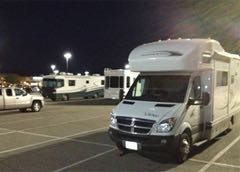
Casino parking lots, on the other hand, are hospitable. Casinos throughout the country welcome adult campers because they know they might get additional business. And the travelers get a quiet, safe spot to rest for the night without being hassled. Since most casinos are open 24/7, security personnel are on duty all night
Here are a few safety tips for free overnight parking (blacktop boondocking) at casinos:
1) After pulling in, check with security to verify whether you can stay overnight in the parking lot and ask where they want you to park.
2) If the casino has a fee-pay campground as part of the facility, it is essential to check with security to ask about your options for staying overnight. Some casinos will allow you to stay in the parking lot anyway. But there are a number of casinos that require you to pull into their campground if you want to stay for the night.
3) Blacktop boondockers: limit your free overnight stay to a single 24-hour period.
4) If there is no designated area for large vehicles, park on the perimeter of the lot. Don’t take up spaces intended for cars. (Note that casinos in crowded urban areas do not have space to accommodate RVs. Be sure to get permission before you park.)
5) Don’t abuse the property owner’s hospitality. A parking lot is not a campground. If there’s enough space, it’s okay to open a slideout, but restrict your activity to the inside of your vehicle.
6) Do not leave your RV unattended overnight or for any extended period of time. This may seem like simple, common sense advice, but you’d be surprised at how many folks park their expensive units in a parking lot and then go off to visit friends for a few days. If you are foolish enough to do this, don’t be surprised upon your return to find your unattended vehicle has been towed away.
“Boondocking” at a casino is convenient. Casinos are located all over the country; many within a mile or two of an interstate exit. RV-friendly casinos are listed in the popular guide, Casino Camping from Roundabout Publications.
“Blacktop boondocking” at a casino is comfortable. You have your home with you, so you can either walk or take the shuttle bus to and from the casino. You can play shorter, more relaxing gaming sessions with breaks in between. For couples, when one wants to play cards or slots and the other doesn’t, there’s no problem. And then there’s the obvious benefit: “blacktop boondocking” at RV-Friendly casinos is free!
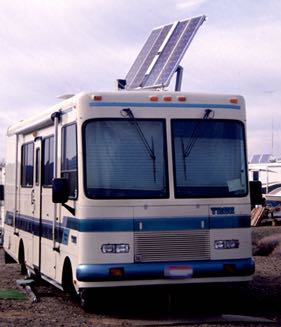
For those who haven’t experienced boondocking, a question often pops up: “Where do you get the stuff you need to make your trip fun, and not a bunch of misery sitting around a candle every night when the sun goes down?” For the boondocker, electricity has to come from somewhere. For some, a mechanical fossil fuel-fired generator is the answer. Others find solar or even wind power a happier alternative. Solar and wind power are quiet and the “fuel” costs are free.
In general, solar panels and wind generators produce low voltage direct current (DC) that charges your RV batteries. The batteries store the power up for use when needed–even when the solar panels or wind generators aren’t producing power. What about “shore power” devices like microwave ovens, computers, or televisions? Most of these can be operated from stored battery power through the use of an inverter, which changes DC battery power into alternating current (AC) power that’s palatable to your shore power equipment.
So, will these “alternative” electrical sources, wind or solar, work for you? In most cases, yes. It really comes down to how much power you use. What’s true for one “RV family” probably won’t hold true for the next. Space doesn’t allow us to go into detail on how to calculate how much power your own lifestyle uses, so we’ll need to use a few generalities.
How Much Power?
All of us need electricity to operate our lighting system, maybe running a couple of lights for four hours a day. It’ nice to keep the dishes clean, and take an occasional shower, so electricity will be required for the RV water pump. Let’s say that water pump will run a total of 45 minutes a day. Most of us will want to watch a little TV–maybe three hours a day. If you’re boondocking in cooler weather, you’ll wind up running the furnace fan to take the chill off–let’s say just two hours a day. The power these devices consume is measured in “amps,” and adding the factor of “how long” they’re used equates to a figure called “amp hours.”
Using “typical” consumption figures for these devices in our hypothetical example, our generalized RVer will use about 43-amp hours of electricity per day. How many solar panels, or how big a wind generator? Whoa, pardner! First let’s talk about where you’re going to put that electricity.
A common misconception is that your lights, pumps, TVs, computers, etc., all draw their needs directly from solar panels or wind generators. But the sun doesn’t shine at night–when you need those lights, and sometimes the wind doesn’t blow. And even with the sun shining brightly, the panels may not be producing enough power to meet a peak of power consumption. Enter your electrical “bank account.”
RV Batteries: Your Power “Bank Account”
RV batteries are like a “savings account,” for electrical power. With them you can save up the power your solar panels produce, and are critical for wind generator folks who probably produce far more power on a windy day than they can consume. Specially designed “deep cycle” batteries are made for “house” use, that is, they can store and provide power for powering lights, pumps, etc. These batteries customarily produce low amounts of current over a long time. If you’re a “motorhomer,” you’ll also have one or more “starting, lighting, ignition” (SLI) batteries which are designed simply to start up and operate your motorhome engine and associated “running” operations.
When choosing batteries for your RV, never try to make an SLI battery do the job of a house battery–it won’t live long enough to tell the tale. Deep cycle batteries for house use are built differently, designed to be deeply discharged and recharged many, many times. SLI batteries produce a lot of current real fast–needed for starting up an engine–and then need to be quickly recharged.
Here’s the first place you need to know how much power you actually use. A properly designed electrical system for boondocking has the right amount of battery capacity to provide your electrical needs for at least two days, while only discharging the batteries to half of their capacity. Why so? Well, you may run into a situation where the sun doesn’t shine for a day, and you’ll need that extra reserve to keep you going. And the other part of the equation? If a house battery is often discharged to less than half its capacity, its longevity will quickly be reduced. Deep cycle batteries can be expensive, so you want to keep them happy and healthy.
So let’s take our hypothetical example, where our RVer uses 43 amp-hours of electricity per day. When he “shops” for RV batteries, he’ll need to have a battery bank with a minimum capacity of 172 amp hours. How so? Double the use, 43 times 2 equals 86, and then never allow the batteries to be discharged to less than half their capacity, so double that again, 86 times 2 equals 172 amp hours of storage capacity. Since it’s a rare day when you’ll find a single deep-cycle battery that will have this kind of capacity, you’ll need to get more than one battery and wire them properly to get the desired amount of capacity. Let’s say our friend finds 12 volt batteries with a capacity of 80 amp-hours. He’d need three of them to meet the needs–and he’d have some extra capacity left over, as his “bank” would provide 240 amp-hours capacity.
Now that we know what our “bank account” looks like in terms of capacity, let’s talk about how to put “money in the bank.”
Solar: The Primary RV Alternative
Most boondockers start out with solar panels as their primary “alternative energy” source. How much solar power do you need? Figure for every amp-hour of battery capacity, you’ll need a ½ a watt of solar panel power. So in our hypothetical example, our RVer could really get away with 120 watts of solar power for his battery bank, provided he boondocks where there’s good solar exposure. What is good exposure? Solar panels need to “see” full sun. Add even a bit of a shadow across their surface, or a tiny bit of cloudiness, and energy production drops off significantly. When we consider panel production, we assume six good hours of sunshine a day. If you boondock in cloudy areas, you’ll need more solar panel muscle. Figure ¾ of a watt per amp-hour of battery capacity.
Mind you, you’ll wind up buying more than just solar panels. Solar panels, left to themselves, can overcharge (read “cook”) your batteries. And at night, left to themselves, panels can likewise discharge your batteries. What’s needed is a electronic “middle man” who controls the flow of electricity. When the batteries are full, the flow of current is cut off. At night, power is not allowed back up to the panels. That “middle man” is a solar regulator, which acts as a kind of automatic switch.
Where does that leave you in terms of dollars and cents? You can buy all the individual components needed, or some outfits will sell you a complete package. A glance at a popular Internet RV solar retailer shows a package, including 200 watts of solar panels, mounting brackets (that allow for easy roof placement of the panel), and a regulator for $349. Add a few bucks for wiring, and you’ve got your stuff. Of course, if you don’t feel comfortable installing a system, you’d have to add installation charges.
But what if your power needs are greater than our hypothetical example? Or what if your needs changed, and you need more power? The beauty of solar power is that it can be expanded with relative ease. Another panel can be mounted on the roof and wired into the existing system without much effort. If our RVer found he needed another 100 watts of power, he could find a suitable panel to add into the system for around $150. Mind you, these are new equipment prices. If you frequent heavily traveled RV hot spots like Quartzsite, Arizona, you’ll find solar dealers often have used equipment for less money. Since solar panels don’t “wear out,” a used panel is not like buying a used car–they’re far more dependable.
Dear RV Shrink: Thank you for the reminder that we should have our alarms tested periodically. After reading your column we tested all of ours and had problems with two of them.
Two months later we were glad we did the testing. It wasn’t something normal like a failed gas fitting. Our stove top burner “went on the fritz” just as we went to bed one night. I smelled gas before the alarm sounded. I jumped out of bed and started investigating just as the buzzer went berserk. In the kitchen I could hear the gas hissing from the stove. I knew exactly what happened immediately. The stove didn’t go on the fritz, Fritz went on the stove.
Yes, our cat, Fritz, got a wild hair up his hind end and was running around the motorhome. He does that on occasion. His gets that wild look in his eyes and runs from end to end of the motorhome as if he is chasing something, or something is chasing him. From what I can figure, he ran across the couch, jumped up on the stove, and as he dove from the stove top his back leg must have pushed in on the knob and twisted it at the same time.
A freak accident for sure, but one that could have been a cat-astrophe had we not smelled the gas or the alarm was not functioning. —Thank you in Zion
Dear Zion:
Glad to hear a happy ending to what could have been a totally different ending to this story.
Yes, it is often the unexpected that can cause serious problems. You can’t prepare for every situation, but having working sensor alarms are your first line of defense. Everyone should check these devices on a regular basis.
You might want to cover your knobs or block Fritz’s path to the stove in case he decides to make a habit out of stove Free BASE jumping. —Keep Smilin’, RV Shrink
The RV Shrink is not really a psychologist (or professional RV technician). But he does know a lot.
We use cookies to ensure that we give you the best experience on our website. By continuing to use our site, you consent to accepting cookies. We NEVER have or will sell reader's data. For more info, please see our privacy policy page.




 There is one place here on Earth, close to home for we North Americans, where someone can feel very much like they’re on Mars, and that’s Death Valley National Park in Southern California. If you have seen photos of Mars, then you can see by my photo above that Death Valley offers a very similar landscape. And good news: you can breath the air!
 We’ve spent our fair share of nights in truck stops, and we know plenty that have. How safe staying in a truck stop often depends on the attitude of the commercial drivers who bring those big rigs through. Witness the case of Dave and Shirley, who rolled their motorhome into a big truck stop one night. They got a rude–and jarring–awakening at around five in the morning. Their car alarm was bleating like a sick sheep, and Dave, bailing out of the motorhome, watched a rapidly retreating semi-truck skating for the exit–just moments before he spotted the remains of the rear end of his toad car, lying in a number of pieces in the parking lot.


 An Electric Bike is the perfect, simplest and most affordable way of sorting all the ‘challenges’ of RV’ing. Get around camp effortlessly, visit the sites or town nearby without unhooking or simply enjoy a fun ride with fellow campers!

 A Perfect Match . . .
 (April 22, 2016) — A group of RV owners has filed a nationwide class-action lawsuit against Dometic Corporation, stating that the company sold defective gas absorption refrigerators with cooling systems that can spontaneously ignite in RVs and boats, putting consumers at risk of deadly fires, explosions, loss of property and loss of the value of their RV/boat, according to consumer rights law firm Hagens Berman.


 New motorhome sales in February showed an improvement compared to February 2015. Overall, a 5-percent bump-up was noted; Class A units accounted for an increase of almost 8 percent, while Class Cs inched up 2 percent. Source: Statistical Surveys Inc.
 Crystal ball gazers in the RV industry say they foresee a 2-percent sales increase of new rigs this year, compared to the 2015 total of nearly 375,000 units. The prophets at the Recreation Vehicle Industry Association pin their prognostication on high hopes for travel trailers and Class C motorhome sales.


 No more roof leaks, for life, guaranteed!
 Will ice cubes in an RV sewer tank dislodge waste buildup?

 Unique RV overnight stops at wineries and farms
 America’s Largest


 Liquefy solid wastes in sewer holding tanks


 Temperature gun is ‘essential equipment’ for many RVers!
 The RV Kitchen
 Protect your RV’s slideout

 Endorsed by Roger Marble of RVtireSafety.com!


 Random RV Thought
 Trivia


 Casino parking lots, on the other hand, are hospitable. Casinos throughout the country welcome adult campers because they know they might get additional business. And the travelers get a quiet, safe spot to rest for the night without being hassled. Since most casinos are open 24/7, security personnel are on duty all night

 RV Batteries: Your Power “Bank Account”
 Solar: The Primary RV Alternative