

By Russ and Tiña De Maris
Looking at the RVs owned by some new RVers, you might think they made their purchase at a scratch and dent sale. While RVers, for the most part–including new ones–don’t get in major accidents, “getting too close to something” seems to be a way of life for those getting accustomed to driving a “big” rig.
It’s likely that compared to what you’ve been driving most of your life an RV is much bigger. Not only is it longer, it’s probably much taller, and possibly a bit wider. Out on the open road these factors aren’t usually a big problem. But put you and your RV in a tight spot, say maneuvering around a fuel island or small campground, and that size suddenly becomes a huge issue.
Keeping out of trouble with your new RV means two things: Knowledge and practice. It’s important to be knowledgeable about your RV’s characteristics. We’re often surprised to find RVers who simply don’t have a clue as to how tall their rig is. Get an accurate measurement, then write it down where the driver can see it. Using a “tape gun” or label maker and printing the information in large print really helps. Put the information close by: A good place is on the upper portion of the windshield. When you approach a low bridge or awning at a fuel station you’ll have the information you need to know whether or not you can make the passage.
Some snicker at this idea, but a couple we know once got “off the beaten track” while towing their travel trailer in an unfamiliar town. Before they knew it, they tried passing under a railroad overpass and literally peeled the roof off their new travel trailer. It took several days out of their vacation plans and the help of their insurance company to put themselves back together.
Practice putting your RV through turns before you get in a ticklish situation. An empty parking lot, an assistant, and some cardboard boxes set up to simulate obstacles can help you see how easily (or how difficult) you can steer and make corners. A major issue that new RVers often run into (literally as well is figuratively) is the phenomenon known as tail swing.
Tail swing “happens” when you steer one direction and the rear end of the rig goes the other. How’s that? We can illustrate it with a pencil. Take a pencil in your hand, holding it parallel to the floor. Pretend the point of the pencil is the front of your RV; the eraser, the rear end. Now “drive” your RV into a left turn. As you do, you’ll find the eraser swings out to the right.
In an automobile you don’t notice the effect of tail swing near as much, as the pivoting point of the car (the rear wheels) is fairly close to the rear bumper. In a motorhome the rear wheels can be quite far away from the back bumper, and the effect of tail swing is multiplied. Now picture yourself at the fuel island with your big motorhome. You’ve parked close enough to the pumps to stretch the fuel hose to the tank. When it’s time to pull out, if you don’t pull far enough forward before making your turn, the rear end of the motorhome can easily meet up with stationary objects (like a fuel pump) with embarrassing consequences. This same effect can plague RVers yanking a trailer.
With a motorhome, carefully watching the rear view mirror can help you see where your tail swing can take you. With a travel trailer, you’ll be blind on the right side as you make a left turn and vise-versa. Practice is where tail swing problems can be accounted for. Drive your motorhome in the parking lot with a spotter ensuring you haven’t “hit” your obstacle boxes. If you’re dealing with a tow rig, the only way to get the “feel” for what your rig can and can’t do is to have someone else drive it while you stand outside and see the tail swing effect for yourself.
Next, we’ll discuss passing with an RV.
If you missed our last part on keep an eye open behind, you can find it here.
#nrv

 Commercial truck drivers are experienced in passing slow traffic, and they provide some of the best tips for RVers on passing topics. First, you’ve got to know your vehicle. When you have a long empty road ahead of you, put your rig through the paces to see just how fast it will accelerate. With an automatic transmission, slap the accelerator down to the firewall and wind up the engine. Try it on the flat, and then compare how much longer it takes you to build up speed on an upgrade situation. When you know your rig’s capabilities, you’ll be in a much better position to put it into real practice.
 To overcome this problem you may find it necessary to pull a little to the opposite side before making a turn. Making a right turn? You may have to pull a bit out toward (or even over) the centerline before making the turn. You may also need to “overshoot” the turn, pulling father ahead than you would normally in order to keep the trailer from tracking into trouble. It’s a matter of experience: Use your mirrors, practice in an open lot before hitting the road.
 For new RVers, backing up the RV may be one of the most fearful of all of the “new” things to learn. After driving a car, an RV can look fearfully large. Backing up a rig, even a trailer, is something that most RVers get the hang of with practice.


 My wife, Jackie, found Sweet Emily at our local humane society about seven years ago after losing our two dogs to bad Chinese dog food. (I never buy anything from China anymore.) Emily had little hair (fleas) and was very insecure. There are really two dogs and two cats that make up the family, but I only took Emily on my recent trip — my first since I lost my wife last spring. There were a few lonesome moments on my trip, but Emily took care of most of them.
 Emily is a great traveling dog and has been across the country four times and has seen most of the U.S. She lives in the full-size back seat of my F150 and as long as she is back there she is content — she knows I will be back. She sleeps in the trailer with me in the queen size bed and takes up too much room.
 This is our dog, Elvis. He is the friendliest, best-natured doggy in the world, and we’re not biased. Elvis is a Shih Tzu – Bichon Frise cross (also called a Shichon, a Zuchon or a Teddy Bear).
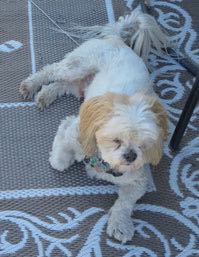 Elvis is 8 years old and has RVed with us just about all of his life (in fivers and currently our class A). Elvis is a great traveler. Kids love him and he loves people; he makes us laugh; and he is a chick magnet.
 For RVers, brake controllers fall into four different categories; two of the types are quite common in use, the other two, much less so. We’ll cover all four types.
 To keep my dark friend happy, I feed him a gruel of enzymes and bacteria, guaranteed to be “earth friendly,” and to relieve my friend of unwanted odors. To be sure, when it doesn’t work, I’m not sure who makes a bigger stink–my tank, or my wife.
 Three areas of dealing with black water should concern RVers: Keeping odor at bay; ensuring solids don’t cause a ‘hang up’ in the tank; being good stewards of the earth with whatever we “output.” What choices we make in terms of treatment (or lack thereof) will affect all three of those areas.
 Hitching up to his old reliable SUV, which when traveling “solo” gave him over 16 miles per gallon, he was shocked to find his towing mileage jumped off a cliff to about 10 miles per gallon. Was he doing something wrong? Were his trailer brakes sticking? Just what is a reasonable expectation for fuel economy when towing a trailer?