Home Blog Page 2177

No Shock Zone: Part 1: Introduction

0


By Mike Sokol

What follows is the first in a 12-part series about basic electricity for RV users and how to protect yourself and your family from shocks and possible electrocution.

Pre-Electricity
I can remember teaching myself basic electricity when I was 12 years old. It seemed like such a mysterious force that could do most anything from run a fan to shock you if you touched a wire. I wanted to know all about it. So for two years I read every book I could find in the library, every Popular Science magazine I could get my hands on and ran “electrical experiments” in my bedroom. By the time I was 14 years old I knew the basics of DC electricity and how it worked.

RV Safety
While RVs as wired from the factory are inherently safe, they can become silent-but-deadly killers if plugged into an improperly wired extension cord or campsite outlet. This is because RVs are basically a big cage of metal insulated from the ground by rubber tires. It’s up to you, the RVer, to make sure the frame and body of your RV is never electrified due to poor maintenance, bad connections, or reversed polarity in a power plug. This so called Hot-Skin problem is what causes a tingle when you touch the doorknob or metal steps of your RV while standing on the ground.

Just the Basics
There are some novel ways to think about and teach basic electricity to the casual RVer, enough so that you can learn how to test for and avoid shocks or potential electrocution at a campsite. There will be little or no math, no fancy schematic reading and certainly no memorization of formulas. It’s my privilege to teach you basic electricity safety as long as you do one thing for me — let me know if the information is making sense and is helpful to you. So after reading this post on RVtravel.com, head over to NoShockZone.org and give us some feedback, good or bad. The failure of the student to learn is the failure of the teacher to teach, and I take my teaching job seriously. So feedback is encouraged.

Why Do We Get Shocked? (What is This Volts Thing?)
What’s so hard to understand about electrical shocks in general is that they don’t seem to happen for any obvious reason. For instance, you can watch a pigeon on a power line that’s not being shocked, yet sometimes touching a power tool yourself while standing on wet ground can bring you to your knees. Just why is that?

Well, the first thing to understand about electricity is the concept of Voltage. Think of Voltage as electrical pressure, just like the pressure in a tank of water. Now in a tank of water we measure pressure in something called PSI (pounds per square inch), which will of course increase if we get a deeper tank. So while 10 PSI of water pressure from a short tank might give you a trickle of water when hooked up to a hose, 100 PSI of water pressure from a really tall tank gives you stream that will spray much further.

Water — and electricity — tries to flow to the side of least pressure. You can imagine that if a pipe is connected between two tanks with exactly the same water level and pressure (say, 100 PSI) there will be no flow of water through the hose. It just sits there and does nothing because the system is equalized. However, if you connect one tank with 100 PSI of water pressure to another tank with 10 PSI of water pressure, water will flow from the high tank to the low tank. We measure this water flow in gallons per minute.

Under Pressure
The same thing happens with electricity. You’ve often heard of “completing an electrical circuit,” but think of it as different electrical pressures. Getting back to the pigeon on the power line, if both of the bird”s feet are on the same wire, they’re at exactly the same electrical pressure. Because they’re at the same pressure, there’s no electrical current flowing through the bird. If, however, the pigeon is unlucky enough to touch one foot on a power line and a wing to the grounded metal power pole, then his one foot will be at 1,000 volts (think PSI of water pressure) and his wing at 0 volts (think an empty tank). This will cause a lot of current to flow through the bird, which we’ll measure in Amperes. And indeed 1,000 Volts across a pigeon can cause a bird explosion.

Now, consider your RV. Sometimes you may feel a shock when you touch your hand on the doorknob, and sometimes not. What’s happening is that there’s an electrical voltage (think pressure) on the body of the RV, which is waiting for some different electrical voltage level to head towards. If your entire body is inside the RV, then like the pigeon every part of you is at exactly the same voltage. And like the pigeon, there’s no current flow and you feel no shock. However, if one of your feet is on the ground at essentially zero volts and your hand is on the door of your RV that is at 100 volts, you become the pipe and the different electrical pressure (Volts) will push current (Amps) through your hand, arm, chest cavity, torso, leg and foot. If your foot is on dry ground there might be so little flow that you might not even feel it. But stand on the damp ground with a wet shoe, and you’ve made a zero voltage connection to the ground with your foot and a lot of current will flow through your body.

Watch the Heart
The dangerous part is when this electrical flow goes through your chest cavity since right in the middle of you is your heart, and hearts don’t like to be shocked. That’s because the beat of your heart is controlled by electricity, which comes from your own internal pacemaker. And just like a clock radio can be scrambled by a nearby lighting strike, even a small amount of electrical current passing through your heart can cause it to start skipping beats and cause a heart attack. Just how little? Glad you asked.

I’m sure by now you’ve seen the 20-Amp marking on a circuit breaker. That means it can supply 20 Amps (Amperes) of current flow when asked to do so. Again, you can think of it as gallons per minute of flow, and Amps are indeed a count of electrons per second flowing through a wire (think pipe). Much more on that later, but it takes less than five milliamps of current to cause your heart to go into fibrillation mode. That’s just 5/1000 of an Amp or 0.005 Amps of alternating current to cause what’s essentially a heart attack. It takes just 30 Volts of Alternating Current (AC) to stop your heart if your hands and feet are wet. On the strange but true side of the coin, while Alternating Current is what causes your heart to go into fibrillation and stop pumping blood, the rescue crew will use Direct Current (DC) of several hundred Volts to reboot your heart and get it beating regularly again. That’s what they’re dumping through the paddles on your chest — Direct Current from big capacitors like you see charging on the TV dramas. “Clear!”

Stay Safe
The first rule of staying safe from electrocution is to keep your heart out of the current flow. You can see that getting shocked from hand to hand or hand to foot is about as bad as it can get. That means if you’re plugging in your RV plug to a campsite receptacle with one hand, the last thing you want to do is hold onto the metal box with your opposite hand or be kneeling on the wet ground. If you have two points of contact and something goes wrong (like you touch a bare wire), the current will flow to your opposite hand or feet, passing through your heart in the process. So always turn off the circuit breaker when plugging or unplugging your campsite power. Not doing so is to invite death by electrocution, and nobody wants that.

Quick Tips
•Use only one hand to plug or unplug any power cables

•Turn off breakers in the pedestal before plugging or unplugging campsite power

•Never stand or kneel on wet ground while making electrical hookups

•If you feel a shock from the doorknob of your RV, do not get into your RV. Shut off the pedestal circuit breaker immediately and alert the campsite manager.

Part 2 of this series will cover how to measure voltage at the campsite pedestal before plugging in. Stay tuned and stay safe.

****

Read all the segments in this series.

Mike Sokol is the chief instructor for the HOW-TO Sound Workshops (www.howtosound.com) and the HOW-TO Church Sound Workshops. He is also an electrical and professional sound expert with 40 years in theindustry. Visit www.NoShockZone.org formore electrical safety tips for both RVers and musicians. Contact him at mike@noshockzone.org .

Copyright Mike Sokol 2010-2016. All Rights Reserved

##RVT761

No Shock Zone: Part Two: Multimeters


By Mike Sokol

If you recall the survey we did July, 2010, in RVtravel.com, you know that 21 percent of the RVers who responded had been shocked by their RV.  Review the report here. What follows is part two in a 12-part series about basic electrical safety for RV users and how to protect yourself and your family from shocks and possible electrocution.

This series of articles is provided as a helpful educational assist in your RV travels, and is not intended to have you circumvent an electrician. If you feel you have a dangerous electrical condition in your RV or at a campground, make sure to contact a qualified, licensed electrician.

Shake & Bake
Remember when you were a child and first started to help with baking there were all sorts of measuring devices and abbreviations to take into consideration? There was a Tablespoon (Tbsp), teaspoon (tsp), Ounce (oz.), with 8 oz. in a cup, and so on. And you better not get your tsp and tbsp mixed up or bad things would happen to your cake. The same types of rules apply when you’re measuring any electrical values. You just need to know how to use a few electrical measuring tools and then you’re ready to test your RV power.

The Meter
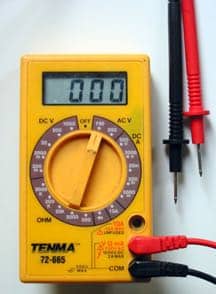
Now is the time to familiarize yourself with your voltmeter. Here’s a pretty typical $30 meter that you can purchase at Lowes, Home Depot or Amazon. You’ll notice a bunch of strange markings on the selection knob, only a few of which will work to measure AC voltage.  Don’t be tempted to just plug the meter leads into a  campsite socket and spin the knob. That will guarantee a burned out meter (at the least).

Note the markings on the control knob are divided up into four major groups.
•AC V (AC voltage)
•DC A (DC amperage)
•OHM (electrical resistance)
•DC V (DC voltage)

The only two groups you’ll be interested in are AC V (for measuring the AC voltage in power outlets) and DC V (for measuring the DC voltage in your batteries). For this article we’ll focus on the AC V group since we’re measuring the 120 or 240 volts AC in a campsite pedestal.

Also take a look at where the meter leads are plugged into the lower right-hand connections. The Black COM (common) input is always connected to your black meter lead, and the red V-Ohm-mA (milliamperes) input is always connected to your red meter lead. Never put either meter lead into the 10A socket, which is designed specifically to check current flow. Doing so will blow the internal fuse in the meter, and possibly damage the meter itself.

All meters read the difference between the two lead connections, so if the black lead is touching 0 volts and the red lead is touching 120 volts, the meter will read 120 volts. However, if both the red and black leads are touching 120 volts, the meter will indicate 0 volts, which is because 120 minus 120 equals 0. See how it works? That’s the key to using a meter. It must be connected between the two voltages you want to measure.

Now, let’s move back to the meter settings. In the AC V area you’ll see a 200 and a 750 setting. When set to 200 the meter will read up to 200 volts, when set to 750 the meter will read up to 750 volts. Since we could be reading as much as 240 volts, we’ll always just set this to 750 and leave it alone during all testing. If you set it to 200 and connect it across a 240 volt outlet, the display will probably stick on 200 volts and start blinking. That doesn’t hurt anything, but it doesn’t tell you the actual voltage. Many meters of this type have a 400- or 600-volt setting, so setting for 400 or 600 volts is fine as well, just as long as it’s set for something more than 250 volts. And if you have an auto-ranging meter, just set it to read AC volts and it will figure out the proper scale for you.

The Outlet
Before you graduate to measuring the big 240-Volt, 50-Amp outlets, you need to start on a common 120-Volt, 20-Amp outlet like you might find in your living room or throughout your RV. Here’s what one looks like and the connections as standardized by the National Electrical Code. You’ll see a little U-shaped hole: that is the Ground; a taller slot on the left, which is the Neutral; and a shorter slot on the right, which is the Hot connection. Don’t be confused if the receptacle is mounted upside down with the ground connection to the top. The taller slot is always the NEUTRAL, and the shorter slot is always the HOT.

This is a GFCI (Ground Fault Circuit Interrupt) receptacle so there are test and reset buttons. More on this later, but pushing the “test” button should cause the “reset” button to pop out and kill the power from the outlet. Pushing the “reset” button in until you feel a click will restore power to the outlet. The job of the GFCI is to kill the power to the plug before it kills you, say from a hot skin condition on your RV. But these GFCI receptacles are only on the 20-amp campsite outlets, not the 30- or 50-amp outlets. In that case you’ll need your own GFCI breaker or outlets in the RV that will help protect you from a shock to ground. We’ll discuss this topic more towards the end of this series.

Also note the difference between the 20-Amp and 15-Amp versions of the outlets. A 20- amp outlet will have another sideways slot for the neutral connection, while a 15-amp outlet will only have a single vertical slot.

The Measurements
Since we’ll be measuring live voltage, you need to observe the safety rules from Part I of this series:
•Use only one hand to hold the plastic handles of the meter leads
•Be sure you don’t touch the metal tip portion of either lead
•Don’t stand or kneel on wet ground. For most situations, dry sneakers will insulate you from the earth sufficiently, and if you’re doing this test in your living room then wooden floors or carpet will protect you if something goes wrong. But if you’re going to measure voltage at a waterlogged campsite I suggest standing on a dry rubber shower mat so your feet are insulated from the ground.

Hot to Neutral
With nothing plugged in to the camp outlet, switch on the 20- Amp Circuit Breaker at the power pedestal, set your meter to the 600 or 750 V AC setting and using one hand insert your meter leads into the left and right Neutral and Hot slots. Remember not to rest your opposite hand on the metal box. It really doesn’t matter which side gets the red or black meter lead since it’s Alternating Current.

Since the Neutral connection is at 0 Volts and the Hot connection should be around 120 volts, you should read somewhere between 115 and 125 volts on the meter display. If not, then something’s wrong with the power hookup. If you measure 0 volts, then maybe you need to reset the circuit breaker, or if you have an outlet with a GFCI (Ground Fault Circuit Interrupt) remember to push the little reset button on the outlet itself. If it still doesn’t measure 110 to 120 volts, immediately contact the camp manager. If you measure 230-240 volts, then that power outlet has been jury-rigged inside the box to produce higher voltage. This is illegal and highly dangerous as you’ll surely blow up every piece of electrical gear in your RV if you plug into this outlet. So, if you read 240 volts on the 120-volt outlet do not plug in your RV, and, again, immediately contact the camp manager.

Hot to Ground
If hot-to-neutral checks out around 120 volts, then it’s time to test the ground, so plug your two meter leads into the HOT (shorter slot) and GROUND (U-shaped hole) connections. Since you’re reading from the Ground connection, which should be 0 volts and the Hot connection, which should be around 120 volts, your meter should show about 120 volts. If you read 0 or something strange such as 60 volts, then the ground wire might be floating, which could cause a hot-skin condition that will shock you when touching the body of the RV.

Neutral to Ground
Next, check from Neutral to Ground. That should read very close to 0 volts, but up to 2 volts is acceptable according to the electrical code. If, however, you read 120 volts from Neutral to Ground, then the polarity of the power outlet is reversed. Don’t plug in. Again, this can cause a dangerous hot-skin condition depending on how your RV is wired.

Final Exam
As a final check, a $5 outlet tester from your local home center will confirm that the polarity of the outlet is correct. Plug it into the power outlet on the pedestal and you should see only the two yellow/amber lights light up. If you see any other combination, do not plug in your RV.

If you’re only using 20-Amp power for your RV, you’re just about done. At this time I recommend plugging this outlet tester into an outlet inside your RV that you can see from the open door or window. Now, go ahead and switch off the circuit breaker, plug in your 20-Amp RV connector, and turn the circuit breaker back on. But before you touch anything on your RV take a peek through the door or window at the outlet tester inside your RV to confirm it’s showing the same Yellow/Yellow pattern. If not, then your extension cord or RV plug has been incorrectly wired. If that’s the case, turn off the circuit breaker and find out what’s wrong before proceeding to power up your RV. I also like to keep this same tester plugged into an inside outlet that’s visible at all times. That way if something happens to the wiring in the campgrounds that electrifies all the RVs in an area, you’ll get warning from the outlet tester before you get shocked on the door frame while stepping out.

Once you’re familiar with the procedures, all this can be done in a minute or two. It’s a very small inconvenience that will help ensure the safety of you, your family, friends and pets. Stay safe!

Quick Tips
•Always set your meter to read AC volts using the 400-, 600- or 750-volt scale
•Hot (short slot) to Neutral (tall slot) should read approx 120 volts
•Hot (short slot) to Ground (U-shape) should read approx 120 volts
•Ground (U-shape) to Neutral (tall slot) should read approx 0 volts

* * *
Read all installments of this series.

Mike Sokol is the chief instructor for the HOW-TO Sound Workshops (www.howtosound.com) and the HOW-TO Church Sound Workshops. He is also an electrical and professional sound expert with 40 years in the industry. Visit www.NoShockZone.org for more electrical safety tips for both RVers and musicians. Contact him at mike@noshockzone.org.

Copyright Mike Sokol 2010-2016. All Rights Reserved 

No Shock Zone: Part Three: Testing campground outlets

1


By Mike Sokol

A July, 2010 survey in RVtravel.com revealed that 21 percent of RVers who responded had been shocked by their RV. Review the survey results at www.noshockzone.org/15. What follows is the third segment of a 12-part series about basic electricity for RV users and how to protect yourself and your family from shocks and possible electrocution.

This series of articles is provided as a helpful educational assist in your RV travels, and is not intended to have you circumvent an electrician. The author and the HOW-TO Sound Workshops will not be held liable or responsible for any injury resulting from reader error or misuse of the information contained in these articles. If you feel you have a dangerous electrical condition in your RV or at a campground, make sure to contact a qualified, licensed electrician.

Reruns
Last week we learned how to read a basic Digital Volt Meter and test a 15- or 20-amp standard outlet such as you might find in your living room or RV interior. Now it’s time to move up the ladder to testing 30- and 50-amp campsite outlets. Again, you’ll be handling live voltage so take all safety precautions.

•Only use one hand to touch the meter probes or campsite pedestal. Electricians are taught to put their other hand in their back pocket so they don’t lean on anything.
•Don’t stand on wet ground while testing outlets. If the ground is perfectly dry you should be safe wearing dry sneakers. If not, then put a dry rubber shower mat down on the ground to stand on while checking voltages.
•Always make sure to turn off the circuit breakers on the power pedestal before plugging or unplugging your RV from campsite power.
•Safety or even standard prescription glasses are highly recommended. These don’t have to be anything fancy, but if something goes wrong you’ll be glad you were wearing glasses. I owe my eyesight to the fact I was wearing glasses when an electrical panel shorted out right in front of my face. It’s cheap insurance.

Bigger Outlets
Today’s RVs have much greater power requirements than those of even 10 years ago. You’ve got lots of appliances, so that single 20-amp outlet can’t provide enough current. This is when you need to step up to 30-amp outlets at the campsite. Let’s see how they’re wired.

Here’s a side-by-side comparison of both a “home-style” 15- or 20-amp outlet on the left and a special “RV” 30 amp outlet on the right. Next week we’ll get into how the amperage rating affects the number of appliances you can run, but for now we’re just measuring voltages.

The first thing you need to note is the orientation of the ground lug on both sockets. Last week we used a 20-amp outlet for an example with its U-shaped ground lug at the bottom, while in this picture the ground lug is at the top. That was not a mistake, as most home outlets are wired with the ground at the bottom, and most electrical panels are wired to more recent code with the ground at the top. It doesn’t really matter which way the socket is wired as long as you keep your own head right-side-up. So if you’re looking at an upside-down outlet, turn the illustration upside down to match the outlet.

While most casual RVers will recognize the little U-shaped hole as the ground, it’s the other two slots that get confusing. As we learned last week in Part II, on a 15- or 20-amp outlet, the taller slot is always the Neutral wire, and the shorter slot is always the Hot wire. Here’s a little more info: if you peek inside an electrical panel or extension cord plug, the ground wire is always GREEN; the Neutral wire is always WHITE; and the Hot wire is always BLACK. This holds true for both the pedestal outlets as well as any extension cord you may have. However, on a 30-amp outlet, there’s no difference in size between the Hot and Neutral slots when viewed from the outside. So here’s where you just have to remember this fact or print this page out. Think: While looking at the front of the outlet, if the ground is at the top, then the “white” is on the “right.” That’s how I remember it. If you’re looking at the back of the receptacle you’ll see two different colored screws, and the white wire goes under the white screw while the black wire goes under the brass screw — but we’re getting ahead of ourselves as that’s a future article on testing extension cables.

Settings
Remember to set your voltmeter to an AC Voltage scale more than 250 volts, typically 600 or 750 V AC. Plug your meter leads into the Black COM and Red VOLTS connections on the meter, and get ready to poke the meter probes into the receptacle. Now turn on the circuit breaker in the campsite pedestal and push in the reset button on the GFCI if it’s popped out.

You can see from the red triangle diagram in the middle of the illustration that from Ground to Neutral you should measure close to 0 (zero) volts. From Hot to Neutral you should measure around 120 volts, and from Ground to Hot you should also measure around 120 volts. Probe between each two slots and note whether the voltages are correct. Be especially careful that the Neutral to Ground reads 0 (zero) volts and the Hot to Ground reads around 120 volts. If not, then the polarity of the plug is reversed and your RV could exhibit a Hot-Skin condition or trip an internal circuit breaker when you plug it in, depending on how it’s wired.

You can accept as low as 108 volts and as high as 132 volts on a 120-volt feed using the 10% plus or minus rule, but realize there will be additional voltage drops at the pedestal outlet when you draw any amperage, and you’ll also have a few volts loss in your extension cord(s). So it’s better to start with at least 115 volts on an unloaded pedestal since it really needs to stay above 110 in your RV to guarantee that none of your electronic appliances suffer from brown-out problems. (See part VI of this series about voltage drops). Plus a green ground wire could have up to 2 or 3 volts between itself and neutral,  but anything more voltage on the ground wire means the outlet is wired incorrectly so DO NOT PLUG IN YOUR RV. Notify the campsite manager immediately and get this checked out by an electrician. Do not open the pedestal box yourself and poke around inside.

What’s This 240-Volt Thing?
Perhaps the most confusing part of hooking up an RV is that some plugs are 120 volts while others that look similar are 240 volts. Just how do they manage to get two different voltages out of the same wires? Glad you asked.

If you remember our water tank example from Part I: the taller the tank, the greater the pressure. And since voltage is really electrical pressure, the same idea holds true. Look at the tank on the left and imagine you’ve got a pressure gauge that reads the difference between two pipes. So if you read between the red pipe at the top and the black pipe at the bottom, your gauge (or meter) will indicate the full pressure, which is in this case 240 PSI (Pounds per Square Inch). However, if you hook up the gauge (or meter) from a center pipe to ether the top or bottom pipe, it will indicate exactly half the pressure, which in this case is 120 PSI. The exact same thing happens at the power transformer on the pole feeding into your house or RV site. You really have 240 volts available, but there’s a center tapped transformer rather than a pipe. So if you connect a meter (or appliance) between the Red and Black wires, it will receive the full electrical pressure, which is 240 volts. But pick only the Black or Red “hot” wire and hook the other side of your meter or appliance to the center-tap White “neutral” wire, and you’ll have exactly half of the full voltage, which will be 120 volts.

50-Amp Outlets
So if your RV has a 50-amp, 120/240-volt plug for its power connection, you really have to understand what you’re hooking into and testing is critical.

Take a look at the illustration on the left. You’ll see a standard 120/240-volt, 50-amp receptacle as found in many campgrounds. Look at the illustration on the left and you’ll see that the slots are placed like a little baseball diamond. If it’s oriented according to code with the U-shaped ground at the top, then follow along. If you plug your meter probes from Home plate (Neutral) to 1st base (Hot 2) you should read around 120 volts. From 1st base to 2nd base (Ground) you should also read about 120 volts.  From second to third base (Hot 1) should read approx 120 volts, and finally from 3rd base back to home you should read  approx 120 volts. Now, from home plate to 2nd base you should read close to zero (0 to 2) volts, and from 1st base to 3rd base you should read between 230 and 240 volts.

So as you move your meter probes around the bases, every slot to the next slot should read about 120 volts. As you read sideways across from the left side (Hot 1) to the right side (Hot 2) you should read between 220 and 250 volts. And, as you measure from top (Ground) to bottom (Neutral), you should read close to zero (0 to 2) volts.

If your meter reads anything else, STOP IMMEDIATELY, shut off the circuit breaker and notify the campground electrician. Do not plug in your RV or any other gear as it could be damaged or you could be electrocuted

Thanks for the Memories
You don’t have to remember all these connections we’ve discussed as each of the plug diagrams above has been scaled for printer output at www.NoShockZone.org. All you have to do is left-click twice on the diagrams left-click the expand box in the upper right corner of the picture, then right-click to print them out on a color printer. Put these pages in a notebook and you’ll always have a power plug reference for when you roll into a new campsite. And after a few times it will seem quick and simple, so don’t become complacent. You could test 99 campsites as perfect, but it could be number 100 that has a wiring issue that could electrify the skin of your RV or destroy every electric appliance you have plugged in. Don’t take a chance. Always test before plugging in.

And, as always, if you think there’s an electrical problem with your RV or campsite outlet, don’t try to fix it yourself. Get a licensed electrician to make the repair. And, if you ever feel a shock from your RV, immediately get away from it and shut off the circuit breaker in the campsite pedestal. Then notify the campsite electrician and refuse to hook up power until the problem is resolved.

Feedback
After you’ve read this article at RVtravel.com, take a trip over to www.NoShockZone.org and send us your comments and suggestions. We love to know how we’re doing with this important project. Part IV of this series will cover amperage and what it means before you plug into a campsite. Stay tuned.

Read all the segments in this series.

Mike Sokol is the chief instructor for the HOW-TO Sound Workshops (www.howtosound.com) and the HOW-TO Church Sound Workshops. He is also an electrical and professional sound expert with 40 years in the industry. Visit www.NoShockZone.org for more electrical safety tips for both RVers and musicians. Contact him at mike@noshockzone.org.

Copyright 2010-2016 by Mike Sokol. All rights reserved

No Shock Zone: Part Four: Preventing hot skin condition

1

By Mike Sokol

If you recall the survey we did July, 2010 in RVtravel.com you know that 21 percent of RVers who responded had been shocked by their RV. What follows is the fourth segment of a 12-part series about basic electricity for RV users and how to protect yourself and your family from shocks and possible electrocution.

This series of articles is provided as a helpful educational assist in your RV travels, and is not intended to have you circumvent an electrician. The author and the HOW-TO Sound Workshops will not be held liable or responsible for any injury resulting from reader error or misuse of the information contained in these articles. If you feel you have a dangerous electrical condition in your RV or at a campground, make sure to contact a qualified, licensed electrician.

The Big Picture
If you’ve been diligently reading this series, you should at this juncture understand the basic concepts of what voltage is, how to read it with a meter and how to check the polarity of a campsite power outlet. If not, then go back and review parts I, II and III on RV electrical safety.

But why is this concept of voltage and polarity so important? Well, one of the greatest dangers of RVing, perhaps second only to a fire (which is really terrifying) is getting shocked and possibly electrocuted when touching the skin of your RV. And while some campers may have been injured by a bare wire on an extension cord or while poking their fingers in a power panel without proper precautions, the majority of RV shocks come when you least expect them, from the skin of your RV while simply opening the door.

Hot Skin
An RV Hot-Skin condition occurs when the frame of the vehicle is no longer at the same voltage potential as the earth around it. This is usually due to an improper power plug connection at a campsite or garage AC outlet. Now to be honest, I think the majority of campgrounds have properly wired and maintained power pedestals, but certainly there are instances where a campsite has outlets with reversed polarity or without proper grounding at all. But I’ve seen enough “rewiring” jobs to know that RV owners are also to blame for improper wiring of their own extension cords and 30-amp dog-bone adapters.

The scenario could go something like this: You plug your RV plug into a loose or worn campsite power outlet. Everything seems fine until you crank up your air conditioner and turn on your coffee maker. That’s when you notice the smell of burning plastic and find that the male plug on your RV extension cord has melted down due to all that current going through a loose connection. Rather than throw that expensive extension cord away, you go to your local big box store and buy a new power plug. However, when you take the wires off of the old plug there’s no diagram to show you how to connect the new plug properly. If you guess right while putting on a new plug, then all is well.

If you guess wrong, then you’ve reversed the polarity of your incoming AC power or not connected the ground wire properly. After that it just takes the right combination of circumstances such as rainstorm to wet the ground in front of your RV, and you touching the screen door with a damp hand while standing outside. That’s when you can get shocked or even electrocuted. The severity of the shock can vary from a mild tingle to stopping your heart, depending on how wet you and the ground are and the voltage of your RV skin. But make no mistake, rather than the 30 or 40 volts of a high-resistance tingle, it’s possible to have the skin and chassis of your RV go to 120 volts with full current of the campsite pedestal with 20, 30 or even 50 amps available.

Insulation
The reason we don’t notice this Hot-Skin condition until it’s too late is that an RV is basically a big metal frame sitting on rubber tires. And those tires act as electrical insulators just like the rubber surrounding the metal wire of your extension cord. That means that the body of your RV can be electrically charged with 30, 60 or even 120 Volts with no visual indication of the problem until you complete the connection to the earth with your hand. Then because your body provides a conductive path to earth (remember the pipes between the water tanks in Part I of this series), current will flow through you to the ground. How much current is really the subject of another article, but if your hands and feet are wet your body becomes a 1,500-Ohm resistor connected from your hand on the doorknob to your feet on the ground. This will allow over 100 mA (milliamperes) of electrical current to flow through your heart.

Tests have shown that as little as 10 mA of a 60-Hz current (what comes out of your electrical outlet) can cause your heart to go into fibrillation (essentially a heart attack). So you can easily get 10 times the current needed to kill yourself from a 120-volt outlet. Note that 100 milliamps of fault current isn’t enough to trip a standard 20- or 30-amp circuit breaker, but it should to trip a GFCI (Ground Fault Circuit Interrupt) on a 20-amp outlet. However, GFCIs aren’t found on 30 and 50 amp pedestal outlets (for a lot of good reasons) so don’t expect that to save you — check for Hot-Skin conditions before you get shocked.

Making a List, Checking It Twice….
What follows are two ways to determine if the skin of your RV has been electrified. One method involves using a voltmeter just like we learned about in Part II of this series, while the second method uses a non-contact AC tester like you see electricians use to check for live outlets. Both methods are described below. But be aware that even if you tested your RV when you made camp and found it safe from a Hot Skin condition, that condition can change at any time if something happens to the campsite power after you’ve plugged in. If you feel even the slightest tingle from your RV, that’s the time to shut off the circuit breaker from the campsite power and get an electrician to double-check the outlet ground and polarity. Don’t bet your life on a faulty connection.

Using a Meter
After you’ve tested the campsite outlet for proper polarity (Part III of this series), powered off the circuit breaker and connected your RV power plug, now is the time to turn the circuit breaker back on and confirm your RV is safe from a Hot-Skin voltage.

To use a standard digital voltmeter such as the one we learned about in Part II of this series, you’ll need to set it to measure AC voltage. Note that since a Hot-Skin condition will typically be less than 120 volts, the 200 volt or 750 volt AC setting [as pictured] will be fine. Just like before, plug the black probe into the black COM connection on the meter and the red probe into the RED VOLTS connection on the meter.

Ready… Set… Test…
If you’re close enough to any metal going into the earth, such as the exterior of the pedestal power box or a metal water pipe, poke it firmly with the sharp tip of the black probe. You’ll need to punch through any rust or paint, so an exterior bolt or machine screw is usually a good choice. Now without touching the body of your RV with your hand poke the skin of your RV with the sharp tip of the red probe. Again, this needs to make connection to the metal skin of your RV, so if you want to avoid making little holes in your paint job pick a spot like the trailer hitch or a chrome door knob.

Next, while both probes are making contact you should read very close to 0 (Zero) volts. However, due to normal voltage drops in the neutral of a loaded circuit it could read up to 5 volts and still be safe. If, however, you read 10 volts, 50 volts or 120 volts between neutral and ground, that’s the time to back away from the RV, turn off the circuit breaker, pull the power plug and immediately get the campsite electrician to find out what’s wrong. If he tells you that 50 volts on the skin of your RV is fine, demand your money back, break camp and get out of there. Do not let your family or pets enter an RV with a Hot Skin condition.  Also, it’s a good idea to alert your local RV association that a campground has a dangerous power condition. That way you help the next RVer, too.

Using a Non-Contact Tester
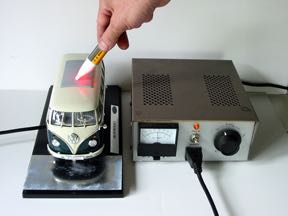
While a digital voltmeter is the gold standard method for testing Hot Skin conditions, it must be used exactly right or it can give you a false sense of security. Therefore, perhaps the easiest and best way to check for an RV Hot Skin is by using a $30 non-contact AC tester such as a Fluke VoltAlert. These testers look like a fat pen with a plastic tip and are available at hardware stores such as Sears or Lowes. Most have a blinking light and beeper that makes noise when the tip is held near an energized circuit. How do I know these things work? Well, I built a Hot Skin simulator that can energize the body of an RV with any voltage from zero to 120 volts at the twist of a dial. I’ve energized everything from a microphone to an Airstream to find the best Hot-Skin testing methods. Yes, it’s a bit Frankenstein, but this gear allows me to see how well the various test methods work. And the Fluke VoltAlert seems to work very well for Hot-Skin conditions as low as 40 volts.

To test for an RV Hot Skin just turn on the non-contact tester by pushing the power button quickly, which will begin to blink once every few seconds to show you it’s on. Then confirm the tester is working properly by poking it into a hot blade of the power outlet on the pedestal. It should beep at you and blink if all is well. Now, gripping the tester firmly in one hand while standing on the ground, move the plastic tip until it’s touching anything metal around your RV. This could be an aluminum screen door, the exterior of an Airstream or the steel of the trailer hitch. With a non-contact tester you do not have to punch through the layer of paint, rust or plastic. If your RV has more than 40 volts on the skin, the VoltAltert will light up and start beeping at you, even from an inch or more away from the surface of the RV.
Caveats
Now, here are a couple of warnings about using non-contact testers (NCVT) to check for Hot-Skin conditions.

1) These testers need to have your hand wrapped around them to sense the earth ground; so if you hold them with just the tips of your fingers it’s possible to get a false-safe reading.

2) Non-contact testers need your feet to be near the ground to know the actual earth potential, so if you’re standing on a fiberglass ladder they won’t read properly. Additionally, since non-contact testers are looking for the voltage difference between the your hand and the plastic tip of the probe, if you’re standing inside an RV with a Hot Skin and you test your galley sink, they won’t indicate trouble when indeed there is. Therefore, always grip the non-contact tester firmly in your hand while standing on the ground outside your RV. And if your vehicle has as little as 40 volts of Hot Skin potential, the tester should alert you of the danger even without physically touching your RV. You can just slip your NCVT pen in your pocket and use it to quickly test any RV in the campground you might be visiting. It only takes a few seconds to test for a Hot-Skin problem this way, and you may save another RV owner’s life.

Outlets Re-visited
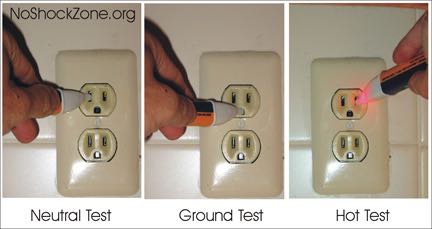
Since these non-contact testers are designed to check outlets for electrical power, they’re also a great way to confirm outlet polarity. If you remember what a typical AC outlet looks like, you can poke the VoltAlert into the tall neutral slot (no blink or beep), then the ground hole (no blink or beep) and finally the shorter hot slot (should blink and beep). It won’t tell you the exact voltage of the outlet like a voltmeter, but it will confirm if the polarity is correct and tell you if the ground connection has been floated and electrified by another RV with a short in its own wiring. This is pretty cheap insurance since you can never be too safe around electricity.

Quick Tips
•Do a Hot-Skin test after you’ve confirmed that the campsite outlet polarity and voltages are correct using a voltmeter.

•Perform a Hot-Skin test using a non-contact tester every time you plug into a campsite or home power outlet.

•If you ever feel the slightest tingle or shock from your RV, avoid all contact, shut off the AC power at the pedestal and get professional help to determine the cause of the shock.

•Even if you’ve stopped getting shocked because the ground is dry, the Hot-Skin problem has not fixed itself.

•Be sure to properly maintain your RV electrical system and test all RV interior outlets for proper polarity and grounding.

Future Shock
Part V of this series will cover amperage and ways to calculate how much your RV needs before you plug into a power pedestal. Stay tuned.

Feedback
After you’ve read this article at RVtravel.com, take a trip over to www.NoShockZone.org and send us your comments and suggestions. We love to know how we’re doing with this important project.

****

Read all the segments of this series.

Mike Sokol is the chief instructor for the HOW-TO Sound Workshops (www.howtosound.com) and the HOW-TO Church Sound Workshops. He is also an electrical and professional sound expert with 40 years in the industry. Visit www.NoShockZone.org for more electrical safety tips for both RVers and musicians. Contact him at mike@noshockzone.org.

©Mike Sokol 2010-2020 – All Rights Reserved

RV Shock Zone. Part Five. Exactly what are amps?

0

By Mike Sokol

If you recall the survey we did July, 2010 in RVtravel.com, you know that 21 percent of RVers who responded had been shocked by their RV. Review the 21 percent report at www.noshockzone.org/15. What follows is the fifth segment of a 12-part series about basic electricity for RV users and how to protect yourself and your family from shocks and possible electrocution.

This series of articles is provided as a helpful educational assist in your RV travels, and is not intended to have you circumvent an electrician. The author and the HOW-TO Sound Workshops will not be held liable or responsible for any injury resulting from reader error or misuse of the information contained in these articles. If you feel you have a dangerous electrical condition in your RV or at a campground, make sure to contact a qualified, licensed electrician.

What’s an Ampere?
We often abbreviate ampere as “amps,” but basically it’s a measure of how many electrons are flowing through a wire or conductor per second. The actual electron count isn’t important, so you can think of it as gallons of electrons per minute, using our water tank model [illustrated in earlier articles in this series]. And, yes, we call this effect “current” both when talking about the flow of water in a river as well as the flow of electrons in a wire. Pretty cool, eh?

Pumps and Hoses
If you look at the first illustration, you’ll see a pump pushing water around in a circle. And depending on the pressure produced by the pump and the size of the pipes, you’ll either pump a lot of Gallons Per Minute (GPM) or a little. In this case we’re using a pump that can produce 120 PSI (Pounds per Square Inch) pressure to move water around a pathway or circuit. And because we have a large diameter pipe all around, this circuit can support a lot of current flow without losing hardly any energy or pressure in the process.

Small Hoses
As you can see from the next illustration, if you use a very narrow pipe for part of this flow, your gallons per minute (GPM) flow will be very low. So a pump that might be able to push 10 Gallons Per Minute through a big pipe could be restricted to perhaps 1 GPM if you use too narrow of a pipe for any part of the circuit. And just like the garden hose you use to water the plants, it can’t deliver enough flow if it’s too small in diameter or too long in length. The exact same thing happens to electricity as it flows through a wire like an extension cord.

Big Wires
Take a look at the illustration of the electrical circuit on the left. Instead of a pump let’s substitute a battery or generator, and instead of a pipe use a wire going around in a circle, which we’ll call a circuit. If the wire is large enough in diameter, then the generator or battery can push the full 10 amperes through the circuit, which is the amount of current your coffee pot might require to heat up. And as long as you don’t try to push more amperes of current through a wire than its rated for, then all should be fine.

Little Wires
However, the exact same generator or battery could be in trouble attempting to push those 10 amperes of current through a skinny wire or extension cord. And while you may notice a significant drop in flow from your garden hose if it’s a bit too skinny, you may not notice the problem you’ll have from a small extension cord when it’s supporting a lot of current flow. Instead of just restricting the water flow in a hose, electrical wires can heat up to the point of catching on fire if you try to push more current through them than they’re rated for. How much current is OK? Well, glad you asked.

Size Me Up
For those of you unfamiliar with extension cord specifications, the lower the number of the gauge, the thicker the wire and the more current that can flow through it without overheating. For example, a 14-gauge extension cord might be rated for only 15 amperes of current flow, while a 10-gauge extension cord could be rated for 30 amperes of current, depending on total length of the cable and type of insulation.

More on this in a future article, but here’s the basic AC amperage capacities of AWG [American Wire Gauge; standardized U.S. wire gauge system] standard wire sizes. As you can see from the chart, the lower the gauge, the larger the diameter of the wire and the more current it can carry without overheating.

Also, it’s often noted that you should make the wire one size larger than called for in the chart if you’ll be running a long distance. NOTE: 50 or 100 ft of extension cord from the campsite pedestal to your RV is a very long distance. Do not expect a 12-gauge extension cord to carry a full 20 amps of current over 50 feet or more. In that case, go to a 10-gauge cable to handle the current over that distance. And you can see that if you want to draw the 50 amps from a 240-volt receptacle, you’ll need a 6-gauge extension cord if you’ll be drawing current from the outlet at maximum capacity. This will also minimize your voltage drop.

Did I say “voltage drop”? I’m sure you’ve heard of it, but how many of you know what it really means? Well, that sounds like a good subject for the next article. So stick around while we continue learning about RV electricity and how to stay safe while using it.

Quick Tips
•Extension cords can heat up and catch on fire if you exceed their amperage rating by drawing too much current.

•The lower the gauge number (AWG) on an extension cord or wire, the more current it can safely carry without overheating.

•Electricity needs a complete circuit for current to flow from the high voltage side to the low voltage side of the generator or battery. That current is measured in amperes.

Future Shock
Part VI of this series will cover how amperage draw causes voltage drop, which is why your coffee pot can cause your lights to dim in your RV. Stay tuned.

Feedback
After you’ve read this article at RVtravel.com, take a trip over to www.NoShockZone.org and send us your comments and suggestions. We love to know how we’re doing with this important project.

Read all the segments in this series.

Mike Sokol is the chief instructor for the HOW-TO Sound Workshops (www.howtosound.com) and the HOW-TO Church Sound Workshops. He is also an electrical and professional sound expert with 40 years in the industry. Visit www.NoShockZone.org for more electrical safety tips for both RVers and musicians. Contact him at mike@noshockzone.org.

Copyright Mike Sokol 2010-2016 – All Rights Reserved

No Shock Zone: Part VI: Voltage Drop

0


By Mike Sokol

If you recall the survey we did July, 2010 in RVtravel.com, you know that 21 percent of RVers who responsed have been shocked by their RV. Review the 21 percent report at www.noshockzone.org/15. What follows is the sixth segment of a 12-part series about basic electricity for RV users and how to protect yourself and your family from shocks and possible electrocution.

This series of articles is provided as a helpful educational assist in your RV travels, and is not intended to have you circumvent an electrician. The author and the HOW-TO Sound Workshops will not be held liable or responsible for any injury resulting from reader error or misuse of the information contained in these articles. If you feel you have a dangerous electrical condition in your RV or at a campground, make sure to contact a qualified, licensed electrician.

Rumors and Innuendo
We’ve all heard about how hooking up an RV on too long or too skinny of an extension cord can force its appliances to run on 100 volts instead of the regular 120 volts, thereby burning out the motors or other components. But before we get into the reality of what happens to gear running on 100 volts rather then a full 120 volts, let’s figure out why this voltage drop thing happens in the first place.

From the Beginning
We’re going to put together the concepts you’ve learned about voltage in Article I and amperage in Article V in this NSZ-RV series. If you’ve not read them already, then please start at the beginning and spend an hour reading parts I through V. Consider this time an investment in your family’s safety. Even if you know how to run a digital voltmeter, please re-read Part II on meters since that’s important to your understanding of how current draw causes voltage drop.

What’s This Voltage Drop Thing?
If you look at the first illustration you’ll see a pump on your left that can supply 120 PSI (Pounds per Square Inch) of pressure, and two pipes heading to the right side. I’ve capped one pipe with a white stopper and the other with a black stopper so that no water can leak out. Because there’s no water flow, the pressure within each pipe will be equal to the pressure of the pump. The bottom pipe, which is hooked to the 120 PSI output of the pump, will have 120 PSI all along its length, while the top pipe, which drains back into the pump, will have 0 PSI along its entire length. And you can imagine that it really doesn’t matter if that pipe is large or small in diameter. The pressure within each pipe will be equal throughout its length. I’ve added a differential pressure gauge to the far right of the illustration that shows there’s now 120 PSI difference between the two pipes, just like a voltmeter reads the voltage difference between its two probes. Note that no real work is being done; it’s just an equalized pressure system. This is exactly what happens to an electrical outlet in your home or RV. There’s electrical pressure (Voltage) but no current flow (Amperage) until you plug something into it.

Big Pipes Equal Small Pressure Loss
Now let’s make our pump do some work. We’ve added a small turbine to the right side of the drawing connecting the top pipe to the bottom pipe. The pressure of the water will cause a current to flow through that small turbine to power your blender making a frozen drink of your choice. But this isn’t a perfect world, and because there are rough spots inside of those big pipes, they offer resistance to the flow. This shows up as a loss of pressure that’s dependent on how long the pipes are and how many gallons per minute we expect them to carry. In this case we have really big pipes carrying the water to the little turbine, so the small amount of flow (current) required only causes a 1 PSI drop in pressure in each pipe. So when we put our pressure meter across the ends of the pipes at the caps, you’ll see that instead of a full 120 PSI of pressure, we only have 118 PSI. That’s an acceptable loss in this case since our little turbine is rated for pressures from 110 to 125 PSI and all is well.

Small Pipes Equal Big Pressure Loss
Imagine, however, what would happen if your plumber went cheap and installed really small feeder pipes to your turbine. Your pump would still be creating 120 PSI of pressure, but the current flow would be restricted by the too-small feeder pipes. Consequently, rather than losing just 1 PSI of pressure, you would now lose 10 PSI of pressure with the same current flow as before. Since the top of the turbine has 10 PSI of pressure holding it back, and the bottom of the turbine only has 110 PSI to begin with, there’s only 100 PSI difference in pressure to drive the little turbine. Our turbine needs at least 110 PSI to operate properly, so now it’s starved for pressure and won’t spin fast enough to do its job. This same effect of pressure loss would occur with larger pipes over very long distances. Therefore, if we made our pipes in the first illustration ten times longer, that 1 PSI of pressure loss would then become 10 PSI of pressure loss.

Big Wires
Now let’s substitute a battery or generator for the pump, and an electric heating element in our coffee maker for the turbine. Our generator is hooked up to the outlet powering the coffee maker’s resistive heating element with really big wires. And just as in the water example, there will be a certain amount of resistance to the current flow. This resistance to current (flow) is what causes voltage drops to occur. How much voltage drop is dependent on the type of metal inside the wire (typically copper, sometimes aluminum), the diameter of the wire (remember that 10-gauge wire is thicker than 14-gauge wire) and how long the run of wire happens to be (50 feet of wire will lose twice as much voltage as 25 feet of wire).

In our case we’ve run a sufficiently heavy wire from the generator to the outlet, so there’s maybe only 1 volt of electrical voltage (pressure) lost on the way through the black wire. But since it has to return through the white wire, there’s another 1 volt of loss on the return trip. That means the bottom side of the heater in our diagram is getting 119 volts of electrical pressure while the top side is getting 1 volt of electrical pressure. Since meters and heaters only care about the difference in voltage applied across their inputs, we’re providing 119 minus 1 which equals 118 volts. Since our little heater is rated for operation with voltages as low as 110 volts, we’re still in good shape and your coffee will be done in time.

But now we’ve cheaped out and installed far too skinny of an extension cord from the generator to the heater outlet. And any time we try to pull a significant current flow (let’s say, 10 amperes) down the skinny wire, there’s a lot of resistance to that flow, causing us to lose electrical pressure (voltage) just as we lost water pressure when using the pump with too-small of connecting pipes. In our generator illustration above there’s a 10-volt drop in the black wire and a matching 10-volt drop in the white wire. That leaves our heater with 110 volts on the bottom feed and 10 volts on the top feed. Again, our meter and heater element only care about the voltage differential applied to them, so it’s only working with 100 volts.

Bad Things
That should sound like a bad thing to you, and indeed it is. Two significant problems occur when you hook up your RV using a long or skinny (or both) extension cord. The first is that voltage drop causes the wire itself to heat up. And it can heat up to the point where it gets limp and catches on fire. The second problem is that your RV is only getting 100 volts of electrical voltage (pressure), when it really wants 120 volts. You can reverse think this and realize that voltage drops only occur when you’re drawing significant amperage like an air conditioner or microwave. So while your electronic appliances such as a television may be operating properly with nothing else running in your RV, as soon as you turn on that roof air conditioner, you might see your television’s electronics starve for voltage and shut down. That’s certainly a problem if you’re watching an NCIS marathon.

Truth or Fiction: Low Voltage Kills Appliances
Well, low voltage affects only certain kinds of appliances and only under certain conditions. Resistive heaters like a coffee pot really don’t care if you feed them 120 volts or 110 volts or even 100 volts. They’ll just happily draw less current, which makes less wattage, which then takes longer to bring your water to a boil. And certainly roof air conditioner compressors can refuse to start if you don’t provide them with sufficient voltage and current. That motor has to push a piston against a lot of Freon gas pressure, and if you don’t have enough push it’s going to stall. However, there is one type of electrical load that can be severely damaged by running off of too low a voltage, and that’s an AC-DC motor with brushes like in a circular saw.

Advanced Concept Alert
Here’s why…. AC-DC motors put out something called a Back EMF (Electro Magnetic Force) when running at their designed voltages. That’s because as these motors are spinning very fast they also act as generators putting out voltage in the reverse direction, and that reverse voltage (pressure) is what limits the current flowing through their brushes (the sparky things you see at the back of your drill). However, if you starve an AC-DC motor for voltage by using too small or too long of an extension cord, they won’t develop enough of this internal reverse voltage to limit the current flow through their own brushes. And that’s why you see lots of sparks fly from your power tools when running them on too long and too skinny extension cords. Reducing the voltage on a power tool increases its amperage draw. You’ll kill the brushes in short order and ruin the motor in your hand drill or circular saw unless you maintain full voltage to the tools no matter what your amperage load happens to be. Thick extension cords make for happy power tools.

Back to Basics
Also, of course, letting your voltage drop below 110 volts is bad for computers, sound systems and virtually everything else in your RV. And while it may not cause an actual meltdown in your stereo, it will reduce the performance of virtually everything not fed with sufficient voltage. Just like trying to start your car’s engine when the battery is nearly depleted will leave you with a grrrr, grrr, grrr and no start, making your appliances run from too low of a voltage, which will sometimes make them shut down or not boot up properly.

Replay
Go ahead and re-read NSZ part V on current flow and make sure you have a heavy enough extension cord for the job without getting a big voltage drop. If you’re in doubt, go one size heavier (lower gauge number) for the wire size, especially if you’re running more than 25 feet of total length. There’s really no such thing as too thick of an extension cord.

Quick Tips:
•Long extension cords need to be heavier to reduce voltage drop.
•Skinny extension cords have more voltage drop than thick extension cords.
•Overloaded extension cords can overheat and catch fire.
•Appliances generally don’t operate at full performance below 100 volts.

Future Shock
Part VI of this series will cover how amperage draw causes voltage drop, which is why your coffee pot can cause your lights to dim in your RV. Stay tuned.

Feedback
After you’ve read this article at RVtravel.com, take a trip over to www.NoShockZone.org and send us your comments and suggestions. We love to know how we’re doing with this important project.

****

Read all the segments in this series.

Mike Sokol is the chief instructor for the HOW-TO Sound Workshops (www.howtosound.com) and the HOW-TO Church Sound Workshops. He is also an electrical and professional sound expert with 40 years in the industry. Visit www.NoShockZone.org for more electrical safety tips for both RVers and musicians. Contact him at mike@noshockzone.org.

Copyright Mike Sokol 2010-2016 – All Rights Reserved

No Shock Zone: Part VII: Wattage

0


By Mike Sokol

If you recall the survey we did July, 2010 in RVtravel.com, you know that 21 percent of RVers who answered the survey have been shocked by their RV. Review the 21 percent report at www.noshockzone.org/15. What follows is the sixth segment of a 12-part series about basic electricity for RV users and how to protect yourself and your family from shocks and possible electrocution.

This series of articles is provided as a helpful educational assist in your RV travels, and is not intended to have you circumvent an electrician. The author and the HOW-TO Sound Workshops will not be held liable or responsible for any injury resulting from reader error or misuse of the information contained in these articles. If you feel you have a dangerous electrical condition in your RV or at a campground, make sure to contact a qualified, licensed electrician.

Watts Up?
If you’ve been reading along this far in the series you already know about voltage (electrical pressure) and amperage (current flow). You also know how to measure voltage using a DMM (Digital Multi Meter) and how to size extension cords for sufficient amperage (current) capacity. But in the end it all comes down to wattage.

Get to Work
We’re going to put voltage and current together and make them get to work. If you notice in the first illustration, there’s a lot of pressure at the bottom of the water tank. However, unless that pressure gets to move something, it simply sits there as stored energy just like the compressed air in a tank. Electricity works exactly the same way.

You’ll typically have around 120 volts of electrical pressure at an electrical outlet, but the air around the outlet has such high resistance to electrical flow, that the electrons just sit in the outlet waiting for a connection. So there’s no current flow unless you connect something that completes the circuit.

High Resistance to Flow
Here we’ve put a hole in the bottom of the tank connected to a pipe and see that water is flowing out under pressure. And you can imagine that flowing water could do useful work. It could turn a water wheel and make flour from wheat, it could drive a piston up and lift a heavy weight or it could even spin a turbine generator and actually make electricity.

If we put a small hole in our tank, there will be a high resistance to water flow and not much work will get done. That’s exactly what happens when you plug in an appliance that doesn’t draw much wattage, perhaps a 100-watt light bulb.

Low Resistance to Flow
But put in a larger hole and there will be a lot more water flowing since there will be less resistance to current flow. And, of course, all that extra current can be used to do even more work.

For instance, a 1,000-watt space heater needs 10 times the current flow of a 100-watt light bulb since it’s drawing 10 times more wattage, and that means 10 times the work is getting done.

So just like the difference between the stream of water from your faucet and the flow of water coming over Niagara Falls, more current and pressure equals more work getting done.

Wattage is Power
The same thing happens in your electrical outlet. Plug in an appliance with a high resistance to current flow (a small hole) and not much current will flow like the left side of the illustration.

The turbine won’t be spinning very fast and can’t do much work. However, plug in something with a low resistance (large hole) to current flow like the right side of the illustration, and a lot more current will flow. In this case the turbine will spin much faster and can do much more work.

That’s the basis of all electrical circuits, and how a power outlet “knows” how much wattage an appliance needs.

Appliances that need a small amount of power like a 100-watt light bulb will have a small electrical hole (with high resistance to flow), figuratively speaking, while other appliances like a 1,500-watt griddle that need much more power will have a larger electrical hole (with low resistance to flow). That built-in electrical resistance is part of the original design of the appliance, but that’s for a future article.

Inventor Alert
It takes voltage (electrical pressure) and amperage (electrical current flow) to get any work done. And that work is defined in a unit of measure called the Watt.

And like many cool discoveries are named after a famous scientist or inventor, in this case it’s named for James Watt, the inventor of the practical steam engine which started the industrial revolution. We’re not going to bore you will all the theory, but everything from horsepower to air conditioning BTUs to burning candles can be described in watts of power.

Basic Math
Here’s the basic formula, which we’ll also use later. Volts times Amps equals Watts (V x A = W). This formula implies that if your electrical outlet is putting out 120 volts and the appliance is drawing 10 amperes, that’s 1,200 watts of power that’s going somewhere. Again, we’ll use this simple formula later for some more calculations, but for now we’ll use it just once to calculate how much wattage (power) is available from 20, 30 and 50 amp campsite outlets.

* 20 amps times 120 volts equals 2,400 watts
* 30 amps times 120 volts equals 3,600 watts
* 50 amps times 240 volts equals 12,000 watts (6,000 watts per 120 volt leg)

That suggests that if you’re plugged into a 20-amp receptacle at a campsite, you can turn on up to 2,400 watts of appliances in your RV before you exceed 20 amps of current flow and trip the circuit breaker in the pedestal.

If you’re plugged into a 30-amp receptacle, you can turn on up to 3,600 watts of appliances before you trip the breaker.

And if you’re plugged into a 50-amp 120/240-volt receptacle, you can turn on up to 6,000 watts of appliances on each leg of your power system for a total of 12,000 watts.

How Much Wattage?
How do you know how much wattage each appliance needs? Well, there are at least two ways to find out. First, you can look at any appliance to find a wattage usage statement someplace on the back panel. For instance, a 1,200-watt hair dryer draws 1,200 watts. A 1,500-watt electric skillet draws 1,500 watts. Turn both on at the same time and it adds up to 2,700 watts. Now, if you’re plugged into a 20-amp outlet you’ve exceeded the 2,400-watt capacity of that circuit and you’ll trip the breaker in a few seconds. There’s a bit of a time delay that gives you a few seconds of grace before the breaker trips, but trip it will. Those same two appliances, however, would run successfully on a 30-amp outlet since that can provide 3,600 watts of power. And of course, a 50-amp 120/240-volt outlet can produce 6,000 watts per leg, so it would be just fine with a hair dryer and electric skillet at the same time.

Make a List
Jot down a list of everything you’ve got in your RV that’s electrical and find its current draw. A string of 20 Christmas lights with 7-watt bulbs will draw 20 times 7, which equals 140 watts. And a 1,000-watt slow-cooker might draw pretty close to 1,000 watts when on the high power setting, but much less when it’s turned to low simmer mode, maybe only 200 watts or so.

This all seems pretty simple until you start calculating wattage from non-heating appliances. A typical television might draw 100 watts of power, and that laptop computer might draw 50 watts from its power supply, which all seems simple enough. But motor-based appliances like your air conditioner or refrigerator will draw a peak of many times their rated wattage just to get things spinning inside. More on this in a later article, but that’s why generators are always more finicky about starting an RV air conditioner compared to an electrical outlet that’s connected to the power company. The circuit breaker in campsite pedestal is much more forgiving of a temporary overload, while a generator will try to protect itself and shut off the power if its peak wattage draw is exceeded for even a fraction of a second.

Measure It
The second way to find out how much current an appliance draws is to actually measure it. You can get a device called aKill-A-Wattat Amazon for $25 that will allow you to plug in your appliances one at a time and actually measure how much wattage they’re drawing from the outlet. That’s also a good way to find out if your electrical conservation efforts are paying off by purchasing more “green” appliances.

And it will allow you to discover all sorts of things about lost power in appliances. For instance, a microwave rated for 700 Watts of cooking power (not the wattage usage number stated on the back panel) probably draws 1,000 watts or more from the power line. Where did those [additional] 300 watts of power go? Well, that discrepancy is due to the inefficiencies of the microwave generating process. So those other 300 watts turn into heat within the cabinet, which must be vented as warm air. You may not worry much about this until you find that those extra 300 watts put you over the edge and your trip a circuit breaker trying to run the 1,200-watt coffee pot and 700-watt (actually 1,000) microwave at the same time your refrigerator compressor kicks in.

And the big wattage item in any RV is the air conditioner, which draws a lot of peak amperage on startup. So when it all the currents add up beyond the capability of the circuit breaker and power cord, the circuit breaker trips and it’s lights out, literally.

How Much is Too Much?
A good rule of thumb is not to exceed around 85 percent of your wattage capacity simply by adding up the appliances you’ll turn on at the same time. So that means that a 20-amp receptacle that can produce 2,400 watts of power probably should not be used to draw more than 2,000 watts continuously. That adds some extra pad for appliances that need a little extra “kick” at startup.

The same rule applies to a 30-amp outlet that can produce 3,600 watts. Try not to run more than 3,000 watts of “planned” wattage and you probably won’t trip the incoming circuit breaker. And a 50-amp 120/240 receptacle has enough wattage to run a small house, which is exactly what you’re doing. They can easily handle 5,000 watts per leg without tripping.

Of course, some of you will want to squeeze every last watt out of the campsite pedestal, so in that case make sure you use a heavy enough extension cord that’s as short as possible from the RV to the campsite receptacle.

Breaker, Breaker…
What happens if you pull too much wattage from a campsite receptacle? Well, if you’ve sized your extension cord properly and the campsite has wired everything correctly, you’ll simply trip the circuit breaker. That’s exactly the job it’s supposed to do and nothing should be harmed from the shutdown.

However, if you have an air conditioner running at the time of power outage, know that they need around 2-1/2 minutes for the compressor to lose its pressure and allow it to restart properly. So give things a few minutes to rest while you turn off your appliances.  Then reset the circuit breaker by turning it all the way OFF first, then flipping it to the ON position. If it holds in the ON position properly, you probably just had a momentary overload. However, if you smell something burning or the circuit breaker trips off again immediately, stop what you’re doing and get an electrician to find out what’s wrong with your rig. Don’t keep flipping a breaker ON that keeps tripping OFF as there’s certainly something wrong that can cause additional electrical damage to your RV’s appliances if you keep applying power. We call that a “smoke test” and you really don’t want to go down that path.

Quick Tips
* A 20-amp service can supply 2,400 watts
* A 30-amp service can supply 3,600 watts
* A 50-amp 120/240 service can supply 12,000 watts (6,000 watts per 120-Volt leg)
* Plan not to exceed 85% of the receptacle wattage rating or you may get circuit breaker tripping
* If you turn on a circuit breaker and it trips right away, contact an electrician immediately to find out the cause of the problem.

Future Shock
Part VIII of this series will cover GFCI (Ground Fault Circuit Interrupter) outlets and breakers, so stick around.

Feedback
After you’ve read this article at RVtravel.com, take a trip over to www.NoShockZone.org and send us your comments and suggestions. We love to know how we’re doing with this important project.

****

Read all the segments in this series.

Mike Sokol is the chief instructor for the HOW-TO Sound Workshops (www.howtosound.com) and the HOW-TO Church Sound Workshops. He is also an electrical and professional sound expert with 40 years in the industry. Visit www.NoShockZone.org for more electrical safety tips for both RVers and musicians. Contact him at mike@noshockzone.org.

Copyright Mike Sokol 2010-2016 – All Rights Reserved

No Shock Zone: Part VIII: GFCI

0


By Mike Sokol

If you recall the survey we did July, 2010 in RVtravel.com, you know that 21 percent of those who reported had been shocked by their RV. Review the 21 percent report at www.noshockzone.org/15. What follows is the eighth segment of a 12-part series about basic electricity for RV users and how to protect yourself and your family from shocks and possible electrocution.

This series of articles is provided as a helpful educational assist in your RV travels, and is not intended to have you circumvent an electrician. The author and the HOW-TO Sound Workshops will not be held liable or responsible for any injury resulting from reader error or misuse of the information contained in these articles. If you feel you have a dangerous electrical condition in your RV or at a campground, make sure to contact a qualified, licensed electrician.

GFCI?
No it’s not the name of an insurance company or a European sports car, GCFI is an abbreviation for Ground Fault Circuit Interrupter or G-F-C-I. They’ve been required in many localities for electrical outlets located near sinks or the outside of your house for the last 10 years or more. The two types of GFCIs you’ll encounter are either built into the power outlet itself (left in the illustration) or inside the circuit breaker at the power panel (right in the illustration). Both do exactly the same thing: they watch for electricity that’s going someplace it shouldn’t in an electrical circuit by way of a fault to ground and then interrupt the flow by tripping the circuit breaker. Rearrange the letters and you get G-F-C-I for Ground Fault Circuit Interrupter. That’s how the name is derived.

Why Do We Need a GFCI?
Well, if you’ve been reading along from Part I of this series, you’ll know that your heart muscle is very sensitive to electrical shock. While it takes around 8/10ths of an amp (800 milliamperes) of current to power a 100-watt light bulb, it takes less than one percent of that same current (5 milliamperes) to send your heart into fibrillation, causing death by electrocution. That’s why the NEC (National Electrical Code) now requires a special type of circuit breaker for damp locations that can tell the difference between the normal currents feeding an electrical appliance and the currents accidentally flowing through you to ground. And while a GFCI sometimes trips unexpectedly, it’s really there to save your life and the life of your appliances and other electrical components.

How Does a GFCI Work?
It’s a pretty ingenious system that uses a small current transformer to detect an imbalanced current flow, so let’s use our water pump analogy to review the typical current path in a standard electrical circuit. As you can see from the illustration, we have our pump and turbine system again. And let’s imagine the pump at the top is pushing 7 gallons per minute (GPM) of water current around in a circle that our little turbine at the bottom is happily using to spin and do some work.

I’ve added flow meters at the bottom left and right of the illustration so we can keep track of these currents. Now since our pipes have no leaks, the current going out of the pump from the black pipe will exactly equal the return current coming back in the white pipe. And this will be an exact balance since no water is lost in this closed loop. That is, if 7.000 GPM (gallons per minute) of water are flowing out of the black pipe, then 7.000 GPM will be returning to the pump via the white pipe. There are no water losses in this perfect system.

Keeping in Balance
Let’s add an extra meter in this system so we can keep track of the water flow a little easier. Notice there’s now a center meter that will show you the difference in flow between the other two meters. If the left and right meters show exactly the same water flow, the center meter will show zero GPM of flow by centering its needle. This is exactly what should happen in an electrical circuit that’s working properly. That is, if a light bulb has exactly 1 amp of current flowing out from the black (hot) wire, then exactly 1 amp of current should be flowing back in the white (neutral) wire. And an electric griddle that has 10 amps of current flowing out the black wire should have exactly 10 amps of current flowing back in the white wire. If there’s nothing wrong in the light bulb or griddle circuit, this electrical current balance will be pretty close to perfect, out to at least 3 decimal places. That is, 10.000 amps of current flow going out will equal 10.000 amps of current flow coming back in.

Out of Balance
Now I’ve added a leak in the black outgoing pipe via the red pipe sticking out to the left. You can see from the red pipe’s meter that 5 GPM of water is flowing out onto the ground. And since only 7 GPM of water is coming out of the black pipe on the pump, there can be only 2 GPM of water returning into the white pipe on the right. Those 5 GPM of imbalance show up in our center balance meter, which alerts us to the fact that there’s a leak somewhere in the system. Now, we really would like to know about small leaks as well, so that center meter will tell us about an imbalance down to very small drips, say less than 1/1000 of a GPM. The same is true of our electrical circuit where we’re interested in currents in the 1/1000 of an ampere range (1 mA or 1 milliampere). That’s because just a few milliamperes of misdirected current flow is close to the danger level for stopping your heart.

Teeter Totter
In an electrical system, a similar type of detector is used at the center of the circuit which is acting like a balance beam. So if 7 amps of current shows up on both sides of the balance, then the beam will be exactly level. However, put 7 amps of current on the left side and 2 amps of current on the right side, and that 5 amps of imbalance will tip the scales, just like the teeter totter ride you took with your dad when you were maybe 50 years younger and a 150 pounds lighter. In our GFCI circuit this is a much more sensitive balance beam that only needs 5 mA (5 milliamperes or 0.005 amps) of current imbalance to tip over rather than the 5 GPM we’ve shown in the water pump illustration. The reason for needing this much sensitivity is that our hearts can go into fibrillation from just 5 mA of AC current flow, so we would like to detect and stop that flow before it stops your heart.

Putting It All Together
So here’s where it all comes together. Notice that our guy is unwisely touching a hot wire with a hand while his foot is in contact with the earth. And while the electrical outlet might have been supplying 7.000 amps of outgoing current to an appliance with exactly 7.000 amps of return current, there are now 7.005 amps going out and only 7.000 amps coming back. Those extra 0.005 amps of current (5 milliamperes) are taking a side trip from his hand to his foot via the heart. And the current balance circuit inside the GFCI is sensitive enough to recognize that imbalance and trip the circuit open with as little as 5 or 6 milliamperes of current flowing someplace it shouldn’t be going. The click you hear when a GFCI trips is its spring loaded contact opening up and interrupting the current flow in the circuit before it causes electrocution. That’s the entire GFCI’s reason for existence, to save you from electrocution and keep your RV’s electrical system safe from damage. Pretty cool, eh?

Also note that the GFCI doesn’t really need a direct ground connection via the ground wire to do its job. Yes, one is required to properly “earth” the entire circuit, but the current balancing act is only between the black and white wires going to the outlet. If the current flow in the white wire exactly matches the current flow in the black wire to within 5 mA (milliamperes), the circuit stays activated. If the current flow is unmatched by any more than 5 mA, say by someone touching a live wire and the earth at the same time, then the trigger circuit inside trips a little switch and the current flow is stopped. It’s that simple.

All this means you should install GFCI breakers where required, and don’t remove or bypass them if there’s false “nuisance” tripping. That so-called false tripping hints there’s something else wrong in your RV electrical system that’s leaking out current to someplace it doesn’t belong. And fixing that electrical leak is important since if you get your body in the middle of the current leak it can shock or even electrocute you.

Future Shock
Part IX of this series will cover why false GFCI tripping occurs and how to troubleshoot for it, so come back next week. See you then.

Feedback
After you’ve read this article at RVtravel.com, take a trip over to www.NoShockZone.org and send us your comments and suggestions. We love to know how we’re doing with this important project.

****

Read all the segments in this series.

Mike Sokol is the chief instructor for the HOW-TO Sound Workshops (www.howtosound.com) and the HOW-TO Church Sound Workshops. He is also an electrical and professional sound expert with 40 years in the industry. Visit www.NoShockZone.org for more electrical safety tips for both RVers and musicians. Contact him at mike@noshockzone.org.

Copyright Mike Sokol 2010-2016 – All Rights Reserved
 

No Shock Zone: Part IX: A call to action

0


By Mike Sokol

I’ll use this week’s column in a two-fold manner: 1) As a review of where we are in this 12-part series on RV electrical safety; and 2) As a call to action.

We’ve now completed Part VIII of this series, and have only four more RV safety articles scheduled. (See below for what’s been covered so far.) Part IX will be on GFCI troubleshooting; Part X on extension cord rewiring; and Part XII will be on basic CPR techniques — in the event of an electrocution. (I haven’t decided what Part XI will be just yet, but perhaps it will touch on electrical safety around boat docks since many of you also enjoy boating.)

I’m glad to study and write about electrical safety, and have received many positive comments about the clarity and benefit of these articles. I would like to continue to add more articles in the future. So here’s how you can help.

#1) Let us know any topics you’d like to see covered in future articles. For example, portable generator grounding is a big issue, and topics such as 12-volt DC battery safety are vitally important, especially around RV house batteries and inverters. If you have any electrically-related areas of concern, please send me an e-mail.

#2) Please pass along the RVtravel.com and NoShockZone.org links to any other forums you belong to. We see referrals from a diverse group of RV forums such as RVtravel.com, Airstream, Monaco, RVing Women, etc., but the more the merrier.

#3) Suggest any RV-oriented magazines that might run these articles in any form. Any magazine or print suggestions or referrals would be appreciated.

#4) We are looking for experts in the various electrical fields to confer with us on these and more advanced topics. For instance, an EE designer who builds portable generators for the RV industry could answer questions on grounding for us all.

#5) We’re looking for invitations to present NoShockZone clinics across the country. We’ve already talked to a few large campgrounds, but if you know of any places that could act as a host site, we’re all ears. We see NSZ clinics as a valuable addition to trade shows, RV dealerships and RV rallies of all sorts. Since I already travel all over the country teaching hands-on sound mixing classes (www.HowToSound.com) it would be possible to schedule an afternoon at a campground for a NSZ clinic as I’m driving through around Texas or Oregon or Florida. Hey, I drove 50,000 miles last year alone, so this would be a nice break from seat time on the road.

#6) Sponsorship support for these clinics is what’s really needed. You can see that www.NoShockZone.org is a new site that presently has zero sponsors. These electrical safety articles are written for no compensation except for the knowledge that we’re educating folks and quite possibly saving lives. And Chuck Woodbury from RVtravel.com sees this as having such importance that he’s created an entire NoShockZone area for past and future articles on his site.

However, to put these clinics on the road we’ll require sponsorship support. Manufacturers of many types should be interested in providing such support. Those of you who have read this series so far know that its purpose is to protect the typical RV user by informing them on how to identify and avoid dangerous electrical situations. Companies that manufacture electrical test equipment or electrical cables and extension cords or even insurance companies should jump onboard our educational safety RV.

And we know that many of you are also concerned about damage to your RV’s electrical appliances and the cost of their replacement. With that in mind I would suggest that personal shock safety and RV appliance damage really involve the same skill sets. A properly connected RV is intrinsically safe for both its appliances and occupants. So everyone wins if more people understand the basics of electricity and how to properly inspect an RV electrical hookup.

If you know of a RV manufacturer, educational grant or safety foundation that might lend monetary support to the NoShockZone clinics, tell them about us, and please introduce us to them. We really need your help to put these educational safety clinics on the road. Contact me at mike@NoShockZone.org and I’ll get back to you within a day.

NSZ-RV Review

RV Electrical Safety: Part VIII — GFCI
No it’s not the name of an insurance company or a European sports car, GFCI is an abbreviation for Ground Fault Circuit Interrupter or G-F-C-I. They’ve been required in many localities for electrical outlets located near sinks or the outside of your house for the last 10 years or more.

RV Electrical Safety: Part VII — Wattage
If you’ve been reading along this far in the series you already know about voltage (electrical pressure) and amperage (current flow). You also know how to measure voltage using a DMM (Digital Multi Meter) and how to size extension cords for sufficient amperage (current) capacity. But in the end it all comes down to wattage.

RV Electrical Safety: Part VI — Voltage Drop
We’ve all heard about how hooking up an RV on too long or too skinny of an extension cord can force its appliances to run on 100 volts instead of the regular 120 volts, thereby burning out the motors or other components. But before we get into the reality of what happens to gear running on 100 volts rather then a full 120 volts, let’s figure out why this voltage drop thing happens in the first place.

RV Electrical Safety: Part V — Amperage
For those of you unfamiliar with extension cord and wire specifications, the lower the number of the gauge, the thicker the wire and the more current that can flow through it without overheating. For example, a 14-gauge extension cord might be rated for only 15 amperes of current flow, while a 10-gauge extension cord could be rated for 30 amperes of current, depending on total length of the cable and type of insulation.

RV Electrical Safety: Part IV — Hot Skin
An RV Hot-Skin condition occurs when the frame and body of the vehicle is no longer at the same voltage potential as the earth around it. This is usually due to an improper power plug connection at a campsite or garage AC outlet. So what follows are two ways to determine if the skin of your RV has been electrified. The first method uses a voltmeter for testing, while the second method uses a non-contact AC tester like electricians use to check for live outlets.

RV Electrical Safety: Part III — Outlets
Today’s RVs have much greater power requirements than those of even 10 years ago. You have many appliances, so that single 20-amp outlet can’t provide enough current. This is when you need to step up to 30- or even 50-amp outlets at the campsite. Let’s see how they’re wired.

RV Electrical Safety: Part II — Meters
Remember when you were a child and first started to help with baking there were all sorts of measuring devices and abbreviations to take into consideration? There was a Tablespoon (tbsp), teaspoon (tsp), Ounce (oz.), with 8 oz. in a cup, and so on. And you better not get your tsp and tbsp mixed up or bad things would happen to your cake. The same types of rules apply when measuring electrical values. You just need to know how to use a few electrical measuring tools and then you’re ready to test your RV power.

RV Electrical Safety: Part I — Volts
While RVs as wired from the factory are inherently safe, they can become silent-but-deadly killers if plugged into an improperly wired extension cord or campsite outlet. This is because RVs are basically a big cage of metal insulated from the ground by rubber tires. It’s up to you, the RVer, to make sure the frame and body of your RV is never electrified due to poor maintenance, bad connections or reversed polarity in a power plug. This so called Hot-Skin problem is what causes a tingle when you touch the doorknob or metal steps of your RV while standing on the ground.

The Shocking Truth About RVs
We had been trying to locate a study on just how many RV owners have been shocked by their recreational vehicles, but search as we might, nobody seemed to have done a study. So in July 2010 we asked www.RVtravel.com to run a simple 10-second survey directed to their 85,000 opted-in newsletter readers, and we found that 21% of you report getting shocked from your RV.

****

Read all the segments in this series.

Mike Sokol is the chief instructor for the HOW-TO Sound Workshops (www.howtosound.com) and the HOW-TO Church Sound Workshops. He is also an electrical and professional sound expert with 40 years in the industry. Visit www.NoShockZone.org for more electrical safety tips for both RVers and musicians. Contact him at mike@noshockzone.org.

Copyright Mike Sokol 2010-2016 – All Rights Reserved
 

No Shock Zone: Part X: GFCI troubleshooting

0

By Mike Sokol

If you recall the survey we did July, 2010 in RVtravel.com, you know that 21 percent of RVers who answered the survey have been shocked by their RV. What follows is the eighth segment of a 12-part series about basic electricity for RV users and how to protect yourself and your family from shocks and possible electrocution.

This series of articles is provided as a helpful educational assist in your RV travels, and is not intended to have you circumvent an electrician. The author and the HOW-TO Sound Workshops will not be held liable or responsible for any injury resulting from reader error or misuse of the information contained in these articles. If you feel you have a dangerous electrical condition in your RV or at a campground, make sure to contact a qualified, licensed electrician.

GFCI review
If you don’t already know what a GFCI circuit breaker is, please read part VIII on basic theory and operation of this lifesaving device. GFCI devices are among the least understood of all electrical safety circuits, but their function is really pretty simple once you understand their basic operating principals.

It’s All About Balance
Here’s the illustration we used in Part XIII to demonstrate what a GFCI is looking for electrically. Note that a perfectly isolated electrical appliance should have exactly the same amount of electrical current going out and coming back in.

For example, if an applicance draws 7.000 amperes of current from the black/hot wire, then exactly 7.000 amperes of return current should be coming back in the white wire. However, if there’s any secondary connection to the earth/ground from something like our happy camper poking a piece of metal in a socket while standing on the ground, there will now be more current going out the black wire than is returning from the white wire.

GFCI breakers in America are designed to trip when there’s any more than 5 milliamperes of difference between the black and white wires. Note that a GFCI breaker doesn’t really need the green/ground wire at all to function. The GFCI detector circuit only cares about what’s going out of the black wire compared to what’s coming back into the white wire.

Nuisance Tripping
What bothers many campers and home owners about GFCI breakers is that they’ll occasionally trip for no apparent reason. So if you plug your shore power to the GFCI outlet in your garage to run your RV refrigerator while you’re stocking for an extended trip next week, you may come back the following day to find the power out and your food spoiled. Nobody was in the RV and nothing looks out of place.

Or you plug in a power drill to your exterior RV outlet and BAM! it trips before you can pull the trigger on the drill. Why would that happen when the drill runs just fine in your basement workshop? Those sorts of situations are what makes home and RV owners suspicious of GFCIs and want to replace them with a non-protected outlet — which, I might add, is illegal to do.

Less Than Perfect?
What could cause an appliance or electrical circuit to behave badly and fool a GFCI into tripping? Glad you asked. Every appliance has at least two separate wires connecting it to the power outlet, and many will have a third “green” wire known as the safety ground. The purpose of this ground wire is to drain off any electrical leakage within the appliance itself that might occur from deteriorated insulation, a pinched wire or perhaps a failed component such as a power transformer or light bulb socket with water inside.

This deterioration or component failure often occurs in old electrical appliances. So if you’re plugging in a Fender guitar amp from your teenage years, the amp probably has a lot of heat damage to the power transformer from those extended bar jams of “Smoke on the Water.” That overheating is what causes that peculiar “burnt transformer” smell that we also associate with a bad fluorescent light ballast.

An appliance’s or amplifier’s insulation breakdown doesn’t always result in a complete short circuit that would trip a regular 20-amp circuit breaker. It can be like a small leak in a pipe that’s dripping water just a bit. So let’s assume that there’s 10 milliamperes of electrical leakage from the hot/black wire of the power cord to the chassis of your amplifier. That’s way less than the 3 or 4 amperes of current your amp is drawing from the circuit to run the tubes and power the speakers. Therefore, a 20-amp circuit breaker thinks that all is well.

However, plug that same guitar amplifier into a GFCI breaker and it sees there are 4.010 amperes of current going to the black wire and only 4.000 amperes of current coming back from the white wire. Where did those extra 10 milliamperes (0.010 amps) of current go?

Well, back through the green wire that ties to the white wire way back at the electrical panel. But since the GFCI doesn’t know or care if that extra 10 mA of current was properly disposed of via the green ground wire or your hand touching the electrified chassis of the amplifier, it trips the breaker in an attempt to save your life. Let’s not call this nuisance tripping, but rather life-saving tripping.

Charting Fault Combinations
So here are two ways to determine which of your appliances is tripping the GFCI. The first is pretty simple. Just unplug every appliance from its own electrical outlet and begin plugging them back in one at a time and turning them on. You’ll want to cycle the appliance on and off a few times since there can be ground fault current “spikes” when you turn on a microwave or light switch.

But here’s where it gets tricky: ground fault currents are additive. So if you have two appliances that are each leaking 4 mA (milliamperes) of current to ground, turning on either one of them won’t trip your GFCI, but turning on both appliances at the same time will allow their fault currents of 4 mA and 4 mA to add up to 8 mA. And, of course, 8 mA is greater than the 5 mA limit of the GFCI breaker so it trips.

This might require a little detective work, but I usually make a simple chart or spreadsheet of all my appliances and turn them on singly and in combination with every other possible appliance. Charting seems like an unnecessary step, but that’s when you’ll see obvious combinations that cause a problem, like in my chart above. It shows that when I turned on both the porch light and the microwave, the GFCI would trip.

Now I know there’s something electrically leaking to ground in both the porch light and microwave. The porch light might have a water leak in the wall, which is letting moisture into an unsealed electrical box, while the microwave could have a chaffed wire from bouncing down the highway for the last few years. Both problems should be corrected since they’ll only get worse, not better, with age.

Measure It
There is, however, an even better method if you’re an RV tech or can borrow or buy a clamp-on ammeter such as the Fluke shown in the picture. To do this properly you’ll need a meter that can display down to 0.001 amperes, which is 1 mA resolution.

Clamp-on ammeters have a current transformer that looks for current flowing through the wires placed inside their jaws. However, if you simply clamp them around the entire power cord of an appliance, you’ll be summing the current going out from the black wire with the currents returning from the green and white wires and you won’t know the actual ground leakage current. Because the GFCI ignores the green wire current in its own leakage calculations, we need to do the same thing with our clamp-on ammeter to get the real currents involved.

You can do this ground fault leakage test by sacrificing a short extension cord to make a test cable. (Don’t you feel like a scientist, now?). With the extension cord unplugged from everything, just slit off the outer covering, being careful not to nick the insulation of the black, white or green wires.

This allows you to plug your appliances one at a time into a non-GFCI outlet using your test cable to see how much current is leaking back to ground. Clamp the ammeter around the black (hot) and white (neutral) wires as shown in the picture, keeping the green (ground) wire out of the jaws. Your ammeter will now be registering how much current is going out the black wire minus how much is coming back the white wire. So any currents you read on the meter will be the ground leakage that can cause the GFCI to trip from that appliance.

Note that there’s going to be a certain amount of leakage to ground from anything plugged into a wall outlet. So 1 mA or so is not a problem. In this case I have 0.0008 amps which is 0.8 mA of current flow, just less than 1 mA. That by itself shouldn’t cause a GFCI to trip. But you can see that if you have five appliances plugged into a single GFCI (like a campsite 20-amp receptacle) and each one is leaking around 1 mA of current to ground, then that GFCI breaker is going to trip whenever it feels like doing so.

Troubleshooting each appliance for ground fault leakage is beyond the scope of this article, but once you’ve identified the problem, you can either replace or repair each item, checking again with your clamp-on ammeter to confirm you’ve fixed the current leak to ground. Once your total ground leakage current is below 5 mA, then your random GFCI tripping should become a thing of the past.

Wrap Up
GFCI breakers always trip for a reason, and that reason is they see an imbalance between how much current is going out to an appliance from the black wire compared to how much is coming back in from the white wire. If you clamp an ammeter around the black and white wires at the same time, any current flow detected will be ground leakage within the appliance itself. Over 5 mA of leakage to ground is supposed to trip a residential GFCI, so it’s only doing its job.

Future Shock
Part XI of this series will cover extension cord connector wiring and testing, so come back next week. See you then.

****

Read all the segments in this series.

Copyright Mike Sokol 2010-2016 – All Rights Reserved


Using your RV generator in tight quarters? You need this!

It’s critical while camped in tight quarters — for example at a rally or tailgate party — that you do not send your generator’s exhaust into the coach next door. This has happened and people have died from breathing the fumes.


The solution is a Gen-turi generator exhaust venting system, which you will see explained in the video to the right produced by Camco. With the Gen-turi system installed, the potentially deadly fumes will be diverted from the ground and into the air above your coach and those of your neighbors, so they won’t be inhaled by you or anyone around you.

The Gen-turi utilizes a tubing and coupling system to raise generator exhaust above the top level of your RV. It can be used with RVs utilizing virtually any exhaust pipes size by way of a variety of adapters. Additional features include: lightweight design, a rubberized stabilizing/sound reduction system and a storage bag.

Reduces noise
Generator exhaust “noise” comes from two sources: vibration and the sound made by the actual gases leaving the exhaust pipe. Most manufacturers mount generators in a manner that uses some type of rubber material to isolate the vibration of the generator. Even though the Gen-turi is rigidly secured to the exhaust system, rubber straps are used to stabilize the Gen-turi to the coach. This prevents transferring the vibration noise of the generator system to the coach.

As an added benefit, the noise made by the gases discharging from the generator exhaust pipe is diverted upward, above the roof line of the coach. As a result, in most installations, the exhaust system is actually quieter with the Gen-turi installed.

In the video here, you’ll see the venting system explained and then installed. The Gen-turi system is available at Amazon.com and many RV accessory retailers.

Essential tool aids escape from vehicle in accident

0

After a bad car accident a few seconds can mean the difference between life and death for you and your loved ones. Many people fear wearing a seat belt in case they were to be trapped in a burning or sinking vehicle. Electric windows do not work without power and would need to be shattered so you could escape.

LifeHammer’s Original Emergency Hammer is a high-quality car escape tool, designed to help prevent automotive entrapment after an accident. Should power locks become disabled or a safety belt jam after an accident, the double-sided steel hammer heads allow the vehicle occupant to shatter side and rear windows, while a safely concealed razor-sharp blade cuts easily through safety belts.

This product includes a mounting bracket (made of tough ABS plastic) for convenient installation, a polypropylene grip and handle, and a florescent pin which glows in the dark for easy retrieval.

ResQMe is a hand-held rescue tool that is very powerful despite its mini size. A fierce but absolutely safe spring loaded stainless steel spike allows the vehicle occupant to easily break side windows and a carefully concealed stainless steel razor blade slices through a jammed seat belt to prevent vehicular entrapment.

The Lifehammer and ResQMe are available together at a package price at Amazon.com.