By Greg Illes
Everybody knows about walkie-talkies — we’ve seen them ever since Kirk and Spock showed us how they work. But in the last several years, these handy devices have really come into their own. They are smaller, handier, more powerful, and lower in cost than ever before.
 For the RVer, a walkie-talkie set can be a real boon. How about parking the rig in that tight campsite? One person on the outside with a walkie-talkie can give directions and warnings to the driver without having to shout, open windows, make hand signals, run back and forth, etc. Trying to caravan with a friend in another rig? Give them a W-T and you will be able to talk to each other up to a mile or two apart, without cell phone coverage or using up your cell minutes. You can even take one along on a solo hike away from camp, to keep in touch or for that unforeseen emergency. The opportunities are limited only by imagination. At one RV park (with lousy cell coverage), the laundry room was a quarter-mile from our site so we stayed in touch with the hand radios while the washers and dryers hummed away.
Today’s higher-end W-T units come with other useful features such as weather radio reception and NOAA weather alert service (very useful when you’re out of cell/Internet coverage). You can even get a walkie-talkie which uses the CB frequency, but most walkie-talkies typically use other dedicated FM channels which are less crowded.
Looking at the product “hype,” it’s unfortunate that the manufacturers brag about “36-mile range,” because these are FM radio devices and range is limited to line-of-sight. The true effective range in most practical situations is likely to be a couple of miles, and less in hilly terrain. But that is still quite useful — just don’t expect “Star Trek”-style performance.
Parked in their charger, walkie-talkies don’t take up much space, and the units can stay tucked away in a cupboard or drawer until you need them. You can get a complete setup (two hand units, a charger, two ear-set cords) from Target, truck stops, Best Buy, Amazon, and many other locations, for anywhere from $30 to $60, depending on features. For this cost, how could you not have such a useful tool?
photo: France1978 on flickr.com
Greg Illes is a retired systems engineer who loves thinking up RV upgrades and modifications. When he’s not working on his motorhome, he’s traveling in it. You can follow his blog at www.divver-city.com/blog.


 Start by assembling the tools and materials needed to build the buffer: half-inch self-adhesive stripping tape, a tape measure, spray paint, and scissors or box cutter. We used automotive stripping because that’s what we had on hand, but you can buy weather stripping tape at any hardware or building supply store. The tape usually only comes in gray or black, but you can easily spray paint it any color you want.
 First, use the tape measure to measure around the toilet at its widest point. If the shower door will hit the toilet when it is open, you’ll want to use a longer strip of tape to protect that side, too. Next, cut the tape to the desired length. Spray-paint the tape and let it dry. Peel off the adhesive backing and position it around the toilet bowl. Apply pressure so it will stick to the toilet.
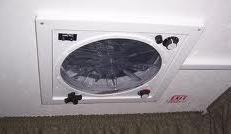 Another method is to install — if it isn’t already installed — a Fan-tastic Vent (photo). This vent and fan operates on very low amperage and can run for hours off your batteries without pulling too much juice out of them. Set to the highest speed, the fan will turn over the air in your rig in minutes. During the hottest part of the day, set it to draw the hot air out. During cooler periods in late afternoon or early evening, set it to reverse and draw in the cooler outside air.
 Some years ago, a worthy alternative appeared — a silicone rubber tape that was self-fusing. It bonded to itself with enthusiasm, and had no adhesive to age or create a mess. Furthermore, it was impervious to many chemicals, ozone and UV, which age and deteriorate lesser products.
 When my wife and I bought our motorhome the salesman was our best friend — now he doesn’t even know our name. Our new best friend is the head mechanic at the dealership. I just wanted to camp, but my wife wanted the doorbell that played a dozen different tunes, electric steps, push-button awning and a media center that is so hi-tech our toad is a Geek Squad VW with two guys in it. So far we have spent more time on the road looking for RV repair service than fishing. When things aren’t working right I find myself blaming my wife for talking me into all these expensive extras. It has caused a lot of frustration and arguing in our marriage. Am I wrong? Do I need an attitude adjustment? I hate conflict — I just want to go fishing. —Broken Down in Biloxi

 We were met at the entry booth by a young woman who informed us we could indeed stay for $10 a night for three nights maximum but the catch… we would have to sit through a one-and-a-half-hour sales pitch to join this membership park.
 I wouldn’t want to belong to a park system that stoops to this kind of “bait-and-switch” advertising. That said, some of these park systems can be worthwhile as long as they remain solvent and they offer tangible benefits to their members. They can be quirky requiring rotation of stays, transfer limits, and a laundry list of rules and regulations requiring a law degree to understand.
 First, check the controls on the front of the refrigerator. These are properly called an “eyebrow board” or “upper board.” Is the board getting power? You’ll know it if any of the lamps or indicators on the board are lit up when the power switch is on. If the upper control board has power, you’ll find your problem on the back of the refrigerator. Do your checking behind the vent lid on the rig’s exterior wall.
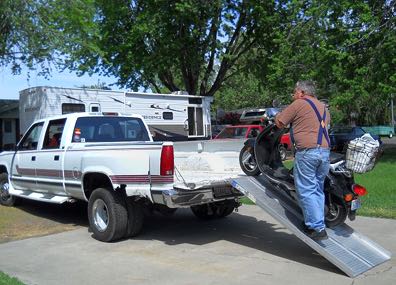 When you’re traveling between RV parks, hauling scooters around can be challenging. The most important thing is to know what your RV can handle, since what works for one rig may not work on another.
 Sizing down” for the RV lifestyle can be tough. Where do you put your laptop — other than on your lap — when you have some serious computing to do? Enter the laptop desk.
 A similar system, but one that gets the laptop off your lap entirely, is to use a “bed table.” These little stands take a flat platform and add legs, usually folding ones. Many have room for a mouse and also prevent burnt laps. But what to do when you need to move and don’t want to disrupt your work in progress? The one pictured above left is from Sam’s Club. Careful though — those handy drink and silverware holders could create issues with free mouse movement.
 Here’s another idea: Coupling the flat and stable platform with “full-to-the-floor legs,” the “Table Mate II” is made with lightweight plastic and is adjustable in height and platform angle. There aren’t any side braces, allowing users to slide their legs in and out from under the rig without fear of banging knees or legs. The whole rig slides right up over your lap, bringing the computer into reach and at precisely the right height. They’re adjustable so you can use it with more than one chair or even the sofa.