Home Blog Page 2187

Is age slowing your response time? Practice!

0

By Bob Difley


Our response time slows as we age. We don’t think or process information as efficiently as when we were young.

reflex testAs much as you think you can perform certain functions as fast now as you ever could, it’s just not true. One area that it doesn’t pay to take chances or cling to old beliefs is our ability regarding safety.

For instance, how fast could you react to a sudden galley fire? Fast enough to stop it before it spread to the rest of your RV? Don’t guess. Try a timed practice drill.

Have your spouse shout “Fire!” (Don’t do this in a crowded campground.) Jump from your chair, rush to free the fire extinguisher from its wall mount (while your wife screams [not too loud] and reacts with feigned panic to create an atmosphere of chaos — which will likely be the case in a real emergency and will affect your thinking and efficiency), release the trigger, and — here, just pretend — pull the trigger while aiming the extinguisher at the virtual blaze. Call out to your spouse to stop the stopwatch.

Now do it again. And again. After a few times — admit it, your reaction time from start to finish decreased, didn’t it? — it will be planted more firmly into your hippocampus, or hippopotamus, whatever that part of your brain is called that stores memories.

This means that if the real thing happens, your chances are now much better of getting the fire out before it’s too late.

And, here’s a recommendation: Before “spraying” that fire extinguisher on any RV fire, make sure you have the right one for the job. Our friend Mac McCoy, Mac the Fire Guy, is the expert on this sort of thing. His website offers a wealth of information about fire safety.

What to do about conflicting sleep schedules in “small” RV?

0
Dear RV Shrink:
rvshrinkWe live nine months of the year in a Class “C” motorhome. It is usually 27 feet of heaven. The only time I find it small is when my wife stays up late watching television. She is a night owl and I can’t sleep. Don’t tell me to buy ear plugs or earphones, I’ve tried both of those items. My wife gets so involved in her shows she starts crying or laughing both of which make the coach rock n’ roll. She also pops popcorn when I am trying to sleep. I need a solution before I develop a severe case of sleep apnea. —Sleepless in Seattle

Dear Sleepless:
There is only one way to eat an elephant — one bite at a time. Your first step should be a good set of support jacks to eliminate the coach movement. Then you need to discover the things that you do that annoy your wife when you get up at dark thirty and she is trying to sleep off her wild night of popcorn bingeing. Never go to the negotiating table empty-handed.

Being on the same schedule in a small space would make it much easier on both of you. If you can’t work out an arrangement you will both need to work on your consideration skills. Nothing is easy to the unwilling. I know you have already tried ear plugs but they are not the only solution. A fan nearby will create a constant noise level that you might find soothing as well as noise insulation against exploding popcorn.

If none of these ideas works, you might try installing a smoke alarm above the toaster. When you get up to watch the early morning farm report on TV, the toaster will trip the smoke alarm about the time the coffee begins percolating. This will wake your wife and bring her to the breakfast (negotiating) table that I mentioned earlier.

Unless you want to buy a larger motorhome, don’t flinch too early. Hold out for good faith bargaining that will work for both of you. The most important trip you may take in your motorhome is meeting your wife half way to the popcorn popper. —Keep Smilin’, RV Shrink

The RV Shrink is not really a psychologist (or professional RV technician). But he does know a lot.

#rvs737

Stretch your camping dollars with caretaking

0

By Bob Difley


Caretaking takes many forms, from simply camping at a remote location to deter theft or vandalism, to staying on someone else’s property while they are away. This can often entail watering plants, feeding pets, or gardening.

caretakerUsually you will stay in your own rig but have access to electrical and water connections and the use of a bathroom facility or sewer hookup. Each caretaking position is different and usually involves trading your services for free living and sometimes, depending on the work and responsibility, also a small stipend.

To find caretaking positions, check with local realtors for house sitting positions, in the classified sections of local newspapers, word-of-mouth at federal agencies like the BLM, NFS, Fish & Wildlife Service, etc.

However, the best source may be in the listings in the Caretaker Gazette, which specializes in finding property caretaking and house sitting positions. It’s published quarterly and includes descriptions of the position, whether pay is included, and details of duties.

If you find a listing of interest, act on it quickly — the choicest ones go first. Have letters of referral and references ready to email or print and send to those seeking caretakers. The easier you make their decision of who to hire, the more likely you are to get the position.

You can find Bob Difley’s RVing e-books on Amazon Kindle.

Guide to basic RV weight terms

0

Overloading an RV, whether a motorhome, travel trailer, fifth wheel trailer or other recreational vehicle, can spell big trouble. Here is advice from RV expert Mark Polk of RV Education 101 about how to understand basic RV weight terms. Make sure you understand these terms before buying an RV.

Everyone should have a basic understanding of RV weight terms. Do your research to avoid becoming a statistic in relationship to overloaded recreational vehicle, whether it’s a motorhome, travel trailer or other RV.

Gross Vehicle Weight Rating (GVWR):
The maximum permissible weight of the vehicle when fully loaded for travel including the vehicle, cargo, liquids, fuel, passengers, and any towed vehicle tongue weight. Motorhomes, tow vehicles, and trailers all have GVWR.

Unloaded Vehicle Weight or Dry Weight (UVW):
The actual weight of the trailer or truck as built at the factory. The UVW does not include passengers, cargo, fresh water, LP gas, or after market accessories.

Cargo Carrying Capacity (CCC):
The maximum permissible weight of personal belongings that can be added. CCC is equal or less than GVWR minus UVW, full fresh water weight, and full LP gas weight.

Gross Axle Weight Rating (GAWR):
Every axle has a GAWR. It is the maximum allowable weight that the components (tires, wheels, brakes) of each axle are designed to support.

Gross Combined Weight Rating (GCWR):
The maximum permissible weight of the tow vehicle and trailer combined when both are fully loaded for travel. GCWR also applies to a motor home towing a vehicle or trailer behind it. GCWR minus GVWR represents the allowable weight for the towed vehicle. Note: The hitch receiver mounted on the towing vehicle must be rated for this amount of weight. If it is rated for less that is the maximum amount you can tow.

Gross Vehicle Weight or Gross Trailer Weight (GVW), (GTW):
This is not a rating this is the actual weight of the tow vehicle or trailer when they are fully loaded for travel. This includes the vehicle, cargo, liquids &amp fuel, passengers, and the towed vehicle’s tongue weight.

#NRV

Husband thinks wife expects too much from campground host

Dear RV Shrink:

rvshrinkMy wife and I just had a big argument because I told her she was short with the campground host. We came into the campground, with our tent camper, late evening, and the host reluctantly opened his motorhome door to talk to us. I think he was watching a ball game and we disturbed him. My wife thought he was rude and was very upset with him. I tried to explain that the campground host program is not a 24/7 job, usually pays with free rent, and is designed more to supervise an area, not monitor and police it around the clock. When I told her the campground host is not like the doorman at the Ritz, Mount St. Helen went off. Can you straighten one of us out — preferably her. Thanks in advance. —Squabble in Sequoia

Dear Squabble:
You are absolutely right in your understanding of the campground host job, but you need some work on your explanation delivery to your wife. Give her a break. Nothing is as frustrating as arguing with someone who knows what he’s talking about. Sometimes after a day of driving and getting in late, nerve endings can be a bit frayed, fuses a bit short and sarcasm levels a bit high. 

At this point in the day everyone should put themselves in the other persons moccasins. In a perfect world the host would see that you are in late and having a tough time. Your wife might consider the host has had enough problems for one day and is trying to relax and watch his game. 

You have the hardest job. You have to be a spectator and not a referee. I think you were doing fine until the “Ritz” remark. My suggestion would be to get your wife a campground host job. This will save you some rent, give her a broader view of the many duties a campground host is responsible for, and a glimpse into the hassles many of them have to deal with daily.

I must temper all these remarks with the fact that hosts come in all varieties and some have a much more compassionate disposition than others. Your wife could have been partially right about this host. You should always try to meet her halfway unless she is a poor judge of distance. I’m not suggesting you and your wife ignore your disagreements. “Discussion is an exchange of knowledge; and argument an exchange of ignorance.” But, one thing you should never do is argue in a tent. When you go stomping out of a tent and slam the flap behind you, there are no sound effects.  —Keep Smilin’, Dr. R.V. Shrink

The RV Shrink is not really a psychologist (or professional RV technician). But he does know a lot.

#rvs737

Do-it-yourself dish drainer

By Cheryl Probst


RV sinks come in awkward sizes, especially when it comes to dish drainers. There’s usually not enough room on the counter for a standard size drainer, so what’s a person to do? One solution is to make your own drainer to fit in the sink. Our version is inexpensive and takes only a few minutes to make.

Start with a coated wire rack that is the width of the bottom of the sink you’ll be using. You can buy a new rack, but we used one we found for 39 cents at a thrift store. If the rack is too long to fit the sink, use a wire cutter to trim one end to the length you need.

Next, you’ll need two pill boxes. Ones that Wal-Mart gives away (the long “pill-a-day” boxes), or something similar, are perfect for this. Use zip ties to attach the pill boxes to the rack. Voila! You have a dish drainer.

Taking it apart? Tips for putting it back together — correctly!

By Steve Savage
RV Mobility Services


For all you do-it-yourselfers out there, here’s something important to remember: Not even those of us who work on RVs for a living know how everything we work on is assembled. It’s a sure bet you don’t either. Most of the calls I’ve received recently have been the result of someone correctly diagnosing what was wrong, but after repairs were made the unit failed to work. Why? On reassembly it wasn’t put back together correctly.

I carry a digital camera right along with my other tools and I never hesitate to snap pictures when I’m working on something I haven’t seen before. I also shoot pictures when I have to remove a part and order a replacement, and may not get back to the job for several days.

Plenty of things in an RV can be assembled incorrectly and yet everything will still fit — screw holes line up correctly, and so forth. It takes me much longer to repair something that’s been taken apart by someone else, and it’s harder to be on the lookout for things I would never expect to find. Remember, too: Make some repairs on your RV incorrectly and it can be dangerous.

Here are some simple steps to follow on your next RV repair project: Pay attention when you take something apart. Take pictures of the item intact and as you disassemble it. Download the service manual for the correct procedure. Doing these things will save you time and money and keep you safe, as well.

Check your water tank venting and save water


By Greg Illes

It’s surprising at times how much impact a simple oversight can be. In our Itasca motorhome, the fresh water tank had a factory-installed venting tube. This is a necessary feature so that the tank can “breathe” with capacity and altitude changes. However, the way the designers chose to install this vent was not ideal.

The vent was routed immediately out of the tank and down below the RV floor. Consequently, normal driving would slosh our fresh water out of the vent. On one occasion, we arrived after a long winding road at our destination with nearly 30 percent of our water already spilled overboard!

This venting style is not uncommon, especially if you have dual-fill capability (gravity tube and city-water connections). So it’s a really good idea to check the design of your venting system and make corrections if necessary.

If your venting system is designed with an uphill vent like the top image in the diagram, you’re probably in good shape to keep all of your water in the tank. But if you have venting which goes immediately downhill, your fresh water will spill out on turns, slopes, and the typical jostling which accompanies motoring down the road.

If your venting system is a wasteful one, the fix is fairly easy. You can interrupt your vent line and make it much more difficult for the water to exit. CAUTION: Don’t think about simply capping it off — that would result in tank collapse or rupture. Always make modifications with equal-diameter tubing. And always be sure any changes you make leave the vent clear and unobstructed.

The two basic fixes are to either rerun the vent uphill (for example, to where the gravity fill entrance is), or to make a racetrack of tubing around the top of the tank before exiting downwards. Either method will prevent or drastically reduce water spillage. A variation would be to run tubing upward a couple of feet and then back down again (no, this will not cause a siphoning action).

Every installation is different, so it takes some study of your available space and maybe some experimentation. But if you’re losing precious water, it’s definitely worth the trouble and a few bucks’ worth of tubing.

Greg Illes is a retired systems engineer who loves thinking up RV upgrades and modifications. When he’s not working on his motorhome, he’s traveling in it. You can follow his blog at www.divver-city.com/blog.

Send and receive faxes while traveling

0

By Chris Guld
www.GeeksOnTour.TV


RVers use the Internet for everything else, why not faxing?  Even if you do travel with an all-in-one printer/fax machine, most of them will need a cable from a landline telephone in order to work.  There are websites that you can use for faxing.

Receiving is easy.  All that’s required is a phone number that receives the faxed document and redirects it as an attachment to an email.  We’ve used eFax.com for many years and have had no problem with our grand total of about three faxes per year!  Here’s how it works: You sign up for a free account; you will be assigned a fax number; now you can give that number when anyone wants to send you a fax.  To them it’s just like sending to any other regular old fax number, but to you it looks like an attachment to an email.

Is it really Free? If you go to eFax.com you will see eFax Plus for $16.95/mo. and eFax Pro for 19.95/mo. There is a free version, honest!  You need to browse to www.efax.com/efax-free in order to sign up. With the free version you can’t choose your phone number, and you’re limited to receiving no more than ten faxes per month.  You can’t send faxes with eFax-free.

When I need it, I use a different free service: FaxZero.com. To use the free fax-sending service of FaxZero, you don’t even need to sign up for an account! You just fill out the form with the name and the email of the sender (you) and the name and fax number of the receiver. You can then type a note for the cover sheet and upload a document to be sent. FaxZero will send an email to the address given for the sender. When you see that email and click the confirmation, your fax will be sent.  You will receive another email to confirm that the fax was sent successfully. The free FaxZero is limited to faxes of no more than three pages plus cover, and no more than five faxes per day.

If the document you need to fax is a physical piece of paper, then we have another step.  If you have a printer/scanner, then you’re all set.  Just scan the paper — now you have a document on your computer that you can upload and fax with FaxZero.  Don’t have a scanner?  In a pinch, I take a photo of the document, but FaxZero specifies that the uploaded file must be a .doc, .docx, or .pdf.  I open up my word processing program and choose Insert Picture, specifying the picture of the paper I just took.  Now I have a document file!  I might even use Word’s ability to Save As a .pdf file to make it smaller and more efficient.

Watch out for tree branches at the campsite

0

By Jim Twamley


RVers have a love/hate relationship with trees. We love them because they provide shade on hot days, and loathe them when they reach out and grab our RV while we’re backing into or pulling out of a campsite.

Here is an example of how a tree limb can remove RV siding with surgical precision. Tree limbs are also brutal on rubber roofs, causing punctures, or rubbing and tearing on roof edges. A good patch kit will fix the rubber roof, but the siding will need more extensive repairs.
I’ve seen RVers on their roofs with saws and pruning hooks trying to avoid the embrace of a tree. It’s fine if you want to hug a tree, but it’s not a good thing when a tree hugs your RV. To avoid these unfriendly encounters with wood, I suggest you always check the overhead clearance before you pull into or out of your campsite.

And trees aren’t the only “roof destroyers.” Be careful when pulling into service stations, too. Plenty of damage has been done to RVs at the pump through the years.

Don’t give up gardening to RV: Grow a “bumper garden”

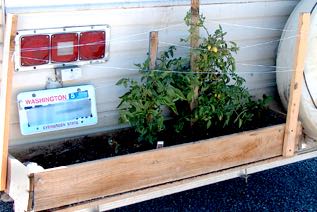
Does RVing mean you can’t enjoy gardening? Absolutely not! An RV bumper garden is easy to build and keeps fresh greens practically at your doorstep.

Hit the lumberyard for a few cedar fence boards and construct a “loose” bottomed box in a size your rear bumper will accommodate. We held ours together with galvanized metal corner brackets, the end result being a one-foot by four-foot box. A little open space where the bottom meets the edges allows for water drainage.

Connecting the bumper planter to our “square tube” bumper required a little finesse. Just screwing the planter into the bumper proved too unstable, what with the weight of the soil taken into account. We built a custom bracket to moor the box securely. We laid two strips of “plumber’s tape” perpendicular to the bumper, one at each end of the planter box. Holes were drilled through the planter box to run appropriately sized carriage bolts through the tape and box bottom, one on each side of the bumper. At the far end of the bolts we put another strap of plumber’s tape, and used lock washers and nuts to firmly strap the box to the bumper. Total requirements? Four carriage bolts, washers, and nuts, plus four plumber’s tape straps.

To enhance the “drainability,” add a layer of gravel and top it off with good-quality planting soil. Our first “sowing” included tomatoes, both the “cherry” variety and larger slicers, good for use on hamburgers — guess who’s talking here! As the tomatoes got taller we added stakes to support the vines. These were uprights screwed into the planter box, with garden twine to help support the plants and their stakes against road bounce. In cool country we covered the uprights and twine with plastic to keep out the cold.

We’ve gardened tomatoes, strawberries and beans, but of course, taller plants like row corn might not be able to hold their ground as well in the planter box. Our beans are the bush variety, and when they get too tall, we may need to relocate the license plate for the sake of visibility. Maybe keeping shorter plants on that side of the planter box would have been wiser. The “intensive” method of gardening will lend itself well to mobile gardening. You are indeed dealing with a postage-stamp size bit of soil, and the more you can pack in, the better off you’ll be — done properly. Keeping your plants trimmed will help them bush out at the bottom, which seems to do better.

Handle it right and you can put a whole new meaning on the phrase, “bumper crop”!

“Funny” screws save time and frustration

By Russ and Tiña De Maris


Reader Fred Campbell of New Mexico recently wrote in concerning his fondness for Robertson screws, which some of us airheads refer to as “square drive.” As Fred aptly points out, “Robertson screws are those with the square hole in the head as opposed to a cross or a slot.”

You’ll find many RV manufacturers have used Robertson screws to varying degrees. What’s the advantage? The Robertson is square – to a point. Below the top level of the screw head the socket has a taper, which makes getting the bit in the socket easier and can keep the screw on the bit without fussing. Try that with a straight slot or Phillips.

You can thank Canadian P.L. Robertson for the invention, way back in 1908. He had licensed the design to a British party, but they deliberately drove the company into bankruptcy, thereafter buying the rights to the design from the bankruptcy court. Yes, you might say Robertson got screwed in the deal, as he then spent big money buying the rights to his own design back from the crooked character.

Interestingly, Henry Ford gave Robertson screws a shot on Model T Fords, liked them, and tried to buy the license for use. When Robertson refused, Ford would only use the screws on Canadian-built Model Ts, and the Robertson screw never took off in the U.S.

Got any Robertsons in your RV? Fred Campbell warns, “I have seen more people try, and fail, to remove a Robertson screw with a Philips head screwdriver than I care to mention.” The frustration is real, and the Phillips head suffers. But a genuine Robertson driver or bit? We can personally attest that we’ve lost more Robertson bits than we’ve ever worn out.

Fred has a similar story: “I had to purchase a Robertson out of necessity when I couldn’t remove a screw near a water tank in the old (1970) Layton. It had rusted due to condensation on the tank. I purchased the driver at a Sears tool outlet for about $5 in 1975, and I still have it to this day. I purchased a second one within the past few years and modified it to fit in my portable 3/8″ drill. I use these all the time in my RV.”

You can find Robertson screws at specialty hardware outlets and some hardware stores. They’re great for putting in stuff you’ll want to take back out later, without the hassle of torn screw heads. We’ve found they help clean up a fellow’s language, too.

Many thanks to Fred for sharing his thoughts with us.

photo: saforrest on wikimedia commons