Home Blog Page 2196

More ado about a drop-down TV bracket


By Greg Illes

Awhile back we ran a story of mine on a fold-down TV bracket that I put into my Class A motorhome. We immediately were hit with cries of, “Where can we get one?” from our readers. Here’s a follow-up.

The bracket is full-custom, not store-bought. In order to get the TV nearly flush to the windshield, and also up tight against the overhead when stored, I needed a bent bracket design.

First, I used a piece of wire to mock up the angle and length I needed. Then I had a local plastics shop put a bend in a piece of 3/8″ ABS textured sheet.

The sheet is attached at the front with two standard three-inch steel hinges, fastened to a metal portion of the overhead structure.

At the back edge, I used two strap retainers to hold one-inch black nylon straps. These use standard strap snap-catches to hold the TV up in stored position. I used two for stability and fail-safe design (don’t want that puppy coming down while I’m driving), plus I needed the finished affair to be rattle-free. These worked out very nice.

I punched a one-inch hole in the overhead to accept all the cabling, and I put a split-sleeve cable cover over it all to dress it up a little.

The TV didn’t hang down quite vertically (bent bracket center-of-gravity offset), so I mounted a small wooden knob into the windshield vertical post (not shown in photos). The bottom of the bent bracket slips over the edge of the knob to hold the TV vertical, and also to keep it from swinging.

Greg Illes is a retired systems engineer who loves thinking up RV upgrades and modifications. When he’s not working on his motorhome, he’s traveling in it. You can follow his blog at www.divver-city.com/blog.

RVs: Rent or own?

0

By Steve Savage, Mobility RV Service

Have you ever considered renting an RV? How about wondering whether you would be better off renting than buying? Here are a few things to consider.

Cost Average owners use their RVs very infrequently. If one buys a new RV, making payments over several years, and were to figure the actual cost per hour of use, from a dollars and cents (or should I say sense?) standpoint, it is almost never cheaper to buy new than to rent. Once you start to add in depreciation and upkeep, most new buyers would have been many dollars ahead to rent rather than buy.

How about buying used rather than new? Buying used is almost always the better way to go unless you are looking for something special or are the type of person who keeps what they buy and maintains it for many years. Then the cost comparison waters become murkier. If one were able to find a genuinely good buy, where depreciation is not a factor, actual per hour cost starts to favor ownership, provided it does not simply sit in the backyard.

Speaking of backyards, don’t forget to factor in storage fees if you live where you are not allowed to keep your RV in your yard — a problem that is becoming increasingly common for many RV owners.

On the other hand, if you are an avid RVer and use your RV on regular basis, ownership may be more realistic. Rental fees would really add up if you used your RV on a weekly basis.

Convenience There is no contest when it comes to convenience: Having your RV next to your house or in your backyard makes for ease of loading and unloading and also makes for easier maintenance. In some areas, your RV might also be less prone to vandalism when it is close at hand. Convenience is less a factor if you have to keep your RV in a storage facility.

Again, usage patterns have to be factored in here, as simply renting the RV, driving it home, loading it and hitting the road is not much of a hindrance, provided you only have to do it a few times a year.

Maintenance and the play factor If you do not want the worry of maintaining an RV, rent!  All RVs, without exception, require regular maintenance. One thing folks often fail to consider when they talk about how much renting costs is the rental company is responsible for maintaining their units, so they take on all those tasks owners normally would have to do or pay to have done.

If you are the type of owner who enjoys maintaining their own rig or “playing with your RV,” for lack of a better term, by making small modifications and doing minor maintenance, ownership is the way to fly. Some folks enjoy working on their RV in the same way that antique car owners do. There are worse hobbies, for sure just be realistic when it comes to assessing your skill level.

Luxury The majority of rental units are basic Class C motorhomes. They are completely serviceable but pretty bare bones (although higher-end units are available in some areas). Look over what is available in your rental market. If it would suit you, you are home free. If you want something nicer than what you find in the rental market, owning your own RV moves you to the head of the class.

Factors favoring ownership may be things as simple as wanting an awning when you camp, something most rental units lack, or perhaps simply wanting more luxury.

It’s mine There is something to be said from an emotional standpoint for owning your rig. Some people just are not comfortable sharing. Just like some folks rent or borrow tools and some folks insist on owning their own, not everyone is comfortable using what someone else has used. You know if you fall into this category, so no sense denying it. You already knew you were not interested in renting before you started reading this article!

I’m just not sure about RVing Funny as it sounds, some people are just not sure they will like RVing or they want to try to interest their spouse in RVing in the least risky manner. In those cases, ownership, even low-dollar buy-in just to try, or anticipated buy-and-resell, is a mistake! If you are new to this game, you may mistakenly assume RVs are infinitely flippable. The problem is that the rules of buying and selling change constantly and even established dealers often make mistakes.

What that means is something you buy one day may not find a buyer the next, or you will at least lose money on the resale. Renting in these types of situations provides you with a set cost and nothing hanging around in your back yard if you find the latest “Go RVing” advertisement proves to be more fiction than fact, once you hit the road.

As usual, there is a no best way to do it. Both renting and ownership have distinct advantages and distinct costs. The checkbook is in your pocket you decide.

photo: twm1340 on flickr.com

Ironing out computer location problems

0

By Jim Twamley

If you find yourself in need of a computer desk for your RV but still haven’t got the problem figured out, here’s an idea.
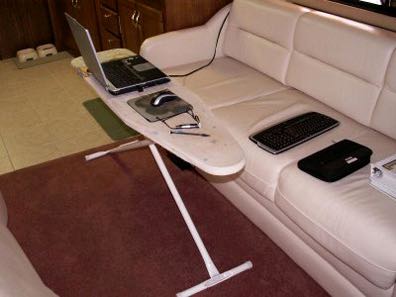
We were in the process of obtaining a permanent computer desk for Marilyn, but in the meantime we found that a conventional ironing board serves the purpose well.

It’s a long surface so you can pile stuff on it, and it adjusts to any height you need. It also folds up and stores under the couch when not in service. Not a bad use of space in a pinch.

Editor’s note: We’ve found a similar arrangement works great when trying to find a suitable place for the traveling sewing machine.

Safe drinking water on the road

By Russ and Tiña De Maris

Water — that life-sustaining drink. Once you exclude fat from your body mass (who among us wouldn’t like to do that?), about 70 percent of what remains is water. The average human sucks up over a half gallon of the stuff a day.

But is that “cool, clear water” that you consume safe? It’s one thing to determine if the water supply at your home base is safe — it’s quite another to know what you’re putting in your fresh water tank when on the road. If you do most of your RVing while attached to city water supplies at, say, an RV park or public campground, your water supply is more than likely inspected by a government agency and likely meets those EPA “safe to drink for healthy people” standards.

If you get your water from a well or some type of unknown source, drinking water issues could become a much greater concern. An appropriate water filter system may be what you’ll want to install. But what if you don’t want the hassle of installing or maintaining a water system? The alternative is bottled water. Is it any better than tap water?

The Natural Resources Defense Council (NRDC) undertook a four-year study of bottled water and came up with some interesting findings: Of 1,000 bottles tested, 25 percent were simply bottled tap water. Most of the “tap water” bottles were safe; however, some did have contaminants that could cause problems for folks with weakened immune systems.

Read the label on the bottle. If it says, “From a municipal source” or “From a community water system,” then it’s probably just tap water. The label will usually indicate if additional treatment has been given the water once it left the city tap. The NRDC suggests if you’re concerned about drinking water quality, then buy bottled water from companies that get their water from a known, reliable source.

What about water sold out of vending machines? It’s not bottled water, nor is it as regulated as bottled water. Typically — but not necessarily — it comes from a municipal source line, and that has to meet drinking water standards. But the actual machines and their maintenance fall under local law.

Vended water is not considered bottled water and is not regulated as such. The water source for vending machines is typically the local public water supply, which must be in compliance with EPA drinking water standards. Additional treatment may occur to reduce dissolved substances and disinfect the water supply. While the water going into the machine may be potable and clean, don’t expect what comes out of the machine to necessarily be in the same state.

One California study revealed that supermarket vending machines had much higher bacterial counts than plain tap water. At that time the local director for water quality told reporters, “You’re safer drinking the tap water. Not only are you safer, but you’re paying, oh, let’s see, about 250 times less per gallon.”

Ah, it’s almost enough to make you swear off water and turn to something else.

RV laundry room tips that could help you

By Jim Twamley

Many RVers find having a washer/dryer system in their rig to be the cat’s meow. But they don’t come without some drawbacks — sometimes a little tweaking can make your life with washing equipment better.

I met up with a couple of RVers at an RV rally. They knew what they wanted in their motorhome — a stacking, apartment-sized washer and dryer for the laundry closet. Since the dryer is a front loader, it is located on the top shelf of the closet because it’s easier to work with in this configuration.

Underneath is the top-loading washing machine. To enhance this working space the family relocated a factory-installed light moved from the top of the closet to the side wall by the washing machine. That cleared up one problem in a hurry — being able to see into the machine.

But one of the problems with having a top-loading wash machine under the dryer is the dryer shelf prevents the washer lid from opening completely. To overcome this issue the couple installed a magnet underneath the dryer shelf. Visit a hardware store and look through their cabinet latch section — you’ll find just the thing with a little digging. The magnet holds up the washer lid, freeing up both hands to do the laundry. Simple yet ingenious!

Can WD-40 really do all that?

By Greg Illes
The “WD” in WD-40 stands for “water displacement,” and it was reportedly the 40th blend that finally made it to production. Since that time (1953), the simple product has achieved near-legendary status in virtually all walks of life. I wouldn’t be surprised to find out that an astronaut was spritzing the stuff on the pivot joints of the Hubble telescope.

The “WD” in WD-40 stands for “water displacement,” and it was reportedly the 40th blend that finally made it to production. Since that time (1953), the simple product has achieved near-legendary status in virtually all walks of life. I wouldn’t be surprised to find out that an astronaut was spritzing the stuff on the pivot joints of the Hubble telescope.

Certainly, any RV has hundreds of places where a penetrating lubricant can do some good, and we all have found many of them. But in more recent times, the “legend” has branched out from a basic penetrating oil. People started using it for ancillary purposes like removing sticky-label goo. Eventually, with folks writing to the company, WD-40 compiled an impressive list of uses — more than 2,000, and counting. You can see this list on WD-40’s website, ten pages at 200 tiny-print items per page. Many of the entries are similar “loosens this” and “lubricates that” kinds of things — but there are some exceptions.

I’m thinking that only a small handful of people would ever read this list in its entirety. Certainly, I have not. I’m pretty happy with using WD-40 as a light-duty penetrating oil for squeaks and rusty fasteners. But I did scan the big list for interesting and/or useful items, a few of which are presented below. Mind you, I make no claim to have tried these out or verified them. I leave that to the (cautious) reader.

• Keeps wicker from squeaking
• Removes crayon marks
• Cleans bug splatter
• Keeps snow from sticking to shovel
• Removes gum from concrete
• Removes ink stains from leather

• Prevents bathroom grout mildew
• Cleans bird droppings
• Removes adhesive labels
• Helps remove burned-on food
• Keeps watch bands from pulling wrist hairs
• Removes duct tape adhesive

• Great for sharpening stones
• Removes stuck-on hair wax
• Stops ice formation on horseshoes
• Waterproofs feathers on arrows
• Keeps dirt from sticking to shovels
• Stops squeaking on stilts

And, lastly, an esoteric favorite:

• Keeps missile silo doors swinging freely.

Finally, a solution!

Remember, these uses are not represented by WD-40, RVtravel.com, or this author as anything but interesting or entertaining ideas. If an item has any merit, you will have to decide for yourself. And also remember to always try it on something you don’t care about first (grin).

Greg Illes is a retired systems engineer who loves thinking up RV upgrades and modifications. When he’s not working on his motorhome, he’s traveling in it. You can follow his blog at www.divver-city.com/blog.

Busy summer weekends are coming — Here’s a survival technique

0

By Bob Difley

Summer RVing can be one of the more pleasant aspects of the RV lifestyle, and also one of the more stressful. Full-timers or those on an extended vacation have to camp somewhere on busy weekends.

If you’ve ever spent a weekend in a state park campground or a popular family RV resort — if you can even get in without a reservation — you know that it will be crowded and there will be lots of kids having lots of fun (and making lots of noise), excited dogs barking at all the stimulus of being surrounded by strangers, and campfire get-togethers with conversations (sometimes just a few feet outside your bedroom window) rising in decibels in relation to the amount of alcohol consumed and sometimes lasting into the wee hours.

Don’t expect rangers to come by and quiet things down after the unenforced 10:00 quiet hour arrives. They don’t have enough rangers with the budget cutbacks to even cover daytime shifts, let alone after 5:00 when they all disappear.

Maybe all this doesn’t bother you. Good for you — I commend you on your tolerance. But for some of us senior folk, we would rather opt for a quieter, less-crowded camping experience. And there is an answer — a better option: Find boondocking spots in the National Forests or on other public lands where most of the time there will be far fewer campers and they will be spread out, unlike the sardines-in-a-can layout of most established campgrounds. In many cases, there will be single, isolated campsites, nestled in a forested grove out of sight of any other campers.

To take advantage of these quiet, uncrowded campsites, you have to put out a bit more effort. You can’t phone in a reservation to hold your site, there are no comprehensive lists of boondocking locations (or dispersed camping areas as they are called), there is no way to check whether the boondocking campsites are full before you drive in to actually check, and you will have to have learned some boondocking skills before you wander into the woods.

But the rewards are many. Once you find a good boondocking campsite, record it on your GPS or notate it in your campground book. Don’t forget to record explicit directions — your memory may not be as good as you think it is. This way you won’t have to search for it the next time you want to use it. Over time you will have collected several favorite boondocking sites, as well as discovering many that you passed by without staying in — a regular treasure trove of escapes from chaotic state parks and family destination RV resorts.

You can find Bob Difley’s RVing e-books on Amazon Kindle.

Recycling gray water

By Jim Twamley

I have no problem recycling RV gray water onto grass, shrubs and trees. Plants will thrive on RV gray water if you don’t use harsh soaps or chemicals. Your gray tank holds shower water, laundry water (if you have a washer and dryer), dishwater, teeth brushing and hand washing water. If you think about it, that amounts to a lot of water usage. Selecting plant-friendly biodegradable detergents and soaps will allow you to recycle this water instead of allowing it to go to waste.

I’ve stayed at many campgrounds that didn’t have sewer drains at the campsites. We can usually go two weeks before having to dump our black water, but the gray water tank will only last about three days before we need to empty. I’m too lazy to pack everything up and go to the dump station, so I water the surrounding vegetation with our gray water.

EDITOR’S NOTE: If you wish to follow Jim’s advice, please check with the campground owner or manager first to be sure he or she approves.

You will need an adapter (sold at most RV stores or at Amazon) that will attach to a standard garden hose and to your black/gray water drain pipe. If you didn’t already know, there is a controversy surrounding this idea. Some parks forbid the practice and some people argue that it is unsanitary. I don’t let the hose sit in one place causing a puddle, but move it around to different plants until the tank is empty. In many parts of the country water is in limited supply and recycling gray water makes more sense than sending it down the sewer to a treatment facility.

When I’m at a fairground or outdoor event that has RV parking on the grass, I use a short hose to drain my gray water tank directly under the RV. By doing it this way you don’t encroach on your neighbor’s space. Instead of throwing an old hose away, I recycle it for this use. I know some folks object to this method of disposing of gray water and that’s why it remains a controversy. Because of waterborne diseases like cholera, you should always dispose of black water into a sewer system. Gray water, on the other hand, has far fewer contaminates and in my opinion is safe enough for recycling. As long as you are not offloading gray water near water sources such as a lake, stream or a well, there should be no problem.

Park rangers give techno tips to get you out of trouble

0

By Russ and Tiña De Maris

Rangers at Utah’s Zion National Park say that technology has proven a godsend for some visitors who’ve gotten into trouble. No, we’re not talking GPS systems or satellite phones but, rather, the simple use of cellular telephones.

Here’s an example: A Virginia man tried descending a steep trail after dark. The man stepped off the trail to urinate. He lost his balance and fell onto the switchback below, breaking his leg. Unable to stand, he crawled and reached as high as possible for cell signal to send two brief text messages to his friends who called rangers for help.

In one recent season, Zion’s rangers have dealt with several hiking and canyoneering incidents with the aid of text messaging. These include canyoneering parties who have gotten ropes stuck, were unable to find rappel anchors, and who were underprepared for the route and conditions.

Why is text messaging sometimes helpful? Voice contact from the canyon floors is often impossible due to the nature of the terrain and noise of flowing water. Though cell service is from quite limited to nonexistent in the park’s terrain of deep, narrow canyons, texting has sometimes worked when calls couldn’t. Text messaging has helped rangers respond quicker, and often spare themselves unnecessary danger.

The use of text messaging to get out of trouble isn’t limited to parks like Zion. There are plenty of places that RVers can travel, even without getting too far off the beaten track, where cellular voice service is sketchy. Even in some of these areas, text messaging may work. So, if you find yourself in a predicament and can’t get a voice call through, try texting someone instead.

Look below the surface to find “travel jewels”

0


By Greg Illes

Trekking across the featureless desert south of Death Valley, traveling dancer/artist Marta Becket got a flat tire. The year was 1967, and that simple loss of air pressure would change her life — and the lives of hundreds of thousands of others — forever.

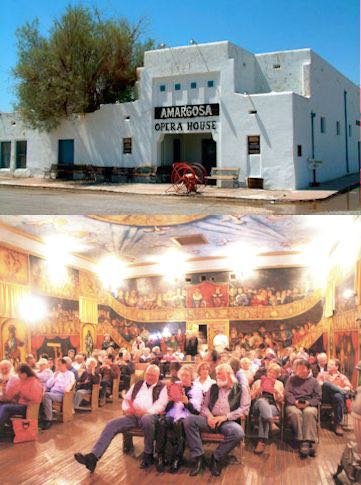
Marta ended up buying the tiny hamlet of Death Valley Junction, and turning it into a one-of-a-kind stopover. Originally used as housing for borax workers, the structure became a hotel and theater. Outside, wild horses and peacocks made their home in or near the town. A small airstrip invited bold pilots to visit (I was one of them). Surrounding BLM land made it easy to camp, but for many the hotel rooms were too appealing.

In the theater, Marta would produce plays for one or two persons, living out her dream of being a star performer. For three seasons a year, on Friday and Saturday nights, she hardly ever missed a performance.

Rather than a sad story of a lonely wannabe in a forgotten town, this tale turned into a Cinderella life for Marta. People traveled for hundreds of miles to watch the unique artist ply her trade. The performances were quirky, vaudevillian at times, laden with both corny and clever humor.

During non-performing seasons (basically the desert summers), Marta used her artistic skills to decorate the walls of nearly every room in every building. One of the most famous decorations is an admiring audience in the theater. “I’ll always play to a full house,” she would proclaim.

But Marta didn’t really need the painted audience, always playing to an appreciative crowd even after she stopped dancing in her late eighties. You can find out more about her remarkable life with a web search or on Facebook.

Marta has performed as recently as 2013, but at age 91 as of this writing, it’s hard to say when she will grace the old stage again. Marta’s performances may be at an end, but her legacy lives on in the well-preserved buildings at Death Valley Junction and the Amargosa Opera House. If you are traveling across this somewhat monotonous stretch of desert, do yourself a favor and take a delightful break to tour the old town, learn about Marta’s life, and admire what will and determination can accomplish.

photo: Greg Illes and wikipedia

Greg Illes is a retired systems engineer who loves thinking up RV upgrades and modifications. When he’s not working on his motorhome, he’s traveling in it. You can follow his blog at www.divver-city.com/blog.

Chilling while driving your motorhome

0

By Russ and Tiña De Maris

A new reader sent us an email with an interesting question: “Can we run the propane generator while driving?”

It’s a great question, particularly for folks with larger motorhomes that, while equipped with factory “dash air,” don’t cool down with that comparatively miniscule-scale air conditioner.

Really, operating a motorhome’s roof air system while tooling down the highway is fine, whether the motorhome’s generator is LP-fired or otherwise. Keep in mind, if the generator draws from the motorhome’s fuel source — for example, a gasoline-fired generator drawing on the motorhome’s fuel tank — you’ll have fewer miles in the tank for getting wherever it is you’re going, and it will affect your fuel economy figures, if you’re keeping them.

There are other ways to keep yourself cool without drawing on the roof air. If you’re piloting a Class A motorhome or a large Class C and you find the dash air just doesn’t cut it, then take a tip from other RVers who’ve hung a heavy curtain behind the motorhome cockpit to isolate that area from the rest of the rig. Pull the curtain closed and you’ll reduce the area that the dash air needs to keep cool. Provided everyone is in the cockpit area, the result should be a less costly way to keep cool on the road.

Looking for deals? Check out the visitors bureau

0

By Bob Difley

When you’re traveling by RV, you cover a lot of ground — and you can spend a lot of money. Who doesn’t want a discount now and then to ease the wallet? Nearly all area attractions at one time or another offer either discounts, free days, two-for-ones or other incentives. How can you take advantage of them?

Always check at every tourist bureau and visitor information location you find and ask about your specific interests — as well as some things you may not have an interest in at present yet you may find interesting and entertaining.

The city of San Diego, for instance, sells a Balboa Park Museum Pass that is good for a week and offers admission to 17 museums in the park. With this pass you could visit museums that you might not otherwise choose to, and surprise yourself with the enjoyment of it.

Many restaurants offer early diner, senior, or two-for-one discounts. Ask the attendant for coupons. If an attraction offers a deal, the tourist bureaus and visitor centers will have the information — and the discount coupons — so these are must-stops. Check for senior and off-season discounts, as well.