

By Russ and Tiña De Maris
Car and RV stereo systems are turning to newer digital methods of playing music. While CDs aren’t yet a thing of the past, you may find a USB flash drive connection on your stereo system. How can you bring “your” music to that flash drive port? It’s easy if you have music on your computer already.
1. Plug a USB flash drive into any open USB port on your laptop or desktop computer. Some flash drives have a light that will flash, indicating the drive has been found by your computer.
2. Search your computer for the music files you want to take with you. Windows users, click on the Windows icon down in the lower left corner of your screen and “search” by song title, artist or music format (MP3, AAC, etc.). Apple users, use the Apple button with the F key to look for music.
3. Right-click on the file you want to copy over to your flash drive. Click “Copy” then open and navigate your way to the “removable disk” window. That window will have opened when you plugged the flash drive into your USB port. Click “Paste” and you’ll copy the music file to the USB drive. Repeat as you like.
Applers, use the Apple cut shortcut by clicking the Apple button and “C” key; Apple copy shortcut using the Apple button and the “V” key.
The most common acceptable music formats for mobile sound systems are MP3 and WMV files — check your owner’s manual for what formats your unit will accept.
Now you can plug your flash drive into your car or RV stereo and use the appropriate control to bring your music to your ears.
One more hint: If you’ve got MP3 songs and want them in a specific order, create a “playlist” or .m3u file, too.
photo: pioneer electronics
 If it isn’t tied down it will fall, roll around and make a mess. This twisting and turning, the churning and shaking, all cause wear and tear on things that are secured in drawers like your pots and pans. If you store metal on metal it will cause abrasion and do things like wear off that nice T-fal non-stick coating on your expensive pans.
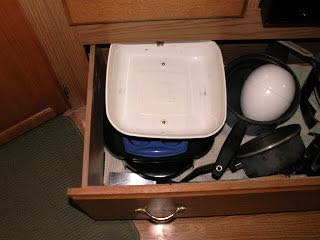 Some RVers use bubble wrap or dish towels to accomplish this. I wore off the non-stick coating on my last electric skillet by putting the lid upside down in it so the drawer would close. Now I put a rubber muffin pan in the skillet before I put the lid in place and it protects the non-stick lining of the skillet from abrasion.
 Always check your blind spots, which are bigger and more prevalent on RVs. Using mirrors increases your safety but they don’t always show everything on the road, so always be aware of what’s around you.
 Noise: Many RVers say that a FRED (FRont End Diesel) motorhome is a lot more prone to be noisy while motoring down the road. One even suggested that if you want a FRED, consider installing an intercom system, like you might have in a helicopter.
 We had always looked at all the waterways that we passed by and thought somewhat wistfully, “Wouldn’t it be nice to wander over to the far side of that peaceful little lake,” or something to that effect. After a half-day guided kayak tour in a local slough, we began looking into inflatable kayaks. Inflatables have both advantages and disadvantages over the hard-shell, do-or-die kayaks that you see the death-wish guys flinging down waterfalls.
 The RVer was left a bit shaken: Do older RVs burn up because of newer electrical services? The answer to that question is, No. Properly wired and maintained RVs, regardless of age, don’t “catch fire” by being plugged into a “modern” electrical service. The smoke here was from the RV park puffing up an improbable excuse to refuse an “older” RV.
 We still argue against the smarts of using a “Bearing Buddy” or “Easy Lube” system; we’re still not convinced that the system is all that great, in that, if you pump in a different kind of grease than is already in the system, you may easily have fatal compatibility issues. But even without that point, the picture illustrates the wisdom of periodic inspections of the inside of those hubs.
 The suggestion was to spray your plastic headlights with inspect spray containing a high concentrations of Deet. Yeah, a shot of Deet, followed by a wipe down with a rag or paper towel, and Hey, Presto! your headlights are cleared up again. Is it really so?
 My living room window was broken when our deck table fell through it during a storm. Do you have to take the whole window out to fix it? It was the bottom window portion that broke. —Gail, Sebring, FL
 someone support the window from the outside as you gently push from the inside. At this point, all that is holding the window in place is the sealant around the perimeter of the exterior. Work the wide putty knife around the frame as you carefully push the window out of the opening through the sidewall.
 My husband and I have been feeding birds for 40 years in our backyard. When we sold our home and began living full-time in our travel trailer, we decided one of our favorite pastimes could easily continue with a tube feeder and a hummingbird feeder hanging from our window awnings wherever we parked. We get so much enjoyment from the birds that visit our various camping sites. Recently, while visiting Yellowstone National Park, a ranger stopped at our rig and chewed me up one side and down the other for feeding the birds. We were threatened with a ticket and a stiff fine if we did not remove the feeders from our trailer and discontinue feeding the animals in the park. I have complained all the way up the chain of command to the Secretary of the Interior. My husband thinks I should just drop it and move on with my life. Am I overreacting? I’m not stopping traffic feeding bears, I’m simply doing what 50 million other bird-feeding enthusiasts do every day in their backyard. Please help me heal. —Busted in Geyser Basin